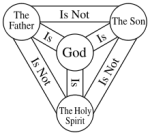
 This article is a response to a request from my princess who asked me to write about the Trinity for her. She remembered that I had taught her and her brother about the Most Holy Trinity and asked that I write about it for her.
I’m very proud that my daughter is meditating on the Trinity. Before proceeding, I’d like to explain that that I do have a daughter and a son. Some may find it strange that a consecrated brother has children, but it’s not that strange at all. It’s just not that common.
Let’s see . . . St. Augustine had a son. Elizabeth Ann Seton had five children. Louise de Marillac also had a son. Jane Frances de Chantal was the mother of four. St. Maximilian Kolbe’s mother became a Franciscan sister. There have been widowed men who are fathers and have consecrated their lives to the service of the Church, but widowers are a smaller number than widows. I’m not sure what that says about men and women. Do women outlive men because they need to remain here to do more penance or do men die before women because they don’t have the stamina to deal with life’s challenges? I guess we’ll find out in heaven. But I’m very happy to be among these great men and women who have been parents and consecrated sons and daughters of God and the Church. Having said all of this, let’s get back to the Trinity.
Writing about the Trinity can be a task as daunting as rewriting the Summa Theologica. An old legend tells us of St. Augustine who pondered the mystery of the Trinity. While doing so he encountered a child on a beach who was trying to pour the ocean into a hole that he had dug in the sand. When Augustine told that child that it was impossible to pour the entire ocean into a small hole in the sand, the child told him that it was far easier to do that tan to fully comprehend the Trinity.
Anything that we can say about the Most Holy Trinity is based on what God has chosen to reveal to us about Him. There is much more to come, but we won’t see it until eternity. All I can do here, Princess, is to “paint a picture of the Trinity” with very broad strokes. I may have to do this in parts so as not to make it too long and boring. Let’s begin with what the Trinity is not.
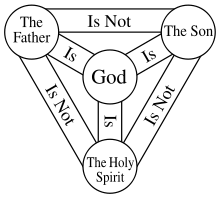
When we speak about the Father, Son and Holy Spirit, we’re not speaking about part of God. God does not have parts, because he’s not created. Only created things have parts. Nor is God some existential composite. We cannot speak about parts of God. When speaking of the Trinity, we’re not speaking about parts of God. We’re speaking about persons in God. We must make a distinction between person and people. People are human and created. Personhood describes the nature of a being. Peoplehood describes the being as part of a collective. God is not part of a collective as are human beings. Therefore, we are both persons and people. God is three persons, not three people; because there is no collective.
St. Thomas Aquinas tells us that God is simple. It is also important to understand that God is fully actualized. There is nothing missing in him. There cannot be an absence of love in God. However, love is oriented toward the other. It is not self-centered. Love exists in communion with the other (the beloved).
In God there is otherness in oneness. This otherness is three persons: Father, Son and Holy Spirit, one God. In these three persons, there is perfect love. There has to be love. If there were not love in God; IT would be something else, but not God. Where there is love, there is also communion. Communion only exists when there is otherness.
This otherness in God has revealed itself to us as three persons who are one God: Father, Son and Holy Spirit. They do not share a common divinity. Each person is fully divine, fully God and to see one is to see the other. Remember that we said that God is simple. Where you share something, you’re dividing it. It ceases to be simple and becomes multiple. It also loses something.
Analogies don’t always work perfectly, but they help. If I have a pizza and I slice it, I no longer have a pizza. I have pizza. There is a difference between having pizza and A pizza. The former are parts of the latter. But do you see how complicated this became when we started dividing and sharing? Throw away any notion that Father, Son and Holy Spirit, divide and share divinity, godliness, power, authority or whatever. Each is the same, but each is a distinct person. It’s incredible how fascinating God is in his simplicity and his eternal communion of love.
“According to Aristotle, a good is something desired. Now is there anything more desirable than God—He is the greatest good,” (Taylor Marshall, 2014). Imagine if God had to go beyond himself to love and be loved, to find community and experience family. Would he then be the greatest good? No, because he would have an unmet desire. He would be missing something in himself, something that he has to go find outside of himself. What kind of God is that? The opposite thought would be to believe that God does not wish to love, does not wish community and family. Would this be the perfect God? No. Community, family and love are natural to God. Hence, when we are created in God’s image and likeness, guess what? We are created for community, family and love. There is more that can be said about the creation of man, but that’s another essay.
Catholic dogma tells us, “The mystery of the Most Holy Trinity is the central mystery of Christian faith and life. It is the mystery of God in himself,” (Catechism of the Catholic Church, No. 234).
Let’s start wrapping up by saying that this mystery is uniquely Christian in that God has revealed it to the world through Jesus Christ and no one else. God tells us about himself in this mystery. He tells us that he is one, that he exists in a community of love and that he is beyond anything that we can imagine. He invites us to engage with him as Father, Son and Holy Spirit and to come to know him in his fullness when we get to heaven.
Let us remember what he said to the Apostles. “Go therefore and make disciples of all the nations, baptizing them in the name of the Father and the Son and the Holy Spirit,” (Mt 28:19). Observe, the he commissions the Apostles to baptize in “the name” not “the names”. Father, Son and Holy Spirit are one and three. On another day “Jesus said to him, “Have I been so long with you, and yet you have not come to know Me, Philip? He who has seen Me has seen the Father; how can you say, ‘Show us the Father’?”(Jn 14:9). If you have seen Christ, you have seen the Father. It is the Holy Spirit who opens the eyes of faith to find the Father through Christ the Son.

My Princess
Princess, if you have found Christ, then you have found the Father, because she who sees him sees the one who sent him. This vision of faith is given to you by the Holy Spirit.
Stay tuned Princess . . . more to come on the Trinity.
Daddy 🙂


 3.
3. Franciscans of Life