 In mid-November, we had a workshop to train lay volunteers to work with Project Joseph. It was the first time that the brothers delivered the talks. Normally, I deliver all the talks. They were outstanding. I was very proud of their knowledge of theology, spirituality, the life issues and pastoral care. These guys are in the early stages of formation and doing a million other things. Remember, we get no money from anywhere. St. Francis said that the brothers had to work for a living. Our brothers hold jobs, support the ministry, themselves and loved ones. They divide their time between community, work, ministry, prayer, family and friends, and more prayer. The workshop went well. Our next step is to place the new volunteers and have them shadow us for a few weeks until they get the hang of it.
Project Joseph Workshop

New Faces
Christ, Br. Bill, Br. Jay, Ruban
We have a few new faces among the Franciscans of life. I’ll be doing a write-up on each of these ugly mutts. For the time being, I’ll just show you some pictures. Of course, if you are interested in adopting or fostering one of these pets, we would be glad to assist you. All joking aside, we’re very blessed to have these new members to our great Franciscan family. The most wonderful thing about this is that the Lord sent them. We did nothing to recruit.
Br. William Vito, FFV
The fellow in the grey habit is Brother William Vito (aka. Bill). Br. Bill is a novice, that’s why he’s wearing the grey habit. He is a computer geek and is very invested in serving the voiceless among people with disabilities. He is also an outstanding religious educator. He teaches teens, preparing them for Confirmation. He teaches with conviction, passion, love and most important, fidelity to Holy Mother Church.
Then there is Postulant Chris. Chris is another computer geek. Chris runs Project Joseph in Ft. Lauderdale. He commutes over 30 miles to make himself available to our dads. The best part about Chris is his contagious smile, especially when he messes up.
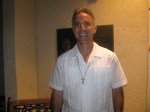
Postulant Chris
We won’t mention the fact that the superior asked him to organize a photo shoot and to make sure that everyone who needed to be there was there and was properly dressed. To make a long story short (too late), Chris is very obedient. He did exactly as asked. On the day of the photo shoot, the brothers who were supposed to be there were there. Did I mention that Chris was also supposed to be in the picture?
OK, I forgot that important detail. In any case, guess who walked into the room in his grunge clothes? You guessed it right, Postulant Chris. Suddenly, all eyes are on him. Chris had completely forgotten the very event that he had set up. The photo shoot had to be postponed. Who could get angry? Chris just put on that little boy smile, like the kid with his hands in the cookie jar. In all honesty, if you ever forget the definition of Franciscan joy, all you have to do is look at Postulant Chris. He projects that joy no matter what the situation.

Postulant Ruban
Ruban, no I did not misspell it, is from India and you guessed it, he too is a computer geek. I believe that God may be trying to tell us something. He keeps sending us these guys from the world of technology. Ruban does not have a pastoral assignment yet, as he is too young in the Franciscan life. Right now, he’s concentrating on mastering the outer expressions of Catholicism and Franciscan life. This is very important. There is no such thing as a good Franciscan, Jesuit, Benedictine, Dominican or Diocesan priest unless the man is first a good Catholic.
The first three months are very hard on the brothers. There are many externals and changes that one has to learn while on the run. Therefore, Ruban spends a lot of time before the Blessed Sacrament, learning to navigate the breviary, understanding the rubrics of the mass, the constitutions and other externals that are essential to the life of a Catholic and a future novice. The one thing that no one misses when one meets Ruban is his curious nature. I’m seriously thinking of giving him the name George as his religious name. Curious George would describe him well.
Closing Thoughts
I would like to close this entry with one thought. As we approach Christmas and we look upon the Christ Child in the manger, let us remember that human nature was the Father’s gift to his most beloved Son. God the Father would never give his Son a gift that was not precious in his eyes. The infant in the manger shares the same nature as your neighbor and yourself. Thank God for the gift of being human and show Him your gratitude by treating every human being with the same gentleness and care that St. Joseph and Our Lady had for Jesus.
I’m Back . . .
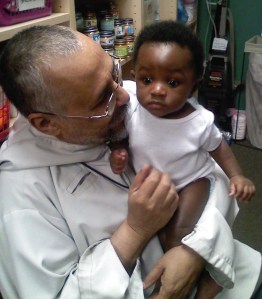
Baby is not too sure about this
as I promised. It’s been a very busy year. Let’s see, . . . where to start counting the Lord’s blessings.
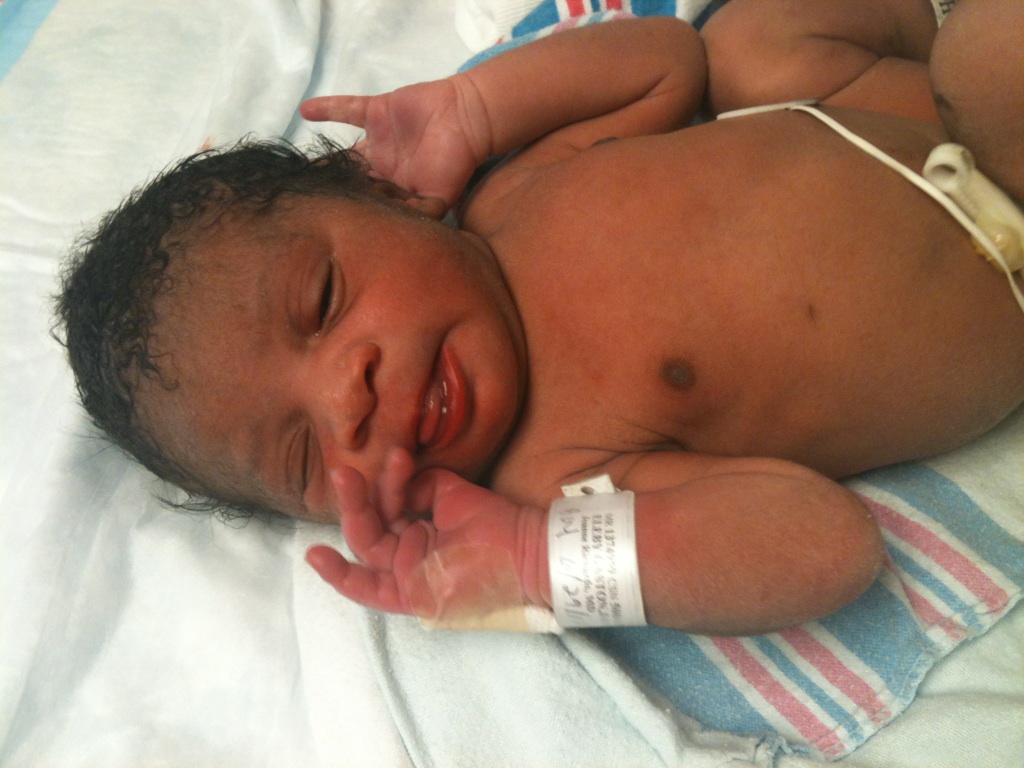 Let’s begin with ministry. Our Project Joseph, which for those who don’t know is our ministry to fathers in crisis pregnancies is growing. This past year we moved to a new location in Miami and BOOM! We suddenly had to start two groups to serve the needs of the dads. Now we have five groups going in four centers. This year, we reached 50 Project Joseph Babies. Who are the Project Joseph Babies? These are the babies born to dads in our program. They’re all beautiful, healthy and happy kids. We’re very glad to have them and very thankful to Our Lady of Guadalupe who protected in the womb. We are very proud of their parents too. For some of our parents, having a child is very frightening. These are hard times in which we live. Let’s thank Our Lady for protecting the unborn and send up a cheer for the parents who trusted. I’m always reminded of Elizabeth’s words to Mary, “Blessed is she who trusted . . . “ It’s interesting, because Elizabeth is speaking to an expectant mother.
Let us remember . . .Let us pray
This week, our nation remembers the most tragic decision made in this country, the legalization of abortion. It is a time of prayer and action for those who have a moral conscience. Let us examine two moral issues and fallacies here.
During the Civil War, our government emancipated the slaves. It ruled that human beings are not property. However, today, we speak about the infant in his mother’s womb as her property. If he were not the mother’s property, would she have the right to destroy him? Do we have a right to destroy what we do not own and what is not attacking us? The argument that it’s not a person does not fly for one simple reason, no one can prove that he’s not. There are those who say that the pro-life population cannot prove that the infant in the mother’s womb is a person. The pro- life person is not attempting to destroy the child in the womb. He or she is choosing on the side of life. If left to proceed naturally, a person will emerge from the womb. Those who doubt that the child is a person, are acting on an assumption, not a fact. Their actions destroy life. The choice to allow a pregnancy to take it’s natural course does not need to prove anything, because such a choice is not interfering with the natural course of events.
There is another moral issue here. Every human being has two parents. However, current law in the United States and other countries that have legal abortion do not acknowledge fatherhood until the mother decides to keep her child. This raises an important question of justice. Is fatherhood determined by nature or by the determination of the mother? According to current legislation, a man becomes the father of his pre-born daughter when her mother acknowledges that she has a daughter. In other words, fatherhood has become contingent on the will of the  mother. Even the legal system cannot protect a man’s right to act as a father. A man has no right to stop the destruction of his daughter in the womb. Fatherhood is a natural right, not a civil right. When civil law takes away the rights of fatherhood and makes them subordinate to the will of the pregnant mother, it violates that man’s dignity. Such a violation is a sin against justice. There is a strange parallel between this and slavery. The rights of the slaves were contingent on the will of their masters. Today, the rights of fathers are contingent on the will of the mother.
Every child has the right to have a father and a mother. Every man has the right to be his child’s father from the moment of conception. This is the way that nature designed it. Nature designed it this way, because in his eternal wisdom, God built these laws into nature. Observe that we do not question the paternity of any other species except that of man, because it is expedient. If we acknowledge that the child in the womb has a father, then we will have to protect that father’s right to protect his daughter from abortion. We negotiate with language in order to create laws that deny a man’s fatherhood. If the child does not have a father, he is subject to the unilateral decisions made by the mother.
Allow me to conclude with a story that happened in our Archdiocese. I am not violating any confidences. It has been shared across our diocese. A few years ago, a young mother called one of our Respect Life Centers. She was distraught. She had two children. The doctor has just told her that her pre-born daughter had Down Syndrome and that she should “terminate the pregnancy.” The Director of Respect 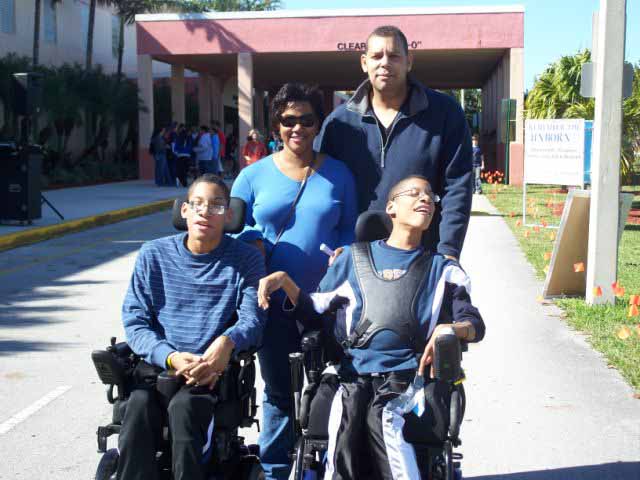 Life invited her to come to the center nearest to her home. When she arrived at the center, the volunteer who had waited for her received her with a hug. They prayed and talked for a very long time. The Center promised the mother to walk with her and to provide emotional, spiritual and material assistance as long as necessary. The father was invited to participate in the dialogue. Together, they decided to keep their daughter.
Nine months later, the daughter was born. Effectively, she had Down Syndrome. She also became the person who would bring great joy, love and unity to that family. The parents asked God for one favor, to bless their daughter and grant them the grace to do whatever they needed to do. God has never let them down.
Every life that comes into existence is a reflection of the love and life of God himself. No one life has less value than another. God knows every human being from all eternity. Each person who is conceived, regardless of the circumstances under which he or she is conceived, has a place in God’s plan for our salvation. As we proceed through this week, let us pray for those who will be marching in defense of human life. Let us also pray for those who do not yet understand the sacredness of human life and the true meaning of justice.
Where are the Catholic pro-life men?
As we look out at the world of men (males) who struggle with paternity, we often wonder why or what is happening in society. We should wonder is why not? Why are we surprised, when there is such a shortage of good Catholic men to guide their brothers? Therefore, why should some men not be lost in the culture of death and at a complete loss as they face the daunting task of parenting?
This is not to say that those who have walked themselves into situations where they face unexpe cted fatherhood bare no responsibility for their actions and for their choices before or after. It is easy to point the finger and wag our tongues at so many men who do not step up to the plate and become good Christian fathers who embody the very presence of the Fatherhood of God. Yet, other men, who claim to have found the loving Fatherhood of God and claim to live in the Spirit of the Father, do not reach out and share the Gospel with their brothers.
It is very easy to condemn a culture of death and to sentence those facing life-threatening choices such as abortion and contraception from the comfort of our homes. Such a person is like the judge who sits in judgment on his bench and condemns the guilty man for his delinquencies; but when his day in court is over, he retires to his quiet and serene suburban home. On the way home, he deliberately bypasses the riotous and noisy neighborhoods where the delinquents that eventually will find their way into his courtroom are being bred and formed. Such a judge may feel that he is doing something for society by passing judgment. The truth of the matter is that while he has time that is not on the bench, he does nothing for the community that passes through his courts on a daily basis. In other words, he does nothing to put himself out of a job.
The same is tru e about Catholic men who sit in judgment of their brothers who are considering abortion or even worse, who have participated in an abortion by providing the dastardly service, taking the life of an unborn child or pushing the mothers of the children whom they conceived to submit to such a horrid crime. We go to pregnancy centers, prolife workshops, provide education to men who are struggling with the challenges of poverty, addictions, violence, displacement and a lack of sexual integrity. It is a challenge to bring these men into the centers, the churches, and the community of believers. Evangelization and service to them can seem an insurmountable task, because there are not enough workers in the vineyard. In other words, there is a critical shortage of Catholic men who serve their brothers and evangelize them.
The prolife movement has become feminized, as if abortion, euthanasia, the destruction of human embryos, the unscrupulous use of the death penalty and the  killing of infants who were not killed by abortifacients were a women’s issue. Middle-age women and teens are at the forefront of the prolife movement, especially among Catholics. Catholic men attend workshops and lectures and then go home. However, one third of the people affected by crimes against human life, ultimately against God, are men. Another third are women and the last third are the unborn children.
We need to challenge men to step up to the plate and be good fathers. We need to evangelize young men instead of handing them condoms. It is our duty to bring all men back to Jesus. However, we need men to evangelize their  brothers. These can be married men or single. They can be secular or consecrated religious. Teams of consecrated celibate men and married men are the ideal missionary team. Together, we can present the big picture of what men can be.
If you’re male and are reading this, ask yourself if God is calling you to serve your brothers in the prolife ministry by walking the journey with them. Don’t worry about not having anything to contribute or not knowing what to do. Those of us who are in the ministry will walk with you and together we can walk with our brothers. Just bring the gift of your masculinity before the Lord and put it at the service of your brothers.
Where are the prolife men?
For more information contact Brother Jay here .
Loyal Subjects of the King and Faithful Sons and Daughters of God
 We have a moral duty to be children of the Church. At this time, when our nation goes to the polls to vote, we must remind ourselves that we are citizens of the Church and a nation. As citizens of the Church, we must guide our nation to fulfill the destiny that God has given to every nation, to ensure the welfare of its people. We must first secure every human being’s right to life, then all of the other rights that flow from that.
Several years ago, I found myself teaching a group of high school students who live with autism and learning disabilities. We were discussing human rights. A 16-year old boy raised his hand and said, “If you don’t secure the right to life, why waste time discussing the other rights?” It causes one to wonder who has learning disabilities.
The unborn, sick, elderly, disabled and the embryo in a Petri dish are all sons and daughters of God. They have come into existence through the Word of God, not man’s will. Man supplies the mechanics; only God can give life.
As Brothers of Life, it is our mission to remind Catholics of our martyrs, who gave their lives for their faith. Along with them, we have a rich tradition of holy men and women who suffered a bloodless martyrdom, living with inconveniences and sometimes suffering and hardship, as a natural part of living a virtuous life. Sometimes, the Gospel of Life requires sacrifice. Very often, true love hurts.
The enemy deceives us into believing that we must make certain sacrifices in order to have safer neighborhood, better schools, more jobs and the other things that we want for our families. However, on the great moral ladder, the highest good remains the dignity of life.
The bible is our best guide. Look at how it is organized. The first book of the bible is the Book of the Beginning, not by coincidence. God wrote about the origin and the sacredness of life into the hearts and consciences of the biblical writers. They could not compose the sacred texts and ignore the one great truth; all life comes from and through the Word of God and all was created for Him. As St. Francis so clearly wrote in his Canticle of the Creatures, all life reflects something of the Glory of God.

Today, some men and women seek political posts at the expense of life. This is an immoral use of the democratic process. The true and noble purpose of democracy is to protect the inalienable rights of man, not to gain a vote at the expense of man. Man’s first inalienable right is the right to be born. His second inalienable right is inscribed on the other side of the same coin, the right to die at a time and in a manner of God’s choosing. God chooses when we are to be born and when we are to die according to his plan for our salvation. Man has no right to interfere with God’s plan for his salvation.
We are not an evolutionary accident. We are the product of the mind of God. In His mind there is a precise moment in history that is conducive to our salvation. He brings us into existence and gives us the right number of years of life to work out our salvation according to His plan.
The highest form of worship is to love, respect and protect what God creates. The highest form of service is to make proper use of what he gives us. To use science and law in a manner that is contrary to his plan is a grave sin, because it is an irresponsible use of God-given talent and freedom. We must ask ourselves whether it is moral to place men and women in office who will use knowledge and freedom to offer legal protection to the murder of innocent people.
We have been given freedom for a purpose. Contrary to popular opinion, God did not give us freedom to choose right or wrong. God gave us freedom so that we might choose what is right and thereby be truly deserving of his grace and heaven. God made is with the same attributes as his Son. Jesus freely chose to do the Will of his Father. He embodies everything that a man should be and should do. He chooses to die, rather than allow us to perish. We, who are created in the i mage and likeness of the Son, have the power to make the same choice. We can live with suffering and challenges, rather than allow others to perish.
We may have to vote for a candidate that does not deliver the material things that we want or need, but who supports and protects the highest good of all, the right to be born and the right to live as long as God wishes us to live. For many of us, this may be a form of bloodless martyrdom. Like St. Thomas More, we must be loyal subjects of the king and faithful sons and daughters of the Church, even if it means martyrdom.
Jesus Wants to Go to the Poor
It’s been a slow day for this old brother. There is a head bug going around and we have become good friends. The problem is that when you get one of these colds, you can’t go to the pregnancy centers, because you don’t want to spread it to the parents and children, especially the moms that are expecting. God forbid that they get sick. It’s not only cruel, because pregnant women can take very few medications, but they often lack medical insurance. The largest sector of people are immigrants who are struggling to make it. Because of the restrictions on Medicaid and Food Stamps, they need our help.
We desperately need funds and people to open a house for pregnant women who live in abusive situations. They have no place to go. The existing community resources  are over extended. More homes are needed, esepcially a home where pregnant mothers can go with their children. Many homes and shelters have limits on the ages of the children that they can bring with them.
A few weeks ago I received a call from a woman. She was pregnant and had a 12-year old. She had to get away from an difficult situation. No shelter in the metropolitan area would take her, because she had a 12-year old. They don’t take mothers with pre-teens. Br. Peter and I found ourselves trying to find a place for Jesus. He was homeless, just like he was when Mary and Joseph arrived in Bethlehem 2000 years ago. After six hours of calling, begging and praying, a home became available. St. Joseph, the protector of families came through for us.
The unemployment rate is on the rise. This really concerns me. I want to do something about it, but without more brothers and volunteers, we are very limited. I want to give these people something of Jesus and sometimes, I don’t know where to begin. So . . . as the song from the Sound of Music says, “Let’s go to the very beginning. A very good place to start.” Do you remember that song? It’s the one where Maria teaches the children to sin the Do Re Mi.
We always go to the beginning. We sit and we listen and try to help them find services. We provide clothing, food, counseling and education. We now have a father’s program that is increasing, thanks to the intercessory prayers of St. Joseph. We have put our men’s services in his hands. Since we have done so, the number of men coming to our classes has quadrupled. There are couples who were living together that have now married and are forming families. Some couples have separated, realizing that sex and having children is not the best foundation for a marriage. At the same time, they have committed to working together for the good of their children. A married couple that seemed to be on the verge of divorce is now enjoying days walking through the park, visiting the local mall and spending time talking. These are all signs of St. Joseph working overtime.
I want to invite you to come visit us and spend some time with our families. They are truly wonderful. We do not have a big friary and probably never will have one. We live very simply, according to the spirit of St. Francis who wanted his brothers to live the monastic experience of prayer, obedience and brotherhood among God’s people as itinerant preachers and brothers to all. Therefore, we own nothing, not even a house. We cannot offer the comforts of a traditional monastery or priory. However, like the early Franciscans, we offer you a home with brothers who care about each other, the Church and the poor. We take Jesus to them and find him among them.
Obedience to the Church, the Rule, and the superior, the Eucharist, common prayer and individual prayer is the foundation of the work. Without this, the work ceases to be Jesus’ work. It becomes social work. Think about it and let us know. I look forward to hearing from you.
Fraternally,
Brother Jay
SOLEMNITY OF ST. FRANCIS
Life around the here is moving rather quickly this week. Several things are converging at the same time. The big thing is the upcoming Solemnity of Saint Francis on October 3rd and 4th. The plan is to get together with other Franciscans around the area on Sunday, October 3. The Secular Franciscans are having a profession that day. Therefore, we’ll be there to welcome a new sister into the Franciscan family, along with one of the Friars Minor of the Holy Name Province. Later that evening we will gather to celebrate the Transitus of our Holy Father St. Francis.
The Transitus is a beautiful celebration. It takes place within the Liturgy of the Hours. During the celebration, we recall Francis’ passing from this world into eternity. If you have ever been to a Jewish Seder, the Transitus follows that format.  One person asks the story and then it is narrated through prayers, songs and scripture readings. It is flanked on both sides with the parts of Vespers, the Psalter at the beginning and the Gospel canticle and prayers of intercession on the concluding side. There is always a relic and lots of candles and incense too. On the morning of the 4th we celebrate the solemn mass for the Solemnity of St. Francis. Since the different Franciscan communities down here are small, several communities gather for this great feast. It’s a wonderful tribute to our Holy Father, because it’s one of the few times a year when the communities gather as one family acknowledging their common Franciscan heritage.
But the Solemnity of St. Francis is more than just a memory. If it were that alone, it would be like any other national holiday in which we remember a national hero. It’s a time to thank God for the gift of our call to serve him following it the footsteps of St. Francis. God will never be outdone in generosity. He not only calls Francis to the perfection of the Gospel, but he shared that call with millions of men and women around the world from 1209 to this day. It’s incredible to think that no matter how small one Franciscan community is, that we belong to a much larger family that finds itself around the world and that spans eight-centuries.
To better prepare for this celebration, the Brothers of Life have taken this week to spend more time in prayer, reading and studying. We are out less. But we have doubled our time before the Blessed Sacrament. We’re very fortunate, because there is a parish about five-minutes from our house that has daily adoration from early in the morning to the evening. It’s a wonderful experience to be there with Jesus. I can’t explain it. You just have to experience it for yourself. But you just can’t leave once you realize how wonderful God is and how present he truly is in the Blessed Sacrament. It’s incredible to look at the host and realize that this is the same man who walked through all those cities and towns in Palestine healing the sick, preaching, making people feel loved and wanted by God, feeding the hungry and forgiving sin. I’m in awe at the thought that this was the same man with whom the Apostles spoke, ate and slept for three-years.
St. Francis of Assisi wrote a wonderful prayer that he recited before the Blessed Sacrament, before every crucifix and every time that he remembered the Blessed Sacrament but was unable to get to a Church. “We adore you O Christ and we bless you, here and in all of your churches throughout the whole world, because by your holy cross you have redeemed the world.” It’s beautiful to think that one can remember the most Blessed Sacrament, when one cannot get there and still be closes to the Lord. Being there, with another brother kneeling next to you just adds to your love of neighbor and experience of God’s love.
Are they really disposable?
The issue of the poor and other marginalized people in society transcends political affiliation and social strata.
We live in a world where human beings are objectified – they’re treated as objects. If a certain person or group of persons does not produce or benefit society in any significant way, they are marginalized by society and looked at as somebody not really worthy of any human kindness or charity.
For instance, being made aware of a couple’s pregnancy, the couple may deliberate between themselves and see the child (or tissue mass as others may refer to this emerging life) as a hindrance to plans they’ve already made for themselves.
Mayb e the child will be viewed as a financial burden which would rob them of certain other things they are working for in their lives. Maybe he/she will be viewed as a hindrance to their careers and professional aspirations. After all, it will be years before such a creature will be able to make itself “useful”. So the child is aborted and the problem is “solved.”
The aged and dying relative who has been relegated to a hospital bed and shows no signs of improvement ought to be “released” from their condition since the chance of their recovery is small. Besides, it will save a lot of money in medical costs, which can be put to more useful (or selfish) purposes.
The poor who live under overpasses and in back alleys who can make no real contribution to society are viewed oftentimes and undue burdens on society. They can’t contribute anything, so they deserve nothing in return. It all boils down to perceived worth of a human being and their dignity.
The Catholic Church has always held that life is sacred from conception to natural death. All human life! A human’s worth is not determined by what they offer, but by who they are – A living human being created by God and for God and in His Image!
But our society is too practical for all of this. It can simplify everything down to an ugly and devilish ideal of cost effectiveness. A human is only worth what it can give to me or to something that may benefit me down the road.
We don’t see Christ in the poor anymore – we see just another burden on society. This isn’t a political issue, it’s a natural effect of a depraved society steeped in commercialism and meism (“me” being the center of all that is and all that matters).
Written by: Br. Pieter (Candidate)
The Assumption of Mary and the Culture of Life
Many may wonder what the importance of the Assumption of Mary may be. Some people actually deny it. Others think that they know. The truth of the Assumption is best understood in light of the Culture of Life. Christ came to bring life that we may have it to the fullest. He states this unequivocally and abashedly in the Gospel. He also promises that he who believes in him will not perish. So why doubt the assumption of Mary? Christ keeps his promise. He brings life and brings it to the fullest.
The fullness of life is found when the mind, body and soul are oriented toward Christ and absorbed into his mystery. This is the promise that God makes to us through his Son. To prove that his words are not empty Christ always provides signs. Remember what he says, “So that you may know that the Son of Man has the power to forgive sins, I say take up your bed and walk.” The miracle affirms Christ’s power and majesty over life and death. It affirms his power over sin and corruption.
In the Old Testament, the Law is given to Moses. “You shall not kill.” God cannot be clearer. Life is sacred, in every stage and in all of its dimensions. Therefore, it is his desire that man treasure human life as he does. It is God’s wish to save us from death, not only spiritual death, but also physical death. “Let him who has no sin throw the first stone. Now go and sin no more.”
The Assumption of Mary is the most pro-life sign from God himself. It speaks more about Christ than it does about Mary. Those who look at it as if to say that Mary is being elevated to the status of a goddess are missing the point. Mary is elevated to that which is hers by right of her creation. She is a daughter of the Father, saved in heart, mind, body and soul through the life, death and resurrection of Christ. God offers us Mary as proof that he keeps his promises.
God never forgets his promises. He constantly gives us signs to remind us that he has not forgotten us. The Assumption is such a sign. The woman who cooperated perfectly with the will of the Father, Son and Holy Spirit is the first to be granted the fullness of eternal life, in body and soul.
Look at the Assumption of Mary as sign of God’s great love for human life. It is comprehensible that the Father would restore the physical life of the Son on Easter Sunday; after all, that’s his son. Here, he takes another human being and restores that person to life in body and soul. He makes a statement about the dignity and sacredness of human life. It is his will that human life not suffer the effects of evil. 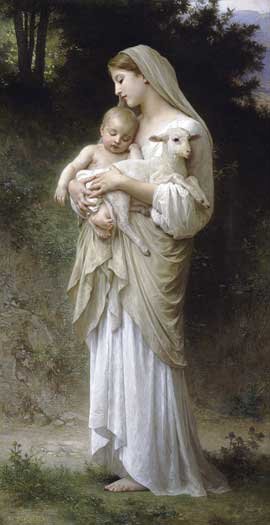
Mary, who is has done everything according to the will of the Father is the first creature, but not the last, to enter the gates of heaven with body and soul. Why? Because it is God’s will that the Culture of Death shall never prevail. He delivers to us a sign that the Gospel of Life shall triumph. Mary is the sign, given to us by Christ. Through Mary’s assumption, Christ makes a statement about him and the sacredness of human life. It is his wish to see life protected from evil. It is his will that every human being shall be protected from sin. It is his plan to restore physical and spiritual life to all men. Therefore, he does what is in his power to do. He protects human life from the corruption of sin. Mary’s assumption is the sign that Christ will keep his promise. The Assumption of Mary is a sign of the sacredness of life and Christ’s invitation to join him in the protection of human life.
 3.
3. Franciscans of Life