Habit forming habits


The Franciscans of Life embrace the holy habit.  Aware that clothes do not make the man and habits do not make the monk, there is something to be said about the way we dress.  Our cordclothes remind us of our place in society.  Remembering our place in society helps us to remember what our relationship to others should be.

When a police officer puts on a uniform, he knows that he’s a law enforcement official and that his relationship to others in the community should be one of authority, service and role model.  A flight attendant knows that his place in the cabin is also one of authority, service and safety.  People look to him for security, especially people like me who are afraid of flying.  It’s the same for nurses, doctors, auto technicians, even employees at McDonald’s.  The uniform communicates something to those who see it and it sets boundaries for those who wear it.

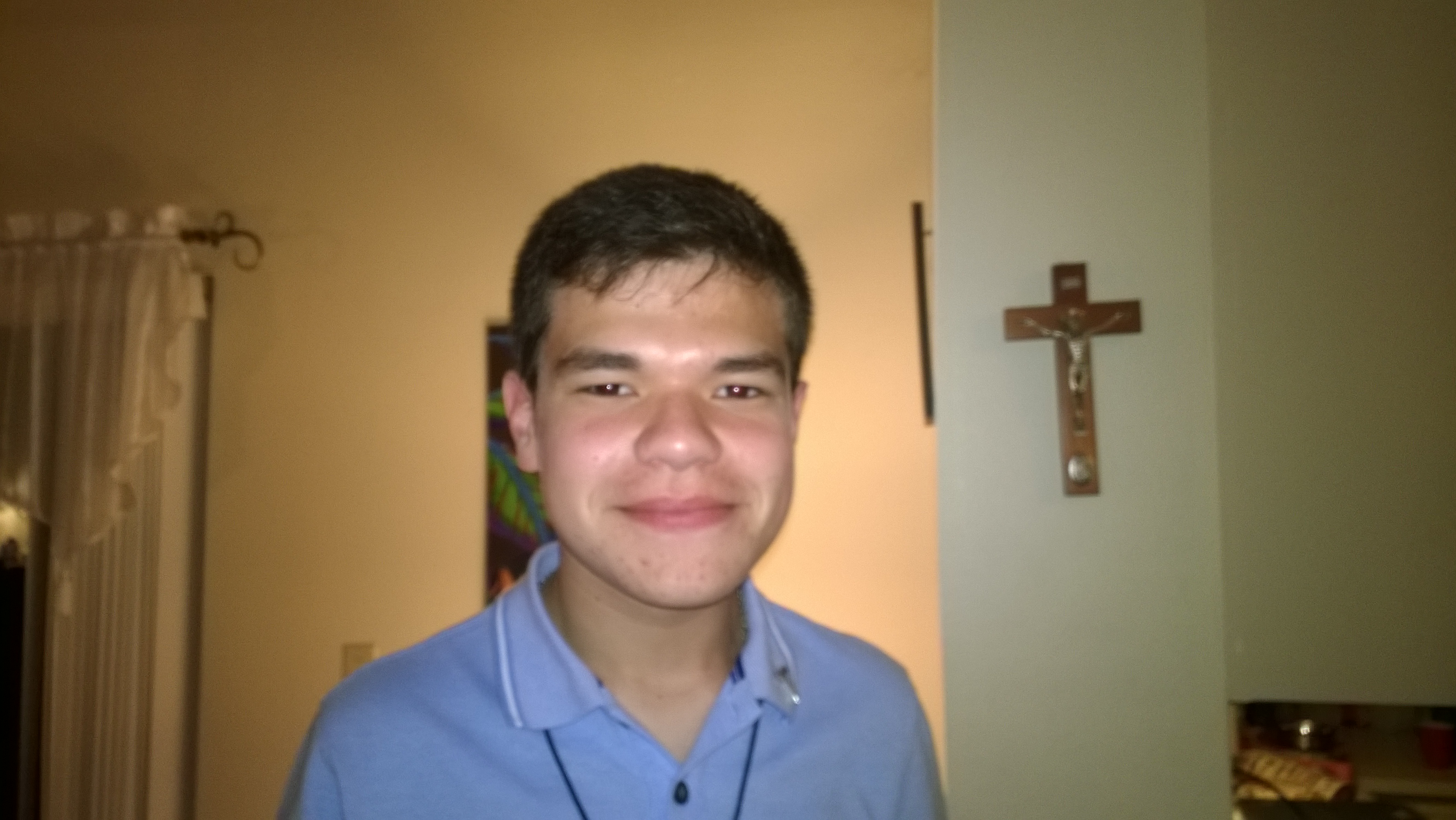
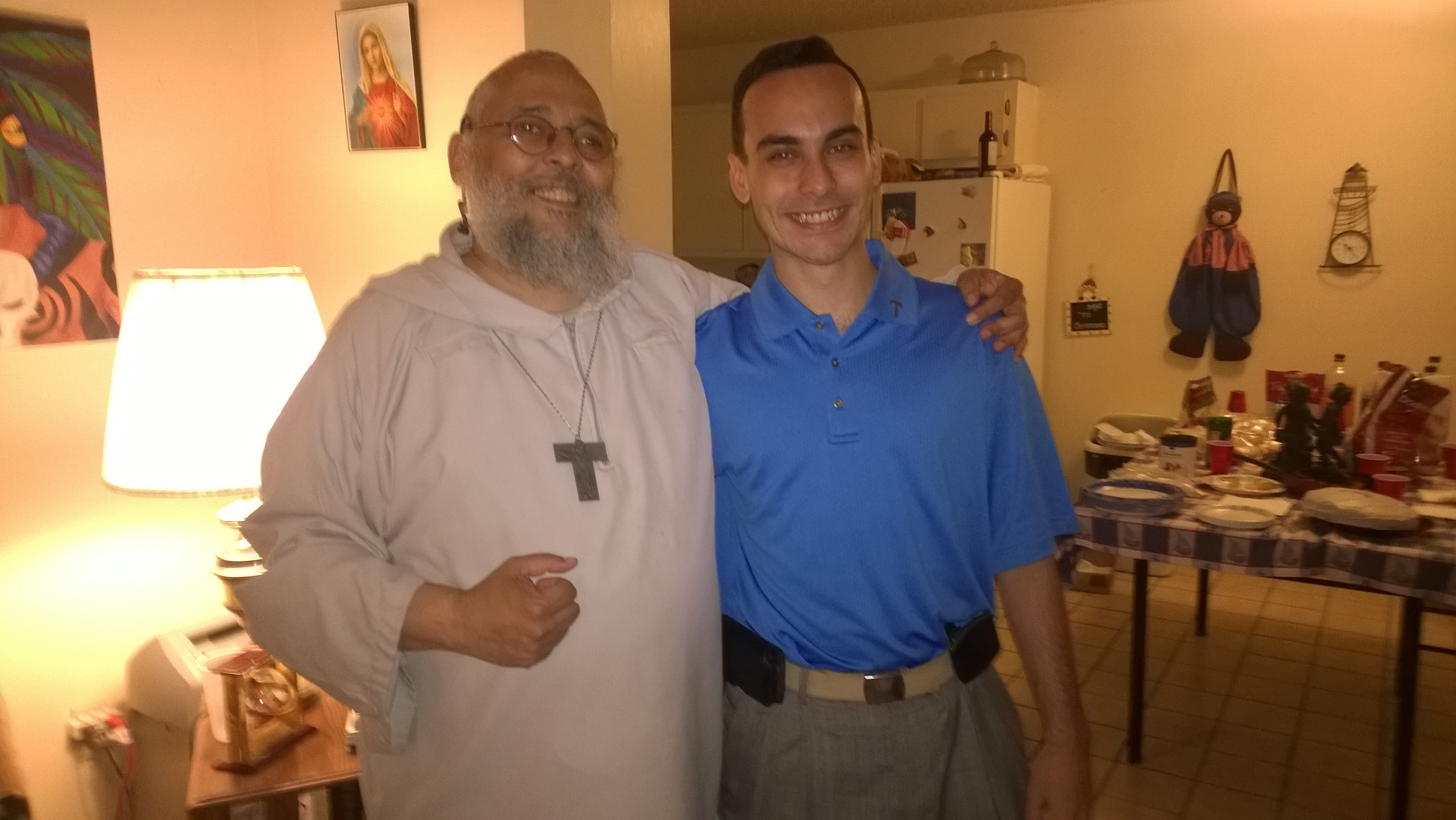
Before going further on the merits of the habit or uniform of the Franciscans of Life, let’s make sure that we know what it is.  The aspirants wear grey slacks, a blue or white polo in honor of Our Lady or a white button down shirt, tucked inside their pants.   They are to wear a Tau pin on the left wing of the collar, not a pendant.  The superior can allow a pendant for other forms of dress where it would be more appropriate than a pin.

Postulants are to wear a white Havanera shirt, also known as a Guayavera.  It must be solid white, in honor of the purity of the Immaculate Mother of the Lord and patroness of our family.  Every brother who wears it must keep in mind that he must be a  living witness to the beatitude that says, “Blessed are the pure of heart, for they shall see God”  (Mt 5:8) and that other passage that says,  “My mother and brothers are those who hear God’s word and put it into practice,” (Lk 8:21).

ThMARY AND TRINITYe white garment reminds us that we must be like Mary who practiced what the Lord revealed to her with great purity of heart.  There was no agenda, no selfishness, no resentment, and no search for control, profit or pleasure in Our Lady.  There was only one thought, to fulfill what God had asked of her.  This is true purity.  It goes beyond physical chastity.  One can abstain from sins of the flesh, but easily fall into other sins that are equally damning.  The shirt is worn over grey slacks and finally a Tau pendant must be worn by the brother postulant.  We will address the grey further down.

There are two kinds of novices.  There are novices who are called to remain in the world as secular laymen.  We call them secular brothers.  Then there are novices who wish to consecrate their life to Christ living celibate, poor and obedient in a stable family of brothers.  We call them consecrated brothers or regular brothers, because their daily life is far more regulated than that of the secular brothers.  The novice wears the white Habanera, grey slacks and the Tau pendant.
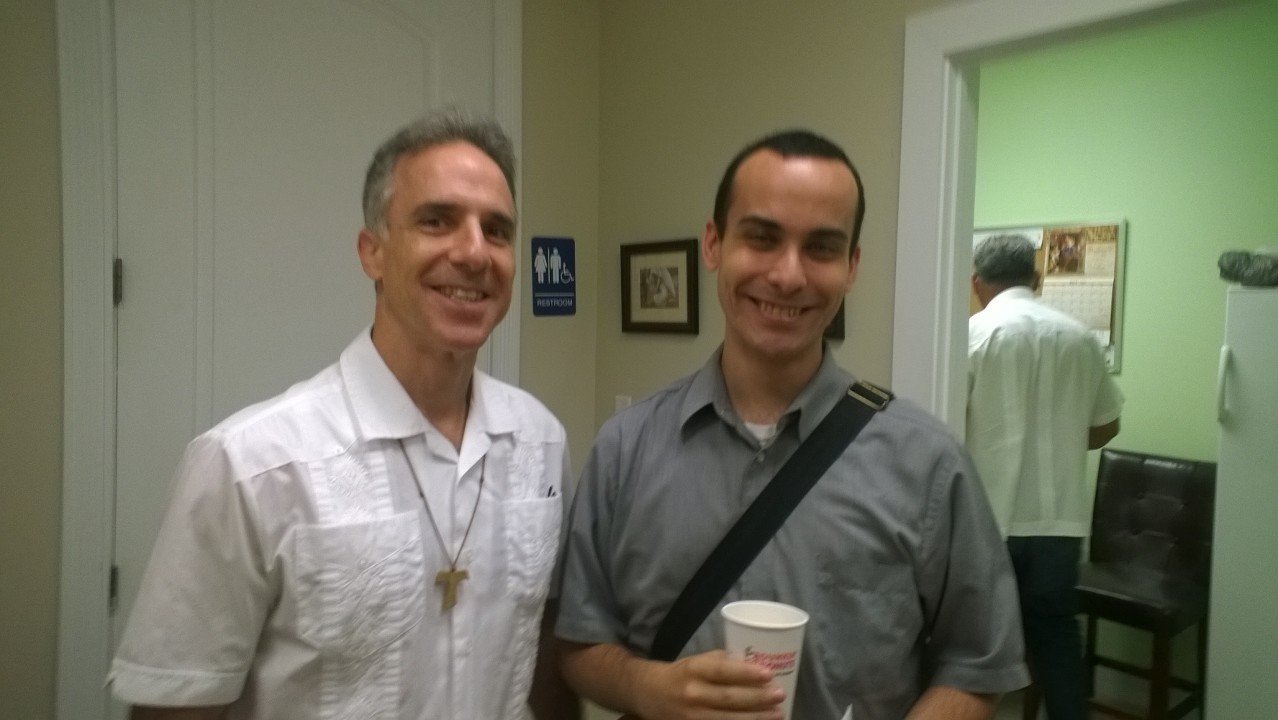
El hermano Chris y Bernardo van para allá.

If the novice is a regular brother, he will also wear the medieval habit when not wearing the shirt and slacks.  The medieval habit consists of a grey tunic with a cowl, a cord and Tau cross over his heart.  Because we aspire to capture the life and spirit of the early brothers who followed Francis of Assisi, the tunic is to be the dress of the working peasant of that day.  It is worn over grey slacks.  All of the brothers are to wear shoes, black or brown.  Sport shoes are not worn with the uniforms or habits.  They must wear a belt and a white under t-shirt with sleeves.

Our clothing must be simple enough to avoid all appearances of extravagance, wealth or luxury.  It should be practical according to culture and climate.  Subdued enough so as not to call negative attention to the brother.

There are times when other forms of dress are more appropriate.  The rules remain the same.  These clothes must be simple, avoid any hint of affluence and be subdued.  The Tau must be worn at all times.  If for some reason the pendant is not practical for the work that a brother does or for the event, the brother may opt to keep a Tau pin handy to wear in such TAU IMAGEcases.    Wherever the brother goes, it should be evident that he belongs to a Franciscan brotherhood.  The general rule is to wear the Franciscan uniform as often as possible, without causing discomfort to others, especially spouses and children.

We have already stated that the white is worn in honor of the purity of the Blessed Virgin Mary, a purity of heart and action to which Christ calls us.  The story behind the grey goes back to the Middle Ages.  Most clothing was made of wool.  Poor people did not have the means to buy expensive dyes.  The wool was often worn without the benefit of dye.  Therefore, it was brown, off-white, or grey depending on the color of the sheep.  The early brothers made their habits out of grey wool.  Brown wool was later adopted, but grey also remained.  The Conventual friars adopted the custom of dying their habit black like that of the Benedictine monks.  This practice lasted until the 1990s.  Today, they wear grey.  Because there are more brown sheep than grey, brown wool was easier to find, hence the custom of brown among many religious communities.

We no longer have to find a sheep, sheer it and weave cloth in order to make clothes.  Thanks to modern technology, we can buy our clothing off the rack or have it made by a tailor.  In choosing the colofrancis and clarers for the Franciscans of Life, we went back to early Franciscan tradition.  We found that Clare and Francis were practical.  Not only did they try to make use of whatever wool was the cheapest, but they were also very conscientious about working conditions.  Although the brothers are men of penance, this does not mean that we be unreasonable.  Penance does not have to be a torture in order to please God.  Francis and Clare gave us an example of dress that set them apart as poor and part of a family.  The tunic and cord were the constant.  Today, the Tau is the constant.  When two or more brothers walk into a setting, people should be able say, ‘Here comes the Church.”
Our habit reminds us that we belong to a family of brothers.  We’re never alone even in solitude.  We’re part of something bigger than ourselves.  We’re united to each other by prayer, penance, discipline, faith and above all love.logo

The habit serves as a guard against infidelity.  I reminds us who we are, sons of the Church called to be faithful to the Commandments, the Gospel, Holy Mother Church, the holy rule, and to Christ’s call to live and proclaim the Gospel of Life through everything that we do, everything that we say, and everything that we don’t do or say.  It also protects our purity.  Whether we’re married, single or celibate, some things don’t change.  Our bodies don’t know
that our hearts and minds are Catholic.  Spontaneous temptations and attractions will happen.  It’s part of being alive.    The habit reminds us of our relationship to others.  Everyone is our brother and sister, not the object of our desire or a thing to be used for our satisfaction.

The habit can help us regulate how we deal with others.  It should help us remember to keep custody over our eyes and a holy distance from temptation.  The habit helps us set boundaries.  This is true discipline, a form of self-control and a display of emotional maturity.

JOHNPAUL-BABYThere is much more to wearing a habit besides chastity and fraternity.  The fact that we dress the same and that our dress does not call particular attention to us allows us a certain degree of anonymity.  Yes, people may notice us and ask questions about our identity.  That’s a perfect moment to speak to people about our family, its Gospel vision and its mission, thus drawing the attention from ourselves and onto what really matters, the Gospel of Life.

We can say much about the value of uniformity.  Holy Mother Church reminds us that the habit is an external sign of poverty, which was so dear to Our Lord, his Blessed Mother and our holy father Francis.  Poverty is the way that Christ chose to enter the world.  Poverty was his condition at the time of his franciscan walkdeath, naked on a cross and buried in a borrowed tomb, because the “Son of Man has no place to lay his head” (Mt 8:20).  “Who, though he was in the form of God,  did not regard equality with God something to be grasped.  Rather, he emptied himself, taking the form of a slave” (Phil 2:6-7).

Think about it brothers, the habit allows helps us to be visible as members of a family that if faithful to Christ from within the Church.  We do not walk alone.

I encourage you to wear your Franciscan symbols as often as possible, but don’t let them become a matter of routine either.  Think about it as you’re putting them on.

I am part of a family.

I am a brother to all men.

I am a son of the Church.

I am the voice of the voiceless.Francis and lepers

I am a sinner.

Published in: on October 9, 2014 at 11:19 AM  Leave a Comment  

Fr. Benedict Joseph Groeschel’s Snowball


fr__benedictI want to begin by expressing to the Franciscan Friars and Sisters of the Renewal (CFR) the most profound condolences from the Franciscan Brothers of Life on the passing of Fr. Benedict Joseph Groeschel, CFR.  The Franciscan family may well have another icon in heaven.  Father was certainly an icon while he was still with us.

My first encounter with Father Benedict was at the retreat house on Long “Gisland” as it sounded to me when he pronounced it.  It was Advent 1980.  I can’t recall the exact date, but he was hosting a Christmas party.  I was attached to the Province of St. Augustine, but I had a Capuchin classmate at Catholic University of America from the Province of St. Mary.  He had told me all about this colorful friar whom he wanted me to meet.  As Providence would have it, we had to travel to New York for something and I got to meet the man whom I would later dub “Uncle Mame”.

He was loud, excited and to my young eyes, a little off.  But, since he was a psychologist, I didn’t think much of it.  All of us in this field are eccentric, neurotic or both.  Yes, I became a neuropsych, but not at that point.  Something remained with me.  Like Auntie Mame, Benedict’s energy came from a noble heart.  There was nothing pretentious about it.  It was very credible.

A few years later, I asked for a dispensation and left the Capuchin Order, married, fathered three children and was widowed with two surviving children.  Not having the Capuchins, having lost my wife and one child, and left alone to parent two children who were still in elementary school, life became terrifying.  Like all people who are afraid, I too found different routes of escape that only complicated my life rather than help.

One day, in 1997, I can’t recall if I was watching EWTN or listening to some Catholic radio station, but I clearly remember that Father Benedict was doing a live program and you could call in after the show and speak to him off the air.  I wish I could recall the name of that program.

In any case, I remembered my encounter with Uncle Mame, some 17 years before.  I didn’t expect him to remember me, why should he.  I was one of thousands of friars in the Capuchin Order and we had met in the midst of Christmas party.  There was no time to get to know each other.  Nonetheless, I had listened to him that morning and I remembered that energetic brand of kindness that emulated from him.  I decided to call, thinking that I would never get through, maybe hoping that I would never get through.  I’m not sure which.  The fact is that I did get through.

I quickly explained my situation to him and told him that I was a former Capuchin, now a widowed dad of two very young children whose life was upside down and I couldn’t find a way get it on its feet again.  I remember telling him of my fears as briefly as possible, figuring that this is a telephone interview, not a face to face spiritual direction.  To this day, I have no idea what he said and it does not really matter.  What matters is that whatever he said got me on the right path.

I remember his voice of concern for me, as if I were the only person on the queue waiting to talk to him.  His voice was strong, but soft and soothing.  Whatever his words were, they didn’t seem as important as the fact that this friar truly cared about me.  I felt loved and cared for in a very special way.  There was nothing mystical or magical about it.  My life was still difficult.  But as the days went by, whatever Father Benedict said to me started to kick in, kind of like a time-released medication.

That conversation led to other conversations with other holy men and women.  Father helped me to realize that more than afraid, I was hungry.  I was hungry for the Church.  I was hungry for my Franciscan brothers.  I was hungry for the life that Saint Francis had given to his sons and daughters.  I was hungry for a tangible experience of God.  My short conversation with him was the little snowball that rolled down the hill and grew and grew.

Fast forward.  Today, my daughter is happily married.  My son has finished his education, owns his own home, and is financially and socially independent.  Both are model Christians.  In 2009, I returned to Franciscan life.  This time, not as a Capuchin, but as one of the founders of a new Franciscan brotherhood committed to preaching the Gospel of Life and living the Gospel as the first brothers lived it.  We are the Franciscan Brothers of Life or Fratres Franciscani Vitae (FFV).

Is Father Benedict responsible for this?  I would say that he set that little snowball in motion that turned into a very big snowball that led to my “reconversion”.  In simple words, Father Benedict was a crucial element in a process, a small yet essential pebble on my journey’s road.

When we wrote our constitutions for the Franciscans of Life, we borrowed heavily from Father Benedict’s writings on the Franciscans of the Renewal.  Though our mission may be slightly different from that of the CFR, our vision and roots are the same, St. Francis of Assisi and the early brothers.  An important spiritual benefactor was Father Benedict Joseph Groeschel, CFR.  His courage and that of the early CFRs inspires our brothers to look back and go forward to proclaim the Gospel of Life while living it as did those first brothers.

Thank you Father Benedict.  One never knows where the seeds will land.  But I can assure you, my good and faithful Franciscan brother that you planted a seed in my life, which was probably the first of many that I needed in order to begin again in a new garden.

Rest in peace my Brother.

Published in: on October 5, 2014 at 1:04 AM  Comments (1)  

Sermon for the Transitus of St. Francis


04 October 2014

Almost 800 years ago, Francesco Bernadone, also known as Francis, died in his hometown of Assisi, Italy. On the evening of October 3, 1226.  He was canonized July 16, 1228 and declared to be saint of the Church.  The faithful were commanded to observe his memorial and venerate him every year on the 4th of October by Pope Gregory IX

Tonight, about one million Franciscan men and women around the world and their families, on every continent, are hosting this ritual called “The Transitus of St. Francis”or the “Passing of St. Francis”

There is an important question here that demands a response.Why are we still commemorating the death of this man 800 years later? Other people die everyday and life goes on.  But on the anniversary of the death of St. Francis the Church has created a space in her calendar to begin the commemoration after sunset on Oct 3rd and conclude with sunset on Oct 4th

The answer to why we’re still commemorating this death lies in the answer to another question of greater importance.  What if this was the night of my death, would it be remembered?

  • By whom?
  • How?
  • What have I given to God and to the world that deserves to be remembered?
  • Have I given anything to God and to the world that deserves to be remembered?

We call this a “transitus” from the word “transition” or better said, “the point of no return”

Once we reach the moment of death, there is no return.  You will not come back to finish what you should have done.  There will be no coming back to go to confession.  If your death is unexpected, such as a tragedy, there will be no time for confession or Anointing of the Sick.  You transition from here to there as you are.

In addition, the death of St. Francis reminds us that nothing comes to a complete stop at death.  The fact that we’re remembering St. Francis’ death 800 years later is the best proof of that.   Another good proof that nothing comes to a complete stop at death is the fact that whatever you planted will continue to grow after you die.

If you planted love, forgiveness, compassion, honesty, humility, kindness, fairness, love of God and love of man, those are good seeds and they will continue to grow into sturdy plants, maybe trees.

If you planted prejudice, laziness, gossip, miscommunication, lies, arrogance, resentment, vindictiveness, impurity, vulgarity, indifference toward good things, or irresponsibility, those are the bad sees and they too will continue to grow . . . into weeds and maybe poisonous plants that will continue to kill in your honor long after you’re gone.

Francis’ died leaving behind good seeds, a family of brothers and sisters committed to living according to the Gospel without glossing over it, without trying to find loopholes by interpreting it this way and that way.  He left behind seeds of obedience to the Church.

We don’t always understand the Church and we don’t always agree with her.  How many of us always understand our mothers or always agree with them?  Do we stop loving, respecting and obeying them, even when our hair turns grey or at age 50, we run out the door because Mom called that she needs something or she needs me to run an errand?  “Oh God she couldn’t have picked a worse time.” But we go.  That should be our relationship with Holy Mother Church

Francis planted seeds of forgiveness and peace.  He did not live in a perfect world.  War, crime, political conflicts, poverty, disease, social conflicts, religious wars, battles for power, turf and pleasure were part of their daily bread in the 13th century. He tried to convert the Muslims and failed, or so it may seem.  To this day, the sons of St. Francis have a presence in Jordan, Egypt, Palestine and Israel.  To this day, the Franciscans are the custodians of the Holy Land appointed by the Holy See.  Jews, Muslims and Christians don’t seem to care about their presence.  Probably one of the few points on which they agree.

Francis did not convert the Muslims, but he did not push their back to the corner either with hate language or resentment.  He did not retaliate for their crimes against Christians.  He told the Sultan that he was a Christian and he spoke to the Sultan about Christ.  The Sultan asked him many questions about himself and quickly realized that Francis was an honest man. He truly lived according to what he said he believed.  He was credible, which made him respected.  Francis died, leaving the Muslim world with a sense of respect for his memory.  Will we leave the world with gift?

Throughout his life, Francis warned his brothers and sisters about the danger of dying in a state of mortal sin.  Some people say that because we don’t mention mortal sin, it has ceased to exist.  Not true.

He was very aware that all of us are going to face judgment.  He writes for his brothers and sisters a short rule with guidelines on how to avoid sin and do penance for their sins and for those who don’t do penance.  This is the rule that the Franciscans of Life follow, the Rule of the Brothers of Penance.

Penance has several important effects on our souls.  It’s a way of atonement for the wrong things that we have done and for the good things that we didn’t do.  It’s a way of suffering on earth, rather than suffering in purgatory or worse, in hell.  It’s an act of justice toward God and neighbor.  Asking for forgiveness is not the same as giving back the money you stole.  Asking God for forgiveness only gets us out of hell and into Purgatory.

Doing penance is asking for forgiveness, atoning for our sins, and showing God that we love him and that we love mankind, whom God loves very much.  It means restoring things to their proper place.  This is what got Francis into heaven.  It was not that he never sinned.  It was that his entire life was spent trying to change, to love God more, to love mankind more, to make up for his sins, and to do the right thing rather than avoid it or postpone it.

He was a man who spent his life in a constant state of conversion and the Gospel was his guide.  Christ was his role model.  There was a wedding between the soul of Francis and the mind of God and children were born to this spiritual nuptial.  His brothers are the product of his love for God.

We are here, because Francis of Assisi loved God and man so much that his love cannot be forgotten.  It lives on in his Franciscan family.  We are here because we want to learn to die as saints should die, in the arms of God.

Published in: on October 4, 2014 at 1:24 AM  Leave a Comment  

Francis of Assisi, the Communion of Saints and His Sons


san franciscoThis is turning into the most amazing “St. Francis Week” that I’ve ever experienced.  I know that some people may not understand this, but there is no magic or mythology here.  The Communion of Saints is real and we can experience it in our lives.  Maybe we can’t experience it often; but it’s there.

On Saturday, another brother and I gave a talk on the Franciscans of Life and Project Joseph, our ministry to dads in crisis pregnancies.  We spoke before an audience of 350 or more people.  In order to prepare, Brother and I coordinated.  Before I knew it, we had fliers, a YouTube channel for the Franciscan Brothers of Life and a link to our web page, which I’m hoping that one of our brothers who is a geek can touch up, because it needs updating.

Nevertheless, during those few days leading up to the conference, Brother was also getting ready to leave town for a few days.  We had to work together, work quickly, work well and pray that everything would go without a glitch.  I should mention that Brother and I have never given a presentation together.

What transpired was incredible.  We not only presented and people loved the presentation, but we enjoyed being together and working on a common project.  I must state here that this brother is young enough to be my son.  I mean truly.  He’s actually three months older than my biological son.   However, no one would have noticed the age difference were it not for our physical appearance.  There was a harmony, comradery, and a sense offrancis and leo mission that held
us together.  It was Christ’s mission.  We were not preparing thing presentation for us, but for Christ and his Church.

The next day, Brother left for NY.  He had to travel to NY for research purposes.  No . . . he was not researching NY.  This was real science.  He was going to be gone from Sunday to Tuesday.   However, before he left, the other brothers texted and sent messages encouraging him and letting him know that they would be praying for his success.  We don’t’ all live in the same house.  In addition, some of our brothers are secular brothers, with spouses and children.  They have lives outside of the Franciscans of Life.  Yet, the Lord brought us together behind this young brother of ours who was leaving on what we considered an adventure that we wanted to support, because we knew that it means a great deal to him and it’s something that he enjoys doing.

Were it not for the Gospel, the Church and our Franciscan family spirit, we would never have met and maybe not even cared.  When all was said and done, the project is so technical and scientific that none of us understood a word of what Brother explained.  From where I’m sitting as superior, I’m seeing Christ and his apostles gathered in brotherhood after the Resurrection.  Christ had fulfilled his promise, “I will not leave you desolate; I will come to you” (John 14:18).

“Behold, I am with you and will keep you wherever you go, and will bring you back to this land; for I will not leave you until I have done that of which I have spoken to you” (Gen 28:15).

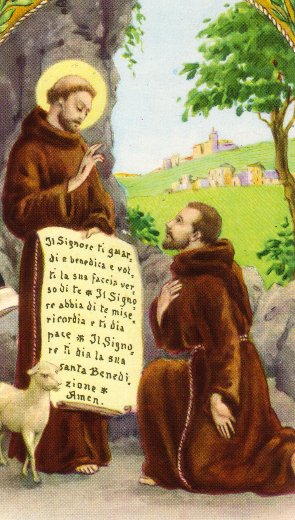
It is the presence of Christ in the lives of sinful men that keeps bringing us back through mutual love and support.

We have brothers in formation to be secular brothers and brothers in formation who will profess the evangelical counsels and are consecrated celibate brothers.  On Monday, Brother Leo, one of our celibate novices and I spent the day together.  We took the time to review the changes that have to be made to our habits to make them more practical.  Then I went for a doctor’s appointment and Brother went with me.  He brought me lunch, which was delicious.

That night, we had formation class for the men preparing for the consecrated life.  We remembered the one brother in NY.  Smack in the middle of the formation class, we decided to call NY to find that our brother was about to pray the Divine Office.  We put him on speaker phone and gathered round to share with him what was going on here in Florida and to find out how his mission was progressing.

This may sound small to many people, but the fact is that this is what speaks to us about Christ and his Apostles.  The brotherhood of the Franciscans of Life is built upon the brotherhood between Christ and his apostles.  The yearning to be together across the miles, the excitement of one brother’s success, and the desire to hear each other is very much the same as that of the Apostles after the Crucifixion when they thought they had lost it all.  They sat in the upper room longing for days gone by.  These men loved each other, because they had been loved by the Master.  They knew what love was, because they learned to love from Love himself.

As we progress along our journey as Franciscans of Life, we enter into a profound relationship of trust, concern, support, and family.  In this family, we find Christ who said, “For where two or three are gathered in my name, there am I in the midst of them.” (Mat 18:20).

Wednesday evening came and I’m sitting at the kitchen table with two aspirants planning the Transitus for October 3rd.   I’m going to ask you to imagine this scenario.  There is the superior general of a young community, but a superior general nonetheless.  There is a certain degree of respect that comes with that office.

But the beautiful part of this was that we began with prayer for the grace to plan the Transitus well.  We want it to be a true memorial of the life of St. Francis and a celebration of the gifts that God gave to the Church through Francis.  The whole time that we’re being very serious and reverent about the parts of the ritual, who’s going to do what and when, I’m also teasing the aspirants about many things, from their antics to the weight of the brother who will play St. Francis and whom we get to carry around.  Of course, the aspirants are dishing it back at me as quickly as I can dish it out to them.

During the course of the evening, I proposed a format for the Transitus, but I asked the aspirants what they thought of each proposal.  They gave their input and we made some changes.  Some things we could not change, because they’re part of tradition; but at least I learned from the aspirants about the importance of working with each other as brothers, allowing the Holy Spirit to move freely and guide us.

Brothers keep their superior company as he catches his breadth.

Brothers keep their superior company as he catches his breadth.

My brothers teach me much more than what I teach them and they don’t realize it.  

We finally ended the evening at 1:00 AM celebrating and discussing our work, spiritual experiences and our journeys.  We even shared our struggles with sin and what we do to overcome them.

Why am I telling you all of this?  Because as we get ready to celebrate the feast day of our Holy Father Francis, the Communion of Saints becomes more evident.  We are brought together by the love and respect that he taught us to have for each other and for all of our brothers and sisters. But Francis is not the source of that love and respect.  He is not the source of that joy that we experience in all of these moments of family life.  Francis is the master teacher.

blessing of st francisHe has taught us how to find love, respect and joy in Jesus Christ, through Jesus Christ.   From him we have learned how to find Jesus through our brothers and sisters in the Church militant, the Church suffering and the Church triumphant.    In one simple term, our Franciscan experience is one of an apostolic family united with its redeemer through the Communion of Saints.

This Communion of Saints allows us to experience and share with the world the love and peace that Christ and his apostles shared.  The feast of St. Francis is really a celebration of the wonders that God has reserved for the pleasure of the Communion of Saints.

Obedience is deadly


I’ve been thinking, what can I say or write in preparation for the Solemnity of St. Francis of Assisi (October 4th) that would speak to others and would come from my heart rather than san franciscomy head.  Then it occurred to me to share the Lord has taught us through St. Francis.  Every teaching has been a blessing.

I have to say that the most visible blessing that God has given to the world is the Franciscan family.  I don’t think that anyone really knows how many sons and daughters St. Francis has. If I were to compare Francis to a biblical personality, it would be Abraham, the father of many.   I think the first quality of St. Francis that I respond to is fatherhood.

This is interesting, because Francis always identified himself as our little brother.  But this little brother has commanded the attention of millions of men and women around the world, not all of them Catholic.  He has certainly had the obedience of thousands of men and women during the last 800 years.  What makes Francis such a special man and a father figure is not that he was authoritarian or controlling.  What makes him a special figure and a father is that he was respectable.  Francis is credible.  Credible people are respectable.  He set out to live his life according to the Gospel.  To everyone who came to him, he offered the Gospel.  He did not impose himself on anyone.  On the contrary, he was the father who guided his sons and daughters into the future.

Parents normally point to careers, education, potential spouses, hobbies, social activities and many other things that they believe will enhance the lives of their children.  Francis is no different.  He points to Christ and his Blessed Mother.  He points to the Church.  He points to prayer, penance, poverty, family, service  and to the Cross.

I have often thought that Francis is like the man who has an elderly parent who may no longer be physically attractive, but he knows his parent and he knows the beauty inside.  This man makes sure that his children are exposed to this grandparent, who has warts and wrinkles, is old and appears to walk a little out of step with the rest of the world.  He exemplifies filial love and love that goes beyond the faults, to the heart of the other.

This is Francis relationship with the Church and his sons and daughters.  In some respects, the Church can be WP_20140819_001that grandparent that is no longer physically attractive and at times can be cranky.  Just like Grandma’, she is beautiful inside and has much wisdom to pass on to us, if we open ourselves to receive it.  Francis loves the Church, warts and all.  He takes his sons and daughters into the heart of the Church, through example more than words.  He teaches us to look beyond the surface and see the glory of the Church.
I can’t speak about Francis without speaking about family.  As I said above, Francis identifies himself as everyone’s little brother.  He was right to do so.  You see, in a large family the youngest is usually singled out.  Sometimes his older siblings will bully him and at other times they will spoil him.  This certainly was the relationship that Francis had with the first generation of brothers.

Everything was not sugar and roses as some people want to make it appear.  There were
brothers who worshipped the ground upon which Francis walkedBrother & Tasha.  There were also brothers who fought his vision of the Gospel Life tooth and nail, to the point of being mean.  But like all good little brothers, Francis loved them just the same.  Little brothers can often become the most forgiving persons.  Francis was the brother who always forgave.

Even when his brothers were wrong, Francis maintained the clarity of mind necessary to separate between the person and the deed.  I wouldn’t say that he hated the sin and loved the sinner.  Francis went beyond this.  He did not judge anyone to be a sinner.  It would be contrary to his way of thinking to look at someone and say that he or she is a sinner whom I must love, even when he has committed a sin that I must hate.  What we see in Francis’ writings and his actions is honesty.  He recognized sinful deeds and he pointed them out when necessary.

His admonitions are full of sinful deeds that he notices among his brothers and sisters.  poor man walking in integrityThat’s why he wrote the admonitions.  Why admonish those who need no admonishing?  However, when one reads through the admonitions, his letters, his rules and his testament, he does not refer to a single person as a sinner, other than himself.  He leaves that to God.  In other words, St. Francis is a person who can teach us what belongs to God, what belongs to the Church, to the superior and to the individual.  He does not cross those boundaries.
Today, we have too many people who want to make the world right by dictating to others, including correcting the Church.  There is such a thing as fraternal correction, which Francis used quite often.  But let’s look at his style.  Look at the admonitions.  He speaks about faults that are to be avoided and how they are to be rectified if they are committed.  He is a brother, not a policeman.  He didn’t even police his own brothers.

A brother corrects while being very careful not to cross the line and assume authority that he does not have.  A brother who is faithful to the Gospel corrects without making a judgment about the state of the other person’s soul.

I want to draw attention to an aspect of him that is rarely addressed, obedience.  Francis’ poverty is well known.  But very little is said about Francis’ obedience and what he taught the brothers concerning obedience.

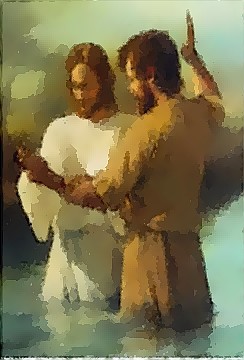
Francis knew that Christ is the firstborn among many brothers and sisters.  He knew JohnBaptist-athat John the Baptist is the voice who points out the Lamb of God.  Each of these men had a
mission assigned to him by the Father.  In both cases, the mission ended up terribly, if we measure it by human standards.  Both were executed.

As tragic, as cruel and as unjust as both of these executions were, they could not be any other way, because to change the conclusion would be to thwart God’s plan for our redemption.   Our loss of paradise is the product of disobedience.  Recovery can only happen through obedience.  Obedience goes beyond compliance.  Obedience is charity.  Obedience is poverty.  Obedience is the greatest expression of union between the soul of man and the mind of God.

Therefore, Francis demanded that his sons and daughters obey.  Above all, we are to obey God.  We know when God speaks to us, because the Church confirms it for us.  We can’t jump a rung on the hierarchical ladder.  We seek to know the will of God in order to fulfill it.  It is the Church who tells us if we’re on the right track.  We can’t simply say that the will of God is X and the entire college of bishops is wrong and I’m right.  It doesn’t work that way and Francis knew it.  He reminds us in his Testament that the rule was of divine inspiration, not human influence.  He quickly adds that he knows this because the Lord Pope confirmed it for him.

Obedience can be deadly.  John lost his head.  Jesus was crucified.  We already mentioned Fr. Miguel Pro, SJ Martyrthis.  Francis reminds us that we cannot be obedient without dying.  This death is not symbolic, metaphoric or allegory.  It’s very real.  We die to ourselves and to many things
around us.

Francis taught us there is only one question that we need to ask.  “Is this a sin?”  If I’m being commanded to sin, I have a duty to disobey.  However, if I’m being commanded to do something that is not a sin, even if I believe it is not the best decision made by legitimate authority, I am bound to obey.  God is pleased by obedience more than by the thing that we do or not do.lamb of god

Jesus said “Truly, I say to you, among those born of women there has risen no one greater than John the Baptist; yet he who is least in the kingdom of heaven is greater than he”  (Matt 11:11)

John would obey, even though it would cost him his life.  Jesus knew that his life would take the same turn.  At some point, his obedience to the Father would cost him his life.

From a human perspective, these deaths were scandalous, because they were foolish.  There was no just reason for these men to be executed.  But from a divine perspective, these deaths were the greatest acts of love that the world has ever seen.  When one obeys the Beloved, even unto death, there is no greater love, regardless how foolish the command.  One is freely giving.  No one is taking.

“No one takes it from me, but I lay it down of my own accord. I have power to lay it down, and I have power to take it again; this charge I have received from my Father,” (John 10:18)

Francis teaches us what he learned from Christ, “obedience, even unto death,” without murmuring and without second thoughts, obedience given, rather than compliance demanded.WP_20140825_081

Today, there is much talk about the Church and her prudential judgments.  Many excuse themselves from obedience, because the Church, the bishop, the superior or the boss is less than prudent or the command is not infallible. They’re looking in the wrong direction. Francis taught us to look out for sin.  If there is no sin, we turn our complete attention and gaze to what is asked of us and we respond with love for God and for the authority that God places over us.

Despite everything that Francis said and wrote about Lady Poverty, he begins his most important piece of writing with the words, “The Rule . . . is to observe the Holy Gospel in obedience.”

Christ is the Master and Francis is his hired teacher sent to us, through the Church, by the Holy Spirit.  He teaches us that obedience is an absolute requirement in order to be like Christ, even when obedience is deadly (in the eyes of the world).

franciscans of life

Holy Father St. Francis . . .Pray for us.

A Deacon’s Deacon


caravaggio_st_francis_in_ecstasy
The Solemnity of St. Francis of Assisi is just around the corner.  I’m moved to write a few thoughts on it.  What a surprise, right?

Our Holy Father Francis was a man who walked in many shoes.  He was a family man, even though he was never married.  He had parents and siblings and was very close to all of them.  He was a patriot who went off to war to fight for Assisi ending up as a prisoner of war for one year.  Fast forward just a little and we see him living the life of a hermit and a penitent asking God to tell him what to do next.  He was a layman, religious brother and very late in his life, a deacon.  Pope Innocent III approved the order 1209.  Pope Honorius gave the final approval to the Rule in 1223.  It seems that this is when Francis was tonsured.

It’s rare that I meet a deacon who does not remind me that Francis was one of them.  In philosophy we learn that words have meaning.  For the sake of clarity, let’s establish that Francis lived 800 years ago.  Today’s deacon shares in Christ’s Diakonia as Francis did in the 13th century.

Peter said to him, “You shall never wash my feet.” Jesus answered him, “If I do not wash you, youhave no part in me,” (John 13:8).

Simply put, he’s one of their predecessors in the diaconate.  As we approach the feast day of one of the world’s most celebrated deacons, after Stephen the martyr, there are some points that deacons may want to reflect on.

Rev. Brother Francis Bernadone did not limit himself to identifying with the poor, nor did he stop at giving back his father’s name, fortune and future inheritance.  He saw the poverty of Christ at the Last Supper, at Calvary and in the Eucharist.  The God of creationsan franciscon remains with us, out of pure love, fully alive in his glorified body under the appearance of the most basic forms of food, bread and wine.   Christ chose bread and wine in order to remain with all men.  Bread and wine are found in every culture.  In the Eucharist, Francis contemplates the poverty of Christ and he has only one desire, to make Christ’s poverty his bride.  Francis’ place at the altar went beyond performing certain liturgical functions; it was about becoming a poor man as Christ was poor on the altar of Calvary.


Can today’s deacons say the same about themselves?  Can they say that they see Christ’s poverty?  Can they say that they aspire to make Christ’s poverty their own or do they gloss over it, as Francis used to say, by labeling it “spiritual poverty” or “poverty of spirit,”  terms that Francis considered a form of white washing.

Deacon Francis wanted only one thing.  He wanted to reflect perfection.  Thus he spent most of his life trying to become The Mirror of Perfection, that mirror which reflects the perfection of Christ.  He became the reflection of the perfect deacon, Jesus Christ who came to serve, not to be served, Jesus Christ who said,

“Go and tell John what you have seen and heard: the blind receive their sight, the lame walk, lepers are cleansed, and the deaf hear, the dead are raised up, the poor have good news preached to them,” (John 7:22).

Francis became the servant of the voiceless as was Christ.  Diakonia, in Franciscan tradition, takes its inspiration from Christ who is one with the poor and serves among them.  In Francis’ mind, being a deacon and being a Friar Minor were perfectly compatible as long as the deacon focused on union with the voiceless and in service of the voiceless.

Francis also placed his ministry at the service of his brothers, not above his brothers.  It would seem that the idea of permanent deacons became difficult to fit into the Franciscan tradition when the diaconate became a transitional step toward the priesthood and when deacons themselves assumed a clerical attitude.   Some deacons are readily available and visible for liturgical functions and missing in action among the voiceless and among those who ask for their help with the faith.  Francis was to be found more often serving the sick, teaching the crowds, listening to a young man struggling with the faith, or serving food to the hungry, than he was serving at a liturgy.  That’s probably why we Franciscans don’t remember him as a deacon, but as a brother, teacher and spiritual father.

Those who are deacons of the mysteries of Jesus Christ must please all men in all ways. For they are not deacons of meats and drinks [only] but servants of the church of God (St. Ignatius of Antioch)

(more…)

Published in: on September 25, 2014 at 2:46 AM  Comments (1)  

God’s Love: What’s the dose?


We sometimes forget that God loves us far more than we love ourselves.  I’ve had a difficult week with pneumonia, again.  By Saturday morning, I knew that I was headed for trouble.  I awoke my poor doctor at 5:00 AM with shallow breathing and glucose levels through the roof.  I really felt badly. The man works hard, has young children and who knows how much he gets to sleep during the week.

Needless to say that his service paged him and he responded immediately.  As soon as I told him the problem, I could almost hear him wake up at the other end.  He asked me to hang up for a few minutes and promised to call back.  In less than five minutes, the phones rings and I hear a very polite voice, “Brother Jay?”  It was my doctor.  He had gone to his computer, searched a database, read the notes from another of my doctors and figured out the problem.  Now he had to find a solution.  He explained the problem and told me to hang up again.  Within minutes he was back on the line.  He had spoken to the local 24 hour pharmacy and had asked the pharmacist to prepare a special batch of insulin for me and requested that it be quick.  Shortly after he hung up, the pharmacy called.  The insulin was ready.  I just had to send someone to pick it up.  In the meantime, the doctor called me three more times on Saturday to check up on me and have me read him my glucose levels.  How many doctors spend that much time on one patient on their day off?

Divine PhysicianBut the story does not end there.  That was only the beginning.  I sent out a text to the brothers asking for their prayers.  Within minutes, the brothers were calling me from different cities in the area.  They were concerned.  Some headed for the nearest Blessed Sacrament chapel.  Brother Bernard came and spent the day with me.  He arrived at 11:30 AM and remained until 11PM.  I truly appreciated it, because his company kept my mind occupied. Normally, I would have been waiting to see the glucose levels drop, maybe worrying about my diet and spend the day feeling miserable.   In the meantime, the other brothers continued to call during the day, all day Saturday.

When Sunday morning rolled around, I felt better enough to attend Holy Mass.  I checked my morning glucose and to my surprise, it was normal, so I didn’t take the insulin.  I went to mass.  As I was leaving, Brother Masseo called to tell me that he was driving in from another city about 25 miles away to spend the day with me.  The folks in my house had to take care of their jobs.  There was some concern about whether I should stay alone or not.  Brother Masseo was not part of this conversation.  He didn’t even know that it was taking place.  His call and offer to come spend the day was like a prayer come true.  We met up at my home again, after mass.

Brother brought me lunch, which was delicious.  Normally, I test my glucose before meals, but I felt fine and did not do it.  Two hours after lunch, I checked and to my pleasant surprise, it was normal.  I checked three times.  Each time, it was normal.  I spent an entire day insulin free, the first in a long time.

When Julian arrived, Masseo left.  He was going to drive 25 miles to go home and finish another assignment.  But there were also phone calls and texts from brothers as far away as 60 miles.  Finally, it was Sunday evening and once again the telephone rang.  It was my doctor again.  He wanted to check in on me and make sure that everything was OK.  I imagesCA84KBW0explained to him that I was fine and told him about my insulin free day. Ha sked me if I had done anything different, which I had not.  He then said my normal was not normal for diabetics.    I explained that God loves us through the people he places in our lives, beginning with him and moving along to my Franciscan Brothers of Life.  The only explanation that I could give him is that

GOD’S LOVE COMES IN LARGE DOSES.

Published in: on September 22, 2014 at 12:38 AM  Comments (1)  
Tags:

Why do I do this?


I’m trying very hard not to engage in heavy philosophy and theology these days.  I’m tired, my health is poor, my brothers need my attention, it’s “Franciscan Season,” then I have to rest for the Advent Season.  But every once in a while someone says something or publishes bang-head-heresomething that stirs my juices and I can’t turn my brain off.  I keep asking the brothers to elect a new superior.  If someone else were the superior, he could order me to stop thinking about A, B, and C and I would have to make an effort to focus on something else.  But that’s not the way it works these days.

I read an article, which you can read, if you have time.  The link is at the bottom of the page. I refuted the writer’s comments and placed them on Facebook.  In a nutshell, the writer interpreted something that the Holy Father said about Mary as making her part of the Godhead and more important than Jesus.  If you read the article, the Pope never said such a thing.  After my refutation, a poster from Facebook chimed in

To me this is like arguing about which version of Little Red Riding Hood is correct.

I responded like this.  I’m just going to give you snippets of my response.

When we come to the person of Jesus Christ, we have to face the question about a real person who exists in real history, but has two natures, one divine and one human and he proved it to those who knew him. He died on a Friday and walked out of a tomb on a Sunday. Dying is very human. Walking out of a tomb after three days is not normal for human beings to do.

I gave a few other examples such as Jesus walking through walls and asking for food, before moving on to this other point.

VISITATIONNow we have the union of two natures in one man. The divine nature is that of the second person of the Trinity and the human nature is that of Jesus of Nazareth. But the second person of the Trinity, who happens to be pre-existent, is also the infant who was born of Mary and who could not be born, had there not been a mother to carry him for nine months and give birth to him.

Yes, I know that God could have taken on human nature using any means he wished.  But he’s God and I’m not.  Who am I to tell God how to enter the world?

Another post shows up and said  “Not buying any of it.”  That’s fine, because Truth is not for sale.

As Franciscans, we present it, but we don’t try to sell it, shove it down anyone’s throat, or seduce anyone into acceptance.  The Truth is of God and God does not need help to distribute grace. Faith is a gift of grace.  God just asks us to deliver the message.  He does the rest.

021001-N-3228G-008However, I did state that I would give my life for this, meaning that I am willing to die rather than deny that the Second Person of the Trinity broke into human history by taking on human nature from Mary of Nazareth.  I’m not about to argue with him why he didn’t use some other way.  That’s like arguing about technique with the lifeguard who’s trying to save your from drowning.

Of course it finally came out.  The famous question.

Explaining a fairy tale, is just explaining a fairy tale. Where is logic and science?

It seems that some people have elevated science to be the “Source of All Truth”, an assumption that even many non-believers reject.

In a certain sense, modern man is more naive than the ancient Chinese, Romans, Greeks, Aztecs, Incas, Mayans, Brahmans and other great thinkers.  The ancient thinkers never believed that one discipline had all the answers.  Truth is distributed among science, art, nature, human behavior and development, the environment, math, and other disciplines.  Theology studies Truth in order to understand that to which our faith has already given assent.   In plain English, science can only answer some questions, the answers to other questions are to be found in other domains out of the reach of science.

Can science create beauty or something that is beautiful?  Beauty exists before the beautiful.  Science did not create beauty.  It created something beautiful using technology.  Case in point, science does not have all the answers, so why even ask this question?  I explained that science can only deal with that which is contained by space, time or both.

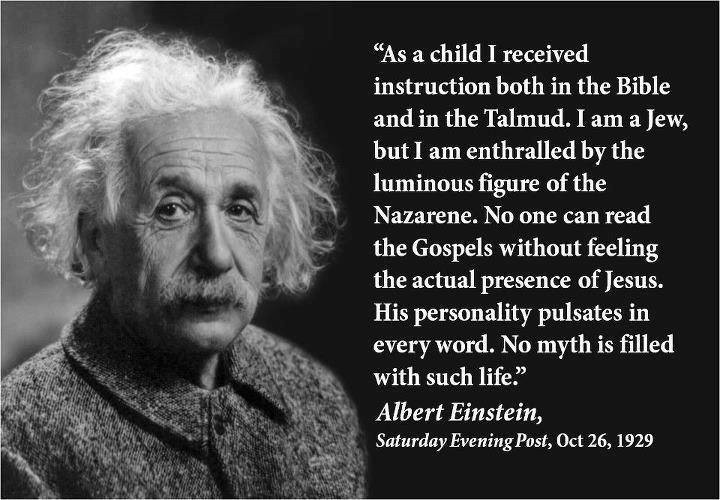
einstein and jesus

Einstein also taught us that space and time are relative to each other and to that which occupies it.  If science could show us all truth, then truth would be limited to space and time.  In which case, there would be no absolute truth, because science is not absolute.  We’d exist in a world of relativism where nothing can be trusted, because nothing is guaranteed.

If there is no absolute truth, then there is no such thing as absolute love, friendship, fidelity, honesty, patience, kindness, compassion, purity, detachment and many other things.  If we contain these things in space and time, they would be relative, not constant.  You couldn’t trust that your feelings for a loved one are the same today as they were when you went to bed last night.  Einstein’s theory of relativity helps us understand the relationship between space and time.  To use a modern word, they’re synced.

I think that Truth has to be bigger than the bubble in which we live.  Einstein would agree.  He once said,

The most beautiful and most profound experience is the sensation of the mystical. It is the sower of all true science. He to whom this emotion is a stranger, who can no longer wonder and stand rapt in awe, is as good as dead. To know that what is impenetrable to us really exists, manifesting itself as the highest wisdom and the most radiant beauty which our dull faculties can comprehend only in their primitive forms.
( Albert Einstein – The Merging of Spirit and Science)

Fr. Miguel Pro, SJ Martyr

Miguel Pro, SJ Gave his life for Christ the King

After explaining why I would give my life for this, I asked my FB friend, “If you were put with your back against the wall and told to believe a falsehood or shot for denying what you believe to be false, which would you choose?”

The response was rather interesting.  “What a ridiculous choice. I would pretend to buy it and walk away, wondering at the stupidity of my captor.”

To which I was forced to respond, “There is the difference between you and I. I would never forfeit my life for a lie, but I would for the truth.”  Our preoccupation with empirical truth has actually deteriorated our ethical character.

So she hit me with, “Your perception of the truth is not necessarily the truth. You have submitted yourself to ideological brainwashing.”

 Here is the weakness in that thinking.  You’re assuming a great deal about the other person.  She’s assuming that I’m naive, ignorant, weak-minded and that she has no need to walk in my shoes, because she has her stuff and mine all figured out.  We can never make such assumptions.  St. Francis never assumed that he understood the other person.  He allowed the other person to open himself up to him and he in turn reciprocated by opening himself to the other.  He took the risk of loving, believing what he could not see and trusting.

I want to do the same.  I want to take the risk of sharing my faith.  I came to the faith on a risk.  I trusted a man named Francis of Assisi.  I believed that he would teach me about Jesus and he did.

For a few years, I lapsed in the faith and underwent a second conversion.  This time I trusted my eyes.  I had completed my studies in neurology and psychology and I’ went through a conversion experience that began in my mind.

As I studied studied neurology and human development. I came to the realization that the How-The-Human-Nervous-System-Works
human brain and its concomitant behaviors are too complex, too ordered, too consistent and at the same time outside of our ability to contain in time and space, which makes them consistently fluid and unpredictable, because we can’t create human experience.  We have to wait for it to happen in order to attempt to understand it.  We can’t create human passions.  We have to wait for them and then analyze them.

For anything that precise to exist free of human control and capable of transcending space and time, while obeying natural law, there must be a Law Giver more intelligent and capable of much more than what I give him credit for.

Why do I do this?  Why do I engage in discussions with fallen away Christians? Because I’m a Franciscan of Life.  God sends us into the world to continue the work of Christ who is the firstborn of many brothers.

What did Christ say was his work, Icame that they may have life, and have it abundantly,” (John 10:10)  The Franciscan of Life is the instrument of Life calling out to life.

imagesCA84KBW0


The article that triggered the dialogue.

http://www.inquisitr.com/1477428/pope-francis-about-to-decree-virgin-mary-to-be-more-important-than-jesus-christ/

Remaining in His love . . .


Everyday I love my brothers more and more. I have never had the privilege of sharing my journey with such a great group of brothers. They’re holy, joyful, intelligent, helpful, prayerful, compassionate, respectful, and faithful to the Holy Father and the Church.

Would you like to meet some of them? Let’s do some this week and later we do more. I’ll introduce you.

Before introducing you, allow me to remind the readers that I’m their superior. You’ll see why this is important as we go through the introductions.

Aspirant Alberto, FFV

Aspirant Alberto, FFV

Alberto is one of the most mature young men that I have ever met. Alberto has taught me to laugh at my human limitations, including my neurosis. Don’t try to shy away, we all have a few of those around. But with Albert, I’ve learned to laugh about them. He has taught me to accept them, because they’re a part of what makes me unique.  Most important, he has taught me to love God more.  His love of God is awe inspiring.  Alberto is American of Cuban ancestry and has just begun his first year of aspirancy with us or as his Mom calls it, his year of Ibuprofen.  🙂

Postulant Eduardo, FFV

Postulant Eduardo, FFV

Eduardo is a postulant as a secular brother. He is originally from Peru and now lives in Florida. He’s brilliant. Eduardo has written some of the best papers that I’ve read on the heresies of the early Church. He’s concise and clear.

You can always count on Eduardo when you need a favor. I have never seen him without a smile. The greatest thing that I’ve learned from Eduardo is to be gentle. I acknowledge the I can be rough around the edges. During the time that I have been with Eduardo, I’ve discovered that a smile is contagious and probably the best way to spread the Gospel of Life.

Br. Christopher Thomas, FFV

Br. Christopher Thomas, FFV

Br. Chris is our first professed secular brother. He came to us from Jamaica, via NY. I think that his GPS may need some attention. He is still in formation. Even after profession, you remain in formation for three years until we agree that you’re ready to fly. Brother loves the founding fathers of the USA. I’m not particularly impressed with any of them, because they were all so anti-Catholic. Be that as it may, Br Chris loves them. Had I been more familiar with this, I would have given him the name, Br. George Benjamin Thomas.

What have I learned from Chris? There are so many things, but the most important of all is Chris is always smiling and has a wonderful self deprecating humor, but don’t tell him. He’ll deny both. Chris’ desire to understand the faith and his dedication to the fathers in Project Joseph make him a model Franciscan of Life.

Postulant Luis, FFV

Postulant Luis, FFV

Luis comes to us from Colombia. If you ever want to learn to pray, watch this man. Luis has taught me many things about prayer, Our Lady, the Holy Rosary, but most importantly, he has taught me the miracle that can happen when we remain open to life. He comes from a large family. I’ve met 8/10 and they are beautiful people.  Luis has also taught me a great deal about fidelity.  He is often very tired when he has to drive to our mother house for a three hour formation meeting.  He never leaves without smiling.

Br. Leo Gerard, FFV

Br. Leo Gerard, FFV

Brother Leo comes to us from Boston. He is a registered nurse and ministers to the terminally ill and their families. Brother has taught me to be generous with my time and with my resources. When I’m not feeling well, the first person who texts me or calls me is Br. Leo. When we need prayer, we can count on Leo. Brother Leo has been a living example of gentility and obedience.

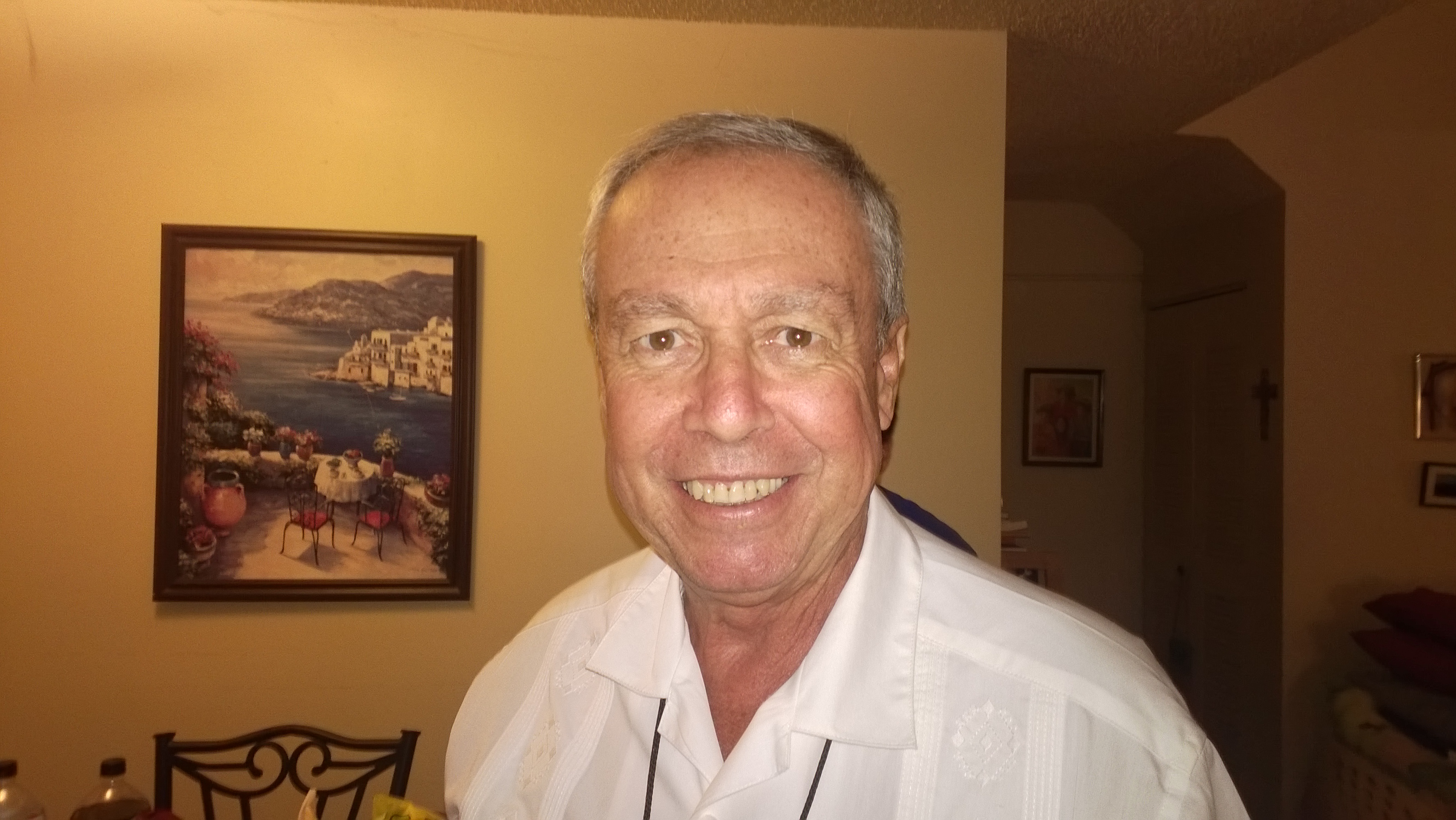
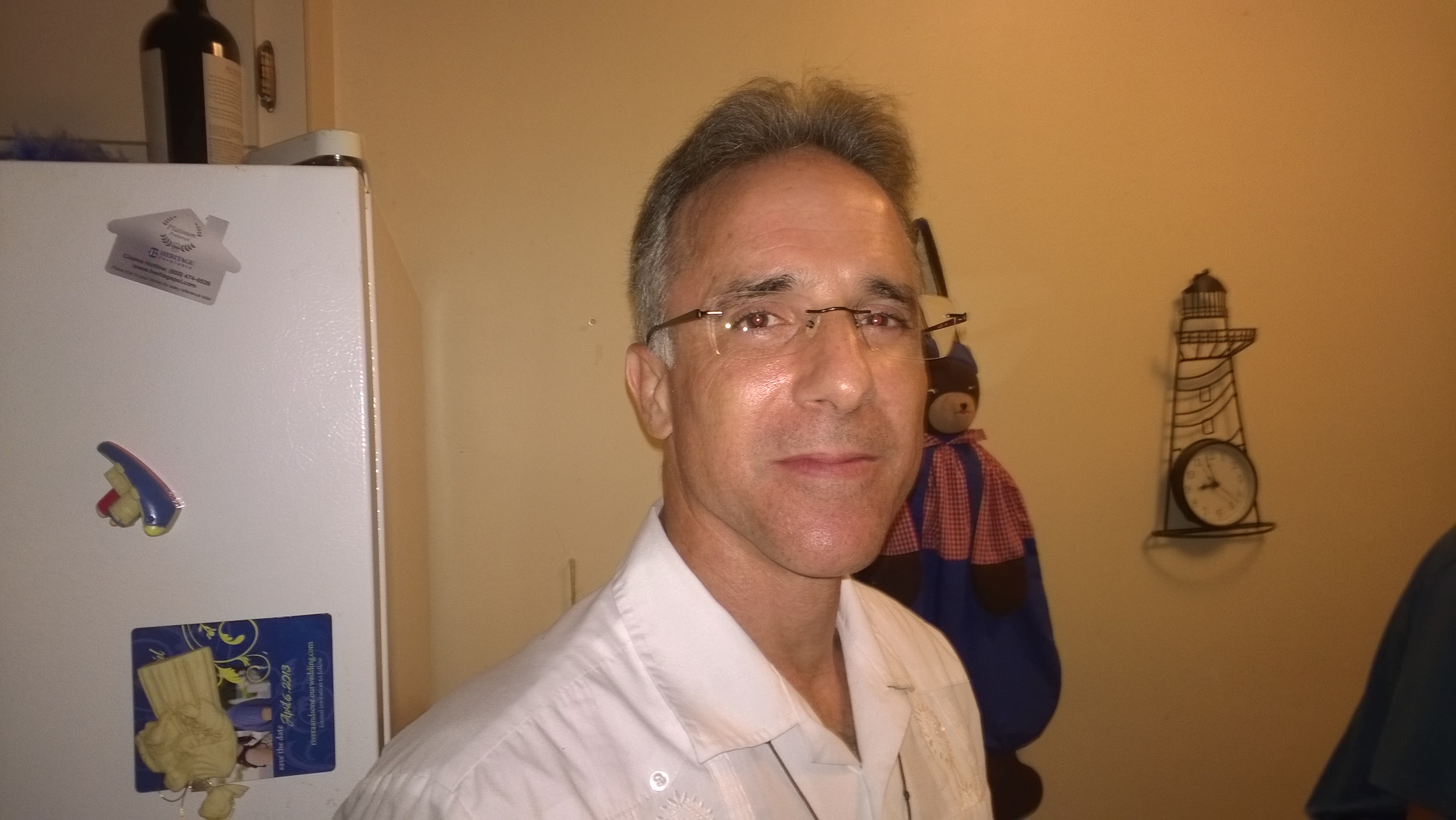
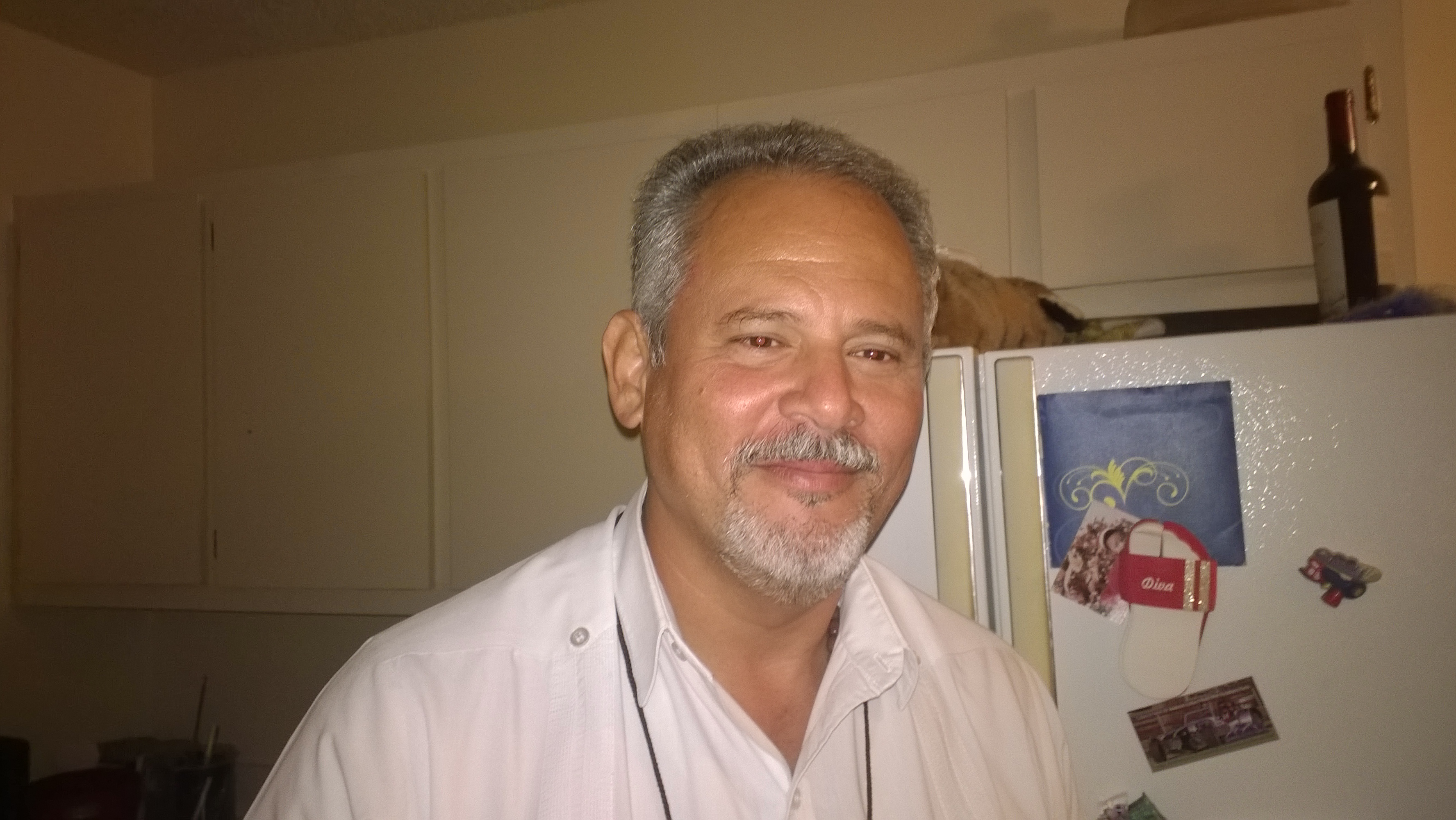
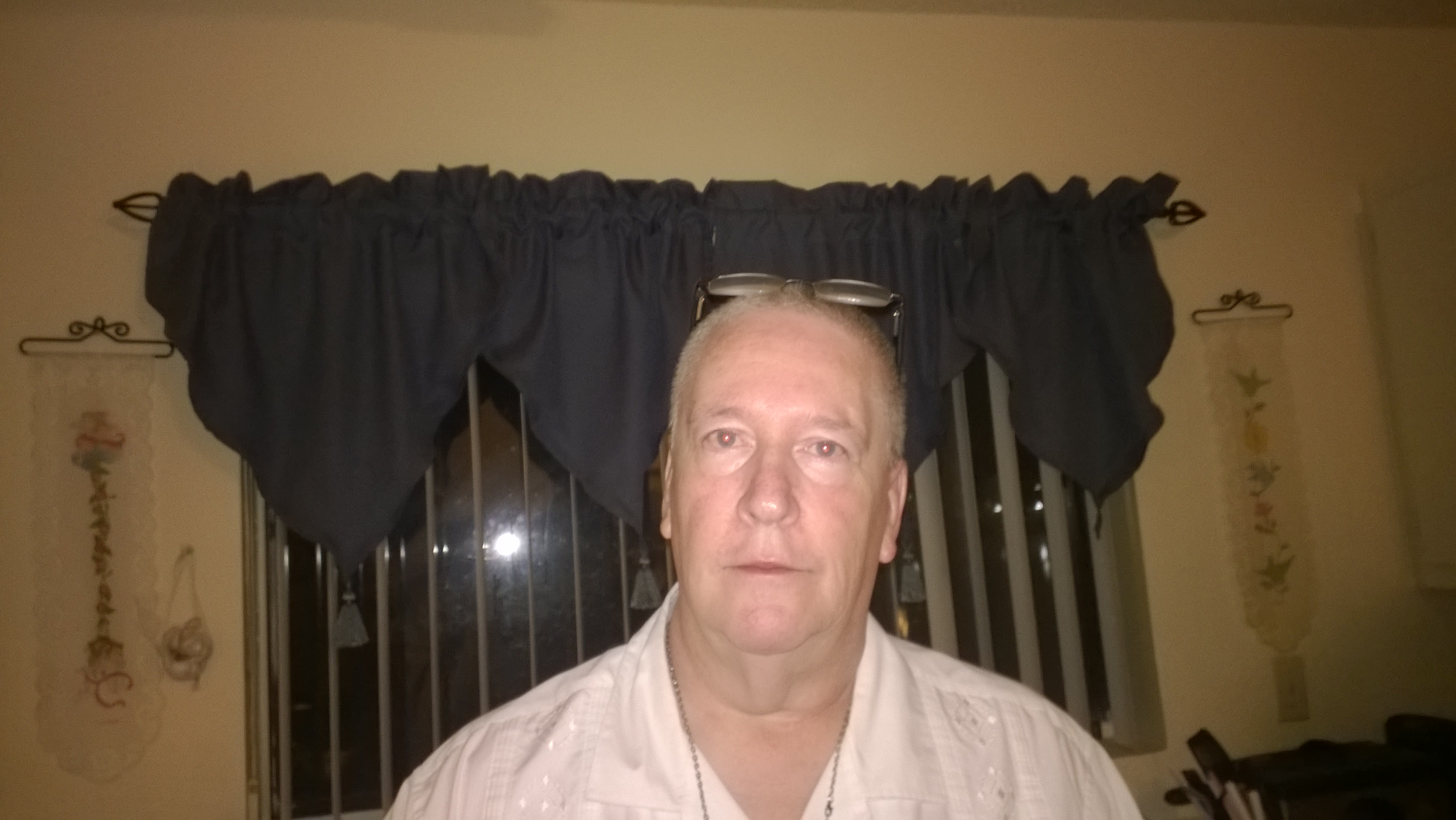
Br. Jay, FFV & Aspirant Bernardo, FFV

Br. Jay, FFV & Aspirant Bernardo, FFV

No, we’re not a comedy routine like Laurel and Hardy or El Gordo y El Flaco. I took this picture together for a very special reason.

Bernardo and I share an interesting background. I’m of Hispanic and Israeli extraction and he’s of Cuban and Italian extraction. There is a story here. Bernardo and I first met on Catholic Answers Forum. Very often we’d get into some prolonged discussion on Traditionalism. I have to admit here that I dislike the expression “Traditionalist Catholic.”   There are 23 Catholic Churches that make up the Catholic Church and none of them is called the Traditionalist Catholic Church.  So we used to have these little encounters on line.

Last year, I worked on the Archdiocesan Synod for Miami.  While standing in the garage, a young man came running behind me and asked, “Are you JReducation?”   The JR is from my religious name and education is what I’ve done most of my life.  We introduced and from there a wonderful friendship has evolved.

I attended the liturgy for the Exaltation of the Holy Cross in the extraordinary form with Bernardo and many mutual friends and some new ones that I made that day.  I’m learning many things from Bernardo.  I think I’m learning that I can be a traditional Franciscan without being a radical traditionalist.  I can also be a very forward looking Franciscan, without being a Modernist.

In simple language, Bernardo has taught me that being a Franciscan and a brother to all is the most important tradition in my life.  He is a  model of love, generosity, fidelity, obedience, prayer, patience and penance.  I’m learning a great deal about Franciscan life through my dialogues with Bernardo.

That’s it for now.  I’m very tired.  Next time, I’ll do  more profiles as I get them.  For now, let’s stop here.  I must say that I feel that I have so little to do and so much to learn when I’m around my brothers.  I’m the superior, but they seem to be my teachers.

To tell the truth,

MY LIFE WOULD BE INCOMPLETE WITHOUT MY BROTHERS.

Brothers keep their superior company as he catches his breadth.

Brothers keep their superior company as he catches his breadth.

A note to my brothers:

When I leave this world, remember that there was one superior who loved you as a mother loves the child inscribed in the palm of her hand. and I will be watching over you from heaven.  If the Lord allows it, I would like to be your patron saint during your darkest hours, to guide you through the night into the dawn.

I love you guys and appreciate everything that you have given to me.  Remember, Franciscan fraternity is not about belonging to the same outfit.  You can get that in the US Army. Franciscan fraternity is about loving your brothers as Christ loved his apostles.

Receive my blessing as your superior and spiritual father and my fraternal love as your little and worthless brother.  Don’t forget to pray for me, a sinner.

Always your brother,

Brother Jay, FFV, Superior General

Published in: on September 16, 2014 at 6:09 AM  Comments (1)  

No one builds a house . . .


I just finished reading a talk given by a prominent theologian who is also a Sister of St. Francis. While the talk itself uses language that is quite beautiful, it left me wondering, “What did she just say?”

As I pondered the question, I realized that the problem with the talk is not what she said, but what she did not mention. Nowhere in the talk is God or any of the three divine persons in the Trinity mentioned. Needless to say, Jesus Christ is not in there. One can argue that building_church(1)speaking to a group of Catholic sisters she need not mention Jesus, because it’s a given that the vision and goals that she put forth for the sisters are grounded in faith in Christ. However, I’m not so convinced that one can always assume that this is understood.

When we propose apostolic endeavors, a vision or a mission and we fail to ground them in the person of Jesus Christ and his work of redemption, we run the risk of making these endeavors, visions and mission our own in the bad sense of ownership. In other words, if Jesus is never mentioned in our plans, there is a risk that we will see ourselves at the center of the plan rather than Christ. When we put ourselves at the center of any plan, then we run the risk of error. Worse, we run the risk of becoming prideful. It’s no longer God’s plan and God’s inspiration. It’s all about “look what I came up with.”

My purpose in writing this is to remind you my dearest sons and brothers that any vision, any goal and any future plan that you or the fraternity may conceive must always be examined against God’s plan for the salvation of souls. If it does not fit into what God has revealed to us about himself and his plan for us, then the vision, the goal and the plan does not come from Christ. It may be beautiful and it may be very sound, but if it does not come from Christ, then it comes from man. We did not become Franciscans to worship man. We did not become Franciscans to follow man. Nor did we become Franciscans to do social service for men.

Like our holy father St. Francis, we follow Christ who will lead us to the Father and we depend on the Holy Spirit to help us understand Christ’s way to the Father. The Catholic Church will confirm for us whether or not we’re on the right track. That is her role in our lives, to be our mother. franciscans of life

St. Francis followed Christ from within the Church. Everything that he did, everything that he built, everything that he taught came from the Word of God. Don’t ever allow yourself to follow any path before you discern if it’s consistent with the Word of God. If you do so, you may be a good person, but you’re not a son of St. Francis of Assisi who always sought to reflect Christ, thus becoming the Mirror of Perfection.

Published in: on September 4, 2014 at 3:12 PM  Leave a Comment