Sermon for the Transitus of St. Francis


04 October 2014

Almost 800 years ago, Francesco Bernadone, also known as Francis, died in his hometown of Assisi, Italy. On the evening of October 3, 1226.  He was canonized July 16, 1228 and declared to be saint of the Church.  The faithful were commanded to observe his memorial and venerate him every year on the 4th of October by Pope Gregory IX

Tonight, about one million Franciscan men and women around the world and their families, on every continent, are hosting this ritual called “The Transitus of St. Francis”or the “Passing of St. Francis”

There is an important question here that demands a response.Why are we still commemorating the death of this man 800 years later? Other people die everyday and life goes on.  But on the anniversary of the death of St. Francis the Church has created a space in her calendar to begin the commemoration after sunset on Oct 3rd and conclude with sunset on Oct 4th

The answer to why we’re still commemorating this death lies in the answer to another question of greater importance.  What if this was the night of my death, would it be remembered?

  • By whom?
  • How?
  • What have I given to God and to the world that deserves to be remembered?
  • Have I given anything to God and to the world that deserves to be remembered?

We call this a “transitus” from the word “transition” or better said, “the point of no return”

Once we reach the moment of death, there is no return.  You will not come back to finish what you should have done.  There will be no coming back to go to confession.  If your death is unexpected, such as a tragedy, there will be no time for confession or Anointing of the Sick.  You transition from here to there as you are.

In addition, the death of St. Francis reminds us that nothing comes to a complete stop at death.  The fact that we’re remembering St. Francis’ death 800 years later is the best proof of that.   Another good proof that nothing comes to a complete stop at death is the fact that whatever you planted will continue to grow after you die.

If you planted love, forgiveness, compassion, honesty, humility, kindness, fairness, love of God and love of man, those are good seeds and they will continue to grow into sturdy plants, maybe trees.

If you planted prejudice, laziness, gossip, miscommunication, lies, arrogance, resentment, vindictiveness, impurity, vulgarity, indifference toward good things, or irresponsibility, those are the bad sees and they too will continue to grow . . . into weeds and maybe poisonous plants that will continue to kill in your honor long after you’re gone.

Francis’ died leaving behind good seeds, a family of brothers and sisters committed to living according to the Gospel without glossing over it, without trying to find loopholes by interpreting it this way and that way.  He left behind seeds of obedience to the Church.

We don’t always understand the Church and we don’t always agree with her.  How many of us always understand our mothers or always agree with them?  Do we stop loving, respecting and obeying them, even when our hair turns grey or at age 50, we run out the door because Mom called that she needs something or she needs me to run an errand?  “Oh God she couldn’t have picked a worse time.” But we go.  That should be our relationship with Holy Mother Church

Francis planted seeds of forgiveness and peace.  He did not live in a perfect world.  War, crime, political conflicts, poverty, disease, social conflicts, religious wars, battles for power, turf and pleasure were part of their daily bread in the 13th century. He tried to convert the Muslims and failed, or so it may seem.  To this day, the sons of St. Francis have a presence in Jordan, Egypt, Palestine and Israel.  To this day, the Franciscans are the custodians of the Holy Land appointed by the Holy See.  Jews, Muslims and Christians don’t seem to care about their presence.  Probably one of the few points on which they agree.

Francis did not convert the Muslims, but he did not push their back to the corner either with hate language or resentment.  He did not retaliate for their crimes against Christians.  He told the Sultan that he was a Christian and he spoke to the Sultan about Christ.  The Sultan asked him many questions about himself and quickly realized that Francis was an honest man. He truly lived according to what he said he believed.  He was credible, which made him respected.  Francis died, leaving the Muslim world with a sense of respect for his memory.  Will we leave the world with gift?

Throughout his life, Francis warned his brothers and sisters about the danger of dying in a state of mortal sin.  Some people say that because we don’t mention mortal sin, it has ceased to exist.  Not true.

He was very aware that all of us are going to face judgment.  He writes for his brothers and sisters a short rule with guidelines on how to avoid sin and do penance for their sins and for those who don’t do penance.  This is the rule that the Franciscans of Life follow, the Rule of the Brothers of Penance.

Penance has several important effects on our souls.  It’s a way of atonement for the wrong things that we have done and for the good things that we didn’t do.  It’s a way of suffering on earth, rather than suffering in purgatory or worse, in hell.  It’s an act of justice toward God and neighbor.  Asking for forgiveness is not the same as giving back the money you stole.  Asking God for forgiveness only gets us out of hell and into Purgatory.

Doing penance is asking for forgiveness, atoning for our sins, and showing God that we love him and that we love mankind, whom God loves very much.  It means restoring things to their proper place.  This is what got Francis into heaven.  It was not that he never sinned.  It was that his entire life was spent trying to change, to love God more, to love mankind more, to make up for his sins, and to do the right thing rather than avoid it or postpone it.

He was a man who spent his life in a constant state of conversion and the Gospel was his guide.  Christ was his role model.  There was a wedding between the soul of Francis and the mind of God and children were born to this spiritual nuptial.  His brothers are the product of his love for God.

We are here, because Francis of Assisi loved God and man so much that his love cannot be forgotten.  It lives on in his Franciscan family.  We are here because we want to learn to die as saints should die, in the arms of God.

Published in: on October 4, 2014 at 1:24 AM  Leave a Comment  

Francis of Assisi, the Communion of Saints and His Sons


san franciscoThis is turning into the most amazing “St. Francis Week” that I’ve ever experienced.  I know that some people may not understand this, but there is no magic or mythology here.  The Communion of Saints is real and we can experience it in our lives.  Maybe we can’t experience it often; but it’s there.

On Saturday, another brother and I gave a talk on the Franciscans of Life and Project Joseph, our ministry to dads in crisis pregnancies.  We spoke before an audience of 350 or more people.  In order to prepare, Brother and I coordinated.  Before I knew it, we had fliers, a YouTube channel for the Franciscan Brothers of Life and a link to our web page, which I’m hoping that one of our brothers who is a geek can touch up, because it needs updating.

Nevertheless, during those few days leading up to the conference, Brother was also getting ready to leave town for a few days.  We had to work together, work quickly, work well and pray that everything would go without a glitch.  I should mention that Brother and I have never given a presentation together.

What transpired was incredible.  We not only presented and people loved the presentation, but we enjoyed being together and working on a common project.  I must state here that this brother is young enough to be my son.  I mean truly.  He’s actually three months older than my biological son.   However, no one would have noticed the age difference were it not for our physical appearance.  There was a harmony, comradery, and a sense offrancis and leo mission that held
us together.  It was Christ’s mission.  We were not preparing thing presentation for us, but for Christ and his Church.

The next day, Brother left for NY.  He had to travel to NY for research purposes.  No . . . he was not researching NY.  This was real science.  He was going to be gone from Sunday to Tuesday.   However, before he left, the other brothers texted and sent messages encouraging him and letting him know that they would be praying for his success.  We don’t’ all live in the same house.  In addition, some of our brothers are secular brothers, with spouses and children.  They have lives outside of the Franciscans of Life.  Yet, the Lord brought us together behind this young brother of ours who was leaving on what we considered an adventure that we wanted to support, because we knew that it means a great deal to him and it’s something that he enjoys doing.

Were it not for the Gospel, the Church and our Franciscan family spirit, we would never have met and maybe not even cared.  When all was said and done, the project is so technical and scientific that none of us understood a word of what Brother explained.  From where I’m sitting as superior, I’m seeing Christ and his apostles gathered in brotherhood after the Resurrection.  Christ had fulfilled his promise, “I will not leave you desolate; I will come to you” (John 14:18).

“Behold, I am with you and will keep you wherever you go, and will bring you back to this land; for I will not leave you until I have done that of which I have spoken to you” (Gen 28:15).

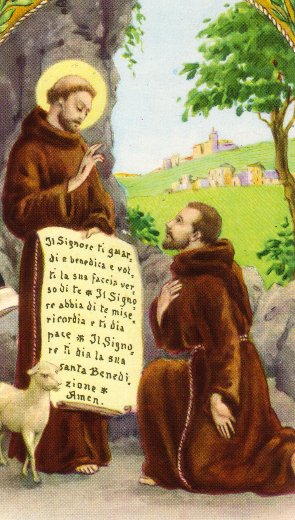
It is the presence of Christ in the lives of sinful men that keeps bringing us back through mutual love and support.

We have brothers in formation to be secular brothers and brothers in formation who will profess the evangelical counsels and are consecrated celibate brothers.  On Monday, Brother Leo, one of our celibate novices and I spent the day together.  We took the time to review the changes that have to be made to our habits to make them more practical.  Then I went for a doctor’s appointment and Brother went with me.  He brought me lunch, which was delicious.

That night, we had formation class for the men preparing for the consecrated life.  We remembered the one brother in NY.  Smack in the middle of the formation class, we decided to call NY to find that our brother was about to pray the Divine Office.  We put him on speaker phone and gathered round to share with him what was going on here in Florida and to find out how his mission was progressing.

This may sound small to many people, but the fact is that this is what speaks to us about Christ and his Apostles.  The brotherhood of the Franciscans of Life is built upon the brotherhood between Christ and his apostles.  The yearning to be together across the miles, the excitement of one brother’s success, and the desire to hear each other is very much the same as that of the Apostles after the Crucifixion when they thought they had lost it all.  They sat in the upper room longing for days gone by.  These men loved each other, because they had been loved by the Master.  They knew what love was, because they learned to love from Love himself.

As we progress along our journey as Franciscans of Life, we enter into a profound relationship of trust, concern, support, and family.  In this family, we find Christ who said, “For where two or three are gathered in my name, there am I in the midst of them.” (Mat 18:20).

Wednesday evening came and I’m sitting at the kitchen table with two aspirants planning the Transitus for October 3rd.   I’m going to ask you to imagine this scenario.  There is the superior general of a young community, but a superior general nonetheless.  There is a certain degree of respect that comes with that office.

But the beautiful part of this was that we began with prayer for the grace to plan the Transitus well.  We want it to be a true memorial of the life of St. Francis and a celebration of the gifts that God gave to the Church through Francis.  The whole time that we’re being very serious and reverent about the parts of the ritual, who’s going to do what and when, I’m also teasing the aspirants about many things, from their antics to the weight of the brother who will play St. Francis and whom we get to carry around.  Of course, the aspirants are dishing it back at me as quickly as I can dish it out to them.

During the course of the evening, I proposed a format for the Transitus, but I asked the aspirants what they thought of each proposal.  They gave their input and we made some changes.  Some things we could not change, because they’re part of tradition; but at least I learned from the aspirants about the importance of working with each other as brothers, allowing the Holy Spirit to move freely and guide us.

Brothers keep their superior company as he catches his breadth.

Brothers keep their superior company as he catches his breadth.

My brothers teach me much more than what I teach them and they don’t realize it.  

We finally ended the evening at 1:00 AM celebrating and discussing our work, spiritual experiences and our journeys.  We even shared our struggles with sin and what we do to overcome them.

Why am I telling you all of this?  Because as we get ready to celebrate the feast day of our Holy Father Francis, the Communion of Saints becomes more evident.  We are brought together by the love and respect that he taught us to have for each other and for all of our brothers and sisters. But Francis is not the source of that love and respect.  He is not the source of that joy that we experience in all of these moments of family life.  Francis is the master teacher.

blessing of st francisHe has taught us how to find love, respect and joy in Jesus Christ, through Jesus Christ.   From him we have learned how to find Jesus through our brothers and sisters in the Church militant, the Church suffering and the Church triumphant.    In one simple term, our Franciscan experience is one of an apostolic family united with its redeemer through the Communion of Saints.

This Communion of Saints allows us to experience and share with the world the love and peace that Christ and his apostles shared.  The feast of St. Francis is really a celebration of the wonders that God has reserved for the pleasure of the Communion of Saints.

Obedience is deadly


I’ve been thinking, what can I say or write in preparation for the Solemnity of St. Francis of Assisi (October 4th) that would speak to others and would come from my heart rather than san franciscomy head.  Then it occurred to me to share the Lord has taught us through St. Francis.  Every teaching has been a blessing.

I have to say that the most visible blessing that God has given to the world is the Franciscan family.  I don’t think that anyone really knows how many sons and daughters St. Francis has. If I were to compare Francis to a biblical personality, it would be Abraham, the father of many.   I think the first quality of St. Francis that I respond to is fatherhood.

This is interesting, because Francis always identified himself as our little brother.  But this little brother has commanded the attention of millions of men and women around the world, not all of them Catholic.  He has certainly had the obedience of thousands of men and women during the last 800 years.  What makes Francis such a special man and a father figure is not that he was authoritarian or controlling.  What makes him a special figure and a father is that he was respectable.  Francis is credible.  Credible people are respectable.  He set out to live his life according to the Gospel.  To everyone who came to him, he offered the Gospel.  He did not impose himself on anyone.  On the contrary, he was the father who guided his sons and daughters into the future.

Parents normally point to careers, education, potential spouses, hobbies, social activities and many other things that they believe will enhance the lives of their children.  Francis is no different.  He points to Christ and his Blessed Mother.  He points to the Church.  He points to prayer, penance, poverty, family, service  and to the Cross.

I have often thought that Francis is like the man who has an elderly parent who may no longer be physically attractive, but he knows his parent and he knows the beauty inside.  This man makes sure that his children are exposed to this grandparent, who has warts and wrinkles, is old and appears to walk a little out of step with the rest of the world.  He exemplifies filial love and love that goes beyond the faults, to the heart of the other.

This is Francis relationship with the Church and his sons and daughters.  In some respects, the Church can be WP_20140819_001that grandparent that is no longer physically attractive and at times can be cranky.  Just like Grandma’, she is beautiful inside and has much wisdom to pass on to us, if we open ourselves to receive it.  Francis loves the Church, warts and all.  He takes his sons and daughters into the heart of the Church, through example more than words.  He teaches us to look beyond the surface and see the glory of the Church.
I can’t speak about Francis without speaking about family.  As I said above, Francis identifies himself as everyone’s little brother.  He was right to do so.  You see, in a large family the youngest is usually singled out.  Sometimes his older siblings will bully him and at other times they will spoil him.  This certainly was the relationship that Francis had with the first generation of brothers.

Everything was not sugar and roses as some people want to make it appear.  There were
brothers who worshipped the ground upon which Francis walkedBrother & Tasha.  There were also brothers who fought his vision of the Gospel Life tooth and nail, to the point of being mean.  But like all good little brothers, Francis loved them just the same.  Little brothers can often become the most forgiving persons.  Francis was the brother who always forgave.

Even when his brothers were wrong, Francis maintained the clarity of mind necessary to separate between the person and the deed.  I wouldn’t say that he hated the sin and loved the sinner.  Francis went beyond this.  He did not judge anyone to be a sinner.  It would be contrary to his way of thinking to look at someone and say that he or she is a sinner whom I must love, even when he has committed a sin that I must hate.  What we see in Francis’ writings and his actions is honesty.  He recognized sinful deeds and he pointed them out when necessary.

His admonitions are full of sinful deeds that he notices among his brothers and sisters.  poor man walking in integrityThat’s why he wrote the admonitions.  Why admonish those who need no admonishing?  However, when one reads through the admonitions, his letters, his rules and his testament, he does not refer to a single person as a sinner, other than himself.  He leaves that to God.  In other words, St. Francis is a person who can teach us what belongs to God, what belongs to the Church, to the superior and to the individual.  He does not cross those boundaries.
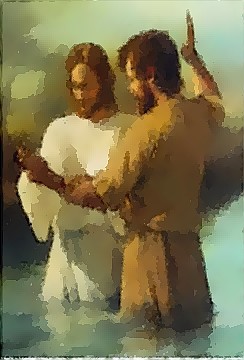
Today, we have too many people who want to make the world right by dictating to others, including correcting the Church.  There is such a thing as fraternal correction, which Francis used quite often.  But let’s look at his style.  Look at the admonitions.  He speaks about faults that are to be avoided and how they are to be rectified if they are committed.  He is a brother, not a policeman.  He didn’t even police his own brothers.

A brother corrects while being very careful not to cross the line and assume authority that he does not have.  A brother who is faithful to the Gospel corrects without making a judgment about the state of the other person’s soul.

I want to draw attention to an aspect of him that is rarely addressed, obedience.  Francis’ poverty is well known.  But very little is said about Francis’ obedience and what he taught the brothers concerning obedience.

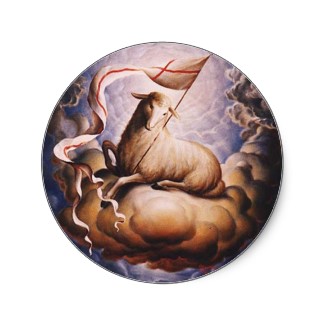
Francis knew that Christ is the firstborn among many brothers and sisters.  He knew JohnBaptist-athat John the Baptist is the voice who points out the Lamb of God.  Each of these men had a
mission assigned to him by the Father.  In both cases, the mission ended up terribly, if we measure it by human standards.  Both were executed.

As tragic, as cruel and as unjust as both of these executions were, they could not be any other way, because to change the conclusion would be to thwart God’s plan for our redemption.   Our loss of paradise is the product of disobedience.  Recovery can only happen through obedience.  Obedience goes beyond compliance.  Obedience is charity.  Obedience is poverty.  Obedience is the greatest expression of union between the soul of man and the mind of God.

Therefore, Francis demanded that his sons and daughters obey.  Above all, we are to obey God.  We know when God speaks to us, because the Church confirms it for us.  We can’t jump a rung on the hierarchical ladder.  We seek to know the will of God in order to fulfill it.  It is the Church who tells us if we’re on the right track.  We can’t simply say that the will of God is X and the entire college of bishops is wrong and I’m right.  It doesn’t work that way and Francis knew it.  He reminds us in his Testament that the rule was of divine inspiration, not human influence.  He quickly adds that he knows this because the Lord Pope confirmed it for him.

Obedience can be deadly.  John lost his head.  Jesus was crucified.  We already mentioned Fr. Miguel Pro, SJ Martyrthis.  Francis reminds us that we cannot be obedient without dying.  This death is not symbolic, metaphoric or allegory.  It’s very real.  We die to ourselves and to many things
around us.

Francis taught us there is only one question that we need to ask.  “Is this a sin?”  If I’m being commanded to sin, I have a duty to disobey.  However, if I’m being commanded to do something that is not a sin, even if I believe it is not the best decision made by legitimate authority, I am bound to obey.  God is pleased by obedience more than by the thing that we do or not do.lamb of god

Jesus said “Truly, I say to you, among those born of women there has risen no one greater than John the Baptist; yet he who is least in the kingdom of heaven is greater than he”  (Matt 11:11)

John would obey, even though it would cost him his life.  Jesus knew that his life would take the same turn.  At some point, his obedience to the Father would cost him his life.

From a human perspective, these deaths were scandalous, because they were foolish.  There was no just reason for these men to be executed.  But from a divine perspective, these deaths were the greatest acts of love that the world has ever seen.  When one obeys the Beloved, even unto death, there is no greater love, regardless how foolish the command.  One is freely giving.  No one is taking.

“No one takes it from me, but I lay it down of my own accord. I have power to lay it down, and I have power to take it again; this charge I have received from my Father,” (John 10:18)

Francis teaches us what he learned from Christ, “obedience, even unto death,” without murmuring and without second thoughts, obedience given, rather than compliance demanded.WP_20140825_081

Today, there is much talk about the Church and her prudential judgments.  Many excuse themselves from obedience, because the Church, the bishop, the superior or the boss is less than prudent or the command is not infallible. They’re looking in the wrong direction. Francis taught us to look out for sin.  If there is no sin, we turn our complete attention and gaze to what is asked of us and we respond with love for God and for the authority that God places over us.

Despite everything that Francis said and wrote about Lady Poverty, he begins his most important piece of writing with the words, “The Rule . . . is to observe the Holy Gospel in obedience.”

Christ is the Master and Francis is his hired teacher sent to us, through the Church, by the Holy Spirit.  He teaches us that obedience is an absolute requirement in order to be like Christ, even when obedience is deadly (in the eyes of the world).

franciscans of life

Holy Father St. Francis . . .Pray for us.

A Deacon’s Deacon


caravaggio_st_francis_in_ecstasy
The Solemnity of St. Francis of Assisi is just around the corner.  I’m moved to write a few thoughts on it.  What a surprise, right?

Our Holy Father Francis was a man who walked in many shoes.  He was a family man, even though he was never married.  He had parents and siblings and was very close to all of them.  He was a patriot who went off to war to fight for Assisi ending up as a prisoner of war for one year.  Fast forward just a little and we see him living the life of a hermit and a penitent asking God to tell him what to do next.  He was a layman, religious brother and very late in his life, a deacon.  Pope Innocent III approved the order 1209.  Pope Honorius gave the final approval to the Rule in 1223.  It seems that this is when Francis was tonsured.

It’s rare that I meet a deacon who does not remind me that Francis was one of them.  In philosophy we learn that words have meaning.  For the sake of clarity, let’s establish that Francis lived 800 years ago.  Today’s deacon shares in Christ’s Diakonia as Francis did in the 13th century.

Peter said to him, “You shall never wash my feet.” Jesus answered him, “If I do not wash you, youhave no part in me,” (John 13:8).

Simply put, he’s one of their predecessors in the diaconate.  As we approach the feast day of one of the world’s most celebrated deacons, after Stephen the martyr, there are some points that deacons may want to reflect on.

Rev. Brother Francis Bernadone did not limit himself to identifying with the poor, nor did he stop at giving back his father’s name, fortune and future inheritance.  He saw the poverty of Christ at the Last Supper, at Calvary and in the Eucharist.  The God of creationsan franciscon remains with us, out of pure love, fully alive in his glorified body under the appearance of the most basic forms of food, bread and wine.   Christ chose bread and wine in order to remain with all men.  Bread and wine are found in every culture.  In the Eucharist, Francis contemplates the poverty of Christ and he has only one desire, to make Christ’s poverty his bride.  Francis’ place at the altar went beyond performing certain liturgical functions; it was about becoming a poor man as Christ was poor on the altar of Calvary.


Can today’s deacons say the same about themselves?  Can they say that they see Christ’s poverty?  Can they say that they aspire to make Christ’s poverty their own or do they gloss over it, as Francis used to say, by labeling it “spiritual poverty” or “poverty of spirit,”  terms that Francis considered a form of white washing.

Deacon Francis wanted only one thing.  He wanted to reflect perfection.  Thus he spent most of his life trying to become The Mirror of Perfection, that mirror which reflects the perfection of Christ.  He became the reflection of the perfect deacon, Jesus Christ who came to serve, not to be served, Jesus Christ who said,

“Go and tell John what you have seen and heard: the blind receive their sight, the lame walk, lepers are cleansed, and the deaf hear, the dead are raised up, the poor have good news preached to them,” (John 7:22).

Francis became the servant of the voiceless as was Christ.  Diakonia, in Franciscan tradition, takes its inspiration from Christ who is one with the poor and serves among them.  In Francis’ mind, being a deacon and being a Friar Minor were perfectly compatible as long as the deacon focused on union with the voiceless and in service of the voiceless.

Francis also placed his ministry at the service of his brothers, not above his brothers.  It would seem that the idea of permanent deacons became difficult to fit into the Franciscan tradition when the diaconate became a transitional step toward the priesthood and when deacons themselves assumed a clerical attitude.   Some deacons are readily available and visible for liturgical functions and missing in action among the voiceless and among those who ask for their help with the faith.  Francis was to be found more often serving the sick, teaching the crowds, listening to a young man struggling with the faith, or serving food to the hungry, than he was serving at a liturgy.  That’s probably why we Franciscans don’t remember him as a deacon, but as a brother, teacher and spiritual father.

Those who are deacons of the mysteries of Jesus Christ must please all men in all ways. For they are not deacons of meats and drinks [only] but servants of the church of God (St. Ignatius of Antioch)

(more…)

Published in: on September 25, 2014 at 2:46 AM  Comments (1)  

God’s Love: What’s the dose?


We sometimes forget that God loves us far more than we love ourselves.  I’ve had a difficult week with pneumonia, again.  By Saturday morning, I knew that I was headed for trouble.  I awoke my poor doctor at 5:00 AM with shallow breathing and glucose levels through the roof.  I really felt badly. The man works hard, has young children and who knows how much he gets to sleep during the week.

Needless to say that his service paged him and he responded immediately.  As soon as I told him the problem, I could almost hear him wake up at the other end.  He asked me to hang up for a few minutes and promised to call back.  In less than five minutes, the phones rings and I hear a very polite voice, “Brother Jay?”  It was my doctor.  He had gone to his computer, searched a database, read the notes from another of my doctors and figured out the problem.  Now he had to find a solution.  He explained the problem and told me to hang up again.  Within minutes he was back on the line.  He had spoken to the local 24 hour pharmacy and had asked the pharmacist to prepare a special batch of insulin for me and requested that it be quick.  Shortly after he hung up, the pharmacy called.  The insulin was ready.  I just had to send someone to pick it up.  In the meantime, the doctor called me three more times on Saturday to check up on me and have me read him my glucose levels.  How many doctors spend that much time on one patient on their day off?

Divine PhysicianBut the story does not end there.  That was only the beginning.  I sent out a text to the brothers asking for their prayers.  Within minutes, the brothers were calling me from different cities in the area.  They were concerned.  Some headed for the nearest Blessed Sacrament chapel.  Brother Bernard came and spent the day with me.  He arrived at 11:30 AM and remained until 11PM.  I truly appreciated it, because his company kept my mind occupied. Normally, I would have been waiting to see the glucose levels drop, maybe worrying about my diet and spend the day feeling miserable.   In the meantime, the other brothers continued to call during the day, all day Saturday.

When Sunday morning rolled around, I felt better enough to attend Holy Mass.  I checked my morning glucose and to my surprise, it was normal, so I didn’t take the insulin.  I went to mass.  As I was leaving, Brother Masseo called to tell me that he was driving in from another city about 25 miles away to spend the day with me.  The folks in my house had to take care of their jobs.  There was some concern about whether I should stay alone or not.  Brother Masseo was not part of this conversation.  He didn’t even know that it was taking place.  His call and offer to come spend the day was like a prayer come true.  We met up at my home again, after mass.

Brother brought me lunch, which was delicious.  Normally, I test my glucose before meals, but I felt fine and did not do it.  Two hours after lunch, I checked and to my pleasant surprise, it was normal.  I checked three times.  Each time, it was normal.  I spent an entire day insulin free, the first in a long time.

When Julian arrived, Masseo left.  He was going to drive 25 miles to go home and finish another assignment.  But there were also phone calls and texts from brothers as far away as 60 miles.  Finally, it was Sunday evening and once again the telephone rang.  It was my doctor again.  He wanted to check in on me and make sure that everything was OK.  I imagesCA84KBW0explained to him that I was fine and told him about my insulin free day. Ha sked me if I had done anything different, which I had not.  He then said my normal was not normal for diabetics.    I explained that God loves us through the people he places in our lives, beginning with him and moving along to my Franciscan Brothers of Life.  The only explanation that I could give him is that

GOD’S LOVE COMES IN LARGE DOSES.

Published in: on September 22, 2014 at 12:38 AM  Comments (1)  
Tags:

Why do I do this?


I’m trying very hard not to engage in heavy philosophy and theology these days.  I’m tired, my health is poor, my brothers need my attention, it’s “Franciscan Season,” then I have to rest for the Advent Season.  But every once in a while someone says something or publishes bang-head-heresomething that stirs my juices and I can’t turn my brain off.  I keep asking the brothers to elect a new superior.  If someone else were the superior, he could order me to stop thinking about A, B, and C and I would have to make an effort to focus on something else.  But that’s not the way it works these days.

I read an article, which you can read, if you have time.  The link is at the bottom of the page. I refuted the writer’s comments and placed them on Facebook.  In a nutshell, the writer interpreted something that the Holy Father said about Mary as making her part of the Godhead and more important than Jesus.  If you read the article, the Pope never said such a thing.  After my refutation, a poster from Facebook chimed in

To me this is like arguing about which version of Little Red Riding Hood is correct.

I responded like this.  I’m just going to give you snippets of my response.

When we come to the person of Jesus Christ, we have to face the question about a real person who exists in real history, but has two natures, one divine and one human and he proved it to those who knew him. He died on a Friday and walked out of a tomb on a Sunday. Dying is very human. Walking out of a tomb after three days is not normal for human beings to do.

I gave a few other examples such as Jesus walking through walls and asking for food, before moving on to this other point.

VISITATIONNow we have the union of two natures in one man. The divine nature is that of the second person of the Trinity and the human nature is that of Jesus of Nazareth. But the second person of the Trinity, who happens to be pre-existent, is also the infant who was born of Mary and who could not be born, had there not been a mother to carry him for nine months and give birth to him.

Yes, I know that God could have taken on human nature using any means he wished.  But he’s God and I’m not.  Who am I to tell God how to enter the world?

Another post shows up and said  “Not buying any of it.”  That’s fine, because Truth is not for sale.

As Franciscans, we present it, but we don’t try to sell it, shove it down anyone’s throat, or seduce anyone into acceptance.  The Truth is of God and God does not need help to distribute grace. Faith is a gift of grace.  God just asks us to deliver the message.  He does the rest.

021001-N-3228G-008However, I did state that I would give my life for this, meaning that I am willing to die rather than deny that the Second Person of the Trinity broke into human history by taking on human nature from Mary of Nazareth.  I’m not about to argue with him why he didn’t use some other way.  That’s like arguing about technique with the lifeguard who’s trying to save your from drowning.

Of course it finally came out.  The famous question.

Explaining a fairy tale, is just explaining a fairy tale. Where is logic and science?

It seems that some people have elevated science to be the “Source of All Truth”, an assumption that even many non-believers reject.

In a certain sense, modern man is more naive than the ancient Chinese, Romans, Greeks, Aztecs, Incas, Mayans, Brahmans and other great thinkers.  The ancient thinkers never believed that one discipline had all the answers.  Truth is distributed among science, art, nature, human behavior and development, the environment, math, and other disciplines.  Theology studies Truth in order to understand that to which our faith has already given assent.   In plain English, science can only answer some questions, the answers to other questions are to be found in other domains out of the reach of science.

Can science create beauty or something that is beautiful?  Beauty exists before the beautiful.  Science did not create beauty.  It created something beautiful using technology.  Case in point, science does not have all the answers, so why even ask this question?  I explained that science can only deal with that which is contained by space, time or both.

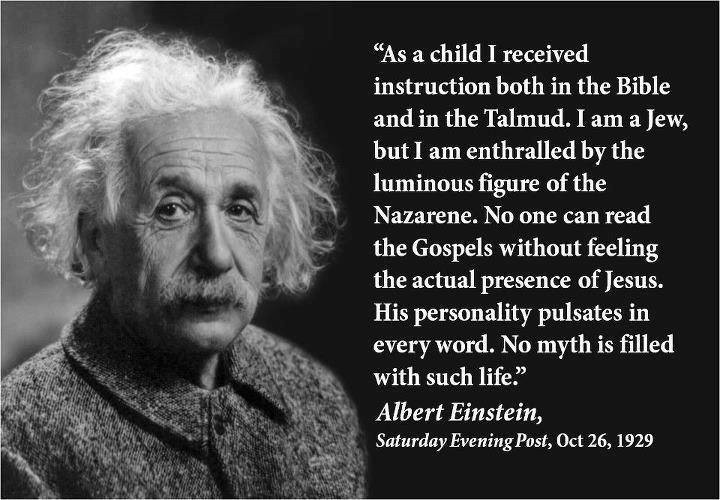
einstein and jesus

Einstein also taught us that space and time are relative to each other and to that which occupies it.  If science could show us all truth, then truth would be limited to space and time.  In which case, there would be no absolute truth, because science is not absolute.  We’d exist in a world of relativism where nothing can be trusted, because nothing is guaranteed.

If there is no absolute truth, then there is no such thing as absolute love, friendship, fidelity, honesty, patience, kindness, compassion, purity, detachment and many other things.  If we contain these things in space and time, they would be relative, not constant.  You couldn’t trust that your feelings for a loved one are the same today as they were when you went to bed last night.  Einstein’s theory of relativity helps us understand the relationship between space and time.  To use a modern word, they’re synced.

I think that Truth has to be bigger than the bubble in which we live.  Einstein would agree.  He once said,

The most beautiful and most profound experience is the sensation of the mystical. It is the sower of all true science. He to whom this emotion is a stranger, who can no longer wonder and stand rapt in awe, is as good as dead. To know that what is impenetrable to us really exists, manifesting itself as the highest wisdom and the most radiant beauty which our dull faculties can comprehend only in their primitive forms.
( Albert Einstein – The Merging of Spirit and Science)

Fr. Miguel Pro, SJ Martyr

Miguel Pro, SJ Gave his life for Christ the King

After explaining why I would give my life for this, I asked my FB friend, “If you were put with your back against the wall and told to believe a falsehood or shot for denying what you believe to be false, which would you choose?”

The response was rather interesting.  “What a ridiculous choice. I would pretend to buy it and walk away, wondering at the stupidity of my captor.”

To which I was forced to respond, “There is the difference between you and I. I would never forfeit my life for a lie, but I would for the truth.”  Our preoccupation with empirical truth has actually deteriorated our ethical character.

So she hit me with, “Your perception of the truth is not necessarily the truth. You have submitted yourself to ideological brainwashing.”

 Here is the weakness in that thinking.  You’re assuming a great deal about the other person.  She’s assuming that I’m naive, ignorant, weak-minded and that she has no need to walk in my shoes, because she has her stuff and mine all figured out.  We can never make such assumptions.  St. Francis never assumed that he understood the other person.  He allowed the other person to open himself up to him and he in turn reciprocated by opening himself to the other.  He took the risk of loving, believing what he could not see and trusting.

I want to do the same.  I want to take the risk of sharing my faith.  I came to the faith on a risk.  I trusted a man named Francis of Assisi.  I believed that he would teach me about Jesus and he did.

For a few years, I lapsed in the faith and underwent a second conversion.  This time I trusted my eyes.  I had completed my studies in neurology and psychology and I’ went through a conversion experience that began in my mind.

As I studied studied neurology and human development. I came to the realization that the How-The-Human-Nervous-System-Works
human brain and its concomitant behaviors are too complex, too ordered, too consistent and at the same time outside of our ability to contain in time and space, which makes them consistently fluid and unpredictable, because we can’t create human experience.  We have to wait for it to happen in order to attempt to understand it.  We can’t create human passions.  We have to wait for them and then analyze them.

For anything that precise to exist free of human control and capable of transcending space and time, while obeying natural law, there must be a Law Giver more intelligent and capable of much more than what I give him credit for.

Why do I do this?  Why do I engage in discussions with fallen away Christians? Because I’m a Franciscan of Life.  God sends us into the world to continue the work of Christ who is the firstborn of many brothers.

What did Christ say was his work, Icame that they may have life, and have it abundantly,” (John 10:10)  The Franciscan of Life is the instrument of Life calling out to life.

imagesCA84KBW0


The article that triggered the dialogue.

http://www.inquisitr.com/1477428/pope-francis-about-to-decree-virgin-mary-to-be-more-important-than-jesus-christ/

A Love Story In Progress


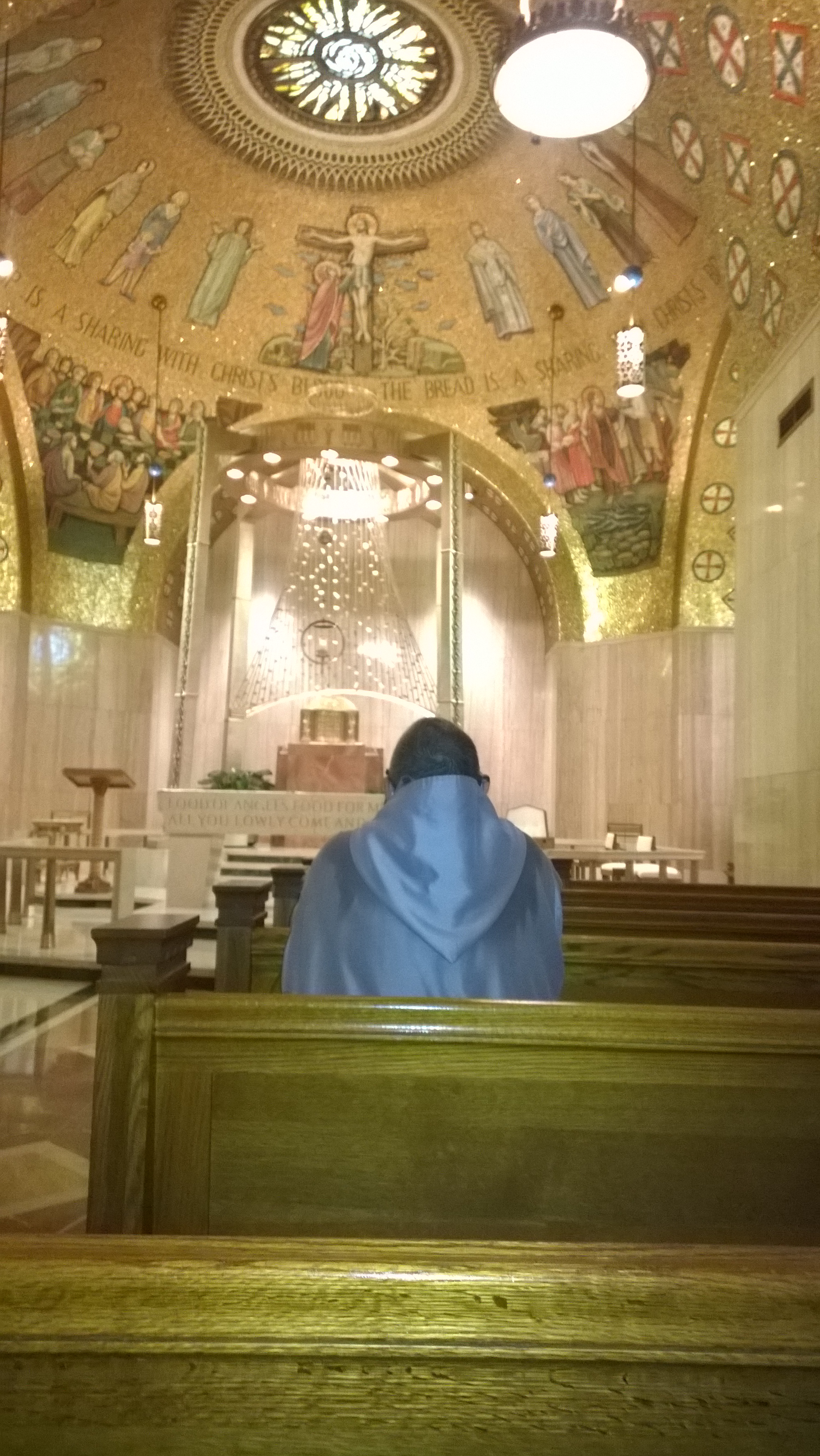
I’ve been thinking about the Evangelical Counsels all morning. I didn’t know why until I reached the pregnancy center where I showed the director my pictures from my vacation. I noticed that I did not take any pictures of anyone or anything else other than The Catholic WP_20140819_001University of America (CUA) and the Basilica of the Immaculate Conception (the basilica). Those two are interconnected. To begin with, they are on the same grounds. You can’t attend school at Catholic University and ignore that basilica. Its presence is formidable.

While I was at CUA, I felt as if I had arrived home. I belonged there. The place was full of memories, good and bad, but they are mine. My daughter’s apartment is not mine and there is nothing of mine in it, except my daughter. I felt no connection there. CUA is definitely home. It was at CUA that I transitioned from adolescence to manhood. Eventually, I had to leave it behind and move along where God called me.
WP_20140819_027
The last place in the world where I wanted to live was South Florida. I had visited here and did not like it for a stay any longer than a week. It’s a different culture. It’s hot and there are no seasons, just dry and rain. It’s in the south, but it is not southern. The dominant culture seems to be very northern. I’m not a water person.

God had other plans. He brought me to South Florida where the Church had a need that I could satisfy. I had the talent, experience, time, freedom and the support necessary to take on the mission. To walk away would have been to say “No” to the Lord.

Obedience is about saying yes to God who speaks through circumstances, the Church, and legitimate authority. Sometimes God asks for that which is hard to give. Just look at Jesus’ in the Garden of Gethsemane. I could not just turn my back on the Church of Miami. God had set everything up.

Poverty is about giving up ownership. We give up material possessions, but it does not stop there. We also give up our wills to God. We give up our opinions and begin to feel and think with the Church. We leave behind significant people in our lives, such as parents and siblings. Most importantly, we give up our home. A Franciscan becomes an itinerant man. Only heaven is home. Every place is on loan for a short time. To visit CUA, walk down memory lane and leave it knowing that I may never see it again was an act of obedience to the will of God and a willingness to freely give up my roots to follow Christ.

Here is where chastity enters the picture. To be chaste is to love with purity of intention, thought, word and deed according to one’s state in life. There is no greater love than to lay down one’s life for another. Jesus taught us this with word and example. Leaving home again, experiencing the pain of separation one more time, feeling the WP_20140819_035excitement of being there and the sadness of leaving is all part of dying. Once again, I was being asked to love without asking for anything in return. That is chastity. Once again I’ve been asked to profess the Evangelical Counsels of obedience, poverty and chastity.

The profession of the evangelical counsels is not a once in a lifetime event. It’s a love story in progress.

Monastic Dad Without Mystic Coffee


This is my last full day of vacation at the home of my daughter and son-in-law. In one sense, I’m sad to be leaving, because I won’t be seeing IMG_3369them again until December. On the other hand, it will be nice to get home, back into my routine and not live out of a suitcase. I don’t see how these folks who travel a lot do it. Living out of a suitcase is not fun.

I’ve made some interesting discoveries during this vacation, discoveries that one does not make in the seminary or on retreat. There are some rules that one must follow if one is a Dad, father-in-law, sibling, theologian and religious superior.

  • If you debate with your family, you will lose every time. Your family does not use the methods of Augustine, Aquinas and Bonaventure and you haven’t used your family’s methods since you left the world; you’re a little rusty.
  • Humor can often be a mystery. You often find yourself wondering what they’re laughing about or you’ll laugh and they won’t understand. Sometimes you get the joke 20 minutes later.
  • If you have a relative who likes to play the Devil’s Advocate, just tell him or her that you accept that you’re as dumb as sheep and move on to pizza. Those of us who are monastic don’t know how to respond to the Devil’s Advocate, because St. John Paul II banned this kind of argumentation in 1983. It’s been a long time since some of us have had to deal with the Devil’s Advocate.
  • Obedience and authority have nothing to do with relationships. Monastic relationships are defined by a hierarchy. You never question a superior or a brother who is older than you are unless he commands you to violate the moral law. Relationships out here are built on respect, love, trust, friendship, cooperation, complementarity and common goals, just as in religious life. However, they are horizontal, not vertical as in a monastic community.
  • Forget structures and schedules. We are very used to following a horarium and doing things a certain way, speaking a certain way, saying some things and never saying other things, or simply doing things in a certain order. In this world, you have to be very flexible. Schedules are governed by work, domestic chores, social commitments and custom. In our world, schedules are governed by the superior, period. He makes up the schedule and the entire community follows along. It’s very easy.
  • As far as what you can or cannot say, the rule and constitutions take care of that. Out here, the rules are not written down. You have to observe. You may often have what I call “The Stupid Look” on your face, because you don’t have a road map for the day or for the conversation. You’re trying to figure out what’s what.

I believe that secular clergy have an advantage over religious men, especially monastic religious. The life of the secular clergy is closer to that of the typical family.  The secular clergyman has never renounced the world. He simply has a different place in the Church. He is a deacon, priest or bishop. But he is not required to distance himself from the secular world.

The life of the monastic is very different. Our first time with our family we may feel like one who is learning to ski. His feet are in two worlds at the same time and he has to keep them from colliding or he will fall.  He’ll feel that he is neither a good monastic nor a good family member.

As a monastic spending time with family, one goes through three stages.

1) You’re excited to see your family; nothing bothers you.

2) You realize that you’re in a different world and you feel anxious.

3) You throw your anxiety into God’s hands and you relax.

Many people think monastic is a place where there is an eight foot wall and you never leave. The truth is that monastic is a way of living and thinking. It can take place in a monastery or on the road. Each order is different. To be monastic is to build your life around prayer, silence, solitude, brotherhood, study, penance and out of that grows service. When you’re a dad and a monastic, your life is very different from that of your adult children, their spouses, and friends.  You have to detach from your old self to become the person Christ means for you to be today.

A Woman Ahead of Her Time


ST CLAREIt’s fascinating that many women in the Church are complaining about not having a voice and not having power, yet in the 13th century, Lady Clare Scifi, defied her parents at the age of 18, ran away from home in the middle of the night to meet with Francis and his friars. There, at San Damiano, she consecrated her life to God and became the mother of the Franciscan Order.

Clare was no lightweight. She was the first female religious superior to govern her community without being subordinate to an abbot or a bishop. She and Francis governed independently of each other. Francis and his successors never had a voice legal or advisory over the Clare and her successors.

When Francis returned from the Holy Land, where he had tried to convert the Sultan and his people, he was determined to enter a monastery. He felt that he had failed as a preacher. It was Clare who set him straight. She insisted that he remain in Europe and continue to preach, because Catholics needed to be converted to Christianity more than the Muslims. She understood that the Muslims did not know the Lord through no fault of their own, but Catholics had become tipid and careless in their practice of the faith.

The Pope decided that Franciscan poverty was too severe for women and he gave Clare and her sisters the Rule of St. Benedict to adapt to their Franciscan spirituality. The Rule of St. Benedict allowed the nuns to own property in common, which was anathema to Francis and Clare. Christ revealed to them that they were to own nothing individually or corporately.

For almost forty-years, Clare engaged in a dialogue with the Holy See, until two days before her death at the age of 59, she received the papal bull that granted her and her sisters the privilege of poverty. It’s important to notice here that Clare engaged in dialogue. She did not disobey, nor did she criticize the Holy See or the hierarchy for seeing things differently. The discussion between the young abbess and the Holy See continued, because the Holy See allowed it, not because Clare was belligerent or defiant.

In 1228, Pope Gregory IX arrived in Assisi for the canonization of St. Francis. At a meeting with Mother Clare he informed her that he was absolving her from her obligation to absolute poverty. Mother Clare chuckled and responded, “With all due respect Your Holiness, but I would much rather be absolved from all my sins than from my duty to God.”

Her obedience, honesty and fidelity won her the respect of popes, bishops, friars and the laity. He life of heroic virtue earned her one of the fastest canonizations in the history of the Church. She died August 11, 1253 and was canonized September 26, 1255 by Pope Alexander IV. The Pope insisted that there was no need for an investigation into Clare’s cause or a beatification, because he personally experienced her sanctity while she was alive. Therefore, he believed the many reports of miracles and stories of heroic virtue without investigating a single one.

How can we read the story of Clare and say that women have not had influence in areas of authority in the Church? Today, there are more than 20,000 daughters of St. Clare. Every house is autonomous. They are not governed by males nor by a mother general either. Each house and its daughter houses governs itself. They are bound to the same canons in the law that bind male religious, especially monastic religious.

St. Clare, pray for us that we may see the Church and all people with the clarity that you saw.

Published in: on August 11, 2014 at 1:06 PM  Leave a Comment  

Cast into the deep . . .


Christ said to Peter,

“Put out into the deep and let down your nets for a APOSTLES FISHINGcatch,” (Lk 5:4)

and when Peter did they had to call for help, because the nets were bursting with the weight of the fish.

When most of us think of Maximilian Kolbe we think of a holy Polish Franciscan friar who took the place of a man condemned to die at Auschwitz and whom the Catholic Church canonized as a martyr. But this is too simplistic a view. His journey to Auschwitz began when he was nine-years old. Speaking through his Immaculate Mother, Christ invited nine-year old Raymond Kolbe to “cast [himself] into the deep.” When the Immaculate appeared to the young boy she showed him two MAX AND MARYcrowns, one white and one red and told him to choose one. Raymond asked what they represented. She told him that the white was for purity and the red for martyrdom. Raymond chose both.

If we fast forward, Raymond eventually enters the Order of Friars Minor Conventual (Conventual Franciscan Friars) and becomes Friar Maximilian Maria. The friars did not use last names in those days. This is a later development when secularism invades religious life.

Maximilian Kolbe began his trek to martyrdom at age nine, accompanied by Mary. It is not coincidence that he achieves martyrdom on the eve of her Assumption into heaven. The relationship between Maximilian and Mary was much deeper than the Sea of Galilee. Together, they would catch many souls.

St. John Paul II, preaching at St. Maximilian’s canonization said, “In the mystery of the Immaculate Conception there revealed itself john paul and marybefore the eyes of [Maximilian’s] soul the marvelous and supernatural world of God’s grace offered to man.” Does not Peter say, “Depart from me Lord, for I am a sinful man”(Lk 5:8)? God never misses an opportunity to reveal his grace and to offer it to man.

To focus on Maximilian’s death and ignore his lifelong journey to Auschwitz, is to miss the movement of God through human history. Throughout his life, Maximilian would have much to teach us about intimacy with God through the Immaculate. We often wonder what exactly happened to John the Baptist while in Elizabeth’s womb when Mary arrived at their home. VISITATION Elizabeth said, “For behold, when the voice of your greeting came to my ears, the babe in my womb leaped for joy,” (Lk 1:44). In presenting the relationship between the soul and Mary Maximilian wrote,

“Mary will enkindle hearts with the love of her Maternal Heart and inflame them with the fire of the charity that burns in the Divine Heart of Jesus.”

He also reminds us that without Mary, our battle against the forces of hell is a lost cause.

“The conflict with Hell cannot be maintained by man alone. The Immaculate has from God the promise of victory over Satan.”

To try to become saints and conquer sin by our own efforts, without the aid of the Mother of the Lord, is a futile cause. Many non-Catholics and non-Orthodox will argue that they know members of their community who have never had a devotion to Mary and have lived very holy lives. This may be true. But that is not to say that Mary is our-lady-crushes-serpent-2absent. Mary does not need our permission or even our friendship to intervene between our soul and hell. This was planned by God from the beginning of time. “I will put enmity between you and the woman, and between your seed and her seed; she shall bruise your head,” (Gn 3:15). We cannot handcuff Mary, because we cannot handcuff God, nor can we alter his plans for our redemption.

Mary is not divine. She is only human. She is not part of the Trinity. Yet, being the mother of the Second Person of the Blessed Trinity, she is inseparable from the Trinity, because the persons in the Trinity are inseparable from each other. She is daughter, spouse and mother.

Christ’s passion, death and resurrection involve the three divine persons of the Trinity and the human person who surrendered her Son to be executed for our redemption, in fulfillment of the Father’s plan. She is the first to cooperate fully with the Holy Spirit for the redemption of mankind. If we want to experience how much the Trinity loves us, we must draw close to Mary.

“The only human person who was as closely united to the Holy Trinity as is absolutely possible, and therefore, the highest reflectionMARY AND TRINITY of the love of the Holy Trinity; the most perfect human, living, visible, audible human being is the Blessed Virgin Mary,” (St. Maximilian Kolbe).

When he surrendered himself to the Mother of God, Maximilian sealed his fate. One cannot surrender to the Mother of God and expect to be spared her Son’s cross. At the same time, without the mother, the cross would not have happened and we would be lost. “His death makes Maximilian particularly like Christ — the Model of all Martyrs – who gives his own life on the Cross for his brethren,” (St. John Paul II)

Through Mary, Christ invited Maximilian to cast his life into the deep. Maximilian accepted the invitation with great joy and peace, because he believed that one should

ST MAX AUSCHWITZ

“Place [himself] in Mary’s hand. She will provide for everything you need for soul and body. Therefore, [one can] be at peace with unlimited confidence in her,” (St. Maximilian Kolbe).

Our intimacy with Christ is proportionate to our intimacy with the Immaculate. Maximilian a modern model of this great truth in Christian Spirituality. However, this intimacy is not without risks. It requires that we cast ourselves, not our nets, into the deep — trusting that she will not allow us to drown in sin and hell.

Saint Maximilian Maria Pray for us

Saint Maximilian Maria
Pray for us

The fact that Friar Maximilian died on the eve of the Assumption is no coincidence. There are no coincidences where the Immaculate is involved.

Published in: on August 11, 2014 at 12:33 AM  Comments (4)