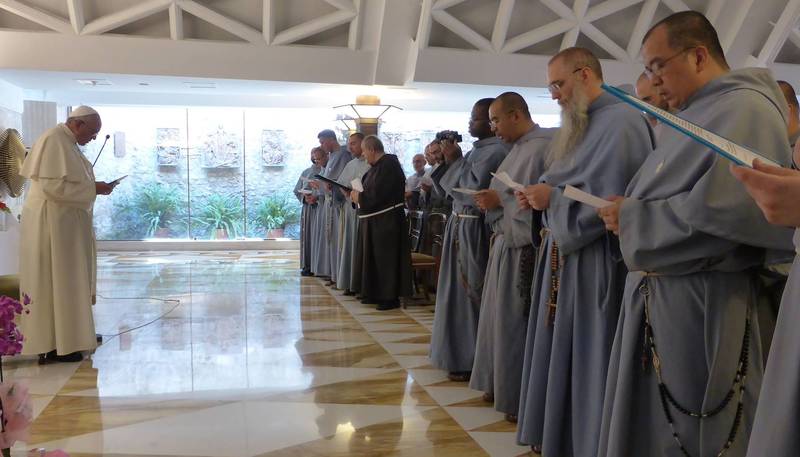
Pope Francis and Franciscans of the Immaculate
It seems that these days everyone wants to gripe and whine about the pope, bishops, and the synod on the family, the Traditional Latin Mass (TLM) or the Mass of Paul VI (Novus Ordo). Then there are such subjects as abortion, same-sex marriage, contraception, divorce, remarriage and Holy Communion and women’s ordination.
Yesterday, I saw another article claiming that Pope Francis has done great harm to Summorum Pontificum, the document written by Pope Benedict clarifying that the Tridentine form of the mass for the Roman Rite was changed a bit by Pope St. John XXIII, but never abrogated. The gist of this complaint is that allegedly Pope Francis told the Franciscan Friars of the Immaculate that they may not celebrate the Tridentine Form without asking for specific permission to do so. To some people, this is a form oppression and a violation of law.
To get past this point, let’s clarify that the Franciscans of the Immaculate were never founded to be a Traditional Latin Mass (TLM) community. When they were founded, the Mass of Paul VI or Novus Ordo was the ordinary form of the mass for the Latin Church. Secondly, Summorum Pontificum clearly states that the superior general alone can make rules about who and when the TLM is celebrated in public or in community, but he must make these rules in keeping with the proper laws of his institute. This means that he must look at the constitutions of his institute and see what they say about the older rite and the newer rite, if they say anything at all. In most cases the constitutions do not speak to this point, because they were written before this became a hot question. Therefore, there is nothing in proper law that allows a superior permission to make the Extraordinary Form of the mass (TLM) to become the norm for his community. The question needs to be put on the table to the community to vote on. Once the community votes on it, the Holy See must approve the change that is to be made to the constitutions.
Let’s remember that the Franciscans of the Immaculate, like any other religious community owe obedience to the Holy Father. At the end of the day, the Holy Father is the legitimate superior general of every institute in the Catholic Church, because he alone exercises universal jurisdiction. Therefore, we cannot accuse the pope of overstepping his boundaries or of abusing power. If you have the power to do something or to prohibit something and you make use of it, how can it be an abuse?
Some will argue that the pope cannot use his power to do harm. This is true. No one can use power to do harm. Power is given to us for the common good. There are times when we use power with the intention of doing something good and somewhere in the process something goes wrong and the end result hurts more than it helps. This was not the intention of the person exercising the power. This was the result of many random acts that were against the idea in the first place. In this case, one can say that the end result was that the lay faithful who were benefiting from the TLM celebrated by the priests of the Franciscans of the Immaculate no longer had that benefit. Obviously, they were hurt by Pope Francis’ decision to stop the TLM among the Franciscans of the Immaculate. Did the Pope intend to hurt these folks? I don’t think so. He intended to put out a fire within the Franciscans of the Immaculate.
This does not mean that the TLM is prohibited or that the Franciscans of the Immaculate are being suppressed. It means that people who had come to depend on the Franciscans of the Immaculate to provide a TLM mass have to look elsewhere, which is an inconvenience. In fairness to the Pope and to the friars, this congregation was never founded for the explicit purpose of celebrating the mass in the Extraordinary Form (TLM Form). The congregation’s mission is to walk the Gospel in the footsteps of St. Maximilian Kolbe and St. Francis of Assisi under the protection and patronage of the Immaculate.
Did something go wrong? Yes. I don’t know what went wrong. I’m not a member of that community. I can see what’s going wrong outside of the community. Pope Benedict XVI started an investigation into the Franciscans of the Immaculate, not Pope Francis. Pope Francis inherited it, but almost everyone blames Pope Francis for it. Like most popes, Pope Francis is not too enthusiastic about people using the mass for their political battles. Therefore he restricts the permission to use the Tridentine Form to those who have specific permission to use it. He never said that it could not be used. He said that one must ask first.
Whatever Summorum Pontificum says about what priest can celebrate the Extraordinary Form of the mass, we cannot forget that the Motu Proprio does not bind the pope, including the one who wrote it, much less the pope who succeeds him. He is free to abrogate it, edit it and interpret it. It is not up to us to tell the pope what he can or cannot do with law.
Boniface VIII in “Constit.” reminds us that the sovereign pontiff is the most fruitful source of . . . law; he can abrogate . . . legislate to the whole Church or part thereof, a country, or a given body of individuals . . . he is not legally obliged to obtain the consent of any other persons and his power is limited only by Divine law.
Another important point here is that this is a situation between a pope and a religious community of Pontifical Right. Meaning . . . that the pope is the highest ranking superior, above whom there is no appeal and who has absolute authority over the religious community. He need not speak ex cathedra to be obeyed. If we look at the writings of St. Francis, he promises obedience to the Bishop of Rome, commands that all the brothers obey him and his canonically elected successors for all time. In essence, Francis binds everyone to obey the pope, regardless of the matter involved, except sin. To put it more bluntly, it’s not for any of us, outside of the Franciscans of the Immaculate, to demand to know what happens within the community or to speak as if we had the authority to make a judgment on a situation that does not fall under our jurisdiction.
We must not lose sight of the fact that the good brothers have not asked us for our help, comments, opinions and interventions. These are well educated men, free to ask for help if they need it, and who have a good understanding of how the legal system in the Church works, should they choose to make use of it. Instead, it seems that they have chosen to apply one of our Seraphic Father’s admonitions.
The Lord says in the Gospel: he “that doth not renounce all that he possesses cannot be” a “disciple “and “he that will save his life, shall lose it.” That man leaves all he possesses and loses his body and his soul who abandons himself wholly to obedience in the hands of his superior, and whatever he does and says—provided he himself knows that what he does is good and not contrary to his [the superior’s] will—is true obedience. And if at times a subject sees things which would be better or more useful to his soul than those which the superior commands him, let him sacrifice his will to God, let him strive to fulfil the work enjoined by the superior. This is true and charitable obedience which is pleasing to God and to one’s neighbor.


 authority to make pronouncements to the rest of the Church. When they speak they sound intelligent, because they can use big words, throw around some citations from previous popes, councils and older catechisms and there are times when their arguments have some logic. To the average layman (not as in non-ordained, but as in newbie to Church politics) these voices can be very impressive and persuasive, to the point that these readers become talking boxes for the bloggers. You hear them repeat, verbatim, what a blogger has written. This is an interesting development, because the blogosphere seems to be giving birth to its own oral tradition within the Catholic Church and some people are beginning to take this tradition seriously.








 year in South Florida, with temperatures in the 40s.


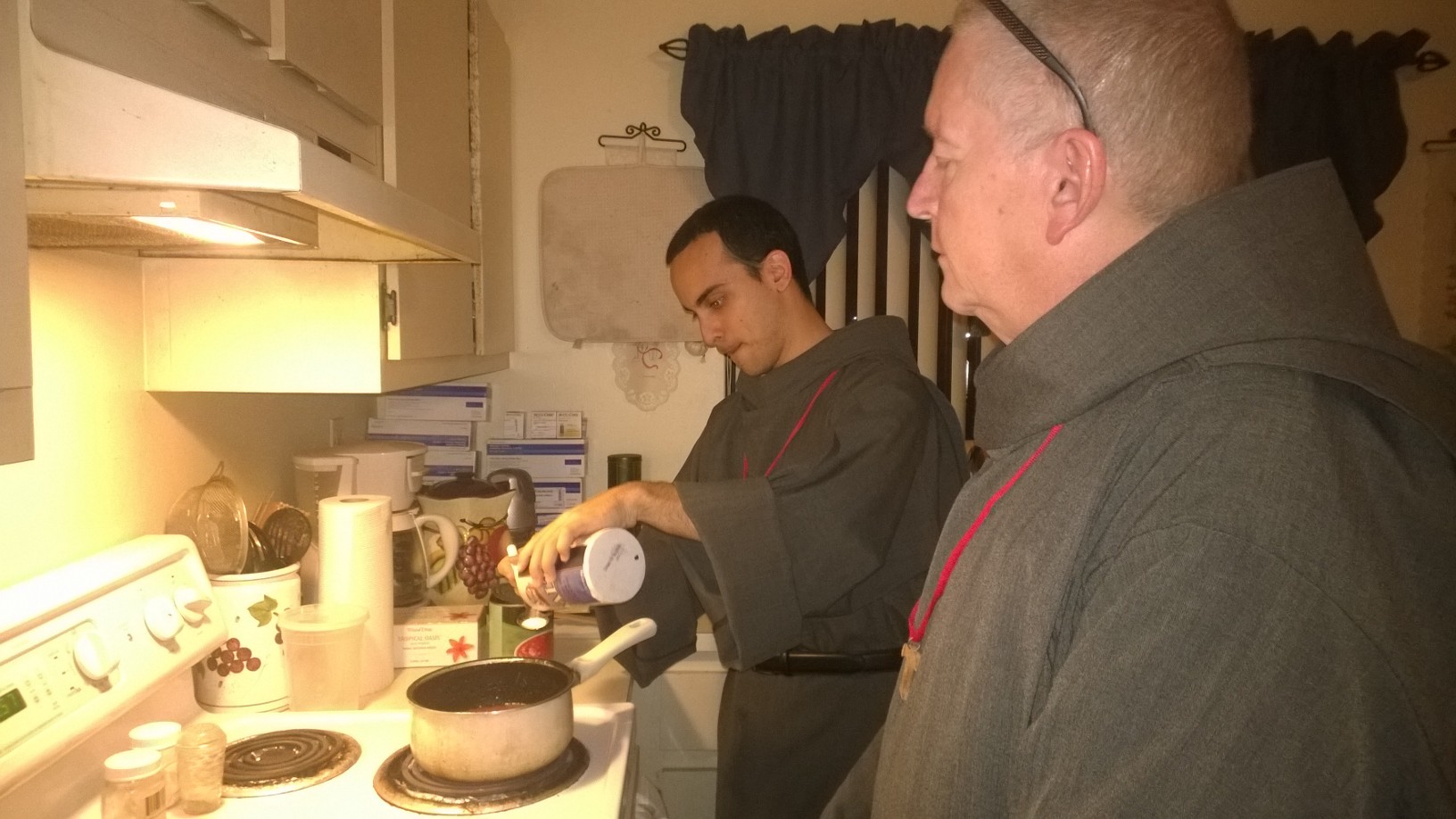
 f Life, wear a grey habit and work within and for the Archdiocese of Miami. What I didn’t know was that my friend worthy also lived in the Miami area and was carefully weighing everything I ever wrote. Even if I had known, it didn’t matter to me. Unless he’s in a crisis pregnancy, terminally ill, immigrant poor, or a person living with a disability he’s not in the target population whom we serve. There are many good laymen, priests, brothers and sisters in the Archdiocese who serve other populations.




 fidelity, while not seeking any other approval than that of the Lord, “also becomes a living memorial of Jesus’ way of living and acting as the Incarnate Word in relation to the Father and in relation to the brethren” (St. John Paul II).
 that grandparent that is no longer physically attractive and at times can be cranky. Just like Grandma’, she is beautiful inside and has much wisdom to pass on to us, if we open ourselves to receive it. Francis loves the Church, warts and all. He takes his sons and daughters into the heart of the Church, through example more than words. He teaches us to look beyond the surface and see the glory of the Church.
 . There were also brothers who fought his vision of the Gospel Life tooth and nail, to the point of being mean. But like all good little brothers, Francis loved them just the same. Little brothers can often become the most forgiving persons. Francis was the brother who always forgave.
 That’s why he wrote the admonitions. Why admonish those who need no admonishing? However, when one reads through the admonitions, his letters, his rules and his testament, he does not refer to a single person as a sinner, other than himself. He leaves that to God. In other words, St. Francis is a person who can teach us what belongs to God, what belongs to the Church, to the superior and to the individual. He does not cross those boundaries.



 3.
3. Franciscans of Life