UN MÉTODO DE ORACIÓN DE FRANCISCANOS POR LA VIDA


For English, click here

Esta mañana, tuve una cita médica. Estaba sentado en la sala de espera usando mi hábito de trabajo. Una mujer muy agradable se sentó a mi lado y me preguntó por mi ropa. Le dije que yo era un laico consagrado. Ella no entendía que cualquier persona que no es un diácono, un sacerdote o un obispo es un laico. Aunque se ha hecho alguna distinción entre el laicado universal y los consagrados. Éstos constituyen un cuerpo muy pequeño, pero especial dentro del cuerpo más grande de laicos.

Mientras la conversación continuaba, la amable señora me preguntó: “¿Rezan los hermanos?” Respondí con una sonrisa: “Espero que al menos la mitad de ellos lo hagan”.

Procedió a decir que no sabía cómo orar. Esa fue mi señal. Le pregunté si podía compartir un método muy sencillo que usan los Franciscanos Por la Vida. Se interesó y emocionó.

Nuestro método puede ser utilizado por cualquier persona. Empecé a usarlo hace muchos años y algunos hermanos aprendieron de mí; Pero no soy su dueño.

Primero: Empiece por encontrar el silencio interior. Si el entorno que te rodea es demasiado ruidoso, encuentra un lugar tranquilo. No siempre será una iglesia o capilla si no se puede llegar. Una vez que usted se habitúa a la oración, podrá ignorar el ruido del mundo, incluso si usted está en un partido de fútbol entre Roma y el Brasil, el juego más ruidoso a que he estado. No pude oír nada durante dos días.

Segundo: Díganse a ustedes mismos: “Recordemos que estamos en la santa presencia de Dios”. Incluso si somos sólo vosotros, todos estamos siempre en la santa presencia de Dios. Esto fue algo que San Juan Bautista de La Salle, fundador de los Hermanos Cristianos les enseñó a decir. Recordarme a mí mismo que estoy en la santa presencia de Dios es como abrir la puerta principal de una casa, mirando afuera y viendo hermosos campos verdes con flores, mariposas y una suave brisa. Me refiero a ella como mi “pequeño pedacito del cielo”.

Estas palabras van a desencadenar una respuesta diferente en cada persona. Lo más importante es la conciencia del OTRO. Lo escribí deliberadamente en mayúsculas. Si queremos orar, debemos ser conscientes que Dios es OTRO, no una cosa. Reconocer que hay alguien más grande a nuestro lado, es nuestro primer contacto con Dios en la oración. No hay nada místico aquí. Usted no ve ni oye nada. Es una conciencia de mi presencia ante la infinita ALTERIDAD de Dios.

Tercero: Comienza a hablar como usted habla con cualquier persona. Santa Teresa de Ávila nos enseñó que la oración es hablar a un amigo. Era famosa por sus charlas cortas y muy íntimas con Cristo. Hubo un momento en que tuvo un contratiempo y ella volteó los ojos hacia arriba y dijo: “Señor, no es de extrañar que no tengas muchos amigos.” En otra ocasión las cosas no iban muy bien con una nueva fundación de un monasterio. Una vez más, levantó los ojos y dijo: -¿Por qué me metiste en este lío? Soy sólo una vieja.” Estaba a final de sus cuarentas o principios de los cincuentas

Cuarto: Háblale a Dios acerca de todo lo que está pasando, Todo lo que ha sucedido, o algo que usted anticipa, incluso cosas buenas, como visitar a su familia en todo el país. Por supuesto, Dios sabe estas cosas. Pero hay un lado maternal en Dios. Las madres a menudo saben lo bueno y lo malo en la vida de sus hijos, antes de que se lo cuenten. Pero hay una experiencia de intimidad y amor cuando el niño le cuenta a mamá su historia en sus propias palabras. Dios se complace en escuchar nuestras palabras. La idea de que Dios se deleita escuchándome, me estimula a contarle todo en detalle, como si un estudiante de primer grado regresara de la escuela.

Quinto: Como cualquier otro Padre, Dios sabe lo que hemos hecho mal, antes de decir algo. Recuerdo haber entrado en una habitación y haber obtenido LA MIRADA de mi madre, seguido de: “¿Qué hiciste?”

Puede que te hayas alejado disfrazando la verdad o reteniendo la verdad de mamá, pero no puedes hacer eso con Dios. Este es el momento de hablar de mis faltas, debilidades, tentaciones y realmente decirle a Dios cómo me siento acerca de estas cosas. A veces, hago cosas que siento que están mal, pero no tengo ni idea de por qué me siento así. Otras veces hago algo que todo el mundo dice que está mal, y no me siento culpable. Hablo con Dios de lo que hice, Cómo me siento y le pido su ayuda para comprender la verdad del asunto. Dios no espera que tengamos todas las respuestas sobre el bien y el mal, el bien y el mal, arriba y abajo. Si ese fuera el caso, no tendríamos mucha necesidad de hablar con él en absoluto. Él sólo esperaría nuestro juicio final para interactuar con nosotros. Pero Dios nos conoce y nos ama. Quiere ayudar a despejar las telarañas en nuestras cabezas.

Sexto: Pídale a Dios las bendiciones que usted y el mundo necesitan. No trate de ser Dios y pretenda saber lo que todo el mundo necesita. “Por favor, haz que mi esposa se enfade menos”, o “Por favor, ayuda a mi padre qué está en el teatro de cirugía “. Debemos creer que Dios sabe lo que nosotros y otros necesitamos. Si alguien va a la cirugía, orar por un buen resultado. Si alguien está enojado, ore para que encuentre paz interior. Pero nunca se olvide de pedirle a Dios: “Danos las gracias que necesitamos para hacer lo correcto y expiar todo lo malo que hayamos hecho”.

Séptimo: Ahora es el momento de agradecer a Dios y decirle que nos pondremos en contacto más tarde en el día.  Observe que hay siete pasos. Piensa en los Siete Días de la Creación, las Siete Alegrías de María, las Siete Ultimas Palabras de Cristo. Momentos de gracia parecen venir en siete.

Published in: on August 23, 2017 at 5:12 PM  Leave a Comment  

FRANCISCANS OF LIFE’S METHOD OF PRAYER


Para Español Señale Aqui

This morning I had a doctor’s appointment. I was sitting in the waiting area wearing my work habit. A very nice woman sat next to me and asked me about my clothes. I told her that  I was a consecrated layman. She didn’t understand that anyone who is not a deacon, priest or bishop is a layman. Though some distinction has been made between the universal laity and consecrated men and women. These constitute a very small, but special body within the larger body of lay people.

As the conversation continued, the nice lady asked me, “Do brothers pray?” To which I responded, with a smile, “I hope at least half of them do so.”

She proceeded to say that she didn’t know how to pray. That was my sign. I asked her if I could share a very simple method that the Franciscans of Life use. She became very interested and excited.

Our method can be used by anyone. I started to use it many years ago and some brothers learned it from me; but I don’t own it.

First: Begin by finding interior silence. If the environment around you is too noisy, find a quiet place. It need not always be a church or chapel if you can’t get to one. Once you get into the habit of prayer, you will be able to shut out the noise of the world, even if you’re at a soccer game between Rome and Brazil, the noisiest game to which I have ever been. I couldn’t hear a thing for two days.

Second: Say to yourself, “Let us remember that we are in the holy presence of God.” Even if it’s just you, all of us are always in the holy presence of God. This was something that St. John Baptist de La Salle, founder of the Christian Brothers taught them to say. Reminding myself that I am in the holy presence of God is like opening the front door of a house, looking outside and seeing beautiful green fields with flowers, butterflies and a gentle breeze. I refer to it as my “tiny taste of heaven.”

These words are going to trigger a different response from each person. The most important thing is the awareness of the OTHER. I deliberately wrote it in upper case. If we want to pray, we must be aware of the OTHERNESS of God. Acknowledging that there is someone bigger with us, is our first contact with God in prayer. There is nothing mystical here. You don’t see or hear anything. It’s an awareness of my presence before God’s infinite OTHERNESS.

Third: Just begin to speak as you speak to anyone else. St. Teresa of Avila taught us that prayer is speaking to a friend. She was famous for her short and very intimate chats with Christ. There was a time when she had a mishap and she turned her eyes upward and said, “Lord, it’s no wonder you don’t have many friends.” On another occasion things were not  going very well with a new foundation of a monastery. Again, she raised her eyes and said, “Why did you get me into this mess? I’m only an old woman.” She may have been in her late 40s or early 50s.

Fourth: Tell God about everything that’s going on, anything that has happened, or something that you anticipate, even good things, like visiting your family across the country. Of course, God knows these things. But there is a maternal side to God. Mothers often know the good and the bad in their children’s lives, before they’re told about it. But there is an experience of intimacy and love when the child tells Mom his story in his own words. God delights in hearing our words. The idea that God delights hearing me, stimulates me to tell him everything in detail, like a first-grader coming home from school.

Fifth: Like any other parent, God knows what we’ve done wrong, before we say anything. I remember walking into a room and getting THE LOOK from my mother, followed by, “What did you do?” You may have gotten away disguising the truth or withholding the truth from Mom, but you can’t do that with God. This is the time to talk about my faults, weaknesses, temptations and really tell God how I feel about these things. Sometimes, I do things that I feel are wrong, but I have no idea why I feel that way. Other times I do something that everyone says is wrong, and I don’t feel guilty. I talk to God about what I did, how I feel and I ask for his help to understand the truth of the matter. God does not expect us to have all the answers about good and evil, right and wrong, up and down. If that were the case, we wouldn’t have much need to talk to him at all. He would just wait until our final judgment to interact with us. But God knows us and loves us. He wants to help clear out the cobwebs in our heads.

Sixth: Ask God for the blessings that you and the world need. Don’t try to be God and pretend to know what everyone needs. “Please make my wife less angry,” or “Please get my father through surgery.“ We must believe that God knows what we and others need. If someone is going for surgery, pray for a good outcome. If someone is angry, pray that he may find interior peace. But never forget to ask God, “Give us whatever graces we need to do the right thing and to atone for any wrong that we have done.”

Seventh: Now it’s time to thank God and to tell him that we’ll be in touch later in the day. Notice that there are seven steps. Think of the Seven days of Creation, the Seven Joys of Mary, the Seven Last Words of Christ. Moments of grace seem to come in sevens.


THE WITNESS OF MAXIMILIAN KOLBE


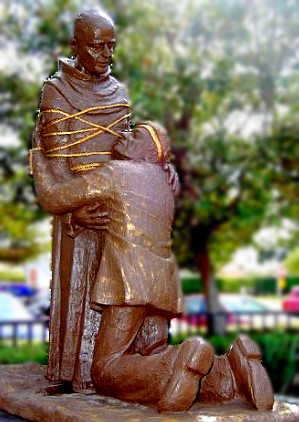
Statue at St. Maximilian Kolbe parish, sculpted by Sr. Margaret Beaudette, S.C. – (c) Jim Davis, Florida Catholic

Those who have heard the name Maximilian Kolbe, immediately remember the friar who gave his life in Auschwitz.  He took the place of an innocent man whom the Nazis wanted to execute as an “example” to others of what happens when prisoners escape.  Nazi logic is as dull as the edge of a butter knife.

They believed that a prisoner had escaped, because they could not find him.  They decided to make an example to discourage escaping; but their victim was an innocent man who had not attempted escape.

Maximilian contemplated this insane scenario.  Insane, because there was no logic to the proposed execution. This irrational sentencing to death of an innocent man was unlikely to discourage any further attempts to escape.  On the contrary, it had the potential to encourage more attempts.  Those present understood that their chances of survival were probably greater if they tried to escape.  If they did get caught and killed by the guards, their death had some meaning.  To be executed to deter further attempts to escape, when one had never attempted to do so, was irrational.

The man whom they chose to execute was a husband and a father.  He cried, not for his life, but for that of his family.  An intact family would soon be deprived of its father, because a group of men with no moral conscience, no sensitivity and no respect for human life were about “console” their wounded pride, because they failed to capture the escaped convict.  The execution of this innocent man was really a ruthless act to appease their disturbed pride.

“Jesus stepped forward… ‘I am he…let these go’ ” (Jn 18)

God had graced Maximilian with intelligence, a conscience, courage, love for all men, a spirit of detachment from all things of this world, and an unwavering trust in the Immaculate.  The Holy Spirit energized the graces that the Father had poured into Maximilian through the cross of His son.  There was no need for time to consider the consequences. Maximilian stepped forward and volunteered to replace the innocent husband and father.

This is God’s moment of glory in the life of St. Maximilian Kolbe, for all to see.  In an instant that required no time and no consideration of the facts, the power of grace, as strong as the wind of a hurricane and burning like flairs from the sun jolted Maximilian.  The rest was up to his will.  He could choose to ignore grace or surrender to the supremacy and wonder of God, knowing that his earthly life was about to come to a cruel and unjustifiable end; but a new life was about to begin.

Maximilian freely chose martyrdom.  But martyrdom is not the choice of a godless man.  God offers martyrdom to those who have lived their lives in His grace and are spiritually solid enough to tolerate martyrdom. They love as they have been loved.

“The light shines in the darkness, and the darkness has not overcome it.” (Jn 1) – Foto (c) ANSA

We honor Maximilian Kolbe and we look to him as a model, not as a hero who gave his life for another man.  Such heroism happens more often than we think.  But Maximilian’s choice was much more than an impulse to protect a life.  Maximilian’s choice was free cooperation with the Love who had loved him first.

Unless we are aware of the presence of the Beloved in our lives and return love for love, we will never have the courage to freely lay down our lives for pure love.

Such courage comes from grace that is not merited by man, but freely offered by God to some souls.  The soul becomes aware of the rule of grace. At the right moment in time, that soul freely and lovingly places itself under the shield of grace and accepts martyrdom.  For this, man must live in the presence of Christ.  Always linked to him through the Immaculate.

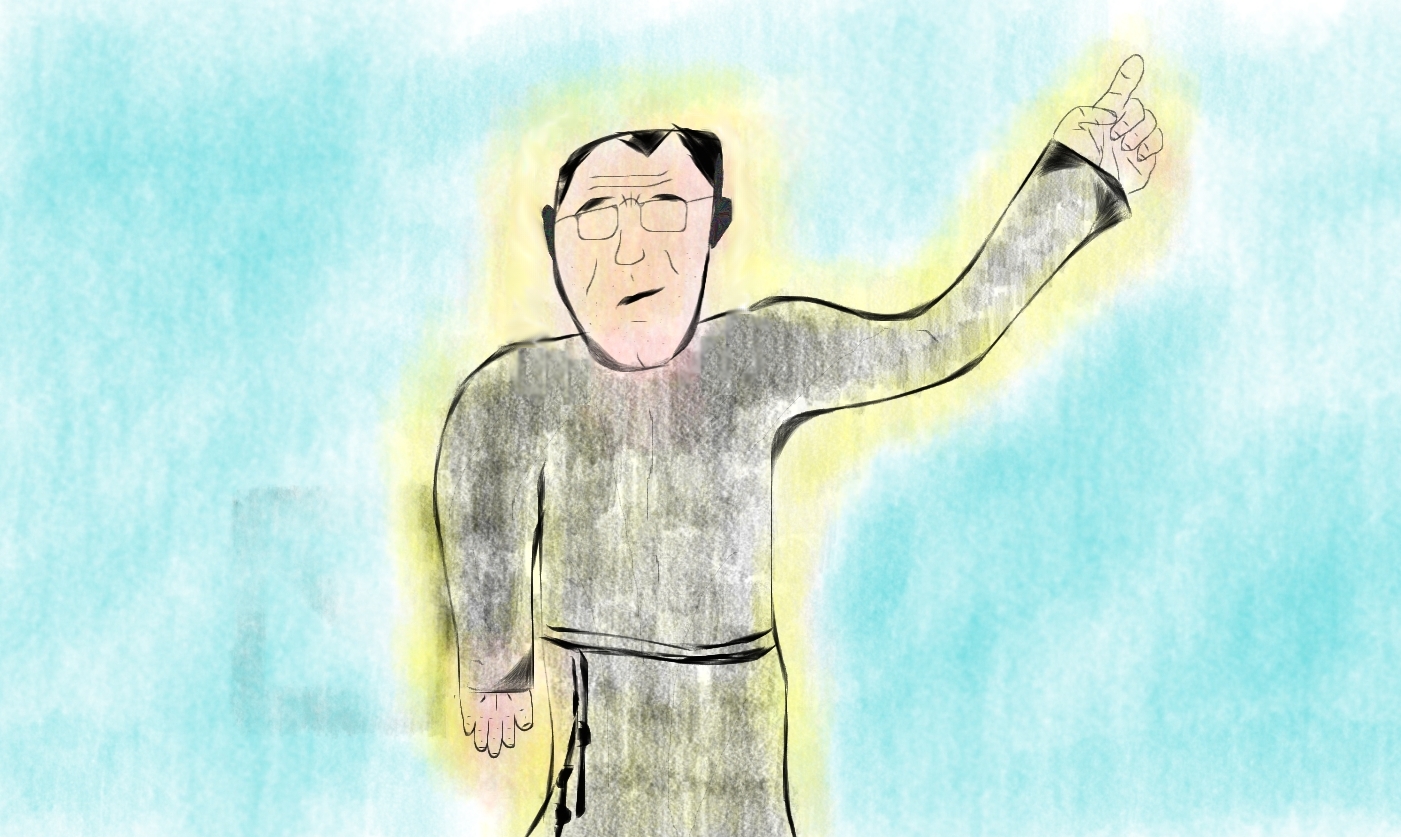
“The conflict with hell cannot be engaged by men…the Immaculate alone has from God the promise of victory over Satan. Assumed into Heaven, the Mother of God now requires our cooperation. She seeks souls who will consecrate themselves entirely to her, wh o will become in her hands effective instruments for the defeat of Satan and the spreading of the Kingdom of God upon Earth.” – St. Maximilian Kolbe. [drawing (c) Franciscans of Life]

Saint Clare and the Monstrance


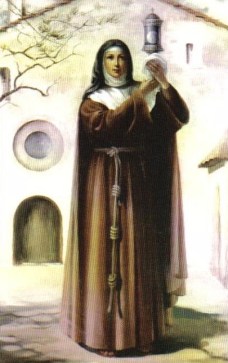
ST CLAREOne the 11th of August, the Church remembers St. Clare of Assisi, the first woman to follow Francis of Assisi.  We consider her the spiritual mother of the Franciscan family.
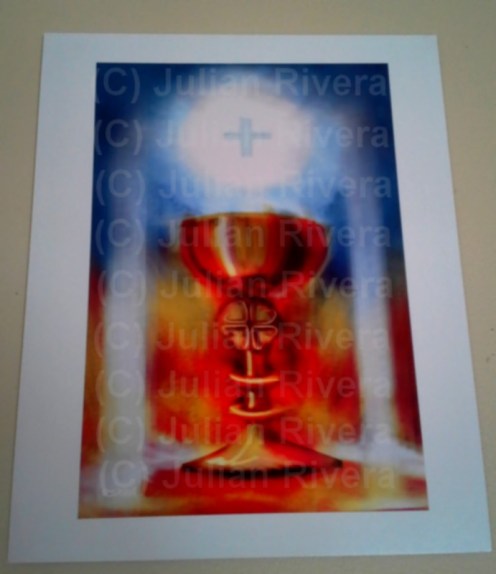
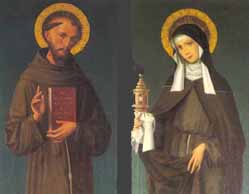
We picture St. Clare holding a monstrance.  The reason being that when Assisi was under siege, St. Clare protected her monastery from the invaders by holding up the ciborium with the Blessed Sacrament.  St. Clare never saw a monstrance.  The first monstrance does not appear until the 16th century.  Clare lived during the 13th century.

But this story tells us a great deal about this woman and about her strong Eucharistic Spirituality.  This event, her writings and her long hours of adoration of the Blessed Sacrament from her sickbed, through a small window that allowed her to see the tabernacle in the monastery chapel, reveal a woman in love with Jesus Christ and to whom Christ was a real person physically present.

We’re often pensive about our favorite athlete, artist, actor, musician, political figure or even a friend or family member.  They are present in our mind, even if we never meet them.

Julian_Corpus_Christi

Digital Artist – Julian Rivera

For information on how to acquire a copy of this beautiful poster, contact us at franciscansoflife@gmail.com

Jesus, on the other hand, is often forgotten, even by Catholics who believe that he is physically, substantially and spiritually present in the Holy Eucharist.  The Apostles handed down to us what they received from Jesus himself, his body and blood under the appearance of bread and wine, but truly different from bread and wine in substance.  The substance of what we see is Christ, alive and physically present.  In every tabernacle around the world, Jesus Christ is physically and wholly present.  Clare knew this.

St. Francis of Assisi often said that he saw nothing of the physical presence of Christ, in this world, except in the Eucharist.  He reminded his sons and daughters to adore Christ in the Blessed Sacrament francis and clareand to behave with grave reverence in the presence of a tabernacle.

We don’t know at what point in her life Clare’s faith in the true and proximate presence of Christ matured.  We know that she paid close attention to everything that Francis taught.  Francis’ admonitions regarding the awe that is due to the Blessed Sacrament and the unquestioning conviction that Christ is with us at all times and in all places, were not lost on Clare.

Many may ask, what did Clare achieve? Clare entered the Monastery of San Damiano at the age of 18 and never left it, not even upon her death.  Her body is still there.

Clare was not the foundress of great works of charity, education or a spiritual teacher as were Catherine, Teresa of Avila, Hildegard, and Therese.  However, she left us something that many Catholics overlook.

She left us an example of faith in the physical presence of Jesus Christ in the Eucharist.  She of one who, like the Virgin Mary, has no doubts about God’s promises.

I will not leave you as orphans; I will come to you. Before long, the world will not see me anymore, but you will see me. Because I live, you also will live,  (Jn 14:18-19).

CHALICE 2

Copyright: Franciscans of Life

The life of Clare of Assisi challenges every Catholic to seek Christ in their lives, in the Holy Eucharist and everywhere.  When we can’t go to Christ, he comes to us.  We must make him the first love of our lives.

Everyone we love, we love because God loved us first.  Without Christ’s love, spouses wouldn’t love each other, parents and children would be simply housemates, and siblings may or may not be friends.   I can love because, Jesus Christ, who is Love made flesh, is closer than my deepest thoughts. His love for me pours out to others.

Clare understood this and shared it with the world.  It’s her legacy to the Church of her time and to the Church today.  In her letters to St. Agnes of Prague, a nun of her order, Clare wrote

Look upon Him Who became contemptible for you, and follow Him, making yourself contemptible in this world for Him.  And then, Place your mind before the mirror of eternity!  Place your soul in the brilliance of glory!  Place your heart in the figure of the divine substance.

12313767_1724552867778905_4437807418574257125_n

Today, it seems that taking life is easier and requires less moral reflection than bringing a life into the world.  We have forgotten the sanctity of life; but God never forgets.  His

divine nature co-exists with human nature in Jesus Christ, ever present among us.  Let us look upon him and place our desires and needs in his divine substance.

As we continue our mission to proclaim the Gospel of Life, we must always remember Jesus.  The Second Person of the Most Holy Trinity became human, died, rose from the dead and remains with us.   Like Clare, trust Him to defeat every form of evil.


A “Historical” Mass to “Look Back in order to Move Forward”


On Tuesday, August 15 we celebrate the Solemnity of the Assumption of the Blessed Virgin Mary.

The previous day (8/14) is the feast of our Patron St. Maximilian Kolbe, who was killed and cremated at Auschwitz on the eve of the Assumption.

In order to venerate him and Our Lady as a group, the Franciscans of Life made arrangements to attend a special event to which our community has been invited.

Gesu Church, the Jesuit parish in Downtown Miami, will be celebrating a Solemn High Mass in the “Extraordinary Form of the Roman Rite”, on Tuesday 8/15 at 7:15 PM. Our community was invited by the celebrant, Fr. Christian Saenz S.J.

The Celebrant and the Parish

Fr. Saenz, S.J. – (C) Natalia Selin

Fr. Saenz studied at Belen, joined the Society of Jesus in 2002 and was ordained by H.E. Archbishop Wenski in 2011. He currently resides in Rome, where he is pursuing graduate studies.


Gesu Church is the most ancient Catholic church in the Archdiocese of Miami. In fact, it pre-dates the establishment of the Archdiocese itself. Until 1952, the entire State was under the jurisdiction of the Diocese of St. Augustine, and it was only in 1958 that H.E. Coleman Carroll was installed as the first bishop of the newly created Diocese of Miami. It was declared an Archdiocese by 1968.

Stations of the Cross and Stained-Glass Windows at Gesu Church – (C) TripAdvisor

The Church, now a masterpiece of architecture with beautiful stained-glass windows, a majestic organ, and a beautiful Main Altar entirely in marble, was initially built in wood in 1896 by the Jesuits and was known as Holy Name Parish. A new church was built on land donated by Mr. Henry Flagler and by 1925 Gesu Parish was built as it is today. In 1974 it was added to the United States Register of Historic Places.

Front of the Church of Gesu – (C) Natalia Selin

The Liturgy

The liturgy we will attend is the old form of the mass, which Pope Benedict called “extraordinary form” of the Roman Rite. This liturgy is the “father” of our current “ordinary form” of the Roman Rite, which was reformed by request of the Second Vatican Council under the authority of Blessed Paul VI.

There are many elements worthy of historical admiration and sacred respect in this form of the mass. For example, the exclusive use of the Latin language, once considered the only liturgical language in the West, as well as the use of Chant and the Organ.

Some elements will be easily recognizable as they carry (though simplified) into the current liturgy.

Some elements will seem new because they did not carry into the new liturgy or became optional. For example: the celebrant faces the Main Altar throughout most of the celebration and prays most of the mass in a low voice (“vox secreta”); alongside the priest and deacon there will be a “subdeacon” who will be tasked with handing the paten and other items to the deacon (the order of the subdeacon was abolished); before mass the celebrant will pray “at the foot of the altar” a psalm and an “act of contrition”; at the end of the mass the celebrant will read the “Last Gospel” (which is actually the first chapter of the Gospel of John); there is a special procession and ritual for the proclamation of the Gospel; there are no Prayers of the Faithful.

Priest (top right), Deacon (top left), Subdeacon (back, holding Paten with Humeral Veil) – (C) Natalia Selin

Some significant variations include: the Sign of Peace is exchanged only between the clerics; the Our Father is prayed aloud only by the priest with the exception of the very last sentence (“et libera nos a malo”, “and deliver us from evil”); the faithful are expected (but not obligated!) to receive Communion on the tongue and by kneeling on the communion rail.

One must attend such a liturgy with an open mindset of gratitude to the Church and to the Holy Spirit for:

(a) unifying the liturgy in the West through the Roman Rite after the Council of Trent (a work which is partially due to the Franciscans, to whom the Roman Rite was first entrusted and who spread it across Europe), placing an emphasis on the transcendence of God and Heaven;

(b) inspiring the Church to adapt to “unity in diversity” by carrying out a reform of the Roman Rite that takes into consideration the cultures, languages, and musical instruments of different peoples who are “one in the Spirit” just like the liturgy is the “One Sacrifice perpetuated throughout time and space”, thus emphasizing the immanence of the God-Man who becomes “all things to all men” and of the People who are “His body”.

It is very unfortunate that a lot of politics – especially in the United States – have mixed with the celebration and attendance of what is called simply “the TLM”. For this reason we do not discuss it often in our blog, though we have touched upon the topic and upon Traditionalist issues from time to time.

One question, however, is worth addressing: what is the official relationship of the Franciscans of Life with the “Traditional Latin Mass”?

First and foremost: we have a historical connection. The Roman Missal was preferred by the Council of Trent “thanks” to the early Franciscans who received it from the Holy Father and made it widespread throughout the Catholic world during 300 years, even though our communities always celebrated it in their own Franciscan way (called the Seraphic Mass) until after the Second Vatican Council. And it is worth of mention that the American Franciscan Liturgical Commission awaits approval from the Holy See for the new Roman-Seraphic Missal adjusted to our own liturgical calendar, never abolished.

St. Pio, OFM Cap., celebrating the Seraphic Mass (moment of the consecration of the host)

Second: our Constitutions define very clearly our brothers’ relationship with the Holy Sacrifice of the Mass.

“The Franciscans of Life are to attend mass together and in the Ordinary Form.

With the permission of the superior, they may attend and celebrate mass in the Extraordinary Form or invite a priest to celebrate it for them, as long as the harmony of the house is not affected.

However, the extraordinary should never become the ordinary.

If the Extraordinary Form is to be attended or used, let it be on a day when there is not a conflict with the two calendars so as to avoid missing a feast that is part of our Franciscan patrimony.”

Why would the harmony of the house be affected? Because, unfortunately, there are two common errors in which the inexperienced and unlearned fall:

(1) to consider the old Latin Mass a museum piece or something for nostalgic folks

(2) to consider the old Latin Mass as the highest expression/best mass/true mass/immemorial mass of the ages/mass of the saints.

Both positions are wrong and lead to a schismatic mindset, that is, a mindset of division and mutual rejection.

In 2000 years the Liturgy of the Church of our Lord has undergone a process of development which Pope Benedict describes as a hermeneutics of continuity. Each apostle handed down what he received, but in slightly different ways. A Coptic mass and a Syro-Malabar mass look nothing alike, yet one was handed down by St. Mark and the other by St. Thomas, and both are equally Catholic!

There are dozens of different ways to celebrate the mass in the East as well as in the West. Some religious orders also have their own missals and liturgical traditions.

After attending the TLM on August 15, whether one leaves mass inspired or bored, moved or untouched, one must keep in mind that the old rite was characterized by grandeur, rigidity, and a definite separation between the clergy and the laity. This was a result of 1500 years of historical development within the Western culture and also a response of the Counter-Reformation of Trent to the over-simplifications, customizations, and blending of roles of early Protestant sects.

After the two World Wars the world entered a new phase and the Second Vatican Council was inspired by God to “look back in order to move forward”.

New documents were unveiled which described the liturgy of the early Church (thus the Prayer of the Faithful were reintroduced, alongside the Sign of Peace).

Elements that were added over time and became redundant were removed (such as the reading of the Last Gospel after the mass has technically ended, or the tracing of many signs of the cross and continuous genuflecting).

A more active participation of the people, now mostly literate and with a Bible in their house, was promoted by celebrating the mass in the language of the people.

The “common priesthood” of all the baptized was emphasized by allowing the priest to celebrate mass facing the congregation (although this was always part of the liturgy, since even in the TLM the priest says “Orate fratres, ut meum ac vestrum sacrificium acceptabile faciat apud Deum”, “Pray, brothers and sisters, that my sacrifice and yours may be acceptable to God”).

While preserving intact and unblemished the holiness of the ministerial priesthood of clerics, the Church did away with roles such as Minor Orders and instead brought forth the laity into the sanctuary through Instituted Lectors and Acolytes, as well as Extraordinary Ministers (women lectors, altar boys and girls, lay ministers of Holy Communion) whose function is to support the priest and deacon when necessary.

Ordinary Form of the Roman Rite celebrated by H.E. Thomas Wenski, Archbishop of Miami – (c) The Florida Catholic

It would be foolish to believe that the development of the liturgy has come to an end. The hermeneutics of continuity will not come to a halt until Christ returns in glory. The Ordinary and Extraordinary forms of the Roman Rite will continue to influence each other, as will the Eastern and Western rites, and the secular and religious liturgies.

It is a great blessing to be able to “look back in order to move forward” and it is to be hoped that our participation will become more active in the Ordinary Form having “met its parents” and realizing that in this day and age we are called to be people open and receptive to the Holy Spirit “qui ubi vult, spirat” – “that blows wherever and however it wants”.

In the union of the Spirit, rigidity becomes unnecessary, and we are free to let the Spirit fill us with joy that at times expresses itself even loudly and in a way that appears confusing (didn’t King David in all his might dance before the Ark? Weren’t the Apostles called “drunk” after Pentecost, as they praised and worshiped as the Spirit guided them?)

On the other hand, today’s rituals are clearly defined by the General Instruction of the Roman Missal (GIRM) and they provide many options to the celebrant for many occasions, thus avoiding the need for novelties, local customs, and ad-libbing – all of which were quite common during the first 1500 years of liturgical development.

This is a splendid opportunity for two traditions, Jesuit and Franciscan, to celebrate together the Assumption of Our Lady using the liturgical form that we once had in common.

Published in: on August 5, 2017 at 2:26 AM  Comments (2)