“Walk in my presence . . . ,” Brother begins his journey


The journey of a consecrated brother in the Franciscans of Life has several steps.  At the beginning they seem to move very quickly and then they slowly settle down.  That’s because the early steps are short.  As the child learns to walk, he takes wider steps.

Let’s follow the journey of Br. Bernardo.  It began at Baptism when his parents and godparents promised to raise him in the Catholic faith and he was washed clean of Original Sin by the waters of Baptism and initiated into the Catholic Church.  He would later make his First Holy Communion and then be confirmed, concluding his initiation into the faith.

But God does not stop working with us on the day of our Confirmation.  On that day, He is finished with the initial part of the process.  Then began the next step.  Like any other man, Bernardo had to find his place in the Church.  After a few years involved in campus ministry and debating Traditionalist points on Catholic Answers Forums, he met the Franciscans of Life.  This dialogue/debate between Bernardo and Br. Jay went from 2012 to the September 2013.  It was almost one year.

Br. Jay invited Bernardo to attend a workshop on the Church’s teachings on the life issues with an introduction to Project Joseph.

This is the young man who entered the door on June 14, 2013 at 9:00 AM.  He was very friendly, but reserved and very guarded.  Almost wondering, “What’s a nice boy like me doing in a place like this?”

That didn’t last very long.  Bernardo can’t keep quiet more than 20 minutes at a time and remaining distant is against his nature.  This is a man who is naturally oriented toward others.  This became obvious very quickly, especially as he and Brother Christopher Thomas enjoyed some coffee and donut.

But God was not finished.  Later, Brother Jay would ask Bernardo to visit a family meeting with the Franciscans of Life.  When the meeting ended, he was excited and happy, like a kid who has just been told that he got an A on a math exam.  He continued to attend the family meetings.WP_20140825_066

On August 23, 2014, Brother Jay decided to risk it and invited Bernardo to enter the aspirancy program.  Brother still had reservations.  But he put it all in the hands of the Immaculate.   On the 24th of August, Bernardo accepted the invitation and was received as an aspirant on August 25, 2014.

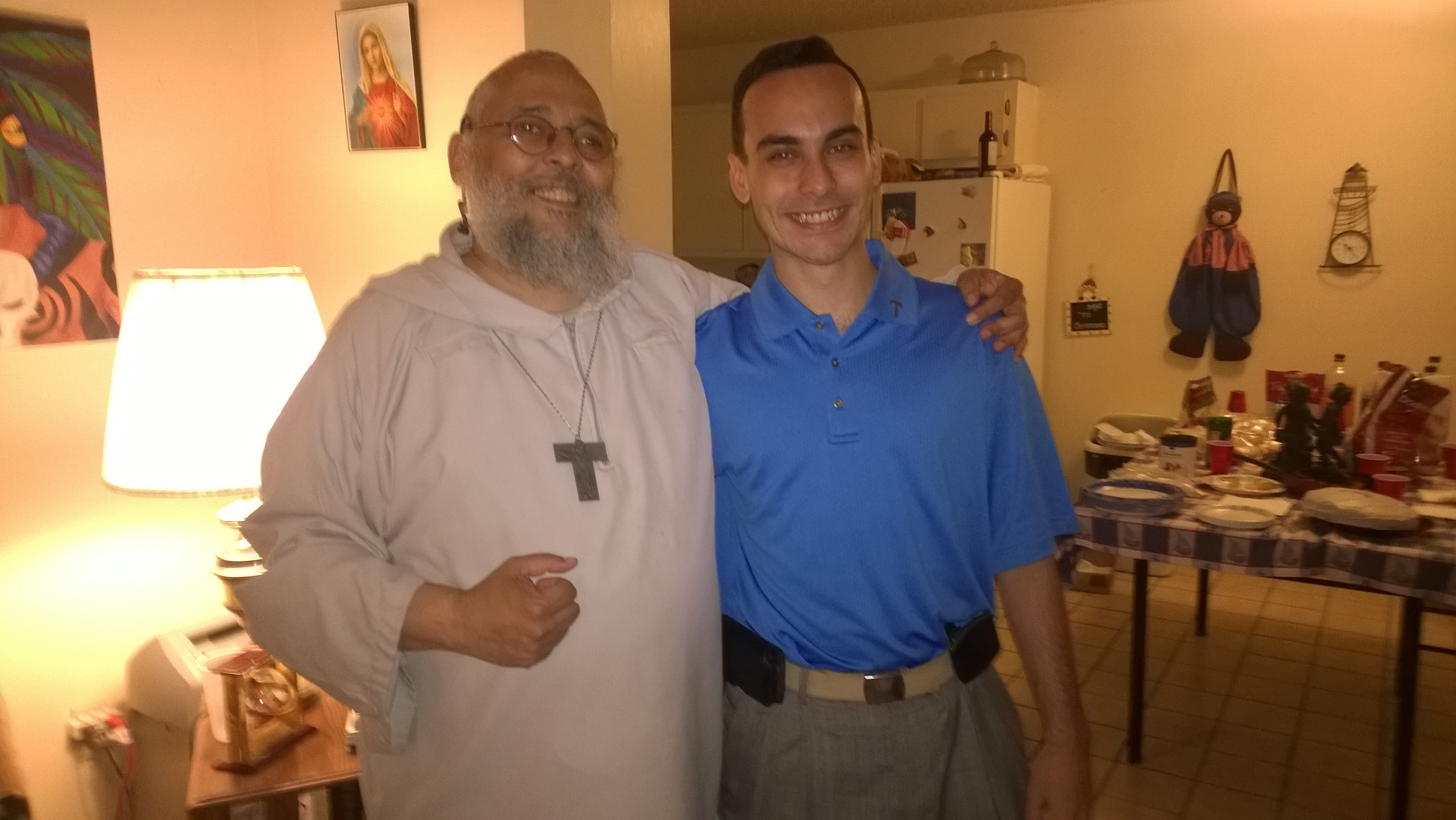
The aspirants receive a white shirt and a Tau pin that they wear on their collar

WP_20140825_081On October 27, 2014, Brother Jay found himself at prayer in front of the Immaculate.  As usual, he prayed for all of his brothers, secular and consecrated; aspirants, postulants, novices and professed.  He was very tired and his eyes started to close.  As if in  a state between asleep and awake he clearly saw Bernardo’s face.

“Is that whom you want me to call for you,” Brother Jay asked the Immaculate.  “But Mother, there are some complications, because he’s a doctoral student and I don’t yet know his family,” Brother Jay told the Immaculate.  “Please give me a sign that I’m understanding you correctly.”

Suddenly, the sleepiness vanished and Brother Jay started to laugh.  He was not sure what was going to happen next, but he was sure of one thing.  He had a message to deliver for the Immaculate.  It didn’t make a difference whether Bernardo believed it or not.  Brother never promised the Immaculate and she never demanded that Bernardo would believe the message.  He was to deliver the invitation to enter the Franciscans of Life.  The  Immaculate had already placed a strategy in Brother Jay’s mind how Bernardo would be a postulant and finish his degree.  On October 29, 2014, Brother Jay delivered the message and the plan that the Immaculate had put into his mind.  In less than 24 hours, Bernardo accepted the invitation.
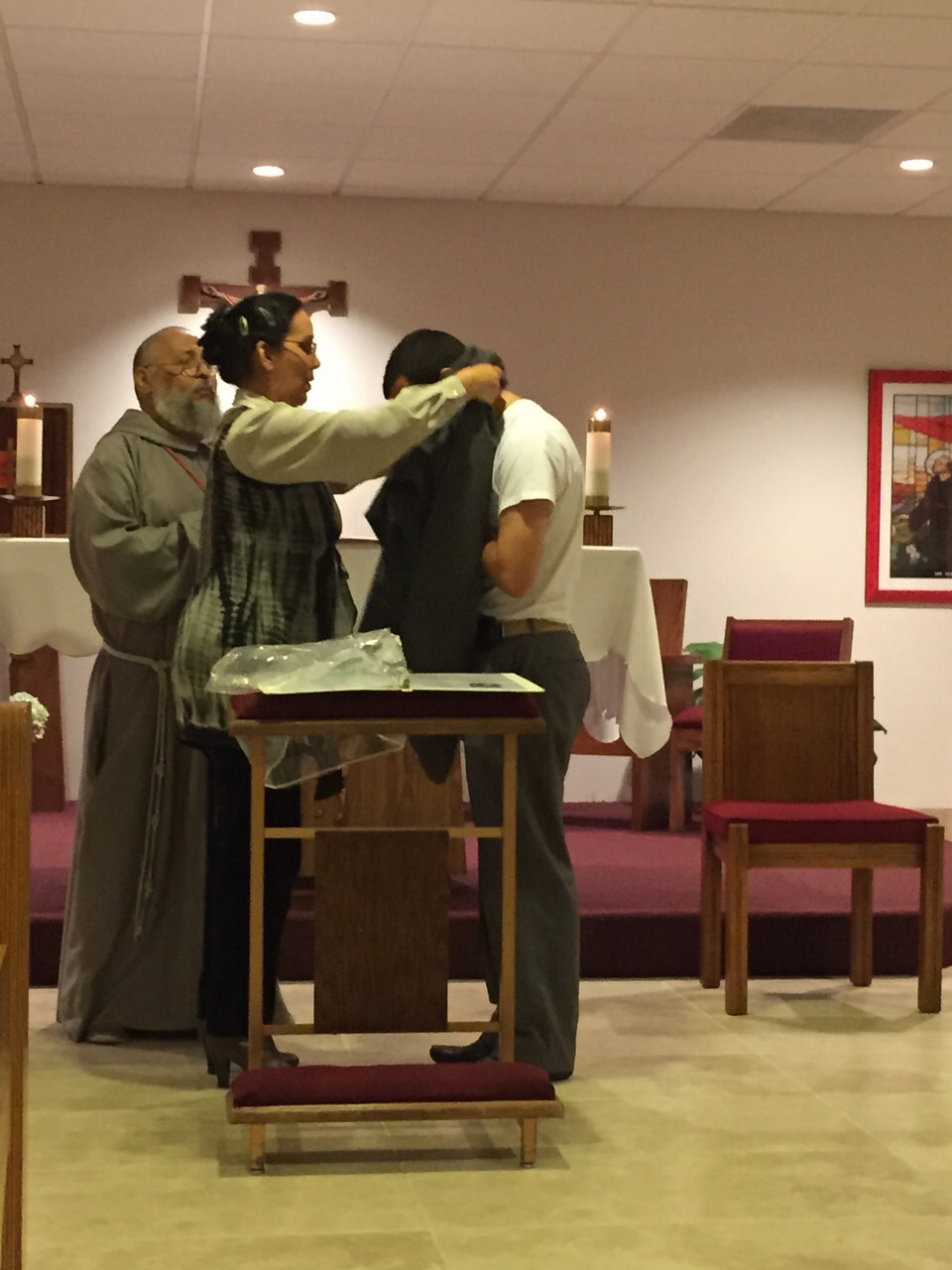
After consulting with the brothers, the date was set.  Bernardo would be invested in the seraphic robe on November 17, 2014 the Feast of St. Elizabeth of Hungary, patroness of the Brothers and Sisters of Penance, whose rule the Franciscans of Life follow.  Brothers have to be invested in the name they received at baptism, when they become novices, a new name is assigned to them.  That evening, he became a Student Brother, in the FFV.  Assisting in the investiture was Mrs. Angela,  Bernardo’s mother and Brother Christopher Thomas, whom Bernardo had chosen as his sponsor and witness.

The habit and all the pieces come in a plastic bag.  Brother Chris was holding the bag, handing Mrs. Torres one piece at a time.  When he handed her the Seraphic Tunic she said, “Que emoción,” which Spanish means “I’m 009so moved.”  

There is no such thing as an investiture without comic relief.  We had to take off Bernardo’s shirt to throw the tunic over his head.  But Bernardo just stood there as his mother and one of us fiddled with the tiny buttons on his shirt.  Finally, Brother Jay said, “Oh for goodness sake.  You can help us, you know.”  The buttons were tiny.

But all worked out well.  At the end of the investiture, Brother, his mother, the brothers and some of his friends who attended took pictures and offered Brother their best wishes.
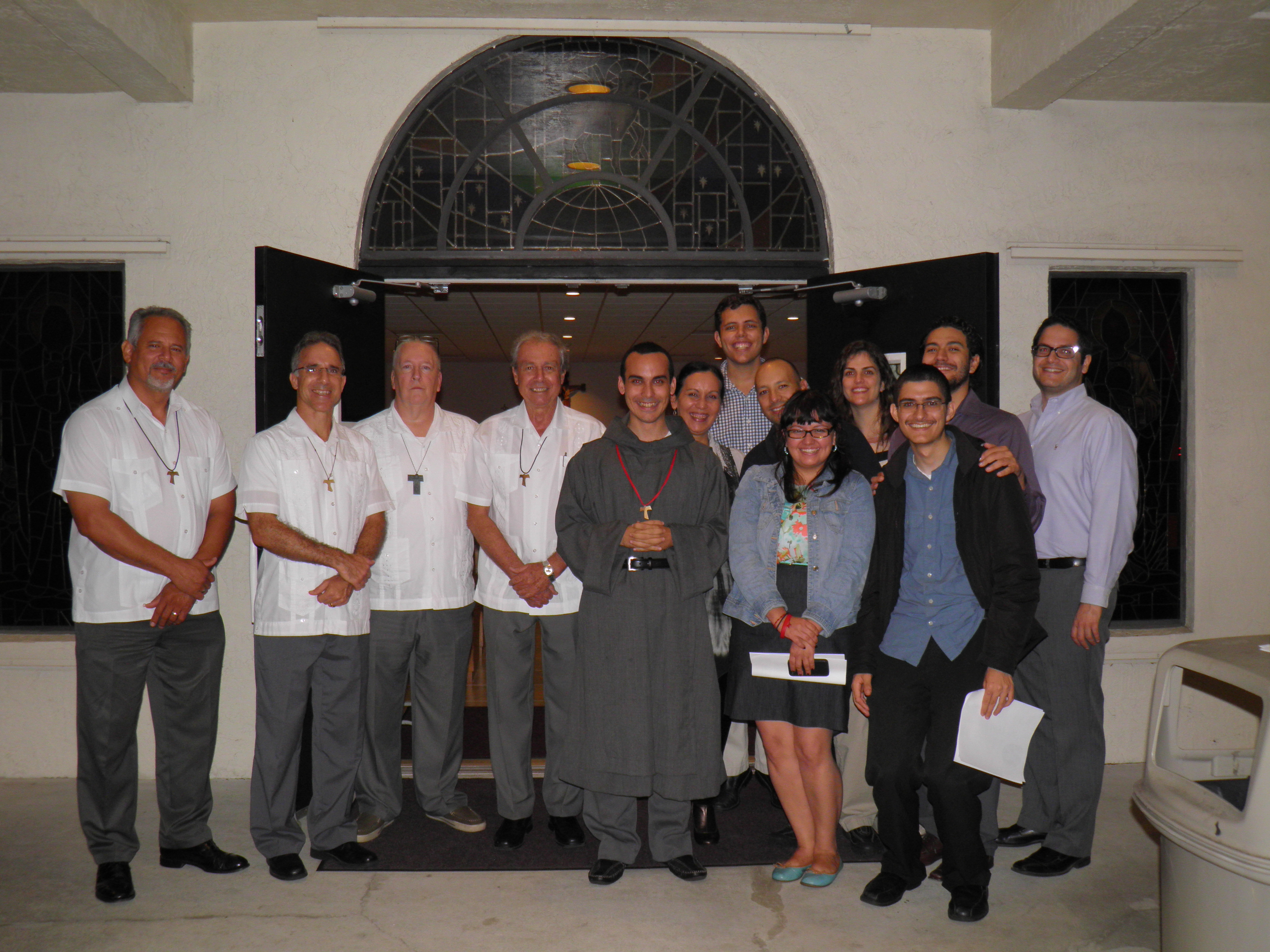
One thing that the new postulant has to be able to do, besides dress himself is to explain each piece of his habit.  The grey was chosen because it was the original color worn by St. Francis and the early brothers.  The tunic stops at midcalf, because that how many Italian peasants wore them in the 13th century.  The cowl (hood) was worn for warmth and the scapular of Our  Lady we have added over the years in honor of the Immaculate who appeared to St. Simon Stock wearing the clothes of a peasant woman, undyed brown wool for her tunic and apron (scapular) and undyed white wool for the mantle.

The postulant’s habit is held together by a leather belt as a reminder that St. Francis also started his journey wearing a leather belt, before he gave it up for a piece of rope.  The cord is received when one enters the novitiate.

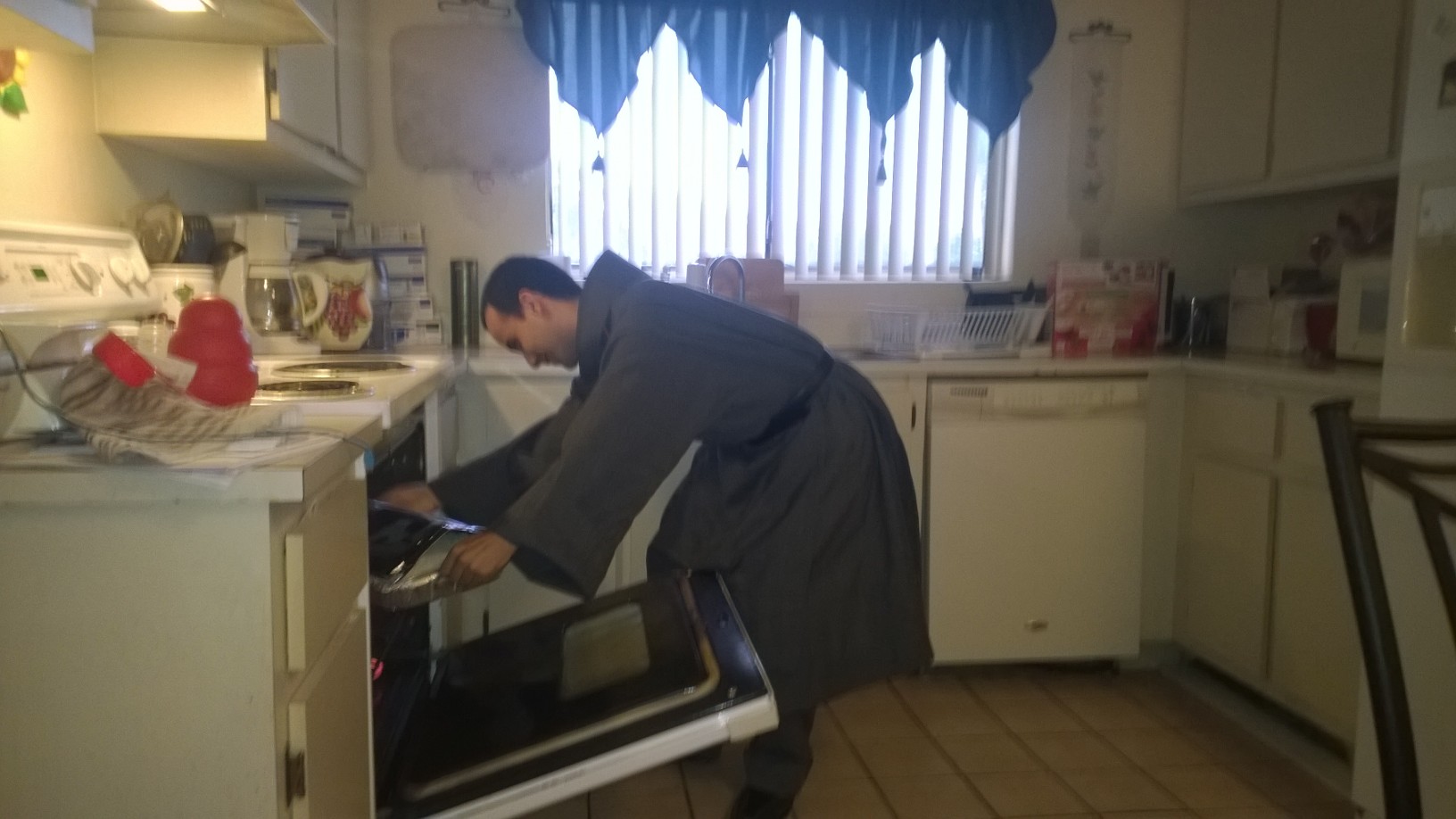
Over the heart, every Franciscan of Life wears the Tau just as St. Francis drew it on his habit when he first learned of its meaning.  Postulants and novices wear a wooden Tau, while professed wear a bronze Tau.  The red cord that holds the Tau in place reminds us of the Passion of Christ to which we have a special devotion.  Finally, there are things to do around the house.  This postulant’s first assignment was to learn how to cook.

Each step is recorded in our family’s chronicles and witnessed by two people other than the superior.  Bernardo had chosen Brother Chris as one of his witnesses, Brother Jay chose Bernardo’s mother to be her son’s second witness, something that does not happen too often. The journey of a new Franciscan of Life only begins here.  There is still much to learn and many steps to be walked.  There is a one year novitiate and at least three years of temporary vows.

You too can walk this path.  Think about it.014
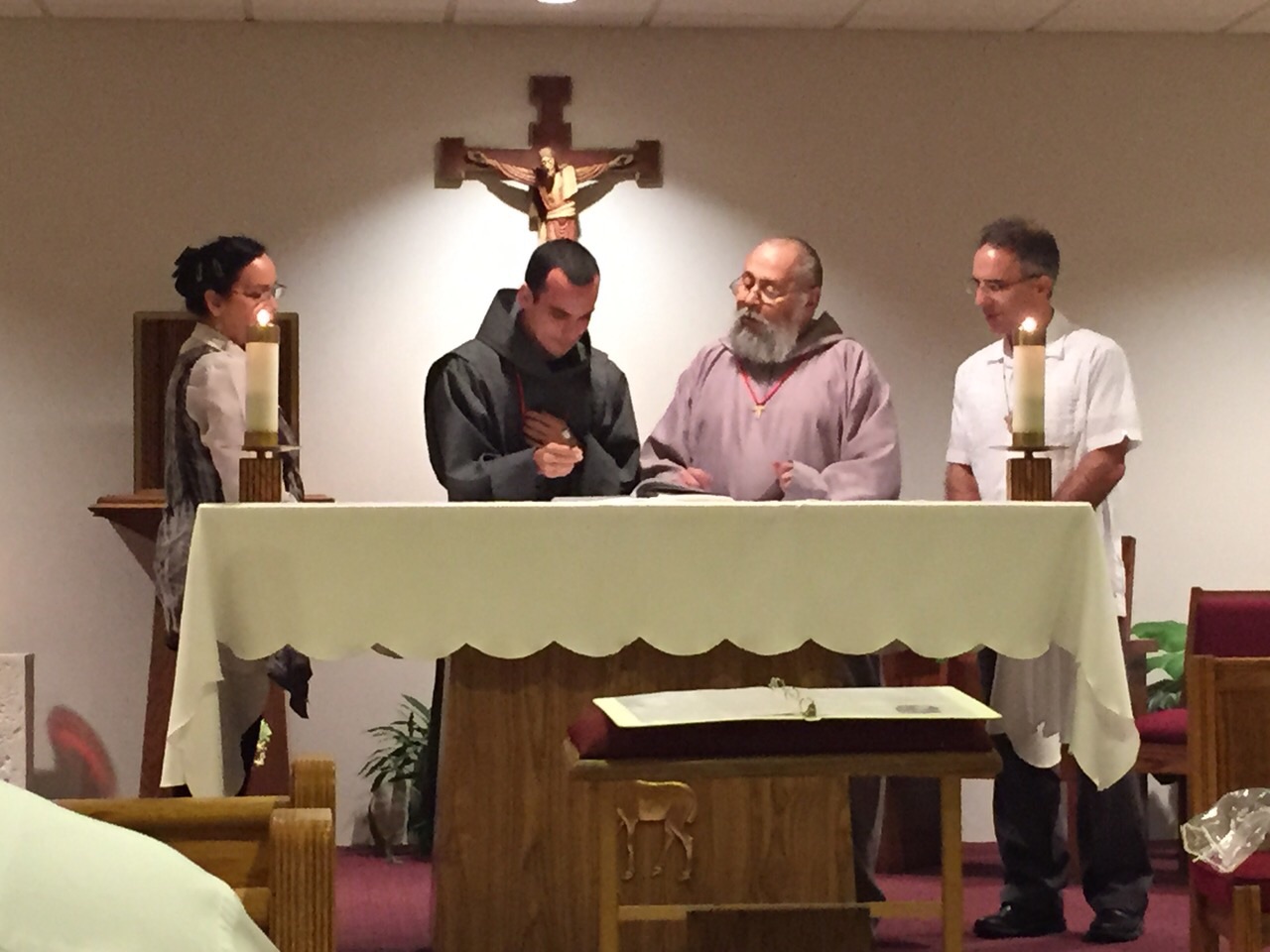
Enjoy the pictures.

Let's see if the oven is ready.

Let’s see if the oven is ready.

WP_20141201_005

Making Mom’s sauce — “Where is she when I need her?”

Figuring out how to cook a precooked lasagna

Figuring out how to cook a precooked lasagna

Getting the lasgna ready for the oven.

Getting the lasgna ready for the oven.

Parents and God: friends or foes?


This week, I’ve had the privilege of working with many parents and their children.  When you work in the field of evangelization, you get to meet many families.  I consider it pretty special.  I always walk away feeling that I have exchanged gifts.  It can be an individual member of a family or an entire family who gives me a gift and to whom I give a gift.

For the sake of privacy and because it would be silly to give so many details, I’m going to combine all of my families into three groups.

GROUP I:

I received a letter from someone whom I do not know.  I have never met this person or any member of her family.  It was a lovely letter.

Brother JR, I just wanted to thank you – you were so instrumental in our family’s conversion five years ago. I spent many long hours reading your articles, which were always gentle and full of the beauty of the faith. For that, for helping us know the beauty of the Catholic Church, I am forever grateful.

God bless you, and please know you’re in my prayers.

This letter moved me a great deal.  The Holy Spirit can use anything and anyone to save.  The key is to be aware of that one is an instrument, not the solution to a problem and certainly not God.  Messages like this help us.

My articles are not written with children in mind.  They’re written for adults.  This means that an adult in the family read the articles and shared it with spouse and children.  This is a parent who has found a means to evangelize the family, a means that works for that family.  This is the duty of parents, to bring their families to the faith.

GROUP II:

The other case is also a letter representative of how other parents think.  I have the honor of helping some men and women discern their vocation.  I like to think of it as walking alongside them.  At the end of the day, God does the calling and they respond.  I’m just there to make sure that the person is paying attention.

In vocation discernment, I not only walk with the inquirer, but I often walk with the parents, if they allow it.

During the walk, I have received many positive and holy reactions from parents, especially those parents who have given God a hearing.  I call it a hearing, because they have sought me out or invited me to their home so as to understand what it is that God is asking of them and their sons.  I’m not God and I’m not the son.  I’m the middleman.  I get the opportunity to have some wonderful conversations with parents about consecrated life, marriage, Holy Orders, and parenting.   I received a letter from a parent that really speaks for the several parents with whom I’ve spoken and edited it for privacy and brevity.

Dear Br. Jay,

God’s greatest gifts to a couple are their children.  It is with great joy and love for God that we support our son’s aspiration to become a religious brother or any other vocation he chooses.  Our son . . . and our family are blessed to have you in our lives.  May our God of love and peace keep you healthy to continue to serve Him.

With much love and admiration,

I had to share this message, because I’ve heard this from other parents.  They understand that their children are a gift.  They understand that giving their son or daughter license to respond to God’s plan for his or her life is an act of love for God and the child.  They understand that having a guide is a blessing that God gives to the family, to the son or daughter and to the guide.  We’re all blessed that God has called us to cooperate with Him in His plan for the salvation of this soul.  They have understood the most important part of all.  God has a plan for every human being who is conceived.

“Before I formed you in the womb I knew you, and before you were born I consecrated you; I appointed you a prophet to the nations.”  Jer 1:5

One’s vocation in life has already been written in God’s heart before one ever existed.  All one has to do is follow what God puts before you in the present moment.  He takes care of the rest.

GROUP III:

I also have had experience with a third group of families who struggle with the idea of a vocation to the priesthood and to the consecrated life.  The reasons for their struggles can be many.  I believe that the bottom line is that they are worried about their children’s happiness.  But here is where faith should enter the picture.

One’s happiness is not dependent on the parent.  A man’s happiness is dependent on the choices he makes.  If he chooses to cooperate with God’s plan for his life, he will be happy.  If he chooses some other plan (no matter how noble), he may as well sign his own death sentence.  There is no happiness outside of God’s plan for you.

In these families, parents want to take charge and direct the son or daughter in whatever direction they believes is best for the adult child.  There can be validity to this.  If my son or daughter were dating someone with a criminal background and were talking marriage, I have a duty to warn my child.  At the end of the day, it is my child who consents to the marriage or not.  It is not I who consent.  My duty before God and child is to guide.  Guidance is not the same as control, manipulation, placing temptations before our children to get them to change their minds (See Thomas Aquinas), nor is it the same as commanding, threatening or using guilt.

The Catechism of the Catholic Church tells us that children living at home have to submit to their parents, meaning to their rules, because it’s the parents’ home.  They do not have to submit to that which is not beneficial to their soul.

As they grow up, children should continue to respect their parents. They should anticipate their wishes, willingly seek their advice, and accept their just admonitions. Obedience toward parents ceases with the emancipation of the children; not so respect, which is always owed to them. This respect has its roots in the fear of God, one of the gifts of the Holy Spirit. (Catechism of the Catholic Church, 2217).

Our faith also tells us that

“Parents must regard their children as children of God and respect them as human persons. Showing themselves obedient to the will of the Father in heaven, they educate their children to fulfill God’s law,(Catechism of the Catholic Church, 2222)

And finally, our faith tells us,

“Parents should respect and encourage their children’s vocations. They should remember and teach that the first calling of the Christian is to follow Jesus (Catechism of the Catholic Church, 2253).

Occasionally, the adult child is up against a parent that seems to have forgotten this.  If I could send a message to parents it would be very simple.

Man was created to cooperate with God, not compete with Him.  To compete with God is to place oneself and one’s child on a slippery slope.  Don’t do it.  You may regret it.  You never know the long-term damage that you may do to your child’s soul.

Some important points to remember.

First, for the parent, competing with God is contrary to the vocation of parenting.  It raises the question, where is God in this picture?

Therefore, life must be treated with the greatest reverence.  Creating obstacles that interfere with the development of a person’s life according to God’s plan runs the risk of violating the sanctity of that person’s life.

I encourage all parents on this slope to step back.  We don’t have to agree with our children’s choices of a vocation.  Our daughter can bring home the last man on earth whom we would pick for her husband; but if there is no moral impediment and he makes her happy, I have to trust that God loves me and loves my child.

Second, for the child, one may never yield to the will of another, when that will is in conflict with God’s plan.  

This includes other people as well, not just parents.  It’s not a license to rebel against parents and follow others down the wrong path.

God makes His plans pretty clear through people, prayer, scripture, sacraments, and events in our lives.  Love of parents is binding until death; but love of God is the first and greatest commandment and it does not end at death.  We are called to love God for eternity.

We too must trust that even if our vocational choice causes our parents some grief, God loves our parents more than we do.  He will give them what they need.  We can never give our parents what God can give them.  We need to move on and give to God what He asks and take what He gives.  Sometimes, the grief is part of God’s plan.  There is such a thing as redemptive suffering.

Father Mitch Pacwa tells the story of how his father swore that he would never speak to him again and would disown him if he joined the Jesuits.  Mother Angelica told the story of how she had to run away from home to join the Poor Clares, because her mother would not hear of it.  I know that Mother Angelica’s mother eventually softened and actually entered the community.  I don’t know if Mr. Pacwa ever made peace with his son.  These two people are examples of a man and a woman who would not stand on the slippery slope with their parents, no matter how much they loved them.  Regardless of how much or how little they understood God’s plan for their lives, they knew that they had to follow the lead that God was giving them.  God would unwrap the rest with time.

If you keep another person company on a slippery slope, because it will make them happy, you may want to ask yourself the question that Christ asked St. Francis.  “Is it better to serve the Master or the servant?”

We must love and assist our parents in every way we can.  But we must always serve the Master first.  When we do, He will give us the means to honor our father and mother.  Was Mary abandoned by Christ?  Yet Christ said,

“Here are my mother and my brothers!  For whoever does the will of my Father in heaven is my brother and sister and mother.” (Matt 12:49-50)

God is both merciful and just.  He will have mercy on those who live according to His plan.  Beware of God’s justice.  It is not God who punishes.  God’s justice is an act of love.  He allows us to live and die with the consequences of our choices.

Jesus said, “Amen, I say to you, there is no one who has given up house or brothers or sisters or mother or father or children or lands for my sake and for the sake of the gospel 30 who will not receive a hundred times more now in this present age: houses and brothers and sisters and mothers and children and lands, with persecutions, and eternal life in the age to come. (Mark 10:29-30)

God created families, parents and children.  When he did so, he had a plan for each member of the family.  None of us can presume to love our parents, spouses, or children more than God loves them.  All of us must see our families as a gift that is part a plan in the mind of God.  We have to allow God to unfold that plan little by little.  As He unfolds it, He also gives us the resources to love each family member even more than we do  now.  In the meantime, we follow the lead that he places before us.  If parents and children make an honest mistake, God will help us find our way.

St. John XXIII said, “Follow the signs of the times.”


Handcuffing God and Gagging Mom? Good luck!


The more that I think about it, the more convinced I become that my mother and God were Jeannie, Amanda, Aunt Nette, & Grandmavery close to each other.  Of course, she’s been deceased for over a decade.  How close they are is no longer a question.  She was a very good woman, though we did not always think so when she put her foot down.  In any case, let’s get back to what Mom and God had in common.  One can’t handcuff either of them and they both insist on having the last word.

A few years ago, I met a young man on Catholic Answers Forum (CAF).  He was a revert to the faith.  Like many reverts and converts his zeal was sometimes very harsh and gave little or no credit to the rest of us foolish mortals who remained with the Catholic Church from before Vatican II to the present moment.

Somewhere along the line, I let it drop that I am a Franciscan oFRANCIS AND LEPER 2f Life, wear a grey habit and work within and for the Archdiocese of Miami.  What I didn’t know was that my friend worthy also lived in the Miami area and was carefully weighing everything I ever wrote.  Even if I had known, it didn’t matter to me.  Unless he’s in a crisis pregnancy, terminally ill, immigrant poor, or a person living with a disability he’s not in the target population whom we serve.  There are many good laymen, priests, brothers and sisters in the Archdiocese who serve other populations.


In 2013, the Archdiocese of Miami held a synod.  I had the honor of being asked to serve on the one of the teams.  It was a wonderful experience for me.  When the first task of the synod was done, that phase was closed out with a special assembly and liturgy.  Some people from campus ministry invited my young friend to the closing ceremonies of the synod.

Somehow, in a crowd of over 1,000 people, he spotted Brother Christopher Thomas, put two and two together and figured out that Chris is a Franciscan Brother of Life.  He followed us

Br. Christopher Thomas, FFV

Br. Christopher Thomas, FFV

out of the hotel into the parking garage and shouted out, “Which one of you is JReducation?”  I think he was a little surprised when I raised my hand.  I don’t remember if he actually introduced himself other than say that he knew me from CAF.  To be honest, I only got a glimpse of him as he ran back into the building.

However, since God and my Mom won’t be handcuffed and they must have the last word, I would soon be speaking to this young man again, and again, and again.  I began to see the seeds of a vocation to the Franciscans of Life.  I kept inviting him to return and return he did; but hedragged his feet.  For a while I considered buying him a horse similar to that of St. Paul.  Everyone saw the Franciscan in him, except him. fall-off-horse

Finally, after several months of looking at us, hehas applied to and been accepted to begin postulancy with the Franciscans of Life as a consecrated celibate brother.  Let’s not all get up and cheer at the same time.  The road ahead is long.  It takes six years to become a clockperpetually professed Franciscan of Life.  You see, God does not operate on our schedule, won’t speak when we say so, and certainly is not under our control.

In my mind, it’s easy to understand God when I think about my mom.  When something needed to happen, she would make it happen.  You couldn’t handcuff the lady. And when you needed to get a message, she’d make sure you heard it.  There was no gagging her.  What you did with the gift was entirely up to you and so it is with God.  He will not be gagged or handcuffed.

However, you will never be forced to follow.  You will be invited.  The response is in your heart.

Published in: on October 29, 2014 at 1:01 AM  Leave a Comment  

What’s the IQ required to enter heaven?


The great feast of All Saints is just around the corner. I use to think that All Saints was a catch all day that the Church created to cover herself in case those non-canonized saints got upset.  I don’t know at what point in time it dawned on me that the Feast of All Saints is really not about the saints themselves, but about the universal call to sanctity.Francis and lepers

There are only 365 days in a calendar year.  There is no way that we can venerate every canonized saint in one year’s time, much less learn very much about all of them.  But then again, it about more than veneration.  It’s about imitation.  Over the centuries thousands of men and women have lived lives of heroic virtue.  They have gone over and beyond what is usual and customary in the spiritual life.  We’re talking about the practice of charity, prayer, penance, humility, docility to the Holy Spirit, desire for God, detachment from the things of this world, service to voiceless, forgiveness, purity and many other virtues that I can’t list here, because we just don’t have the luxury to do so.  But you get the picture.

Last Monday, I was leading the discussion at our weekly formation class.   I mentioned that St. Thomas Aquinas grappled with the Immaculate Conception.  One of our brothers had a knee-jerk reaction.  “How could a saint grapple with a dogma?  Especially Aquinas?”

It’s impoHow-The-Human-Nervous-System-Worksrtant to remember that the saints grapple with the same questions about human existence, the meaning of life and the nature of God as the rest of us.  For some of them, these become lifelong areas of study and reflection, such as Aquinas and Bonaventure.  Others don’t even know the question, much less the answer and they’re not particularly interested.  They know God is very real and that their vocation is to reach out to Him through the practice of virtue, someone like Mother Teresa.

In fact, the Feast of All Saints should help us to see the simplicity of God and God’s love for us.  Among the saints we find geniuses and fools, very charismaticMother Teresa people and others who were more distant, some very blunt and some very diplomatic, some clowns and others who were almost too intense.  It was how they used the few or the many gifts that they had to practice perfect charity that got them to heaven.  Genius is not a prerequisite for heaven.  If that were the case, Peter would never have become Prince of the Apostles and would still be sitting on some dock on the Sea of Galilee.

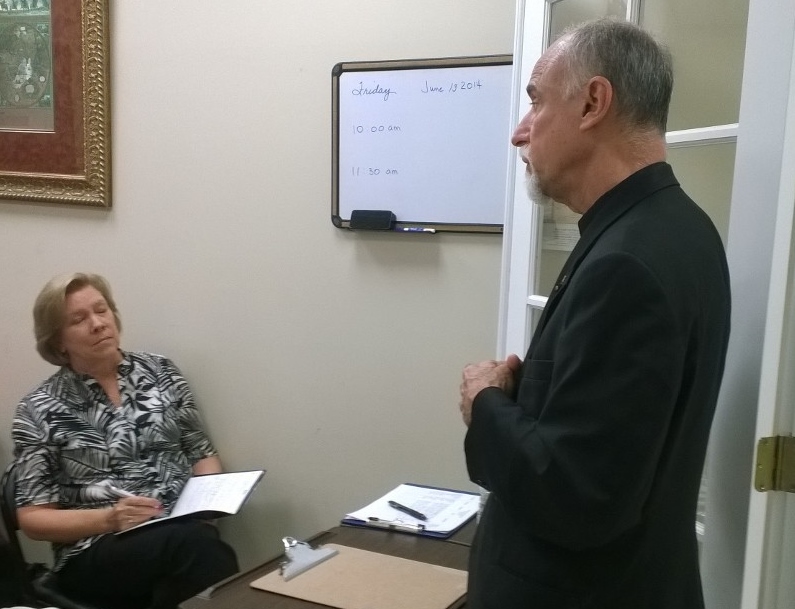
As much as some people want to admire St. Paul for being a no-nonsense preacher and teacher, I’m not so sure that he was as harsh as people paint him out to be.  He may have been a straight shooter.  We see this in his exchange with Peter, but he was also a respectful marksman.  During his entire discourse he refers to Peter as Cephas (Rock).  He never fails to acknowledge Simon’s office in the College of the Apostles.  This is not so typical of one who is allegedly a tough guy.  The tough guy as we understand it is the one who is in your face.  That certainly was not Paul.  He was frank, but he sincerely loved Peter and respected him.  What we see in the story is an event about love, not rebellion.  Love is the highest of the virtues.  Paul love Peter, love the Gentiles and loved the universal Church.  He sets out to protect what he loves by pointing to what he sees as wrong.  But he does so with great respect.

The febaby dohast of all Saints calls us to remember that we have been created for love, nothing more is needed.  You can convert a wise man into a saint and you may never convert a saint into a wise man.  But that’s OK.  The vocation to sanctity is a call to the perfection of love.  That’s what we celebrate November 1.  The God who created us out of love, calls us to share in His love for all eternity.  We can begin today.  You don’t need a high IQ to love.

Published in: on October 29, 2014 at 12:39 AM  Leave a Comment  

I’m over here . . .


Archbishop Thomas Wenski celebrates Mass for Nascent LifeThere are many things about my life, apostolate and role in my community that I love.  But I believe the one thing that I love the most is the many interesting questions that people ask me, not to mention the fact that the people are equally interesting.

In discussing life’s choices with people, I often hear the word “hurt”.  Many conscientious people are fearful of hurting others by their choices, especially their parents and siblings.  This is laudable.  We must always avoid intentionally doing something that will harm another person, be it a parent or a stranger. However, we must be very careful here.

There are two key words there, “intentional” and “harm”.  When harm is intentional, a person knows that this particular evil choice will do harm to another person and he goes forward with it.  This does not mean that good choices never cause pain.  They often do.  But the choice remains good.  One has a moral duty to choose the good and avoid evil.  When there are two goods to be chosen, one has a moral duty to choose the higher good, if there is freedom to do so.

Let’s apply this to vocation.  A vocation is a call from God to man.  God calls man to one of several states in life:  marriage, holy orders, or some form of consecrated life.  These are all good, because they are all from God and lead back to God.  However, they don’t lead  everyone back to God.  If someone forces himself into a marriage to please another person, it is very difficult to find a path to God in a marriage where one is responding to the wishes of another and not to a call from God.

The same holds true the other way around.  One may walk away from a call from God to please another person, because we don’t want to cause pain.  Let’s assume that all things point to the consecrated life or to Holy Orders.  One’s heart is already there.  Along come a parent or sibling, and one holds back from responding to God’s call so as not to cause this other person pain.  What has one done?

In effect, one has inverted the order of love.  The Commandment is very clear.  “Love God above all things and your neighbor as yourself.”  In choosing to avoid the higher good so as not to hurt the other person, we have placed that person above God and brought God down to our level.  We have no problems sacrificing neither ourselves, nor God in this case.  We just don’t want to sacrifice the other.  We have assigned the highest place to the neighbor and the second place to God alongside ourselves. 

No human being has the right to claim God’s place in our hearts and in our choices.  Nor do we have the right to assign God’s place to another, no matter how much we love that person.  There are some things that God wants us to do for others and some things that He reserves for Himself as the Lord and Giver of life.

Let’s remember, when discerning God’s will for our lives, the answer is always in the order of love.  The first place belongs to God.  We respond by doing that which pleases God first and neighbor second. It always pleases God that we make every attempt to serve and please our  neighbor, but never at His expense.  To do so would be a sin against justice.  God does have rights.  Therefore, he has first claim on our lives, whether we’re speaking about parents and children, husbands and wives, or brothers and sisters.  None of these have rights that trump God’s right to our love and surrender.  If anyone of them claim what is rightfully God’s, it is rightful to resist.

We may never do anyone intentional harm.  Intentional harm is an avoidable act that will hurt the other person .  Following God’s will is never to be avoided.  How do we know when we’re following God’s will?

First, there is knowledge.  We know that something is good and pleasing to God.  Our faith enlightens our knowledge.

Second, there is peace.  Even though we know that some tears will be shed, we know that we can place the situation in God’s hands and that in His eternal time, He will comfort those who mourn and reward the generous.

Third, we know that those who truly love us will not grieve forever.  As they realize that we are happy and that we are where we belong, they will be happy.

You cannot love another person and not be happy when he’s happy.  That’s not love.  It’s selfishness.  To cave into selfishness is to cave to sin.  Be it our selfishness or the selfishness of another, selfishness has no place in true love.  True love gives even if it hurts.  Look at St. Francis, St. Clare, St. Thomas Aquinas, St. Gianna Molla, St. Elizabeth Ann Seton, Our Lady . . . were they wrong to love God more than they loved their family and friends?

This praiseworthy fidelity, while not seeking any other approval than that of the Lord, “also becomes a living memorial of Jesus’ way of living and acting as the Incarnate Word in relation to the Father and in relation to the brethren” (St. John Paul II).

Listen attentively, not aggressively


bride & groomThe subject of the family is central to any discussion of the Gospel and society.  God has always chosen to reveal Himself through the family.  He created Adam and Eve as parents to the human family.  He called Abram and Sarai to become mother and father of many nations.  He brought Moses out of his biological family, grafting him to a royal Egyptian family so as to bring His Israelite family out of slavery.  He raised the royal family of David from which he would take human nature in the Holy Family at Bethlehem.  His told Mary “Do not be afraid. Go and tell my brothers to go to Galilee,” (Mt. 28:10).  Throughout salvation history, God has spoken to the world through family life and from within the family.

The Franciscans of Life, though we are a very small and young family, are not less or more Catholic than our other Catholic brothers and sisters.  Christ calls us to live the Gospel in the manner that St. Francis of Assisi lived it.  Building on the experiencelogo of St. Francis, we believe that Christ also calls us to remind the world that the Gospel is a gospel of life.

To proclaim the Gospel of Life, one must proclaim the Gospel of the Family.  It is in the family where Life calls out to life (Vita ad vitam vocat).  If we follow the Gospel, we must accept that human life begins within the context of family.  Every human being has a dignity that protects his right to be conceived, nurtured and born into a family.  He has a right to protection, formation, and to receive care from a family.  At the end of life, he has the right to die naturally in the arms of his family.

From within the natural family, God calls men and women to form new and younger families, as well as families of brothers and sisters who consecrate their lives to live francis and clareaccording to the Gospel.  Such a consecration can take different expressions, from monastic, religious order, society of apostolic life, secular institute, diocesan hermits to consecrated virgins.  To the degree that these associations reproduce the relationship between Christ and his apostles, whom he calls “my brothers”, these are real families. They foreshadow family life in the Kingdom of God beginning with the Trinitarian family.

These thoughts help us who are trying to follow the extraordinary synod on the family with great interest.  Our Catholic identity comes from feeling with the Church.  We’re not talking about feeling emotional.  We’re talking about loving God and man with the Church.  To do so, we must know what the Church is thinking.

Here is where we must draw an important line.  We, brothers, remind ourselves that a synod is a listening session for the Holy Father and from that session will come ideas that the Holy Father will consider for the ordinary synod in October 2015.  The Holy Father will exercise his authority once he has all of the information on hand.

Because the synod has no authority, it all rests with the pope.  The brothers are not alarmed by some of the statements that the media alleges that some bishops have made, nor are we alarmed by those that we know some bishops have made.  The Church cannot change revealed truth.

As stated above, to proclaim the Gospel of Life one must proclaim the Gospel of the Family.  However, it is not we who decide what the Gospel says or does not say.  It’s the teaching 1240044_302298416577020_831596592_nmagisterium of the pope that teaches us what the Gospel says.  It’s important to listen carefully to what the bishops are telling the pope about family; because when all of this discussion is over and done with, the pope will probably issue a post synod exhortation that will carry the weight of the Church’s teaching authority.  Listening carefully requires that we withhold reacting to what is being said until the pope speaks.

We don’t have to agree with every idea that the bishops put on the table.  The pope invited them to be honest and candid.  When you have that kind of openness, you’re going to have to put up with a degree of chaos and nonsense as well.  We cannot have open dialogue without crisis.  There is no such thing.  An open dialogue invites all parties to re-examine what we believe and give respectful thought to what we have never thought about before.  This includes those of us who are not in Vatican City right now.  Not only should synod participants be listening attentively, every Catholic must listen attentively and resist the temptation to judge, condemn, and bash anyone who says something that sounds wrong to us.

There are always some challenges.  These are what lead to crisis or struggle.  The speaker may be wrong.  The person may be quoted incorrectly.  The statement may be sloppy so that it does not accurately reflect what the person is really thinking.  The idea may need to be expressed using tighter language so that it avoids ambiguity.

The Franciscans of Life are listening, assessing what makes sense and what sounds outrageous.  Regarding that which sounds outrageous, we are not pointing fingers at any bishop or cardinal.  We are not labeling anyone a Modernist, conservative, liberal or traditionalist.  We are not sounding the alarm of apostasy among the bishops.  On the contrary, if it sounds outrageous to our ears, we try to understand why it sounds outrageous to us.  The statement may truly be outrageous or we may be hearing it incorrectly.

In the meantime, the Franciscans of Life continue to pray for the pope, the synod fathers, the family and the world.  We continue to hold on to what the Church has traditionally taught us NEWMANabout the family; but we are open to the fact that there are always new experiences that help us better understand what God is saying to us about Himself and our salvation.  These experiences should not be ignored.  Very often, new experiences contribute to our understanding of doctrine.  They don’t change the doctrine, but they can enhance our comprehension.

We invite other Catholics to listen attentively.  Be faithful to what the Church has always taught and be honest and humble enough to admit when we realize that we can still be taught more.  No one ever reaches a ceiling of understanding of God and his divine plan for the human family.  Let us avoid characterizations, name calling, judging people, and self-righteousness.  Let us embrace the truth that the Church has taught using whatever experience can help us better understand the truth.

At the end of the day, we’re looking for the truth that God has revealed to us about the family.  We want to understand whatever there is out there to be understood, not just pieces here and there.  If we ignore those whom we consider to be on theJesus and boy opposite side of the house, how would we know that we truly understand what God is revealing to us?  To understand we must listen, ask questions, separate the reasonable from the unreasonable, truth from falsehood, and Gospel from fashion.  Only then will we be on the right path toward achieving our ultimate goal, to know God, serve God and love Him with all of our heart, mind, body and soul, here and in eternity.
Let us listen attentively, not aggressively.


“Honey! I’m home.”


Divine PhysicianOK, so Brother Jay is back in the hospital, excuse me, it’s his timeshare. 🙂

He was rushed in by ambulance on Tuesday morning, not doing well at all.  Most of the day was spent in restlessness.  On Tuesday night, Brother Christopher Thomas visited and Brother Jay brightened up.  They had a great visit together with lots of comments and laughter.  In the meantime, the nurse was keeping a

Br. Christopher Thomas, FFV

Br. Christopher Thomas, FFV

close eye on things, which neither brother observed.

On Wednesday, the calls, text messages, and emails from the other brothers kept pouring in.  Wednesday evening Aspirant Bernardo visited Brother.  Every time Brother Jay heard

Br. Jay, FFV & Aspirant Raul, FFV

Br. Jay, FFV & Aspirant Bernardo, FFV

from one of his brothers, he smiled.  There was a warm feeling inside that is difficult to explain.  However, as I have always said, “If you experience peace and joy in a particular space, call out like Ricky Ricardo, ‘Honey! I’m home’.”  This space need not be an actual physical place.  It can also be a relationship.  Brotherhood is definitely a relationship that happens in many spaces.

Real brotherhood does not need explanations.  Remember the saying.  “Preach always, when necessary use words.”  Your relationship with your brothers should speak of the relationship within the Trinity, the relationship between Christ and his apostles, your relationship with Christ and with his people.

While Bernardo and Chris were visiting, nurses and therapists were entering and leaving the room.  But the charge nurse was the same for both nights.  She had observed Brother Jay every time he was in contact with a brother, personally or by way of technology.

As Bernardo was leaving, she could no longer hold back her question.  She asked the two brothers (Bernardo and Jay) “Are you guys always this happy when you’re together?”  To which they both answered, “Yes.”  Brother Jay quickly added, he’s my little brother.  Everyone chuckled as Bernardo and the nurse left.   But now follows the good part.

Brothers keep their superior company as he catches his breadth.

Brothers keep their superior company as he catches his breadth.

The nurse was watching.  No sooner had Bernardo turned the corner, she quickly snuck into Brother’s room and asked again.  “You guys seem to really enjoy each other’s company.  I noticed it last night too.  Is the other gentleman related to you?”  The other gentleman is Brother Chris.

“Yes, he’s another brother,” said Brother Jay.

“I hate to be nosy, but I noticed that you talked to some people on the telephone and received some texts while I’ve been in here and you light up.  The medicine must be working.”  How’s that for subtle?

Brother responded, “Well, I think that the medication is working, but the most important part of the therapy is not the chemical, but the human element.  You see those two chaps whom you’ve met?”

Nod.

“And the texts and telephone calls?”

Nod.

“Those are all my brothers.  There are seven of us.  We’re not biological brothers.  The bond is tighter than that.  We were not coincidently born into the same family.  God called us and we freely responded.  We belong to a very small family.”   He then went on to explain Franciscans to a curious person who is Protestant and who believed that Catholics never use the bible.  When she heard the Franciscan brotherhood is built upon revealed truth, starting with Sacred Scripture, she was in awe.

This led to questions about celibacy vs marriage.  Brother quickly dispelled this myth.

CelibaimagesCA84KBW0cy and marriage are not in competition.  They are ways of life.  The best way of life is the one where you find peace and joy.  Sometimes, we get so fixated on one way of life, usually marriage, that we never hear God’s proposal to a marriage between His Son and our soul. Very often, God will throw a monkey wrench into our plans to remind us that he has a plan of his own.  However, God does not impose, he proposes, like an insistent lover.  At the end of the day, we choose celibacy or marriage.

Brother then explained that the brothers come in two wrappers, married and celibate.  Brotherhood is not defined by the way you live out God’s invitation to holiness.

Brotherhood is defined by joy, a sense of belonging, mutual respect, tolerance for each other’s weaknesses and eccentricities, and intimacy (allowing the other brother to walk through the corridors of your heart).    If you find peace and joy in this experience then you have arrived where you belong right now.

We’re sharing this with you because Brother Chris made a prophetic statement.  When Brother Jay told him that he may have a longer visit to the hospital, Chris said “Maybe God wants you to do some hospital ministry.”  Every time Jay is in the hospital, something draws in some of the staff and questions begin.  Up to that point, nothing had happened. Chris was referring to these past experiences. In a few hours, this wonderful dialogue with the nurse took place.

It all began and ended with “being rather than doing”Being joyful brothers rather than busy brothers, is the greatest witness to the Gospel and the greatest sign that one has arrived home.

francis and leo

Not the Liturgical Police


I attended mass this Sunday at my favorite parish.  The homilist is one of my favorite priests.  His message is always very good and very orthodox.  So why am I writing this blog entrance? Two important things happened.  I’ll begin with the least positive and conclude with the more positive event.

Father tends to repeat himself a great deal during his homilies, which makes them very long.  Something has not set well with me about these long homilies and I think I figured out what it is.  They unbalance the liturgy.

One of the major concerns when in the liturgical renewal was to give a more prominent place to the Word of God.  The idea of a Liturgy of the Word with three readings and a psalm was born.  But the theology of the mass was not supposed to change.  The mass is still the unbloody sacrifice of Calvary.  The sacrifice must still occupy pride and place during the mass.

However, when your homily is three times longer than the Eucharistic Prayer, when you have the laity reading aloud from their bibles during the homily, the preacher is everywhere but at the pulpit and the style of the homily resembles a Protestant revival more than a Catholic homily, with people calling out, clapping, cheering and more, then there is a problem.  The problem is that the sacrifice is virtually ignored.  People attend the mass because they love Father N’s homilies.  But Fathehr N’s homilies are an event unto themselves that make the Liturgy of the Eucharist pale by comparison.

Another problem enters the picture when Father N repeatedly makes certain comments.  Every preacher has a pet phrase, slogan or idiomatic expression that he will throw in there with some frequency.  We have to make room for the human element.  A preacher is a human being who comes with his culture, his persona and his style.  We can’t and shouldn’t expect them all to be cut out of the same bolt of cloth.  Even identical twins have different personalities, why should all preachers have the same personality?

Having said this, it is important that the preacher beware when his homilies are attracting more attention to him than to God.  This is important, because it’s very easy to upstage God, if the preacher is not careful.  People can see the preacher, but they can’t see God.  Expressions such as:

Never say no to Father.

I’m a priest.

I’ve been a priest for X number of years.

I’m a priest and he’s only a deacon.

When I walk down the street . . . .

Don’t let any priest tell you differently and if he does, send him to me.

Such expressions can be dangerous.  They become more dangerous when the preacher does not realize that they are calling too much attention to him, making it the Liturgy of HIS word instead of the Liturgy of the Word.

Some people would say that this is a weakness of the revised order of the mass and that going back to the Tridentine form would resolve all of this.  This is not true.  These issues have nothing to do with the form.  They are about preachers failing to execute the Liturgy of the Word as Pope Paul VI intended it to be when he revised the missal.

Preachers must also be sensitive to the possibility of using the congregation instead of proclaiming the Word of God to the faithful.  If the congregation is hanging on to your every word, clapping, calling out during your homily, and cheering you on and if this is usual for your homilies, there is a danger here.  The preacher is risking using the congregation to feed his ego.

The sad part here is that these are good priests and deacons.  They don’t have any intention of doing harm, violating the rubrics, attracting attention, or turning the church into a revival tent.  Their intention is to preach a message to the people of God.    When the preacher hijacks his own homily, it’s a sad day.  This can easily happen when Father or Deacon plan their homilies around the message they want to deliver and include themselves too much in the homily.  They fail to factor in how to use that message to help people move from the table of the Word to the altar of sacrifice.

Human beings need help transitioning from one event to another.  We also need to start looking at the mass as the prayer of the Church, not Father X’s mass that we never miss. “Because Father is a great preacher,” or this is the mass that one tries to avoid, “Because it’s Father X’s mass and I don’t like it.  If that’s the only mass left, then I won’t go to any mass this Sunday.”  These are not viable and acceptable reactions to a mass.   However, these are real dangers when people make it Father X’s mass and Father X encourages it with his behavior and his language.  For months I’ve been uncomfortable with this situation, thinking to myself that something bothered me when Father N celebrates the mass.

I did say that two things happened and that the second was very positive for me.  I was angry when I arrived at home.  I left the mass angry.  Suddenly, one of our new aspirants tells me that he plans on visiting with me next week.  I respond that I hope that I’m in a better mood and proceed to tell him how angry I was at this priest.   He reminded me that I had taught him to focus on the parts of the mass, not this person or the next one.  We don’t go to to mass to police the liturgy.

The fact is that I did teach him this.  You never know for whom you work.   I have been teaching all of our men in formation that they attend holy mass to worship God, not to pay attention to what others are saying or doing.  “Just turn them off your impatience and your pride.”

Hearing these things from the aspirant helped me to realize that I was playing liturgical police rather than praying the liturgy.  In his own mild way, Brother put me back in my place using my words.   It’s good to have brothers to humble you whenever you need to be knocked down a peg or two.


Published in: on October 13, 2014 at 1:57 AM  Leave a Comment  

Habit forming habits


The Franciscans of Life embrace the holy habit.  Aware that clothes do not make the man and habits do not make the monk, there is something to be said about the way we dress.  Our cordclothes remind us of our place in society.  Remembering our place in society helps us to remember what our relationship to others should be.

When a police officer puts on a uniform, he knows that he’s a law enforcement official and that his relationship to others in the community should be one of authority, service and role model.  A flight attendant knows that his place in the cabin is also one of authority, service and safety.  People look to him for security, especially people like me who are afraid of flying.  It’s the same for nurses, doctors, auto technicians, even employees at McDonald’s.  The uniform communicates something to those who see it and it sets boundaries for those who wear it.

Before going further on the merits of the habit or uniform of the Franciscans of Life, let’s make sure that we know what it is.  The aspirants wear grey slacks, a blue or white polo in honor of Our Lady or a white button down shirt, tucked inside their pants.   They are to wear a Tau pin on the left wing of the collar, not a pendant.  The superior can allow a pendant for other forms of dress where it would be more appropriate than a pin.

Postulants are to wear a white Havanera shirt, also known as a Guayavera.  It must be solid white, in honor of the purity of the Immaculate Mother of the Lord and patroness of our family.  Every brother who wears it must keep in mind that he must be a  living witness to the beatitude that says, “Blessed are the pure of heart, for they shall see God”  (Mt 5:8) and that other passage that says,  “My mother and brothers are those who hear God’s word and put it into practice,” (Lk 8:21).

ThMARY AND TRINITYe white garment reminds us that we must be like Mary who practiced what the Lord revealed to her with great purity of heart.  There was no agenda, no selfishness, no resentment, and no search for control, profit or pleasure in Our Lady.  There was only one thought, to fulfill what God had asked of her.  This is true purity.  It goes beyond physical chastity.  One can abstain from sins of the flesh, but easily fall into other sins that are equally damning.  The shirt is worn over grey slacks and finally a Tau pendant must be worn by the brother postulant.  We will address the grey further down.
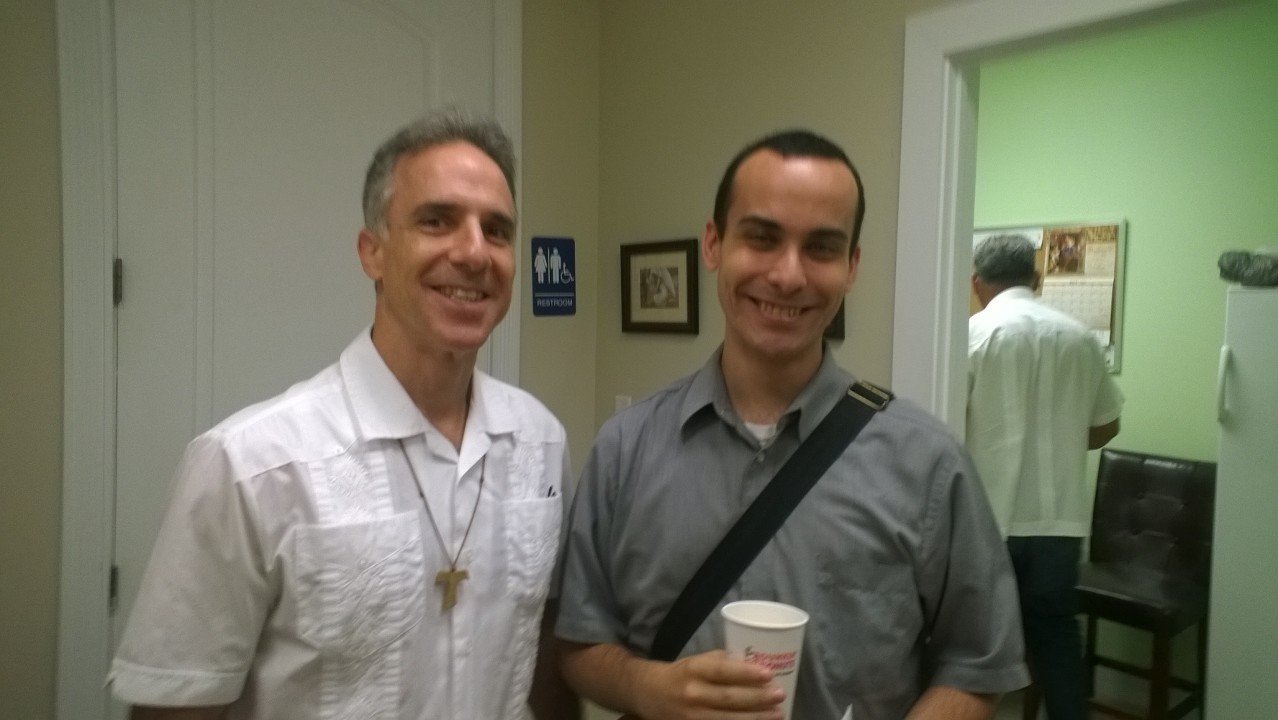
There are two kinds of novices.  There are novices who are called to remain in the world as secular laymen.  We call them secular brothers.  Then there are novices who wish to consecrate their life to Christ living celibate, poor and obedient in a stable family of brothers.  We call them consecrated brothers or regular brothers, because their daily life is far more regulated than that of the secular brothers.  The novice wears the white Habanera, grey slacks and the Tau pendant.

El hermano Chris y Bernardo van para allá.

If the novice is a regular brother, he will also wear the medieval habit when not wearing the shirt and slacks.  The medieval habit consists of a grey tunic with a cowl, a cord and Tau cross over his heart.  Because we aspire to capture the life and spirit of the early brothers who followed Francis of Assisi, the tunic is to be the dress of the working peasant of that day.  It is worn over grey slacks.  All of the brothers are to wear shoes, black or brown.  Sport shoes are not worn with the uniforms or habits.  They must wear a belt and a white under t-shirt with sleeves.

Our clothing must be simple enough to avoid all appearances of extravagance, wealth or luxury.  It should be practical according to culture and climate.  Subdued enough so as not to call negative attention to the brother.

There are times when other forms of dress are more appropriate.  The rules remain the same.  These clothes must be simple, avoid any hint of affluence and be subdued.  The Tau must be worn at all times.  If for some reason the pendant is not practical for the work that a brother does or for the event, the brother may opt to keep a Tau pin handy to wear in such TAU IMAGEcases.    Wherever the brother goes, it should be evident that he belongs to a Franciscan brotherhood.  The general rule is to wear the Franciscan uniform as often as possible, without causing discomfort to others, especially spouses and children.

We have already stated that the white is worn in honor of the purity of the Blessed Virgin Mary, a purity of heart and action to which Christ calls us.  The story behind the grey goes back to the Middle Ages.  Most clothing was made of wool.  Poor people did not have the means to buy expensive dyes.  The wool was often worn without the benefit of dye.  Therefore, it was brown, off-white, or grey depending on the color of the sheep.  The early brothers made their habits out of grey wool.  Brown wool was later adopted, but grey also remained.  The Conventual friars adopted the custom of dying their habit black like that of the Benedictine monks.  This practice lasted until the 1990s.  Today, they wear grey.  Because there are more brown sheep than grey, brown wool was easier to find, hence the custom of brown among many religious communities.

We no longer have to find a sheep, sheer it and weave cloth in order to make clothes.  Thanks to modern technology, we can buy our clothing off the rack or have it made by a tailor.  In choosing the colofrancis and clarers for the Franciscans of Life, we went back to early Franciscan tradition.  We found that Clare and Francis were practical.  Not only did they try to make use of whatever wool was the cheapest, but they were also very conscientious about working conditions.  Although the brothers are men of penance, this does not mean that we be unreasonable.  Penance does not have to be a torture in order to please God.  Francis and Clare gave us an example of dress that set them apart as poor and part of a family.  The tunic and cord were the constant.  Today, the Tau is the constant.  When two or more brothers walk into a setting, people should be able say, ‘Here comes the Church.”

Our habit reminds us that we belong to a family of brothers.  We’re never alone even in solitude.  We’re part of something bigger than ourselves.  We’re united to each other by prayer, penance, discipline, faith and above all love.logo

The habit serves as a guard against infidelity.  I reminds us who we are, sons of the Church called to be faithful to the Commandments, the Gospel, Holy Mother Church, the holy rule, and to Christ’s call to live and proclaim the Gospel of Life through everything that we do, everything that we say, and everything that we don’t do or say.  It also protects our purity.  Whether we’re married, single or celibate, some things don’t change.  Our bodies don’t know
that our hearts and minds are Catholic.  Spontaneous temptations and attractions will happen.  It’s part of being alive.    The habit reminds us of our relationship to others.  Everyone is our brother and sister, not the object of our desire or a thing to be used for our satisfaction.

The habit can help us regulate how we deal with others.  It should help us remember to keep custody over our eyes and a holy distance from temptation.  The habit helps us set boundaries.  This is true discipline, a form of self-control and a display of emotional maturity.

JOHNPAUL-BABYThere is much more to wearing a habit besides chastity and fraternity.  The fact that we dress the same and that our dress does not call particular attention to us allows us a certain degree of anonymity.  Yes, people may notice us and ask questions about our identity.  That’s a perfect moment to speak to people about our family, its Gospel vision and its mission, thus drawing the attention from ourselves and onto what really matters, the Gospel of Life.

We can say much about the value of uniformity.  Holy Mother Church reminds us that the habit is an external sign of poverty, which was so dear to Our Lord, his Blessed Mother and our holy father Francis.  Poverty is the way that Christ chose to enter the world.  Poverty was his condition at the time of his franciscan walkdeath, naked on a cross and buried in a borrowed tomb, because the “Son of Man has no place to lay his head” (Mt 8:20).  “Who, though he was in the form of God,  did not regard equality with God something to be grasped.  Rather, he emptied himself, taking the form of a slave” (Phil 2:6-7).

Think about it brothers, the habit allows helps us to be visible as members of a family that if faithful to Christ from within the Church.  We do not walk alone.

I encourage you to wear your Franciscan symbols as often as possible, but don’t let them become a matter of routine either.  Think about it as you’re putting them on.

I am part of a family.

I am a brother to all men.

I am a son of the Church.

I am the voice of the voiceless.Francis and lepers

I am a sinner.

Published in: on October 9, 2014 at 11:19 AM  Leave a Comment  

DON’T MESS WITH MY FAMILY


This afternoon I received an important challenge from one of our brothers.  October is an important month, because it’s Respect Life Month.  There are also other important events happening this month.

Today, the Extraordinary Synod on the Family began in the Eternal City of Rome.  On October 19th, Venerable Paul VI will be become Blessed Paul VI.  I don’t think that any of this is a coincidence.

Some people have narrowed down and boxed in pro-life ministry to fight against abortion.  There is probably no greater fight than the fight for human life, but we must not limit ourselves to life in the womb.  We must extend our concern to all people from conception to natural death.  We must protect life at all stages of development and in all conditions: Mc Carthy walk 4healthy, sick, poor, rich, male, female, old and young, with special attention to the voiceless.

But where does life flourish?  Where should life find its first home if not in the family?  Today’s family is under attack, maybe no more than families in the past, but certainly by different kinds of demons.  The enemy is resourceful, if nothing else.  He can find different ways of tearing apart the fabric of the family by war, poverty, disease, bigotry, politics, infidelity, heterodoxy, apostasy, atheism and secularism.  The key is not how creative the enemy can get.  The key is how smart we are.

Human life, outside of the context of family life, is very difficult to defend, much more difficult to protect.  To defend means to defend the dignity of human life.  Man has a dignity that is inherent to his roots, which are found in the hand of the Creator.  This dignity must be defended from those who would reduce man to an unexplained accident in the cosmos, making him expendable because he has no justification for his existence; therefore, no inherent value.

Any footbDON'T MESS WITH MEall player will tell you that the best defense is a good offense.  Translated into Gospel terms, human life must be protected from the culture of indifference which is a culture of death.  The best way to protect man and preserve him for the Kingdom is to push back against the economy of sin.  Sin can no longer be allowed to be the currency that rules our lives as individuals, families or nations.  When sin governs our lives, man despairs and the message of Christ is smothered by the cries of angst . . . . Man looking for gods, rather than GoPope Paul VId.
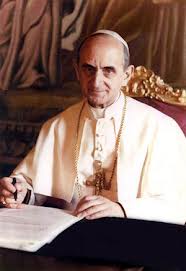
Pope Paul VI foresaw this coming and tried to warn us in his now famous encyclical Humanae Vitae, on the transmission of human life between husbands and wives in the intimacy of marriage and the shelter of the family.  It is probably the Holy Spirit who has inspired Pope Francis to beatify Pope Paul VI at the end of the Extraordinary Synod on the Family.  Immediately following, on October 22nd is the first feast day of St. John Paul II, the author of Gospel of Life.

We besignslieve that this is a good month to do something together that is open to other members of the Catholic and pro-life community.  The Franciscans of Life encourage everyone who reads our blog to organize an activity for this special month on life and the family.  It can be something as simple as an evening rosary between several families, a night of praise and worship, a penitential service in atonement for those who destroy instead of build the human family.  You may want to organize a meal with several couples to celebrate traditional marriage and family.  The demon that afflicts human life and weakens the fabric of the family will only be evicted from our lives with prayer and fasting.  A family or community day of fasting and abstinence is alwaysSt. Max good option.

Please post your ideas in the comments below so that others who read this can take some ideas back to their families and their parishes.  Remember the words of Sacred Scripture.  “Do not be afraid.”  Through the prayers of the Immaculate Christ is slowly, but surely conquering the kingdom of darkness.  He will not leave us orphans.

http://www.catholicnewsagency.com/news/us-bishops-invite-faithful-to-pray-for-family-synod-35304/ (more…)