“In God We Trust” Really?


I’ve been trying to keep up with news and thoughts by and about Catholics on Facebook.  However, I’m starting to feel somewhat disappointed.  It is naive to believe
St_Setonthat one is going to find much that is worthwhile on Facebook; but occasionally one runs into another person who thinks with clarity and shares his or her thoughts in such a way that encourages us to rise to higher moral ground and to a more intense life of virtue and prayer.

Having said this, I must confess that it has been a great disappointment to find the many priests and consecrated religious who post on Facebook talk about every social and civil ill, encourage people to rise in protest, at times denounce those who do evil, but something is obviously lacking from their posts.  God, Jesus, the Immaculate, prayer, the perfection of charity and atonement for one’s sins and those who don’t do penance.  These are never mentioned.

A good example of this gap in “Catholic” posts is found in discussions on discrimination and racism.  Since the US elections several Catholic bloggers have taken to the Internet to denounce racial discrimination and other forms of discrimination, be due to religion, sex, sexual orientation or gender-dysphoria.   They have denounced politicians, Church hierarchy, business men and women, and other members of society for behaviors that are often cruel and unnecessary, or at times for failing to speak up for the voiceless.

Another important area of life in which we find protesting, finger pointing and even name calling is in religion.  We have politicized religion to such an extent that we now speak of fellow believers using popular political jargon:  liberals and conservatives or novus ordo and traditionalists.

Here too, the language is very often offensive.  At times, it offends because it is vulgar and sometimes it offends because words are used to assassinate someone’s character.  They don’t simply describe an immoral behavior or a statement that contradicts absolute truth.  These are words that encourage hatred.

It is important for all of us to be aware of injustices, abuses and disregard for God and man.  When priests and consecrated religious brothers or sisters write only about the evils and don’t mention what the Scriptures, Sacred Tradition and the Magisterium have to say about these things, we fail our people.  People have a right to expect clergy and religious to refer to faith to enlighten human life.  We don’t become priests or religious to be social workers or activists.  Ordination and consecrated life are not essential to the work of an activist.  Conviction is what matters.

I encourage clergy and religious who post on Facebook and in blogs to remember that faith enlightens reason.  Reason enlightened by faith strengthens convictions.  Christ did not come into the world to lead men into a godless revolution.  His followers were to be guided by their faith.  Their faith shed light on the rightness and wrongness around them.  Then they denounced what was wrong and defended what was right.  But they always proclaimed the faith that enlightened them.  Many were martyred for doing so, but there were more converts than martyrs.

Let us look at the world, including the Church, through the eyes of faith.  Let faith help us see what is good and what is evil.  Let faith supply the courage to fight for good and against evil.  Most importantly, never forget to share the faith that drives us, lest others see us as simple social activists or worse.

We who are priests or consecrated men and women have committed our lives to living according to the faith.  The Church has charged us with the duty to proclaim the perfection of charity and the Kingdom of God.  The first step in serving God is to find Him.  The search for God is the search for truth.  We must begin by discerning what God has called each of us to do and how God wants us to go about it.  For priests and religious, the call is not a call to godless social work or godless political activism.

We must never give up and never surrender our awareness of God’s presence in human affairs.  Going into battle for purely human reasons or as some say, for the sake of justice alone, is not the Gospel.  Christ exemplifies true justice.  The exercise of evangelical justice leads man back to the Father.  Christian justice and renewal is built on faith and preached with courage.  There is nothing courageous in insulting another person or group of people.  There is no hope when God is not part of the discussion for justice.

We Fail to See the Light


Very often we hear people say, “That’s good for you guys, because you’re in vows; but the rest of us are not.”  This comes from practicing Catholics.  I believe that people who make such a comment do not understand the temporal purpose of the vowed life.

The vowed life is for the benefit of the person who makes the vows, but also for the benefit of the whole body, the Church.  Married couples also make vows.  Imagine what would happen if people of faith adopted the belief that the marriage vows are for the benefit and responsibility of the couple, but have no bearing on the rest of Christ’s Mystical Body.  Marriage would make no sense.

A vowed life, whether one vows to observe chastity, poverty and obedience or one vows to be faithful to one’s spouse until death, in good times and in hard times, is not wp_20150118_016a private relationship between the person who makes the vow, the people in his life and God.  God does not call people into private relationships with him to the exclusion of everyone else.  Even hermits, such as the Carthusians, embrace the cross in silence and solitude for the benefit of the Church as well as their benefit.

The vows of consecrated life (chastity, poverty and obedience) have a transcendent quality to them.  The individual making the vows renounces everything that the world has to offer in order to live more perfectly the vows made at Baptism.  He or she does not promise to do profession-of-vowssomething different from the rest of the baptized.  He promises to do the same, but more perfectly or as close to perfection as is possible for him.  In doing so he becomes a sign of life in the Kingdom of God.
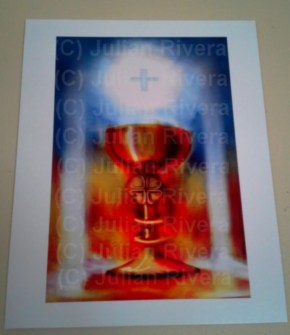
This leads us into the temporal quality of the consecrated life.  God chooses to place consecrated men and women in the middle of His people for the benefit of the Church.  Through their life of prayer, sacrifice, service and love, God’s grace pours into the world.  God is willing to do Julian_Corpus_Christicartwheels to save us.  He gives us the Scriptures.  He gives us Himself through the Incarnation and the Eucharist.  He shares His life with us through the sacraments.  And he places many other sources of grace in the middle of the marketplace for the salvation of his people.
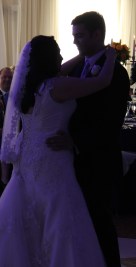
If one assumes that the life and works of the man or woman in vows or the married couple does not affect us or commit us in any way, then one is ignoring and possibly bride-groomrejecting the grace that God wishes to share with us through these states in life.

We need not be married to learn to love without holding anything back.  Everyone is called to love without restrictions on his love. JEANNIE 31 WEEKS PREGNANT

The married couple is God’s sign of such love.  We can’t simply turn away and say, “Love without reservation is for you, because you’re married.”

We need not to vow chastity, poveuntitled-4rty and obedience to learn how to think and act with a pure heart, how to let go of the many things, people and places that redirect our attention away from God and we don’t need to be in vows to be bound to obey God as he reveals His will to us through Sacred Scripture, Jesus Christ and the Church.
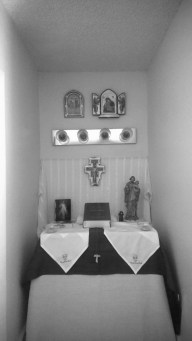
This last one is key, obedience.  Obedience to what God asks of us at any given moment is not for a select few.  oratoryThose bound by a vow of obedience are to be the models of submission to the will of God, not the only people bound to submit to God’s will.

Maybe one of the reasons why vocations to the consecrated life are down and the reason that some consecrated persons are lukewarm in the way they live out the vows, is because we have separated the vowed state in life from the secular man and woman. When we separate the Evangelical Counsels from the secular sphere, what counsels are left to guide the secular man and woman to fulfill his or her baptismal promises?  Chastity, poverty and obedience are the yard-lines that lead to the final goal, the perfection of charity.

How does one know how close or how far he is from the goal without the yard-lines?

When the vows of chastity, poverty obedience and hurricane_matthewthe
vows of marriage are lived as they should be lived, they become a torch that is a sign of God’s light in what sometimes seems like a dark and scary world.flame

SPARE ME THE LITURGICAL GEOMETRY LESSON


People have been trying to impress upon me and others too, that the “new” form of the mass is horizontal whereas the traditional Latin mass is vertical.  I’ve given this a great deal of thought.  From the perspective of language (not Latin, but words) the traditional Latin mass orients the person’s focus toward the transcendent.  There is no mistake about this.

But there is another mistake, which is to say that the current form of the mass fails to orient us toward the transcendent.

There are two ways to “touch” the transcendent.  One can reach up, or that which is transcendent can reach down to man.  Whether man reaches up or God reaches down, the vertical dimension of worship and Catholic spirituality has never been abrogated.  Rather, the action can be uplifting or incarnational.

I think that it would be fair to say that today’s form of the mass, if and when it’s celebrated as per the General Instructions for the Roman Missal (GIRM), has a very dynamic vertical dimension, because it places the focus on God breaking into human history:  the Incarnation.

Everything begins with man reaching out to God asking for forgiveness, during the penitential rite.  This rite is found in both extraordinary and ordinary forms of the Roman rite.  Next, we move to sacred Scripture.  In the ordinary form of the mass, the scriptures are proclaimed in the language of the people.  In the TLM, Latin is usual.  For those who understand Latin or have a missal with the translation, following the proclamation of the scriptures is not a hardship.

Here is where the weakness of both those who love the extraordinary form and those who love the ordinary form of the mass is most visible.  Unfortunately, catechesis in  the Latin Church has been very weak in the area of Sacred Scripture.  To say that many of the religious education books published in the United States could have just as well been produced by Disney Enterprises would not be much of an overstatement.  They fail to convey  the fact that God speaks and we must listen and then respond.

For many Catholics, traditionalists and other, the proclamation of the Sacred Scripture is like story time in elementary school.  Our priests and deacons add to the reduction of the proclamation, because they often fail to mention that what we are about to hear and what we have heard is God’s voice, not the lector’s or the clergyman’s.  Those people are conduits through which God wants to speak to His people.  The vertical quality of the Word of God is obscured by a lack of appreciation on the part of the congregation, poor delivery from those who read it, and very often sermons or homilies that sound more like motivational talks than Divine messages from God to man.

Those who see and hear the voice of God in the proclamation of the Scriptures are definitely praying, because prayer is simply lifting one’s mind and heart to God.  We don’t have to do more.  God does the rest.  During the proclamation of the Scriptures and the homily God calls out to man, as he called out to Adam in the garden, to Abraham, Samuel, and Moses, and to the apostles.  He communicates His love for man and repeats His promise to be save us.

But God also communicates the conditions necessary for salvation.  He reveals to man the moral law that we must observe to be saved.  He offers the means to reconcile, if we violate that law.  He also reveals the consequences for those who violate the moral law and do not repent.

It is during this message that says, “I AM your God and you are my people,” that the soul is intimately tuned in to the voice of God.  But the soul must have a springboard to make the leap from here, into the Word of God.   The springboard for the soul is not an object, but awareness.  We must be aware that it is God who is speaking and that we are commanded to listen carefully.  This is not story time, history class, catechism class or motivational speech to improve your fortune and acquire a younger and better looking wife.  This is the literal voice of God that becomes Incarnate in the Word.  This Word will be offered to the Father in an unbloody sacrifice under the appearance of bread and wine.  Then again, God responds by offering us the Word as spiritual nourishment in Holy Communion.

The horizontal dimension of faith plays an important part in the ordinary form of the mass.  We come to God as a people to fulfill the two Commandments that God gives us, “Love God above all things and love your neighbor as yourself.”   To understand that we relate to each other, not by how we interact at mass, but because of who we ARE, the People of God, and to convert our manners so that everything we do and say reflects God rather than us, adds the horizontal dimension necessary to complete the cross.  This is called ecclesial consciousness.

The ordinary form of the mass provides us with the means to touch and be touched by the Transcendent who speaks directly to us through the Scriptures.  The Word that is proclaimed in the Scripture points our attention to the sacrifice on the altar, which is the life of the Word Himself laid down for our Redemption.  But the Word does not remain in the grave.  It rises and reveals himself to us, glorious and triumphant at every elevation of the sacred host.  He invites us to eat and drink His body and blood under the appearance of bread and wine.  Such great wonder and mystery becomes visible to those who are familiar with the Sacred Scripture, who have an ecclesial consciousness and who attend mass  to present themselves to God, not to fulfill an obligation or to experience the warmth and friendliness of parish life.  Parish life that nurtures the soul is that life which begins with the acknowledgement that the Word has become flesh and is speaking to us.  This is not a replay or a reading of some historical event.  This is reality, more real than the pains of a woman in labor.


Br. Jay

The Quiet Amidst the Storm – Part 2


In our previous article on Hurricane Matthew, we closed discussing the attitude of anxiety that can contaminate others during such events, and we mentioned that our Holy Father St. Francis taught us instead to always go through the world filled with the Lord’s peace and joy.

In this article we wish to share a bit more alongside some practical “hints” on how to achieve and maintain inner peace during difficult times.

Transitus at St. Maximilian Kolbe parish

Transitus at St. Maximilian Kolbe parish

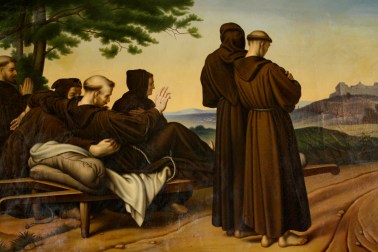
On his deathbed, afflicted by physical suffering and by the struggles of the newborn Franciscan family, St. Francis was able to compose his beautiful Canticle, of which we quote only some strophes:

Be praised, my Lord, through all your creatures…

Praised be You, my Lord, through Brother Wind,
and through the air, cloudy and serene,
and every kind of weather …

 Praised be You, my Lord, through Sister Water…

Praised be You, my Lord, through Brother Fire…

Praised be You, my Lord,
through those who give pardon for Your love,
and bear infirmity and tribulation…

Blessed are those who endure in peace…

Praised be You, my Lord,
through our Sister Bodily Death…

Woe to those who die in mortal sin.
Blessed are those whom death will
find in Your most holy willl…

This is the commitment that the brothers take upon themselves when they profess to follow the life of St. Francis, when they commit to become mirrors of perfection.

Such was the inspiration that our Father gave us, that he would inspire other great saints to imitate this model. St. Teresa of Avila would write: “Let nothing disturb you”. St. Ignatius of Loyola would speak of “holy indifference” as “not preferring health to sickness, riches to poverty, honor to humiliation, long life to a short one[; instead] wish only for those conditions that will aid our pursuit of the goal for which we have been created”.(Spiritual Exercises) There are many other examples, but  ultimately, they all refer back to the ultimate source of Peace and Joy, the good Lord who once said: “Do not worry about your lives…do not worry about tomorrow!” (Mt 6:25,34).

lighthouses-lighthouse-looking-wide-open-sea-horizon-cloud

Furthermore, as Franciscans of Life, we bear the additional commitment of witnessing to the power and majesty of Life, eternal and all-powerful. “I have come that you may have life, and have it fully” (Jn 10:10). Church Father St. Irenaeus once commented:

“The glory of God is man fully alive, and the life of man is the vision of God. If the revelation of God through creation already brings life to all living beings on the earth, how much more will the manifestation of the Father by the Word bring life to those who see God.”

In a practical way, we know that “nobody has seen the Father except the one He sent” and that “he who has seen the Son has seen the Father”, as our Lord reminds us of this and St Francis wishes us to imitate this. Therefore the Franciscan of Life, when seeking to proclaim the Gospel of Life, looks at the person of our Lord within his earthly life, particularly at times when He was surrounded by great agitation and nervousness. How did He act? What did He say?

Thus walking unhurriedly amidst a hurried crowd, being polite at a tired stored employee, smiling at an upset customer, helping a frustrated stranger who is looking for batteries, all of these take a different meaning as they proclaim the Light that shines in the darkness.

A friend of our community mentioned to us during a recent conversation that she felt “ashamed” as she, too, was guilty of having rushed through several stores and having been glued before the TV screen following the alert updates. We do not wish you to misunderstand us… as we said, we too went through the necessary preparations, as prudence is a great virtue. There are, however, certain elements that everyone – even those who have not been through years of formation in Franciscan spirituality – can apply in their daily life to find more of that interior silence that helps us maintain the quiet through the storm.

For example, we avoid following the secular news – including weather updates. The Superior, a man who has mastered interior silence, is tasked with following the development of the event – whatever the event may be – and sharing what he considers necessary for the brothers to know.

To build on a metaphor by Thomas Merton, it seems that the media in this day and age has sadly become a sort of “digital acupuncture” designed to stimulate every possible nerve in the human body, to keep us “on the edge”. “Fortunately”, though, our first-world stores come to the rescue with every sort of product that will reinforce our sense of safety by reinforcing our sense of “having” – even when we purchase those items on credit cards and therefore we are increasing our degree of “not having” (that is, if we assume for the sake of the argument that money is something one can “have”, that is, if we assume that money “is” something).

To make things worse, the media – even those with the best intentions – often miss the elephants in the room. Mother Teresa, recently canonized to the great joy of us all and of so many around the world, reminds us that we need not look far in order to find our neighbor in need. Even before we look at Haiti and the Caribbean, we ought to ask ourselves what we can do to help the homeless men and women on the streets of Miami, Fort Lauderdale, and many other cities of Miami-Dade and Broward who may not even know that there is a deadly hurricane coming their way. Some of them may not have the means to reach a shelter, others may lack an ID that will allow them access into a shelter. Could we find it in our heart to welcome them into our homes for the length of the emergency?

To turn off the “excitement” of the media and to turn from “self” towards the “other” – here are two very useful ways to maintain inner silence, peace, and joy.

The last suggestion I would like to make comes from the spiritual director of St. Teresa of the Andes, a young Carmelite mystic to whom the Lord revealed that she would die within the month. Upon mentioning this to her spiritual director and asking how to go about the remainder of the month, she was told: “Live as usual, as if you were not going to die“. For, in the words of St. Francis, “blessed are those whom the Lord will find doing His holy will“. Then even dreadful, ugly, scary Death becomes no longer our enemy, but our sister.

Francis_blessing

Prophets and Prophecies


St. Francis of Assisi died on the evening of October 3, 1226; that is, 790 years ago.  Nonetheless, he remains very much alive in the Church and the world today.

This little man from a small town in the Umbrian region of Italy achieved what Julius Caesar, Cleopatra, Mark Anthony, Mao, Stalin, Lenin, Hitler, Bonaparte, and George Washington never achieved.  On the day of his death, he left behind a family of men and women, today known as Franciscans.  On that memorable evening of October 3rd 1226, there were more than 5,000 friars, 200 cloistered nuns, and more than 1,000 secular men and women who formed the family of St. Francis or the Franciscan Family.

WP_20140825_081Today, we are about one million around the world.  No one really knows how many groups of Franciscans there are in the world.  The family grew so much that it was impossible to keep it under one superior general and to govern everyone with the same expectations.  Diversity in cultures, languages, political conditions and even geography made it necessary to breakdown into smaller communities that could be more easily governed and who were more cohesive.

This does not mean that the mind and rule of St. Francis were abandoned in order to accommodate to time and place.  It means that the mind, rule and heart of Francis emulated the mind, commandments and heart of Jesus, making room for men and women from every part of the world.  So, his little family of 11 Italian brothers from Umbria grew into an international family that has survived 800 years of changes,st maximilian kolbepolitical persecutions, Church politics, poverty, wars, disease, misunderstanding, rejection, martyrdom, even heresy.

This should make us think about the Church.  Christ promised Peter that the gates of hell would not prevail against him.  He promised to be with us until the end of time, through thick and thin.  Yet, many catastrophic minds believe that the Church is falling apart, the great tribulation is coming and the world is going to hell in a hand basket.

In every age God sends us prophets and prophecies foreshadowing his redemptive work for mankind. The Franciscan family has survived and prospered, despite many setbacks.  By the standards of some of these extremists’ minds, Franciscans contemplationshould have been wiped out during the Protestant Reformation, maybe the Reign of Terror, Nazism, Communism, or the Americanist Heresy.  The fact is that the Franciscan family is alive and growing.

Like every family, it grows old and tired in some places and dies out, only to sprout with vigorous new shoots in other cities and countries.  The gates of hell have never prevailed against the Franciscan family.

Maybe, October 4th, as we celebrate the Solemnity of Our Holy Father Saint Francis, we would do well to meditate on prophecy.  St. Francis and his WP_20140819_035descendants are not just another group in the Church.  We are a prophetic statement for believers and unbelievers alike.  We foreshadow the triumph of Christ the King over all the odds and a new springtime for the Church.

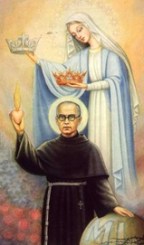
The Franciscans of Life wish all of our friends, a Blessed Feast of St. Francis.

caravaggio_st_francis_in_ecstasy

Following Mary’s GPS


On August 14, we celebrate the feast of St. Maximilian Maria Kolbe, patron of the Franciscans of Life, and the 75th anniversary of his martyrdom.  The next day, August 15th, is the solemnity of the Assumption, also known as the Feast of the Dormition of Mary in the Eastern Churches.  For the moment, let’s put the Assumption on the side.  By the end of this article, we’ll see how it all fits together.  Let’s begin with Maximilian Kolbe.


  1. Todeszelle_Pater_Maximilian_Kolbes,_KZ_Auschwitz_I,_Block_11We must get past the end of the story in order to understand any saint and his or her journey into the mind of God. All too often we look at the finished product, who the person was at the time of death or in the later years of their life, completely missing a life journey that should inspire us to do better.  Such is the case with St. Maximilian Kolbe.  When you mention his name, everyone remembers him as the priest who traded places with a condemned man Auschwitz and whom the Nazis starved and killed by lethal injection.  This heroic act of faith and charity did not spring up on the spur of the moment.  There was a lifetime that led to Maximilian’s ultimate sacrifice where he unites his life and death to that of the Crucified Christ to give man a chance at new life.
  1. MAX AND MARYAccording to his parents’ and brother’s memories, Maximilian was typical pre-adolescent who had the ability to get under people’s skin like most kids in that age group. His mother often cried out in despair, “What’s to become of you Raymond?  Note:  He was born Raymond Kolbe.  But there was something special about this apparent little magnet for trouble.  His parents had taught him to pray.  As a child, he knelt before Our Lady and asked her, “What is to become of me?”  Our Lady gave him a choice between a crown of martyrdom and a crown of purity.  Raymond chose both.

Here is a learning moment for those who are parents.  As important as it is to reign in your restless children and protect them from getting into trouble, as seemed to be Mrs Kolbe’s daily task with Raymond, it is imperative that we never forget that even those little mischievous creatures that we love and call children were given to us to form so that they can return to God.  The school that any child must attend is the school of prayer.

256px-Luxembourgers_in_England-_Evacuees_in_Surrey,_1942_D11110Raymond, despite the grief that he caused his mother, learned to go to prayer when he didn’t know where else to turn.  This is not something that comes built into a child.  This is the work of actual grace given by God to the parent, which the parent passes on to the child as he promised at the child’s baptism.  In other words, Raymond prayed because his parents had fulfilled the covenant they made when they baptized him, “to bring him up in the faith.”  A child who is brought up in the faith may be derailed, but can find his way back more easily than those who have not grown up in the Catholic faith.  We should pay special attention to those parents who raise saints.  Often, they serve as good models for parenting.

  1. At the age of 15, Raymond decided to join the Franciscans. He enters that branch of the Franciscans known as the Friars Minor Conventual or simply the Conventual Franciscans. Upon entering the novitiate, he is invested in the Franciscan habit and given the name Maximilian Maria.  From that point until his death he will be known as Friar or Brother Maximilian Maria. There is much to be learned here.

Jesus and boyFirst for youth – St. John Paul told the youth of the world, “Do not be afraid of Jesus Christ.” When Our Lady offered Raymond a choice between martyrdom and purity, he chose both.  We think of this story and we swoon over this wonderful little boy who was so pious and so holy.  We completely miss what God wants to teach us.  Those who struggle, as did Raymond, are also called to a life of virtue and sacrifice.  Prefabricated saints don’t need to practice heroic virtue or make heroic sacrifices.  Sinners do.
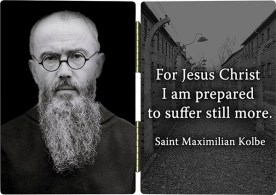
Raymond admitted that he was a sinner.  He also trusted Christ.  He was not afraid of Him.  If Christ used his Immaculate Mother to guide Raymond to Himself, Raymond was willing to take that step into the unknown and follow her lead.  He didn’t become a Franciscan Friar because this was what he wanted to do.  He may have wished to be a friar.  But he examined his attraction to the Franciscan life in light of the call that Christ made to him through the Immaculate.  Raymond entered the Franciscans because the Immaculate said to him, “Do whatever he tells you.”  She promised to be by his side along the journey.  There was no reason to fear Christ, no reason to fear embracing a life of uncertainty, sacrifice, long days and short nights, penances and many humiliations.  Maximilian teaches us that Christ calls us down paths that he has paved specially for each of us.  Christ never calls you where you cannot walk.

The question for the young person should be, “What is to become of me, Lord?”  This was Raymond Kolbe’s question and the Immaculate responded, “Do whatever he tells you.”  Life is not about what I want to do, but about God’s plan for me.

ST MAX AUSCHWITZ

Second for parents:  The Kolbe parents were committed to raising their children in the Catholic faith, as they had promised at their baptism.  They were also conscious that their children were not their special project, but they were a temporary gift from God that they would have to return when God asked.  However, they had no idea what God would ask of their children, when or how.  They st josephremained open to the God of surprises rather than planning out their children’s lives in advance and trying to steer them into careers and marriages without consulting God’s plan for them.  They educated their children in the faith, provided the academic education available to them and offered them guidance along the way.  But they never owned their children.  Their children belonged to God.  When Christ called Raymond to become Brother Maximilian, it may have not been what Mr and Mrs Kolbe expected or planned, but they trusted.  If this was truly the voice of God calling their son, he would be safe and they could offer him no better assurance of his happiness and salvation.  If it was simply an illusion of youth, God would open their son’s eyes to the folly of his choice in life.  Again, they trusted.
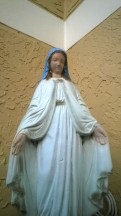
Madonna001The lesson to be learned is that even when we are unsure what God wants  from our children, if the choice is not a sinful one or a danger to to self or others, we can stand back and let the Immaculate guide.  She can only guide our children to her Son.  Her GPS is locked on Christ as the compass is locked on the North Pole.  There is nothing to fear and much to be gained.
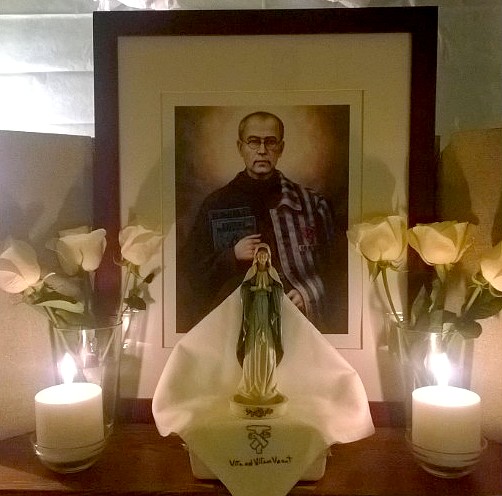
This year, during the feast of St. Maximilian Kolbe, let us focus less on the end product, the martyr and more on the boy, the man and his parents.  Let us learn to follow the guidance of the Immaculate and to trust her Son as they did.  When we commit to following the guidance of the Immaculate, which leads to her son, then the Assumption needs very little if any explanation.  She who leads others to her Son was also called to follow Him in body and soul and will lead all men to the same end.

Shrine to the Immaculate Conception and St. Maximilian Kolbe at the FFV Motherhouse.

The Surpassing Invisible Beauty of Truth


When we observe works of art, in particular sacred art, we are necessarily brought out of ourselves into a new perspective.

­­­­­­­­­­­­

Yet we often hear the claim that modern art is disconnected from beauty and, by extension, is unable to communicate the beauty of holiness. Pope Benedict XVI explained this as follows:

“We are experiencing not just a crisis of sacred art, but a crisis of art in general of unprecedented proportions. It is a symptom of the crisis of man’s very existence. The immense growth in man’s mastery of the material world has left him blind to the question of life’s meaning that transcend the material world.”

Atlas-Statue-Rockefeller-Plaza-Fifth-Avenue-HDR

Modern man defies the transcendent

Unfortunately, many have ran with similar statements too quickly and too far, arriving to claim that modern art is “ugly” and that modern sacred art is nothing but “secular (profane) artworks embedded in sacred spaces”.

Consequences of iconoclastic mindset

The iconoclastic mindset

Others, connecting many more dots than what prudence dictates, have claimed that modern art is ugly because modern souls belong to a global society falling into apostasy. At the extreme end of the spectrum we find the histrionic-schismatic mindset of those who claim that “the ugly images found in Novus Ordo churches are the final offense of the devil, an outrage that sums up all lesser offenses because it represents his goal of obliterating the image of the holy ones in the Church”.

Sadly, the proponents of these and similar statements are indeed upholding a tradition, but not the tradition of Catholic sacred art. They are, in a sense, the modern version of the ones who raised up their scandalized voices to the work of Michelangelo in the Sistine Chapel. Their claim? Michelangelo’s work was too modern.

Paul Barolsky, a  specialist in Italian Renaissance art, explains that contemporary critics of “the first modern artist” accused the Last Judgment of being disconnected from the norms of classical form and violating religious decorum.

Last_Judgment_Sistine_Chapel

However, “The images are not photographs…their whole point is to lead us beyond what can be apprehended at the merely material level to awaken new senses in us, and to teach us a new kind of seeing, which perceives the Invisible in the visible. The sacredness of the image consists precisely in the fact that it comes from an interior vision and thus leads us to such an interior vision. It must be a fruit of contemplation. Art is always a gift. Inspiration is not something one can choose for oneself. It has to be received. Before all things, it requires the gift of a new kind of seeing”.

Many modern art forms, even within sacred art, accomplish this wonderfully even though they may depart from more traditional artistic styles. They are not “modernist”, nor do they belong to that school that religious illustrator Matthew Alderman has called “the Other Modern”.

The Franciscans of Life are patronizing the work of a local artist whom we believe is a representative of the above, and we will feature his artwork for sale on a dedicated section of our website http://www.franciscansoflife.org The proceeds will go towards the education of our student brothers. This young artist specializes in concept illustration, book covers, and fictional fantasy. He has displayed remarkable talent in the production of sacred art using traditional and digital mediums.

Artwork in the community room at our mother house.

Artwork in the community room at our mother house.

St. John Paul II reminds us that modern artists are, just like artists of all ages, men passionately dedicated to the search for new “epiphanies” of beauty, admiring the work of their inspiration, sensing in it some echo of the mystery of creation. While acknowledging that in the modern era a new kind of humanism marked by the absence of and opposition to God has gradually asserted itself, the Church has not ceased to nurture great appreciation for the value of art, even beyond its typical religious expressions…for even when they explore the darkest depths of the soul or the most unsettling aspects of evil, artists give voice to the universal desire for redemption.

Julian_Pentecost

Pentecost

The pontiff reaffirms that just as the Church needs art to make perceptible and attractive the world of the invisible without emptying the message itself of its transcendent value and its aura of mystery, art also needs the Church for the great source of inspiration offered by the religious theme. This partnership has been a source of mutual spiritual enrichment and has led to a greater understanding of man, and to an opening of the human soul to the sense of the eternal.

Pope Francis, in his encyclical Laudato Si, reminds us that we must be able to look even beyond the traditional means of the craft:

Julian_Corpus_Christi

Corpus Christi

“Technoscience, when well directed, can also produce art and enable men…to leap into the world of beauty. Valuable works of art no make use of new technologies. So, in the beauty intended by the one who uses new technical instruments and in the contemplation of such beauty, a quantum leap occurs, resulting in a fulfillment which is uniquely human.”

It is therefore our hope that we will look at all expressions of modern art, and particularly at sacred art, with a renewed understanding of man’s quest for the beyond. There is much to be appreciated, as long as we are capable of casting aside prejudices and overly zealous attitudes.

Art indeed “goes beyond the search of the necessities of life…it expresses practical wisdom, uniting knowledge and skill, to give form to the truth of reality in a language accessible to sight, [and] sacred art is true and beautiful when it evokes and glorifies ….the surpassing invisible beauty of truth and love”.

These words come from a relatively recent book, the Catechism of the Catholic Church, but reflect a wisdom that is timeless. We find it echoed by the same Michelangelo, who affirmed that “every beauty which is seen here by persons resembles more than anything else that celestial source from which we all are come”.

Julian_St_Joseph_and_Christ

St Joseph and Christ in the Workshop


No Bikes Allowed In Heaven


I realize that it’s a little late to write Mother’s Day messages.  In my case, it may be a little late to write a eulogy for my mom who died 15 years ago.  Nonetheless, there is something that I would like to share with all of you who are parents and those who will be parents.

When a parent approaches the Lord for the final judgement, the most important question that he must face is whether or not he fulfilled his duty as a Christian and passed on the faith to his children.

Passing on the faith is more involved than sending kids to weekly CCD and putting them through the drills for First Confession, First Holy Communion and Confirmation.  The sacraments are not graduation ceremonies.  The sacraments are part of a journey.  This is where my mother comes into my spiritual picture.FLAMES

Whatever her faults, were many things that my mom did well.  But the one thing that she did with outstanding fidelity, love, courage and concern was to hand down the faith.  From the moment we were born we were incorporated into the faith community.  I say incorporated to mean that we didn’t just get dragged down to the church to be baptized or the temple to be blessed and “Goodbye”.  There was much more.  Faith was part of our domestic culture.

I remember that the first picture book that I ever read was the story of Moses.  From there, I read every other story in the bible.  Faith was part of our recreation, because bedtime reading was a ritual and a fun time for me.

Religious symbols were present in every room in our house.  I was taught to pay attention to them.  I remember my mother insisting that I bow my head each time I passed a crucifix that was in the entry foyer.  Bowing to the crucifix and altar in church were not new to me.

Morning, evening and night prayers were part of our family schedule.  We prayed before going to school.  When I was older, I prayed the Holy Rosary with my mom every day at 7PM.  I have no idea why it had to be at 7PM.  I can tell you this.  I have no idea what wasrosary on TV at 7PM.  That was time for evening prayer.  Then there were night prayers that were said at bedtime.  The very first prayer that I learned to say was the Lord’s Prayer.  Because I grew up in a bilingual home, my mother made sure that I could pray it in two languages.  After that, other prayers were added, including prayers at the table.
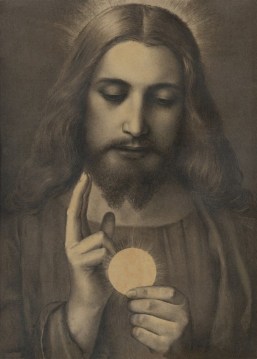
My mother taught us Judeo-Christian morality without proselytizing and without nagging.  I would come home and tell her about something I saw at school or on the street.  My mother would stop to listen.  If the action was good, she explained how I should imitate it, because it pleased God.  If the action was bad, she explained the importance of avoiding it, because it was a sin and sin could land you in hell.  My mom was not afraid of words like “sin” and “hell”.  Despite her use of those terms, I don’t suffer from PTSD.  If anything, I suffer from a guilty conscience when I mess up.

Not to drag this on too long, which I already have, when I was about 11 we had a fire that destroyed a good portion of our home.  It took several months to rebuild, paint and do whatever else they do when they rescue a house.  How would I know?  I was only 11.

I’ll never forget standing outside at 3:00 AM on a very cold March morning, in my PJs and a blanket, watching flames come out of one of the upstairs windows.  When the fire was finally out, I asked my mother, “What are we going to do?”  My mom was very quiet for a moment.  Then she said, “I have no idea.  Let’s not worry about that now.  Let’s find a warm place to sleep.  God always has a plan and he will tell us what to do when the time is right.”  This was a belief that she instilled in us from childhood.  “God has a plan.”  And “Only God knows.”  We were always assured that Providence was taking care of us.

Like any good Judeo-Christian, we worshipped every weekend and on holy days as well.  There was  no such thing as sleeping in and not going to Church until you were old enough to pay your own bills.

The best thing that I learned from my mother was love of God and love of neighbor.  I saw my mom take in kids whose parents could not care for them and they would live with us until the parents were ready to take them home.  One child lived with us about three months.  I saw my mother stop inside the church on her way home to visit the Blessed Sacrament.

12313767_1724552867778905_4437807418574257125_n

I was not asked if I wanted to come in.  I just naturally followed and knelt in front of the tabernacle.  There was no doubt that Christ lived in that little box.  There was no excuse for driving or walking by the church and not stopping to say hello to its sovereign resident.

Remembering these things, I believe that at the moment of her death, whatever faults my mother had were outshined by her perseveration when it came to handing down the faith to her children.  This is the first and most important vocation of parenting.

The roof over the head, the food on the table, the school tuition, and medical bills were all covered.  But as my mother once said, “Giving your kids the material things they need won’t get them to heaven.  No bikes allowed in heaven.  You have to give more.”

Celibacy: a Jewel of Great Price


The question has often been raised by parents and friends. “Why would a ‘normal’ healtFrancis_and_Pietro_Bernardonehy man choose celibacy and chastity over a woman?” Another popular question, “How can you live without a woman?”
There are people who believe that such men do harm to themselves and eventually to others by engaging in gay sex or pedophilia. Nothing can be farther from the truth. There are married men who engage in both behaviors. Neither promiscuity nor marriage are “cures” for gay sex or pedophilia. In fact, these two behaviors do not belong in the same sentence, because they are not related.

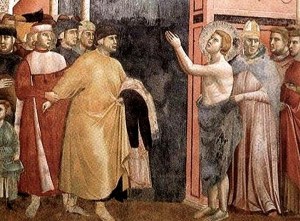
To understand celibate chastity one has to understand love, marriage, and covenant. The man who chooses a celibate chaste life is not running away from marriage, love, and commitment. He is turning to something that he has found, that being the jewel of great price. He is overwhelmed by the love of God.

HeFrancis_leper can love another person and be intimate. However, when he experiences the love of God, he is filled with peace, interior silence, joy, and courage that he has never experienced. His life is different and he wants more. He cannot turn back to the love and intimacy of human romance, not because human romance is bad, but because he has found something even better than good. He has found Him who is the perfect lover: God.
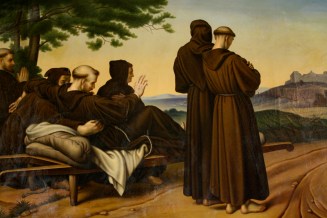
When he compares his current state with his previous life, he discovers new things about himself. The first thing he discovers is that he has a courage that he never knew he had. He can stand up to those who try to control him. He is no longer afraid of bullies. And he makes choices and takes risks that he never took before.
Secondly, he finds that those romantic feelings he once had were truly beautiful and profound shadows of what consecrated life would later offer. Those experiences foreshadowed his romance with God.

Francis_blessingHow does he know this? He no longer question himself or his relationship. He is truly loved by God and he freely returns that love. He no longer wonders whether his beloved will change his mind. His relationship is no longer about liking what he feels or what the other feels for him.

His relationship with God is dynamic, because it is about surprises. God surprises him by filling his time, so that time seems to stand still God also surprises him when he looks back on his life and sees how much he has grown and how far he has moved from where he was.

Former relationships are now the old school where he learned the joys and sorrows of love. Now he feels ready and willing to live with the joys and tears that are part of loving God and being intimately loved by Him. Those old relationships were a training ground for what was to come.

One does not choose chastity and celibacy because he failed at romance, though it may have felt that way in the past. In hindsight, we realize that the past taught us that we could experience the joys and tears of love and continue loving and giving ourselves by the grace of the Beloved with whom we finally settle down.

contemplation

Experiencing the Proximity of God


desert-judea

All too often we go looking for God only to experience frustration at not finding Him. Hence the temptation to think that “God has more important concerns than me” begins to grab hold of us. We begin to believe that the habitual sins that torture us will always be our masters, because “God does not care. God is angry at me or I’m a lost cause”.

The real problem is that we go looking for that which is right next to us.lighthouses-lighthouse-looking-wide-open-sea-horizon-cloud

Imagine the man who tells you that he has lost his mind. Have you ever considered how ridiculous this expression sounds if it’s taken literally? In order to make such a statement as “I’ve lost my mind” one must make use of the very thing that he believes has been lost.

The proximity of God is very similar.

Man cannot look for that of which he has no idea what it is and no experience. If we are looking for God, it’s because we have a sense of His existence. We can’t have a sense of His existence without knowledge. Finding God is not about feeling His presence. Sensual perceptions of God are gifts for a select few who can handle them. Finding God is about knowledge. Only the man who knows that God is closer to him than his own mind can find God, because he knows that God never lost sight of him.

cartujo

Published in: on February 23, 2016 at 12:06 PM  Leave a Comment