I’m over here . . .


Archbishop Thomas Wenski celebrates Mass for Nascent LifeThere are many things about my life, apostolate and role in my community that I love.  But I believe the one thing that I love the most is the many interesting questions that people ask me, not to mention the fact that the people are equally interesting.

In discussing life’s choices with people, I often hear the word “hurt”.  Many conscientious people are fearful of hurting others by their choices, especially their parents and siblings.  This is laudable.  We must always avoid intentionally doing something that will harm another person, be it a parent or a stranger. However, we must be very careful here.

There are two key words there, “intentional” and “harm”.  When harm is intentional, a person knows that this particular evil choice will do harm to another person and he goes forward with it.  This does not mean that good choices never cause pain.  They often do.  But the choice remains good.  One has a moral duty to choose the good and avoid evil.  When there are two goods to be chosen, one has a moral duty to choose the higher good, if there is freedom to do so.

Let’s apply this to vocation.  A vocation is a call from God to man.  God calls man to one of several states in life:  marriage, holy orders, or some form of consecrated life.  These are all good, because they are all from God and lead back to God.  However, they don’t lead  everyone back to God.  If someone forces himself into a marriage to please another person, it is very difficult to find a path to God in a marriage where one is responding to the wishes of another and not to a call from God.
The same holds true the other way around.  One may walk away from a call from God to please another person, because we don’t want to cause pain.  Let’s assume that all things point to the consecrated life or to Holy Orders.  One’s heart is already there.  Along come a parent or sibling, and one holds back from responding to God’s call so as not to cause this other person pain.  What has one done?

In effect, one has inverted the order of love.  The Commandment is very clear.  “Love God above all things and your neighbor as yourself.”  In choosing to avoid the higher good so as not to hurt the other person, we have placed that person above God and brought God down to our level.  We have no problems sacrificing neither ourselves, nor God in this case.  We just don’t want to sacrifice the other.  We have assigned the highest place to the neighbor and the second place to God alongside ourselves. 

No human being has the right to claim God’s place in our hearts and in our choices.  Nor do we have the right to assign God’s place to another, no matter how much we love that person.  There are some things that God wants us to do for others and some things that He reserves for Himself as the Lord and Giver of life.

Let’s remember, when discerning God’s will for our lives, the answer is always in the order of love.  The first place belongs to God.  We respond by doing that which pleases God first and neighbor second. It always pleases God that we make every attempt to serve and please our  neighbor, but never at His expense.  To do so would be a sin against justice.  God does have rights.  Therefore, he has first claim on our lives, whether we’re speaking about parents and children, husbands and wives, or brothers and sisters.  None of these have rights that trump God’s right to our love and surrender.  If anyone of them claim what is rightfully God’s, it is rightful to resist.

We may never do anyone intentional harm.  Intentional harm is an avoidable act that will hurt the other person .  Following God’s will is never to be avoided.  How do we know when we’re following God’s will?

First, there is knowledge.  We know that something is good and pleasing to God.  Our faith enlightens our knowledge.

Second, there is peace.  Even though we know that some tears will be shed, we know that we can place the situation in God’s hands and that in His eternal time, He will comfort those who mourn and reward the generous.

Third, we know that those who truly love us will not grieve forever.  As they realize that we are happy and that we are where we belong, they will be happy.

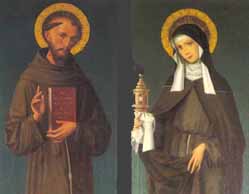
You cannot love another person and not be happy when he’s happy.  That’s not love.  It’s selfishness.  To cave into selfishness is to cave to sin.  Be it our selfishness or the selfishness of another, selfishness has no place in true love.  True love gives even if it hurts.  Look at St. Francis, St. Clare, St. Thomas Aquinas, St. Gianna Molla, St. Elizabeth Ann Seton, Our Lady . . . were they wrong to love God more than they loved their family and friends?

This praiseworthy fidelity, while not seeking any other approval than that of the Lord, “also becomes a living memorial of Jesus’ way of living and acting as the Incarnate Word in relation to the Father and in relation to the brethren” (St. John Paul II).

Listen attentively, not aggressively


bride & groomThe subject of the family is central to any discussion of the Gospel and society.  God has always chosen to reveal Himself through the family.  He created Adam and Eve as parents to the human family.  He called Abram and Sarai to become mother and father of many nations.  He brought Moses out of his biological family, grafting him to a royal Egyptian family so as to bring His Israelite family out of slavery.  He raised the royal family of David from which he would take human nature in the Holy Family at Bethlehem.  His told Mary “Do not be afraid. Go and tell my brothers to go to Galilee,” (Mt. 28:10).  Throughout salvation history, God has spoken to the world through family life and from within the family.

The Franciscans of Life, though we are a very small and young family, are not less or more Catholic than our other Catholic brothers and sisters.  Christ calls us to live the Gospel in the manner that St. Francis of Assisi lived it.  Building on the experiencelogo of St. Francis, we believe that Christ also calls us to remind the world that the Gospel is a gospel of life.

To proclaim the Gospel of Life, one must proclaim the Gospel of the Family.  It is in the family where Life calls out to life (Vita ad vitam vocat).  If we follow the Gospel, we must accept that human life begins within the context of family.  Every human being has a dignity that protects his right to be conceived, nurtured and born into a family.  He has a right to protection, formation, and to receive care from a family.  At the end of life, he has the right to die naturally in the arms of his family.

From within the natural family, God calls men and women to form new and younger families, as well as families of brothers and sisters who consecrate their lives to live francis and clareaccording to the Gospel.  Such a consecration can take different expressions, from monastic, religious order, society of apostolic life, secular institute, diocesan hermits to consecrated virgins.  To the degree that these associations reproduce the relationship between Christ and his apostles, whom he calls “my brothers”, these are real families. They foreshadow family life in the Kingdom of God beginning with the Trinitarian family.

These thoughts help us who are trying to follow the extraordinary synod on the family with great interest.  Our Catholic identity comes from feeling with the Church.  We’re not talking about feeling emotional.  We’re talking about loving God and man with the Church.  To do so, we must know what the Church is thinking.

Here is where we must draw an important line.  We, brothers, remind ourselves that a synod is a listening session for the Holy Father and from that session will come ideas that the Holy Father will consider for the ordinary synod in October 2015.  The Holy Father will exercise his authority once he has all of the information on hand.

Because the synod has no authority, it all rests with the pope.  The brothers are not alarmed by some of the statements that the media alleges that some bishops have made, nor are we alarmed by those that we know some bishops have made.  The Church cannot change revealed truth.

As stated above, to proclaim the Gospel of Life one must proclaim the Gospel of the Family.  However, it is not we who decide what the Gospel says or does not say.  It’s the teaching 1240044_302298416577020_831596592_nmagisterium of the pope that teaches us what the Gospel says.  It’s important to listen carefully to what the bishops are telling the pope about family; because when all of this discussion is over and done with, the pope will probably issue a post synod exhortation that will carry the weight of the Church’s teaching authority.  Listening carefully requires that we withhold reacting to what is being said until the pope speaks.

We don’t have to agree with every idea that the bishops put on the table.  The pope invited them to be honest and candid.  When you have that kind of openness, you’re going to have to put up with a degree of chaos and nonsense as well.  We cannot have open dialogue without crisis.  There is no such thing.  An open dialogue invites all parties to re-examine what we believe and give respectful thought to what we have never thought about before.  This includes those of us who are not in Vatican City right now.  Not only should synod participants be listening attentively, every Catholic must listen attentively and resist the temptation to judge, condemn, and bash anyone who says something that sounds wrong to us.

There are always some challenges.  These are what lead to crisis or struggle.  The speaker may be wrong.  The person may be quoted incorrectly.  The statement may be sloppy so that it does not accurately reflect what the person is really thinking.  The idea may need to be expressed using tighter language so that it avoids ambiguity.

The Franciscans of Life are listening, assessing what makes sense and what sounds outrageous.  Regarding that which sounds outrageous, we are not pointing fingers at any bishop or cardinal.  We are not labeling anyone a Modernist, conservative, liberal or traditionalist.  We are not sounding the alarm of apostasy among the bishops.  On the contrary, if it sounds outrageous to our ears, we try to understand why it sounds outrageous to us.  The statement may truly be outrageous or we may be hearing it incorrectly.

In the meantime, the Franciscans of Life continue to pray for the pope, the synod fathers, the family and the world.  We continue to hold on to what the Church has traditionally taught us NEWMANabout the family; but we are open to the fact that there are always new experiences that help us better understand what God is saying to us about Himself and our salvation.  These experiences should not be ignored.  Very often, new experiences contribute to our understanding of doctrine.  They don’t change the doctrine, but they can enhance our comprehension.

We invite other Catholics to listen attentively.  Be faithful to what the Church has always taught and be honest and humble enough to admit when we realize that we can still be taught more.  No one ever reaches a ceiling of understanding of God and his divine plan for the human family.  Let us avoid characterizations, name calling, judging people, and self-righteousness.  Let us embrace the truth that the Church has taught using whatever experience can help us better understand the truth.

At the end of the day, we’re looking for the truth that God has revealed to us about the family.  We want to understand whatever there is out there to be understood, not just pieces here and there.  If we ignore those whom we consider to be on theJesus and boy opposite side of the house, how would we know that we truly understand what God is revealing to us?  To understand we must listen, ask questions, separate the reasonable from the unreasonable, truth from falsehood, and Gospel from fashion.  Only then will we be on the right path toward achieving our ultimate goal, to know God, serve God and love Him with all of our heart, mind, body and soul, here and in eternity.
Let us listen attentively, not aggressively.


Not the Liturgical Police


I attended mass this Sunday at my favorite parish.  The homilist is one of my favorite priests.  His message is always very good and very orthodox.  So why am I writing this blog entrance? Two important things happened.  I’ll begin with the least positive and conclude with the more positive event.

Father tends to repeat himself a great deal during his homilies, which makes them very long.  Something has not set well with me about these long homilies and I think I figured out what it is.  They unbalance the liturgy.

One of the major concerns when in the liturgical renewal was to give a more prominent place to the Word of God.  The idea of a Liturgy of the Word with three readings and a psalm was born.  But the theology of the mass was not supposed to change.  The mass is still the unbloody sacrifice of Calvary.  The sacrifice must still occupy pride and place during the mass.

However, when your homily is three times longer than the Eucharistic Prayer, when you have the laity reading aloud from their bibles during the homily, the preacher is everywhere but at the pulpit and the style of the homily resembles a Protestant revival more than a Catholic homily, with people calling out, clapping, cheering and more, then there is a problem.  The problem is that the sacrifice is virtually ignored.  People attend the mass because they love Father N’s homilies.  But Fathehr N’s homilies are an event unto themselves that make the Liturgy of the Eucharist pale by comparison.

Another problem enters the picture when Father N repeatedly makes certain comments.  Every preacher has a pet phrase, slogan or idiomatic expression that he will throw in there with some frequency.  We have to make room for the human element.  A preacher is a human being who comes with his culture, his persona and his style.  We can’t and shouldn’t expect them all to be cut out of the same bolt of cloth.  Even identical twins have different personalities, why should all preachers have the same personality?

Having said this, it is important that the preacher beware when his homilies are attracting more attention to him than to God.  This is important, because it’s very easy to upstage God, if the preacher is not careful.  People can see the preacher, but they can’t see God.  Expressions such as:

Never say no to Father.

I’m a priest.

I’ve been a priest for X number of years.

I’m a priest and he’s only a deacon.

When I walk down the street . . . .

Don’t let any priest tell you differently and if he does, send him to me.

Such expressions can be dangerous.  They become more dangerous when the preacher does not realize that they are calling too much attention to him, making it the Liturgy of HIS word instead of the Liturgy of the Word.

Some people would say that this is a weakness of the revised order of the mass and that going back to the Tridentine form would resolve all of this.  This is not true.  These issues have nothing to do with the form.  They are about preachers failing to execute the Liturgy of the Word as Pope Paul VI intended it to be when he revised the missal.

Preachers must also be sensitive to the possibility of using the congregation instead of proclaiming the Word of God to the faithful.  If the congregation is hanging on to your every word, clapping, calling out during your homily, and cheering you on and if this is usual for your homilies, there is a danger here.  The preacher is risking using the congregation to feed his ego.

The sad part here is that these are good priests and deacons.  They don’t have any intention of doing harm, violating the rubrics, attracting attention, or turning the church into a revival tent.  Their intention is to preach a message to the people of God.    When the preacher hijacks his own homily, it’s a sad day.  This can easily happen when Father or Deacon plan their homilies around the message they want to deliver and include themselves too much in the homily.  They fail to factor in how to use that message to help people move from the table of the Word to the altar of sacrifice.

Human beings need help transitioning from one event to another.  We also need to start looking at the mass as the prayer of the Church, not Father X’s mass that we never miss. “Because Father is a great preacher,” or this is the mass that one tries to avoid, “Because it’s Father X’s mass and I don’t like it.  If that’s the only mass left, then I won’t go to any mass this Sunday.”  These are not viable and acceptable reactions to a mass.   However, these are real dangers when people make it Father X’s mass and Father X encourages it with his behavior and his language.  For months I’ve been uncomfortable with this situation, thinking to myself that something bothered me when Father N celebrates the mass.

I did say that two things happened and that the second was very positive for me.  I was angry when I arrived at home.  I left the mass angry.  Suddenly, one of our new aspirants tells me that he plans on visiting with me next week.  I respond that I hope that I’m in a better mood and proceed to tell him how angry I was at this priest.   He reminded me that I had taught him to focus on the parts of the mass, not this person or the next one.  We don’t go to to mass to police the liturgy.

The fact is that I did teach him this.  You never know for whom you work.   I have been teaching all of our men in formation that they attend holy mass to worship God, not to pay attention to what others are saying or doing.  “Just turn them off your impatience and your pride.”

Hearing these things from the aspirant helped me to realize that I was playing liturgical police rather than praying the liturgy.  In his own mild way, Brother put me back in my place using my words.   It’s good to have brothers to humble you whenever you need to be knocked down a peg or two.


Published in: on October 13, 2014 at 1:57 AM  Leave a Comment  

Why do I do this?


I’m trying very hard not to engage in heavy philosophy and theology these days.  I’m tired, my health is poor, my brothers need my attention, it’s “Franciscan Season,” then I have to rest for the Advent Season.  But every once in a while someone says something or publishes bang-head-heresomething that stirs my juices and I can’t turn my brain off.  I keep asking the brothers to elect a new superior.  If someone else were the superior, he could order me to stop thinking about A, B, and C and I would have to make an effort to focus on something else.  But that’s not the way it works these days.

I read an article, which you can read, if you have time.  The link is at the bottom of the page. I refuted the writer’s comments and placed them on Facebook.  In a nutshell, the writer interpreted something that the Holy Father said about Mary as making her part of the Godhead and more important than Jesus.  If you read the article, the Pope never said such a thing.  After my refutation, a poster from Facebook chimed in

To me this is like arguing about which version of Little Red Riding Hood is correct.

I responded like this.  I’m just going to give you snippets of my response.

When we come to the person of Jesus Christ, we have to face the question about a real person who exists in real history, but has two natures, one divine and one human and he proved it to those who knew him. He died on a Friday and walked out of a tomb on a Sunday. Dying is very human. Walking out of a tomb after three days is not normal for human beings to do.

I gave a few other examples such as Jesus walking through walls and asking for food, before moving on to this other point.

VISITATIONNow we have the union of two natures in one man. The divine nature is that of the second person of the Trinity and the human nature is that of Jesus of Nazareth. But the second person of the Trinity, who happens to be pre-existent, is also the infant who was born of Mary and who could not be born, had there not been a mother to carry him for nine months and give birth to him.

Yes, I know that God could have taken on human nature using any means he wished.  But he’s God and I’m not.  Who am I to tell God how to enter the world?

Another post shows up and said  “Not buying any of it.”  That’s fine, because Truth is not for sale.

As Franciscans, we present it, but we don’t try to sell it, shove it down anyone’s throat, or seduce anyone into acceptance.  The Truth is of God and God does not need help to distribute grace. Faith is a gift of grace.  God just asks us to deliver the message.  He does the rest.

021001-N-3228G-008However, I did state that I would give my life for this, meaning that I am willing to die rather than deny that the Second Person of the Trinity broke into human history by taking on human nature from Mary of Nazareth.  I’m not about to argue with him why he didn’t use some other way.  That’s like arguing about technique with the lifeguard who’s trying to save your from drowning.

Of course it finally came out.  The famous question.

Explaining a fairy tale, is just explaining a fairy tale. Where is logic and science?

It seems that some people have elevated science to be the “Source of All Truth”, an assumption that even many non-believers reject.

In a certain sense, modern man is more naive than the ancient Chinese, Romans, Greeks, Aztecs, Incas, Mayans, Brahmans and other great thinkers.  The ancient thinkers never believed that one discipline had all the answers.  Truth is distributed among science, art, nature, human behavior and development, the environment, math, and other disciplines.  Theology studies Truth in order to understand that to which our faith has already given assent.   In plain English, science can only answer some questions, the answers to other questions are to be found in other domains out of the reach of science.

Can science create beauty or something that is beautiful?  Beauty exists before the beautiful.  Science did not create beauty.  It created something beautiful using technology.  Case in point, science does not have all the answers, so why even ask this question?  I explained that science can only deal with that which is contained by space, time or both.

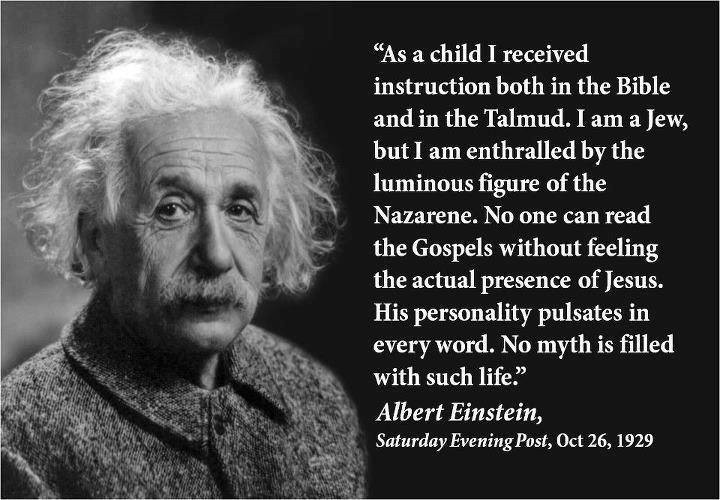
einstein and jesus

Einstein also taught us that space and time are relative to each other and to that which occupies it.  If science could show us all truth, then truth would be limited to space and time.  In which case, there would be no absolute truth, because science is not absolute.  We’d exist in a world of relativism where nothing can be trusted, because nothing is guaranteed.

If there is no absolute truth, then there is no such thing as absolute love, friendship, fidelity, honesty, patience, kindness, compassion, purity, detachment and many other things.  If we contain these things in space and time, they would be relative, not constant.  You couldn’t trust that your feelings for a loved one are the same today as they were when you went to bed last night.  Einstein’s theory of relativity helps us understand the relationship between space and time.  To use a modern word, they’re synced.

I think that Truth has to be bigger than the bubble in which we live.  Einstein would agree.  He once said,

The most beautiful and most profound experience is the sensation of the mystical. It is the sower of all true science. He to whom this emotion is a stranger, who can no longer wonder and stand rapt in awe, is as good as dead. To know that what is impenetrable to us really exists, manifesting itself as the highest wisdom and the most radiant beauty which our dull faculties can comprehend only in their primitive forms.
( Albert Einstein – The Merging of Spirit and Science)

Fr. Miguel Pro, SJ Martyr

Miguel Pro, SJ Gave his life for Christ the King

After explaining why I would give my life for this, I asked my FB friend, “If you were put with your back against the wall and told to believe a falsehood or shot for denying what you believe to be false, which would you choose?”

The response was rather interesting.  “What a ridiculous choice. I would pretend to buy it and walk away, wondering at the stupidity of my captor.”

To which I was forced to respond, “There is the difference between you and I. I would never forfeit my life for a lie, but I would for the truth.”  Our preoccupation with empirical truth has actually deteriorated our ethical character.

So she hit me with, “Your perception of the truth is not necessarily the truth. You have submitted yourself to ideological brainwashing.”

 Here is the weakness in that thinking.  You’re assuming a great deal about the other person.  She’s assuming that I’m naive, ignorant, weak-minded and that she has no need to walk in my shoes, because she has her stuff and mine all figured out.  We can never make such assumptions.  St. Francis never assumed that he understood the other person.  He allowed the other person to open himself up to him and he in turn reciprocated by opening himself to the other.  He took the risk of loving, believing what he could not see and trusting.

I want to do the same.  I want to take the risk of sharing my faith.  I came to the faith on a risk.  I trusted a man named Francis of Assisi.  I believed that he would teach me about Jesus and he did.

For a few years, I lapsed in the faith and underwent a second conversion.  This time I trusted my eyes.  I had completed my studies in neurology and psychology and I’ went through a conversion experience that began in my mind.

As I studied studied neurology and human development. I came to the realization that the How-The-Human-Nervous-System-Works
human brain and its concomitant behaviors are too complex, too ordered, too consistent and at the same time outside of our ability to contain in time and space, which makes them consistently fluid and unpredictable, because we can’t create human experience.  We have to wait for it to happen in order to attempt to understand it.  We can’t create human passions.  We have to wait for them and then analyze them.

For anything that precise to exist free of human control and capable of transcending space and time, while obeying natural law, there must be a Law Giver more intelligent and capable of much more than what I give him credit for.

Why do I do this?  Why do I engage in discussions with fallen away Christians? Because I’m a Franciscan of Life.  God sends us into the world to continue the work of Christ who is the firstborn of many brothers.

What did Christ say was his work, Icame that they may have life, and have it abundantly,” (John 10:10)  The Franciscan of Life is the instrument of Life calling out to life.

imagesCA84KBW0


The article that triggered the dialogue.

http://www.inquisitr.com/1477428/pope-francis-about-to-decree-virgin-mary-to-be-more-important-than-jesus-christ/

Monastic Dad Without Mystic Coffee


This is my last full day of vacation at the home of my daughter and son-in-law. In one sense, I’m sad to be leaving, because I won’t be seeing IMG_3369them again until December. On the other hand, it will be nice to get home, back into my routine and not live out of a suitcase. I don’t see how these folks who travel a lot do it. Living out of a suitcase is not fun.

I’ve made some interesting discoveries during this vacation, discoveries that one does not make in the seminary or on retreat. There are some rules that one must follow if one is a Dad, father-in-law, sibling, theologian and religious superior.

  • If you debate with your family, you will lose every time. Your family does not use the methods of Augustine, Aquinas and Bonaventure and you haven’t used your family’s methods since you left the world; you’re a little rusty.
  • Humor can often be a mystery. You often find yourself wondering what they’re laughing about or you’ll laugh and they won’t understand. Sometimes you get the joke 20 minutes later.
  • If you have a relative who likes to play the Devil’s Advocate, just tell him or her that you accept that you’re as dumb as sheep and move on to pizza. Those of us who are monastic don’t know how to respond to the Devil’s Advocate, because St. John Paul II banned this kind of argumentation in 1983. It’s been a long time since some of us have had to deal with the Devil’s Advocate.
  • Obedience and authority have nothing to do with relationships. Monastic relationships are defined by a hierarchy. You never question a superior or a brother who is older than you are unless he commands you to violate the moral law. Relationships out here are built on respect, love, trust, friendship, cooperation, complementarity and common goals, just as in religious life. However, they are horizontal, not vertical as in a monastic community.
  • Forget structures and schedules. We are very used to following a horarium and doing things a certain way, speaking a certain way, saying some things and never saying other things, or simply doing things in a certain order. In this world, you have to be very flexible. Schedules are governed by work, domestic chores, social commitments and custom. In our world, schedules are governed by the superior, period. He makes up the schedule and the entire community follows along. It’s very easy.
  • As far as what you can or cannot say, the rule and constitutions take care of that. Out here, the rules are not written down. You have to observe. You may often have what I call “The Stupid Look” on your face, because you don’t have a road map for the day or for the conversation. You’re trying to figure out what’s what.

I believe that secular clergy have an advantage over religious men, especially monastic religious. The life of the secular clergy is closer to that of the typical family.  The secular clergyman has never renounced the world. He simply has a different place in the Church. He is a deacon, priest or bishop. But he is not required to distance himself from the secular world.

The life of the monastic is very different. Our first time with our family we may feel like one who is learning to ski. His feet are in two worlds at the same time and he has to keep them from colliding or he will fall.  He’ll feel that he is neither a good monastic nor a good family member.

As a monastic spending time with family, one goes through three stages.

1) You’re excited to see your family; nothing bothers you.

2) You realize that you’re in a different world and you feel anxious.

3) You throw your anxiety into God’s hands and you relax.

Many people think monastic is a place where there is an eight foot wall and you never leave. The truth is that monastic is a way of living and thinking. It can take place in a monastery or on the road. Each order is different. To be monastic is to build your life around prayer, silence, solitude, brotherhood, study, penance and out of that grows service. When you’re a dad and a monastic, your life is very different from that of your adult children, their spouses, and friends.  You have to detach from your old self to become the person Christ means for you to be today.

Which is my strength?


If we had to take a quiz, which virtue would we have to cultivate and which weakness would we have to work to overcome?

St. Francis wrote an admonition that addresses this. I thought I’d share it, because so many people, especially Catholics on all sides of the spectrum are walking around with worries, anger, frustration, and other feelings that take away their interior peace and create noise where there should be interior silence.

Which of virtue do you have to work on?

Read St. Francis’ admonition and examine yourself.

Of the Virtues putting Vices to flight

Where there is charity and wisdom there is neither fear nor ignorance. Where there is patience and humility there is neither anger nor worry. 1 Where there is poverty and joy there is neither cupidity nor avarice. Where there is quiet and meditation there is neither solicitude nor dissipation. Where there is the fear of the Lord to guard the house the enemy cannot find a way to enter. Where there is mercy and discretion there is neither superfluity nor hard-heartedness

Published in: on July 12, 2014 at 7:57 PM  Leave a Comment  

How does morality define discrimination?


If this is true, our country is spiraling out of moral control. Refusing to pay for contraception, abortifacients and anything that violates moral law is not discrimination against women. Discrimination is denying someone what the person has a natural right to have.

Medicare pays a fraction for hearing aids. Many older people have hearing problems. It refuses to pay for prescription glasses without a copay. Most older people need glasses and live on fixed incomes. Medicare clients paid their share of. FICA for years. The current HHS mandate requires no copayment or premium on the part of the employee. Which of the two groups is a victim of discrimination? Discrimination is a grave sin.

When a society discriminates against the elderly, few people notice; because most seniors are part of the voiceless. The Culture of Death has found a voice in the public square.

The Franciscans of Life need everyone’s help to turn the Culture of Death into a Culture of Life. This is our moral obligation as human beings. Let us pray that people will look at these issues and see them as God sees them.

Read more here.
http://www.lifesitenews.com/news/breaking-senate-democrats-introduce-bill-to-overturn-hobby-lobby-decision#

Published in: on July 9, 2014 at 5:49 PM  Leave a Comment  

Lawrence Welk, the Mind and God


I believe that the human mind is the best proof that there is a God whose awesome power and knowledge is unsurpassable. The human mind remains one of the most remarkable mysteries in human existence.
Think about it. Nothing is ever lost. Every event, person, emotion, thought or concept that you ever met, experienced and learned is meticulously stored. It is all possible, because God made it possible. He does not play dice with humanity. We’re not God’s idea of a game of chance.

I was watching a show on the construction of the Statue of Liberty on PBS and I fell asleep. The next show was an old Lawrence Welk show. When I was a little boy, Lawrence Welk and Ed Sullivan were family rituals. My mind must have incorporated the show in the background with one of those wonderfully stored memories. I awoke thinking that I was in my childhood home, with my brothers and sister. The first this I did when I woke up was to call out, “Mommy!”

It took me a few seconds to realize that I was not there, but in the here and now. My mommy went to heaven many years ago. But thanks to God’s incredible wisdom, power and kindness, those memories are very much alive and once in a while, He blesses us with recall. Even the saddest memories are important, because they increase the value and meaning of the happy memories. This reminds me of a question that people often ask me.

“Why did you study neuropsychology and mystical theology as well?” The reason is simple. The study of the mind without religion is lame and religion without understanding the human mind is blind. The truth is that God is very simple; but if He didn’t make Himself complicated, we would never understand Him.

The next time you have doubts about the existence of God, ask yourself if you mind exists. It can’t be examined under a microscope either.

Published in: on July 6, 2014 at 8:32 PM  Leave a Comment