We are proud to present our entirely re-designed community website!

Take a look at it at http://www.franciscansoflife.org and help yourself to donuts and soda while you are at it!

He just visited our new website : )
We are proud to present our entirely re-designed community website!
Take a look at it at http://www.franciscansoflife.org and help yourself to donuts and soda while you are at it!
He just visited our new website : )

A couple of months ago we mentioned that there would be some upcoming articles focusing on Project Joseph and on our family, the Franciscans of Life. The former we addressed in April. Today we continue this “mini series” by answering the question…
Who Are The Franciscans Of Life?

The Franciscans of Life is a private association of Catholic laymen who are celibate, singler, or married. It is the hope of the society to become a public association of the faithful someday, maybe an institute of mixed life, where regular and secular meet.
We exist with the permission and blessing of the Archbishop of Miami, the Most Reverend Thomas Wenski. Men from six countries, four language groups and three generations make up the fraternity.
We attempt to replicate that brotherhood that grew up around Saint Francis of Assisi in the thirteenth century, where there were friars, nuns, married men and women, diocesan priests, widows and single people who followed the Gospel according to the Rule of Penance written by Saint Francis. Today, our fraternity is comprised of men only. There are “regular” brothers who live the evangelical counsels in private vows and “extern” brothers who live the evangelical counsels as single or married men.
Our Way of Life

The Franciscans of Life make a covenant to live the Gospel according to the Rule of Penance and the constitutions of the society. Every brother, celibate, single, or married is a full member of the fraternity. Therefore, each one binds himself to observe obedience to the Church and the superior of the fraternity, to live a life of detachment from material things and temporal honors, and to persevere in chastity in the celibate, single, or married life.
While all of the brothers in Franciscans of Life are lay and secular, we use the term “extern” to identify those brothers who are married or single and hoping to marry, and the term “regular” to identify those brothers who live in community, are in private vows and are celibate.
Eucharist, Liturgy of the Hours, private prayer, fasting and abstinence are the guiding lights for the brothers. Fraternity is a hallmark of Franciscan tradition. Therefore, the brothers look to Christ and the apostles and endeavor to follow that model of fraternal life and service.
Common prayer, sharing, openness to each other, our families, and support for each other along the journey toward the perfection of charity are the means by which the brothers sanctify their lives and the lives of those they touch. The brothers are faithful and obedient to the Catholic Church as she speaks to us through the successor of Peter and the local bishop.
Our Mission

The mission of the fraternity is to proclaim the Gospel of Life through service to the voiceless, in particular the preborn child and his family, the terminally ill and the elderly, the immigrant poor who feels hopeless, and the person living with disabilities.
The brothers engage in a variety of apostolic activities in the Archdiocese of Miami. These include catechesis, campus ministry, Respect Life, prayer vigils at abortion mills, and serving fathers in crisis pregnancies through Project Joseph. Other apostolates are hospice and linking immigrant poor with community resources.
The invisible dimension of the brothers’ mission is a life of atonement for those who embrace the culture of death.
Extern Brothers

The extern brothers live in the secular world, but are not of the world. They are husbands, fathers, and single men. The fraternity is also open to deacons and diocesan priests who have the permission of their bishop to join.
These brothers hold typical jobs in the world and belong to different parishes in the Archdiocese. However, they come together with each other and the regular brothers at the weekly family meeting, liturgical functions, prayer, and apostolic activities.
Those who are husbands and fathers include their spouses and children in as many of the fraternal activities as possible. In this way, the Franciscan spirit is carried into the family and the family is embraced by the fraternity.
The extern brothers and their families engage in the proclamation of the Gospel of Life through participation in activities that promote the sanctity of life.
Regular Brothers
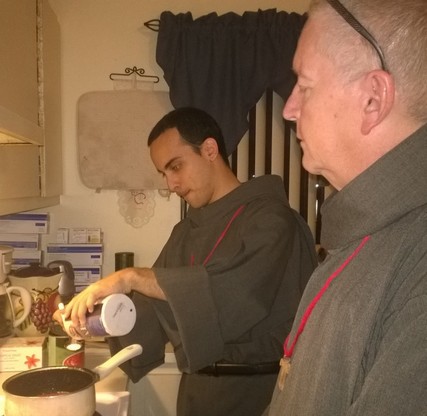
These brothers live in community under the leadership of a superior. They make private vows of obedience, poverty and chastity and are celibate for life.
None of the brothers owns anything individually or in common. They rent their home, share their material resources, and work to provide for their material needs as prescribed by Saint Francis in his Testament. When the income is not enough, the brothers beg as did the early Franciscans.
The daily life of these brothers is comprised of prayer, apostolic service to the voiceless, study, and labor that generates enough income to support the brothers and their work for the poor.
Under the guidance and encouragement of a superior also known as a guardian, the brothers strive to live as a family where brother serves brother as Christ served the apostles when he washed their feet at the Last Supper. These brothers spend a great deal of time together at prayer, work, ministry, study, recreation and rest.
Trinitarian

Like Saint Francis and the first generation Franciscans, the Franciscans of Life look to the Trinity for guidance and example in community, intimacy, love, unity and holiness.
Marian
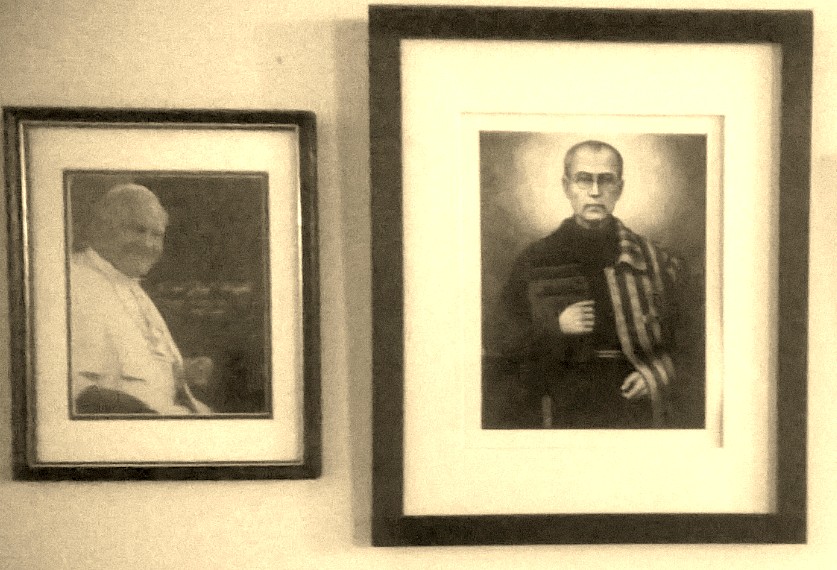
Saint Maximilian Kolbe and Saint John Paul II are the patrons of the Franciscans of Life. From these saints we learn to live under the mantle of the Immaculate and to protect the sanctity of life from conception to death.
“Vita ad vitam vocat…”
Prayerfully consider whether the Lord is inviting you to walk the way with us. In doing so, bear in mind the sayings of our patron saints: “Do not be afraid…forget not love!”
We look forward to hearing from you!


In 2009 Brother Jay Rivera, founder of the Franciscans of Life, was volunteering at Respect Life’s Pregnancy Care Center in Hollywood, Florida when he began to notice that the fathers of the infants in danger of being aborted were not being served by Respect Life Ministry.
It was not that the Archdiocese had anything against the dads. Simply . . . no one noticed. Men dropped off the expectant mother at the center, be it for class, counseling or material assistance, and sat in their cars, drove away or waited in the waiting area. The volunteers who served at the center would eagerly jump to the assistance of the expectant mother, but would have little or no interaction with the father. As Brother Jay watched, the thought hit him. “This is very much like Planned Parenthood and other ‘pro-choice’ organizations. Pregnancy is a woman’s issue.”
Like many other Franciscan fraternities, the Franciscans of Life place themselves under the protection of the Immaculate. Brother began to pray to the Immaculate for guidance. He also spoke to Joan Crown, Archdiocesan Director of Respect Life Ministry for the Archdiocese of Miami.
He laid out before them his concern that the fathers of the preborn babies were out of the loop. They didn’t know what to do or what was expected of them. Many of them were frightened by the sudden news of a pregnancy, wanted to walk away from the situation in the hopes that it would go away or offered to pay for an abortion as one would pay someone compensation for damages in an accident. The mothers were holding on to their preborn babies, but uncertain whether to go forward with the pregnancy.
Thanks to the support from the volunteer counselors and teachers at Respect Life, most of the mothers were determined to give the pregnancy a chance. However, giving your preborn child a chance is not the same as eagerly awaiting his birth. That chance can be revoked at any time.
Brother began walking up to the dads in the parked cars and invited them to come into the center. The men seemed friendly enough, but not too sure what to do about this invitation. They were hesitant. Of course, Brother Jay had no idea what he was going to do with the men either. He knew that he had to offer them something.
Finally one father, whom we shall call David, came inside. He was not too eager to be there, but he seemed curious to find out what this older gentleman who looked like a monk wanted. The first time that he entered the center they spoke for about 45 minutes about anything that came up.
That night, Brother again knelt in prayer asking for guidance. He prayed to St. Francis of Assisi, founder of the Franciscan family, to the Immaculate, patroness of the Franciscans, and to St. Maximilian Kolbe, a Franciscan saint who is the patron of pro-life workers. Simply put, he called a team meeting and placed the situation on the table.
“We have preborn children who are at risk for abandonment and death, if both father and mother don’t step up to the plate. But they don’t know what to do and I don’t know what to teach them, because there is so much information out there and such little time here.”
While at prayer he felt someone saying, “Give it to St. Joseph.”
The next day would be the first Sunday of the month, the day that the Secular and Regular Franciscans have their local community gathering. Brother went to bed and dreamed. He was in a small room that was illumined, but there were no signs of electricity, no flames, or windows. The room just glowed. In the room stood a friar with his back to the door. Brother Jay recognized this friar as Brother Francis of Assisi. Brother Jay saw the grey sleeve of Francis’ habit rise as he raised his arm pointing to something in front of them. When he looked, Brother Jay saw a wooden statue of St. Joseph, about 10 inches tall, holding the child Jesus in one arm and something green in the other hand.
The next day, he attended the fraternity meeting and shared his concern with his Franciscan brothers and sisters. He mentioned the dream as well. A Franciscan sister who was at the meeting got up and left the room.
She came back with a white box. As she handed the white box to Brother Jay, she said:
“Someone gave this to me about 12 years ago. I have another, so I put it in my closet waiting to find someone to whom I could give it. This morning, as I was getting ready to come to the gathering, something told me to put this in my car. I think it’s for you.”
When Brother opened the box, there was the wooden statue that he had seen in his dream. It was 10 inches tall. St. Joseph was holding the child Jesus in one arm and something green in the other hand. They were lilies.
This was the confirmation. Saint Joseph had accepted the challenge. He would walk with Brother Jay and the expectant dads in crisis pregnancies.

Today, Project Joseph has evolved into an archdiocesan network of formation and service for men who are in crisis pregnancies.
The program operates out of four of the five archdiocesan pregnancy help centers: Hollywood, North Dade, South Dade and Fort Lauderdale.
At each center there is at least one trained mentor who provides small group education to fathers, counseling and material assistance.
Fathers may attend an entire program of 18 modules divided into three blocks of six: Becoming a Better Man; Parenting; Future Planning.
After completing this set of modules, fathers are invited to continue in the program where they receive education and support in other areas of fatherhood such as:
Dads are “paid” Parent Dollars for every session they attend. They can cash in these parent dollars for anything from diapers to cribs and mattresses. A father may join Project Joseph at any point from the moment of conception until the child is one-year old. Project Joseph is always there to help if a father needs to return later.
There is no charge for the services that we provide, nor do we charge the Archdiocese of Miami for such services. Project Joseph is financed through grants and donations.
Through the year, Project Joseph serves approximately 20 fathers per week, 50 weeks out of the year. The only time the program is closed is during Holy Week and Christmas week.
It is run by men for men. Our mentors are volunteers from the community. They are Catholics in good standing with the Church.
The Franciscans of Life provide initial and ongoing formation for the mentors.
Project Joseph is grounded in the spirituality of St. Francis of Assisi.
Fathers and mentors are brothers who walk side by side on this journey, as did Saint Francis of Assisi and those whom he and his brothers served. The mentors approach the fathers from the “bottom up”. Like Saint Francis, they are here to serve, not to preach, teach, correct, discipline or be heard. They preach the Gospel through their lives and through their unconditional love for every man whom they serve. We train our mentors in the pastoral methods of Saint Maximilian Kolbe, a Franciscan Friar and patron of pro-life workers.
Like his spiritual father, Saint Francis, Saint Maximilian placed his trust in the Immaculate. He planted the seed and allowed her to guide him and those with whom he walked. Like Christ, he was willing to lay down his life for his brother, especially if that brother was the father of a family. Our mentors are formed in the spirit of total detachment from self and confidence in the Immaculate and Divine Providence. We do what we need to do for the dads and we get out of God’s way.
If you are a man in the Archdiocese of Miami, ask yourself if God is inviting you to help us proclaim the Gospel of Life by walking with your brothers. Do not worry about not knowing what to do. We in the apostolate will walk with you and our brothers. Contact us to find out more!
Below is a short video about Project Joseph:
We had a great couple of days for Project Joseph and the Franciscans of Life!
On Saturday, March 21st, the Franciscans of Life attended the 5th Catholic Men’s Conference of the Archdiocese of Miami. The event, which featured Catholic apologist Tim Staples, took place at St. Mark Catholic Church. We represented Project Joseph along with some of the mentors of Respect Life Ministry.

Our display included some literature and a poster describing the roots of Project Joseph and where it is today. It also featured pictures that the Project Joseph dads allowed us to share, either of their classes or of their beautiful children.
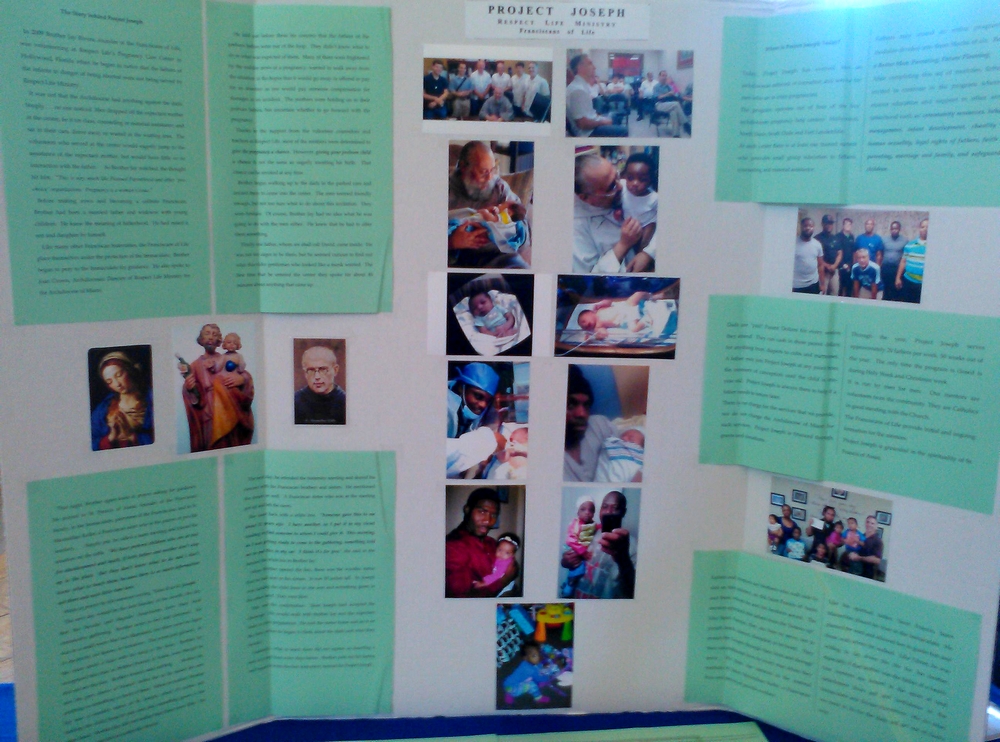
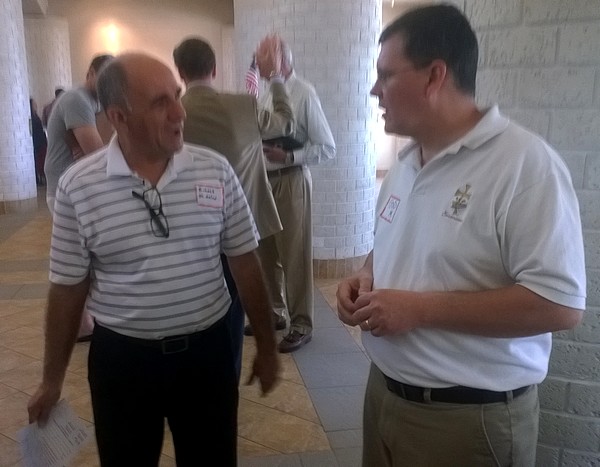
The event was well attended, and we had a chance to talk with several men, some of whom were dads themselves, and present to them information about Project Joseph, as well as invite them to our upcoming workshop.


On Monday, March 23rd we had the joy of receiving Brother Luis as a novice. He received the name Brother Luis Charbel, FFV.
As a secular brother, Br. Charbel exchanges the cord that holds the wooden tau around his neck from a brown one to a red one. The red signifies the Sacred Blood shed by Christ during His Passion, and constitutes for Br. Charbel a reminder that he is called to “obey as Christ obeyed, without murmuring, complaints and resentment”, in order to “live perfect charity as Christ taught us on the cross”.
The exchange of the color and the reception of a new name are for the secular Franciscan of Life “an outward sign of his desire for transformation from the old man enslaved by sin to the new man, liberated by the Passion and Resurrection of Jesus Christ”. It was a beautiful and moving reception, attended by the regular and secular Franciscans of Life and their families. Brother Jay directed the ceremony, and Brother Bernardo offered a reflection on the call and life of the secular brothers.
In the next days we will feature more news about FFV and Project Joseph…stay tuned! 🙂
Every year, Respect Life hosts a “Walk for Life” at Archbishop McCarthy High School to support the Hollywood Pregnancy Center, which provides counseling, education, material assistance, and support to men and women in crisis pregnancies.

It is not uncommon for the three-hour event to witness hundreds of “walkers” who are animated by great music, refreshments, and the Holy Rosary. The event also provides an opportunity for students to earn community service hours.
This year, some of our brothers joined the Walk. It was a great time; we even made some new friends!

This week, I’ve had the privilege of working with many parents and their children. When you work in the field of evangelization, you get to meet many families. I consider it pretty special. I always walk away feeling that I have exchanged gifts. It can be an individual member of a family or an entire family who gives me a gift and to whom I give a gift.
For the sake of privacy and because it would be silly to give so many details, I’m going to combine all of my families into three groups.
GROUP I:
I received a letter from someone whom I do not know. I have never met this person or any member of her family. It was a lovely letter.
Brother JR, I just wanted to thank you – you were so instrumental in our family’s conversion five years ago. I spent many long hours reading your articles, which were always gentle and full of the beauty of the faith. For that, for helping us know the beauty of the Catholic Church, I am forever grateful.
God bless you, and please know you’re in my prayers.
This letter moved me a great deal. The Holy Spirit can use anything and anyone to save. The key is to be aware of that one is an instrument, not the solution to a problem and certainly not God. Messages like this help us.
My articles are not written with children in mind. They’re written for adults. This means that an adult in the family read the articles and shared it with spouse and children. This is a parent who has found a means to evangelize the family, a means that works for that family. This is the duty of parents, to bring their families to the faith.
GROUP II:
The other case is also a letter representative of how other parents think. I have the honor of helping some men and women discern their vocation. I like to think of it as walking alongside them. At the end of the day, God does the calling and they respond. I’m just there to make sure that the person is paying attention.
In vocation discernment, I not only walk with the inquirer, but I often walk with the parents, if they allow it.
During the walk, I have received many positive and holy reactions from parents, especially those parents who have given God a hearing. I call it a hearing, because they have sought me out or invited me to their home so as to understand what it is that God is asking of them and their sons. I’m not God and I’m not the son. I’m the middleman. I get the opportunity to have some wonderful conversations with parents about consecrated life, marriage, Holy Orders, and parenting. I received a letter from a parent that really speaks for the several parents with whom I’ve spoken and edited it for privacy and brevity.
Dear Br. Jay,
God’s greatest gifts to a couple are their children. It is with great joy and love for God that we support our son’s aspiration to become a religious brother or any other vocation he chooses. Our son . . . and our family are blessed to have you in our lives. May our God of love and peace keep you healthy to continue to serve Him.
With much love and admiration,
I had to share this message, because I’ve heard this from other parents. They understand that their children are a gift. They understand that giving their son or daughter license to respond to God’s plan for his or her life is an act of love for God and the child. They understand that having a guide is a blessing that God gives to the family, to the son or daughter and to the guide. We’re all blessed that God has called us to cooperate with Him in His plan for the salvation of this soul. They have understood the most important part of all. God has a plan for every human being who is conceived.
“Before I formed you in the womb I knew you, and before you were born I consecrated you; I appointed you a prophet to the nations.” Jer 1:5
One’s vocation in life has already been written in God’s heart before one ever existed. All one has to do is follow what God puts before you in the present moment. He takes care of the rest.
GROUP III:
I also have had experience with a third group of families who struggle with the idea of a vocation to the priesthood and to the consecrated life. The reasons for their struggles can be many. I believe that the bottom line is that they are worried about their children’s happiness. But here is where faith should enter the picture.
One’s happiness is not dependent on the parent. A man’s happiness is dependent on the choices he makes. If he chooses to cooperate with God’s plan for his life, he will be happy. If he chooses some other plan (no matter how noble), he may as well sign his own death sentence. There is no happiness outside of God’s plan for you.
In these families, parents want to take charge and direct the son or daughter in whatever direction they believes is best for the adult child. There can be validity to this. If my son or daughter were dating someone with a criminal background and were talking marriage, I have a duty to warn my child. At the end of the day, it is my child who consents to the marriage or not. It is not I who consent. My duty before God and child is to guide. Guidance is not the same as control, manipulation, placing temptations before our children to get them to change their minds (See Thomas Aquinas), nor is it the same as commanding, threatening or using guilt.
The Catechism of the Catholic Church tells us that children living at home have to submit to their parents, meaning to their rules, because it’s the parents’ home. They do not have to submit to that which is not beneficial to their soul.
As they grow up, children should continue to respect their parents. They should anticipate their wishes, willingly seek their advice, and accept their just admonitions. Obedience toward parents ceases with the emancipation of the children; not so respect, which is always owed to them. This respect has its roots in the fear of God, one of the gifts of the Holy Spirit. (Catechism of the Catholic Church, 2217).
Our faith also tells us that
“Parents must regard their children as children of God and respect them as human persons. Showing themselves obedient to the will of the Father in heaven, they educate their children to fulfill God’s law,” (Catechism of the Catholic Church, 2222)
And finally, our faith tells us,
“Parents should respect and encourage their children’s vocations. They should remember and teach that the first calling of the Christian is to follow Jesus (Catechism of the Catholic Church, 2253).
Occasionally, the adult child is up against a parent that seems to have forgotten this. If I could send a message to parents it would be very simple.
Man was created to cooperate with God, not compete with Him. To compete with God is to place oneself and one’s child on a slippery slope. Don’t do it. You may regret it. You never know the long-term damage that you may do to your child’s soul.
Some important points to remember.
First, for the parent, competing with God is contrary to the vocation of parenting. It raises the question, where is God in this picture?
Therefore, life must be treated with the greatest reverence. Creating obstacles that interfere with the development of a person’s life according to God’s plan runs the risk of violating the sanctity of that person’s life.
I encourage all parents on this slope to step back. We don’t have to agree with our children’s choices of a vocation. Our daughter can bring home the last man on earth whom we would pick for her husband; but if there is no moral impediment and he makes her happy, I have to trust that God loves me and loves my child.
Second, for the child, one may never yield to the will of another, when that will is in conflict with God’s plan.
This includes other people as well, not just parents. It’s not a license to rebel against parents and follow others down the wrong path.
God makes His plans pretty clear through people, prayer, scripture, sacraments, and events in our lives. Love of parents is binding until death; but love of God is the first and greatest commandment and it does not end at death. We are called to love God for eternity.
We too must trust that even if our vocational choice causes our parents some grief, God loves our parents more than we do. He will give them what they need. We can never give our parents what God can give them. We need to move on and give to God what He asks and take what He gives. Sometimes, the grief is part of God’s plan. There is such a thing as redemptive suffering.
Father Mitch Pacwa tells the story of how his father swore that he would never speak to him again and would disown him if he joined the Jesuits. Mother Angelica told the story of how she had to run away from home to join the Poor Clares, because her mother would not hear of it. I know that Mother Angelica’s mother eventually softened and actually entered the community. I don’t know if Mr. Pacwa ever made peace with his son. These two people are examples of a man and a woman who would not stand on the slippery slope with their parents, no matter how much they loved them. Regardless of how much or how little they understood God’s plan for their lives, they knew that they had to follow the lead that God was giving them. God would unwrap the rest with time.
If you keep another person company on a slippery slope, because it will make them happy, you may want to ask yourself the question that Christ asked St. Francis. “Is it better to serve the Master or the servant?”
We must love and assist our parents in every way we can. But we must always serve the Master first. When we do, He will give us the means to honor our father and mother. Was Mary abandoned by Christ? Yet Christ said,
“Here are my mother and my brothers! For whoever does the will of my Father in heaven is my brother and sister and mother.” (Matt 12:49-50)
God is both merciful and just. He will have mercy on those who live according to His plan. Beware of God’s justice. It is not God who punishes. God’s justice is an act of love. He allows us to live and die with the consequences of our choices.
Jesus said, “Amen, I say to you, there is no one who has given up house or brothers or sisters or mother or father or children or lands for my sake and for the sake of the gospel 30 who will not receive a hundred times more now in this present age: houses and brothers and sisters and mothers and children and lands, with persecutions, and eternal life in the age to come. (Mark 10:29-30)
God created families, parents and children. When he did so, he had a plan for each member of the family. None of us can presume to love our parents, spouses, or children more than God loves them. All of us must see our families as a gift that is part a plan in the mind of God. We have to allow God to unfold that plan little by little. As He unfolds it, He also gives us the resources to love each family member even more than we do now. In the meantime, we follow the lead that he places before us. If parents and children make an honest mistake, God will help us find our way.
St. John XXIII said, “Follow the signs of the times.”
 There are many things about my life, apostolate and role in my community that I love. But I believe the one thing that I love the most is the many interesting questions that people ask me, not to mention the fact that the people are equally interesting.
In discussing life’s choices with people, I often hear the word “hurt”. Many conscientious people are fearful of hurting others by their choices, especially their parents and siblings. This is laudable. We must always avoid intentionally doing something that will harm another person, be it a parent or a stranger. However, we must be very careful here.
There are two key words there, “intentional” and “harm”. When harm is intentional, a person knows that this particular evil choice will do harm to another person and he goes forward with it. This does not mean that good choices never cause pain. They often do. But the choice remains good. One has a moral duty to choose the good and avoid evil. When there are two goods to be chosen, one has a moral duty to choose the higher good, if there is freedom to do so.
Let’s apply this to vocation. A vocation is a call from God to man. God calls man to one of several states in life: marriage, holy orders, or some form of consecrated life. These are all good, because they are all from God and lead back to God. However, they don’t lead  everyone back to God. If someone forces himself into a marriage to please another person, it is very difficult to find a path to God in a marriage where one is responding to the wishes of another and not to a call from God.
The same holds true the other way around. One may walk away from a call from God to please another person, because we don’t want to cause pain. Let’s assume that all things point to the consecrated life or to Holy Orders. One’s heart is already there. Along come a parent or sibling, and one holds back from responding to God’s call so as not to cause this other person pain. What has one done?
In effect, one has inverted the order of love. The Commandment is very clear. “Love God above all things and your neighbor as yourself.” In choosing to avoid the higher good so as not to hurt the other person, we have placed that person above God and brought God down to our level. We have no problems sacrificing neither ourselves, nor God in this case. We just don’t want to sacrifice the other. We have assigned the highest place to the neighbor and the second place to God alongside ourselves.
No human being has the right to claim God’s place in our hearts and in our choices. Nor do we have the right to assign God’s place to another, no matter how much we love that person. There are some things that God wants us to do for others and some things that He reserves for Himself as the Lord and Giver of life.
Let’s remember, when discerning God’s will for our lives, the answer is always in the order of love. The first place belongs to God. We respond by doing that which pleases God first and neighbor second. It always pleases God that we make every attempt to serve and please our  neighbor, but never at His expense. To do so would be a sin against justice. God does have rights. Therefore, he has first claim on our lives, whether we’re speaking about parents and children, husbands and wives, or brothers and sisters. None of these have rights that trump God’s right to our love and surrender. If anyone of them claim what is rightfully God’s, it is rightful to resist.
We may never do anyone intentional harm. Intentional harm is an avoidable act that will hurt the other person . Following God’s will is never to be avoided. How do we know when we’re following God’s will?
First, there is knowledge. We know that something is good and pleasing to God. Our faith enlightens our knowledge.
Second, there is peace. Even though we know that some tears will be shed, we know that we can place the situation in God’s hands and that in His eternal time, He will comfort those who mourn and reward the generous.
Third, we know that those who truly love us will not grieve forever. As they realize that we are happy and that we are where we belong, they will be happy.
You cannot love another person and not be happy when he’s happy. That’s not love. It’s selfishness. To cave into selfishness is to cave to sin. Be it our selfishness or the selfishness of another, selfishness has no place in true love. True love gives even if it hurts. Look at St. Francis, St. Clare, St. Thomas Aquinas, St. Gianna Molla, St. Elizabeth Ann Seton, Our Lady . . . were they wrong to love God more than they loved their family and friends?
This praiseworthy
fidelity, while not seeking any other approval than that of the Lord, “also becomes a living memorial of Jesus’ way of living and acting as the Incarnate Word in relation to the Father and in relation to the brethren” (St. John Paul II).
 The subject of the family is central to any discussion of the Gospel and society. God has always chosen to reveal Himself through the family. He created Adam and Eve as parents to the human family. He called Abram and Sarai to become mother and father of many nations. He brought Moses out of his biological family, grafting him to a royal Egyptian family so as to bring His Israelite family out of slavery. He raised the royal family of David from which he would take human nature in the Holy Family at Bethlehem. His told Mary “Do not be afraid. Go and tell my brothers to go to Galilee,” (Mt. 28:10). Throughout salvation history, God has spoken to the world through family life and from within the family.
The Franciscans of Life, though we are a very small and young family, are not less or more Catholic than our other Catholic brothers and sisters. Christ calls us to live the Gospel in the manner that St. Francis of Assisi lived it. Building on the experience of St. Francis, we believe that Christ also calls us to remind the world that the Gospel is a gospel of life.
To proclaim the Gospel of Life, one must proclaim the Gospel of the Family. It is in the family where Life calls out to life (Vita ad vitam vocat). If we follow the Gospel, we must accept that human life begins within the context of family. Every human being has a dignity that protects his right to be conceived, nurtured and born into a family. He has a right to protection, formation, and to receive care from a family. At the end of life, he has the right to die naturally in the arms of his family.
From within the natural family, God calls men and women to form new and younger families, as well as families of brothers and sisters who consecrate their lives to live 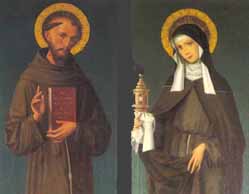 according to the Gospel. Such a consecration can take different expressions, from monastic, religious order, society of apostolic life, secular institute, diocesan hermits to consecrated virgins. To the degree that these associations reproduce the relationship between Christ and his apostles, whom he calls “my brothers”, these are real families. They foreshadow family life in the Kingdom of God beginning with the Trinitarian family.
These thoughts help us who are trying to follow the extraordinary synod on the family with great interest. Our Catholic identity comes from feeling with the Church. We’re not talking about feeling emotional. We’re talking about loving God and man with the Church. To do so, we must know what the Church is thinking.
Here is where we must draw an important line. We, brothers, remind ourselves that a synod is a listening session for the Holy Father and from that session will come ideas that the Holy Father will consider for the ordinary synod in October 2015. The Holy Father will exercise his authority once he has all of the information on hand.
Because the synod has no authority, it all rests with the pope. The brothers are not alarmed by some of the statements that the media alleges that some bishops have made, nor are we alarmed by those that we know some bishops have made. The Church cannot change revealed truth.
As stated above, to proclaim the Gospel of Life one must proclaim the Gospel of the Family. However, it is not we who decide what the Gospel says or does not say. It’s the teaching  magisterium of the pope that teaches us what the Gospel says. It’s important to listen carefully to what the bishops are telling the pope about family; because when all of this discussion is over and done with, the pope will probably issue a post synod exhortation that will carry the weight of the Church’s teaching authority. Listening carefully requires that we withhold reacting to what is being said until the pope speaks.
We don’t have to agree with every idea that the bishops put on the table. The pope invited them to be honest and candid. When you have that kind of openness, you’re going to have to put up with a degree of chaos and nonsense as well. We cannot have open dialogue without crisis. There is no such thing. An open dialogue invites all parties to re-examine what we believe and give respectful thought to what we have never thought about before. This includes those of us who are not in Vatican City right now. Not only should synod participants be listening attentively, every Catholic must listen attentively and resist the temptation to judge, condemn, and bash anyone who says something that sounds wrong to us.
There are always some challenges. These are what lead to crisis or struggle. The speaker may be wrong. The person may be quoted incorrectly. The statement may be sloppy so that it does not accurately reflect what the person is really thinking. The idea may need to be expressed using tighter language so that it avoids ambiguity.
The Franciscans of Life are listening, assessing what makes sense and what sounds outrageous. Regarding that which sounds outrageous, we are not pointing fingers at any bishop or cardinal. We are not labeling anyone a Modernist, conservative, liberal or traditionalist. We are not sounding the alarm of apostasy among the bishops. On the contrary, if it sounds outrageous to our ears, we try to understand why it sounds outrageous to us. The statement may truly be outrageous or we may be hearing it incorrectly.
In the meantime, the Franciscans of Life continue to pray for the pope, the synod fathers, the family and the world. We continue to hold on to what the Church has traditionally taught us  about the family; but we are open to the fact that there are always new experiences that help us better understand what God is saying to us about Himself and our salvation. These experiences should not be ignored. Very often, new experiences contribute to our understanding of doctrine. They don’t change the doctrine, but they can enhance our comprehension.
We invite other Catholics to listen attentively. Be faithful to what the Church has always taught and be honest and humble enough to admit when we realize that we can still be taught more. No one ever reaches a ceiling of understanding of God and his divine plan for the human family. Let us avoid characterizations, name calling, judging people, and self-righteousness. Let us embrace the truth that the Church has taught using whatever experience can help us better understand the truth.
At the end of the day, we’re looking for the truth that God has revealed to us about the family. We want to understand whatever there is out there to be understood, not just pieces here and there. If we ignore those whom we consider to be on the opposite side of the house, how would we know that we truly understand what God is revealing to us? To understand we must listen, ask questions, separate the reasonable from the unreasonable, truth from falsehood, and Gospel from fashion. Only then will we be on the right path toward achieving our ultimate goal, to know God, serve God and love Him with all of our heart, mind, body and soul, here and in eternity.
Let us listen attentively, not aggressively.
 OK, so Brother Jay is back in the hospital, excuse me, it’s his timeshare. 🙂
He was rushed in by ambulance on Tuesday morning, not doing well at all. Most of the day was spent in restlessness. On Tuesday night, Brother Christopher Thomas visited and Brother Jay brightened up. They had a great visit together with lots of comments and laughter. In the meantime, the nurse was keeping a

Br. Christopher Thomas, FFV
close eye on things, which neither brother observed.
On Wednesday, the calls, text messages, and emails from the other brothers kept pouring in. Wednesday evening Aspirant Bernardo visited Brother. Every time Brother Jay heard
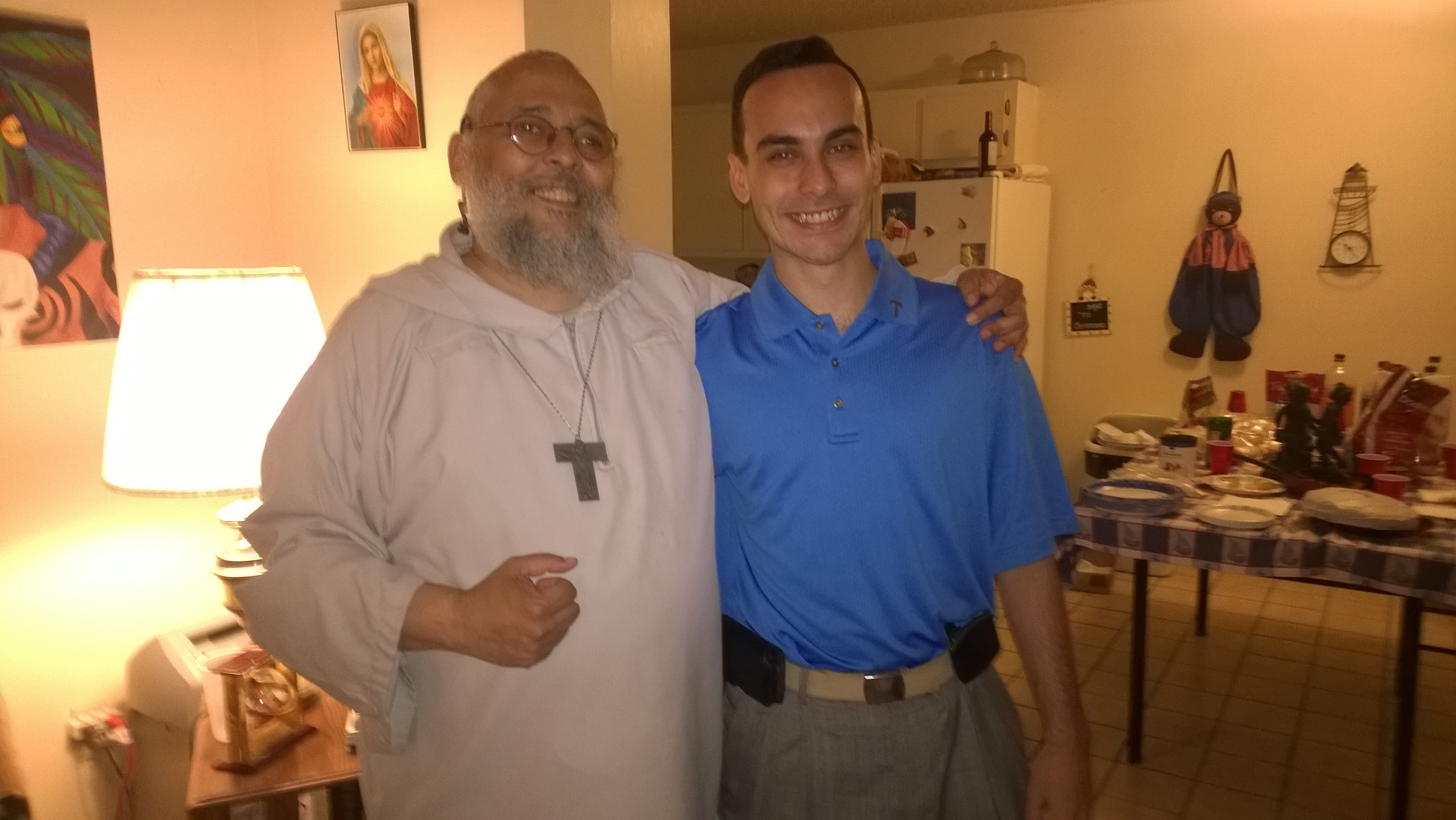
Br. Jay, FFV & Aspirant Bernardo, FFV
from one of his brothers, he smiled. There was a warm feeling inside that is difficult to explain. However, as I have always said, “If you experience peace and joy in a particular space, call out like Ricky Ricardo, ‘Honey! I’m home’.” This space need not be an actual physical place. It can also be a relationship. Brotherhood is definitely a relationship that happens in many spaces.
Real brotherhood does not need explanations. Remember the saying. “Preach always, when necessary use words.” Your relationship with your brothers should speak of the relationship within the Trinity, the relationship between Christ and his apostles, your relationship with Christ and with his people.
While Bernardo and Chris were visiting, nurses and therapists were entering and leaving the room. But the charge nurse was the same for both nights. She had observed Brother Jay every time he was in contact with a brother, personally or by way of technology.
As Bernardo was leaving, she could no longer hold back her question. She asked the two brothers (Bernardo and Jay) “Are you guys always this happy when you’re together?” To which they both answered, “Yes.” Brother Jay quickly added, he’s my little brother. Everyone chuckled as Bernardo and the nurse left. But now follows the good part.

Brothers keep their superior company as he catches his breadth.
The nurse was watching. No sooner had Bernardo turned the corner, she quickly snuck into Brother’s room and asked again. “You guys seem to really enjoy each other’s company. I noticed it last night too. Is the other gentleman related to you?” The other gentleman is Brother Chris.
“Yes, he’s another brother,” said Brother Jay.
“I hate to be nosy, but I noticed that you talked to some people on the telephone and received some texts while I’ve been in here and you light up. The medicine must be working.” How’s that for subtle?
Brother responded, “Well, I think that the medication is working, but the most important part of the therapy is not the chemical, but the human element. You see those two chaps whom you’ve met?”
Nod.
“And the texts and telephone calls?”
Nod.
“Those are all my brothers. There are seven of us. We’re not biological brothers. The bond is tighter than that. We were not coincidently born into the same family. God called us and we freely responded. We belong to a very small family.” He then went on to explain Franciscans to a curious person who is Protestant and who believed that Catholics never use the bible. When she heard the Franciscan brotherhood is built upon revealed truth, starting with Sacred Scripture, she was in awe.
This led to questions about celibacy vs marriage. Brother quickly dispelled this myth.
Celiba
cy and marriage are not in competition. They are ways of life. The best way of life is the one where you find peace and joy. Sometimes, we get so fixated on one way of life, usually marriage, that we never hear God’s proposal to a marriage between His Son and our soul. Very often, God will throw a monkey wrench into our plans to remind us that he has a plan of his own. However, God does not impose, he proposes, like an insistent lover. At the end of the day, we choose celibacy or marriage.
Brother then explained that the brothers come in two wrappers, married and celibate. Brotherhood is not defined by the way you live out God’s invitation to holiness.
Brotherhood is defined by joy, a sense of belonging, mutual respect, tolerance for each other’s weaknesses and eccentricities, and intimacy (allowing the other brother to walk through the corridors of your heart). If you find peace and joy in this experience then you have arrived where you belong right now.
We’re sharing this with you because Brother Chris made a prophetic statement. When Brother Jay told him that he may have a longer visit to the hospital, Chris said “Maybe God wants you to do some hospital ministry.” Every time Jay is in the hospital, something draws in some of the staff and questions begin. Up to that point, nothing had happened. Chris was referring to these past experiences. In a few hours, this wonderful dialogue with the nurse took place.
It all began and ended with “being rather than doing”. Being joyful brothers rather than busy brothers, is the greatest witness to the Gospel and the greatest sign that one has arrived home.


The Solemnity of St. Francis of Assisi is just around the corner. I’m moved to write a few thoughts on it. What a surprise, right?
Our Holy Father Francis was a man who walked in many shoes. He was a family man, even though he was never married. He had parents and siblings and was very close to all of them. He was a patriot who went off to war to fight for Assisi ending up as a prisoner of war for one year. Fast forward just a little and we see him living the life of a hermit and a penitent asking God to tell him what to do next. He was a layman, religious brother and very late in his life, a deacon. Pope Innocent III approved the order 1209. Pope Honorius gave the final approval to the Rule in 1223. It seems that this is when Francis was tonsured.
It’s rare that I meet a deacon who does not remind me that Francis was one of them. In philosophy we learn that words have meaning. For the sake of clarity, let’s establish that Francis lived 800 years ago. Today’s deacon shares in Christ’s Diakonia as Francis did in the 13th century.
Peter said to him, “You shall never wash my feet.” Jesus answered him, “If I do not wash you, youhave no part in me,” (John 13:8).
Simply put, he’s one of their predecessors in the diaconate. As we approach the feast day of one of the world’s most celebrated deacons, after Stephen the martyr, there are some points that deacons may want to reflect on.
Rev. Brother Francis Bernadone did not limit himself to identifying with the poor, nor did he stop at giving back his father’s name, fortune and future inheritance. He saw the poverty of Christ at the Last Supper, at Calvary and in the Eucharist. The God of creation n remains with us, out of pure love, fully alive in his glorified body under the appearance of the most basic forms of food, bread and wine. Christ chose bread and wine in order to remain with all men. Bread and wine are found in every culture. In the Eucharist, Francis contemplates the poverty of Christ and he has only one desire, to make Christ’s poverty his bride. Francis’ place at the altar went beyond performing certain liturgical functions; it was about becoming a poor man as Christ was poor on the altar of Calvary.
Can today’s deacons say the same about themselves? Can they say that they see Christ’s poverty? Can they say that they aspire to make Christ’s poverty their own or do they gloss over it, as Francis used to say, by labeling it “spiritual poverty” or “poverty of spirit,” terms that Francis considered a form of white washing.
Deacon Francis wanted only one thing. He wanted to reflect perfection. Thus he spent most of his life trying to become The Mirror of Perfection, that mirror which reflects the perfection of Christ. He became the reflection of the perfect deacon, Jesus Christ who came to serve, not to be served, Jesus Christ who said,
“Go and tell John what you have seen and heard: the blind receive their sight, the lame walk, lepers are cleansed, and the deaf hear, the dead are raised up, the poor have good news preached to them,” (John 7:22).
Francis became the servant of the voiceless as was Christ. Diakonia, in Franciscan tradition, takes its inspiration from Christ who is one with the poor and serves among them. In Francis’ mind, being a deacon and being a Friar Minor were perfectly compatible as long as the deacon focused on union with the voiceless and in service of the voiceless.
Francis also placed his ministry at the service of his brothers, not above his brothers. It would seem that the idea of permanent deacons became difficult to fit into the Franciscan tradition when the diaconate became a transitional step toward the priesthood and when deacons themselves assumed a clerical attitude. Some deacons are readily available and visible for liturgical functions and missing in action among the voiceless and among those who ask for their help with the faith. Francis was to be found more often serving the sick, teaching the crowds, listening to a young man struggling with the faith, or serving food to the hungry, than he was serving at a liturgy. That’s probably why we Franciscans don’t remember him as a deacon, but as a brother, teacher and spiritual father.
Those who are deacons of the mysteries of Jesus Christ must please all men in all ways. For they are not deacons of meats and drinks [only] but servants of the church of God (St. Ignatius of Antioch)
Vita ad Vitam Vocat
 3.
3. Franciscans of Life