Aftereffects of Holy Mass


The following is a non-exhaustive list of the aftereffects of Holy Mass:

  1. Peace:

My soul and my mind are at peace.  It shows in:

  • The ability to communicate with others (human and animal) in a peaceful manner.
  • The strength to brush off words, events and people that usually rattle me.
  • The absence of anger in my mind, words and actions.

  1. Humility:

The realization that I am what I am before God.  I am nothing more and nothing less, as evidenced by:

  • An effort to present myself to others as I really am:
    1. Without fears
    2. Without pride
    3. Without condescension
    4. With sincerity that is not blunt or offensive
  • Apologizing if I am in the wrong
  • Remembering that I don’t have to do battle with the world

  1. Charity:

I give more to others than what they expect, as evidenced by

  • Greeting with a smile
  • Waiting patiently in the parking lot
  • Yielding the right of way to others
  • Refrain from name calling or ridiculing others
  • Reminding myself that as I treat others, so I treat Christ
  • Avoiding sternness (intimidating rigidity)

  1. Faith:

No doubt that I have witnessed the sacrifice at Calvary and that I have received the body and blood of the living Christ:

  • Comfortable explaining the Eucharist to others
  • Not becoming upset if others are upset that I go to mass too often
  • Remembering that everything in life does not have to be explained to be believed, life has mysteries
  • Aware of God’s presence wherever I go and whatever I do, and of His awareness of my thoughts and intentions


If this is not happening, one must question him or herself: “Am I focusing on the right things?

These are also the sort of things the devout soul – especially the consecrated man or woman – must discuss with a spiritual director.

Published in: on April 3, 2017 at 1:00 AM  Comments (1)  

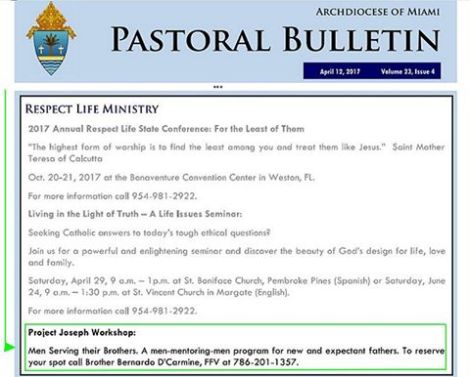
Project Joseph Training – April 29 2017


MEN 25+ IN THE ARCHDIOCESE OF MIAMI: COME, LEARN ABOUT PROJECT JOSEPH AND HOW TO HELP MEN IN CRISIS PREGNANCY.

Official Event Link

To learn more visit www.projectjoseph.org

– You can also RSVP on Facebook –

UPDATES

A huge THANK YOU to the Archdiocese of Miami for including the announcement of the workshop in the Pastoral Bulletin of April, and to the Knights of Columbus of Miami-Dade, Broward, and Monroe County for promoting the workshop.

We look forward to prepare more men so that they be ready to mentor dads in the Archdiocese of Miami’s 5 Pregnancy Help Centers.


Published in: on March 20, 2017 at 2:31 PM  Leave a Comment  

DOES MAN HAVE MORAL RIGHTS OR COINCIDENTAL RIGHTS?


We have some major moral issues on the table that ethics cannot ignore.  We pose them here in question form to allow each reader to arrive at his or her own conclusions, always guided by a well-formed conscience rather than what’s simply comfortable.

1. Is it moral to strip 24 million people of affordable healthcare?

  • Are there alternatives that can help the economy without doing harm to the voiceless?

2. The speculation is that the current government will defund Planned Parenthood for one year.

  • Is this enough to protect the right to be born?  If not, what makes this a moral gesture?

3. There are individuals in government who are seriously considering defunding Meals on Wheels. If that were to happen, 2.4 million senior citizens would lose the one healthy meal they eat.

  • How can we morally justify taking a food resource away from those who cannot buy food?

4. In the Old Testament God delivered the Jewish people from slavery in Egypt, and led them to a promised land where there were already people. In the New Testament, Jesus says, “I was a stranger and you took me in.”  In both situations, the moral option being presented is openness to those who are seeking sanctuary. 

  • Could the people of that time deny sanctuary to the Jews and justify themselves before God?
  • Can we offer God a strong moral reason for denying sanctuary to refugees?
  • Can we say, with certain honesty, that foreign refugees pose a greater threat to human life than those who sell and purchase guns illegally or those involved in drug trafficking and human trafficking?

5. Assisted suicide and direct euthanasia are legal in some countries and being considered in the United States. The argument is that persons whose quality of life fails to meet certain criteria are better off dead.  Even atheists must ask themselves how can one ethically and morally support the taking of a life that is not a direct threat to our safety or that of our family?

  • Who decides the criteria for euthanasia?
  • Are the criteria arbitrary?
  • In that case, is human life an arbitrary coincidence?
  • If man is an accident of nature, how can he claim natural and moral rights?

If I had to face God’s judgement today, can I justify my position and my silence on any of these issues? 

St. Thomas Aquinas reminds us that he who sees sin and remains quiet is as guilty as the person committing the sinful act.

Published in: on March 17, 2017 at 12:32 PM  Leave a Comment  

Do you dare to “Entrust your life”


Many people look at St. Francis of Assisi as someone to be admired, but too difficult to follow.  We often hear, “St. Francis was a saint; I’m not.”  That’s the point.  St. Francis was not born a saint.  He grew physically, emotionally, intellectually and spiritually.  He became a saint through his efforts and the help of Grace.

Today, the Franciscans of Life seek only one thing.  As the psalmist said, “One thing I ask of the Lord; this I seek: To dwell in the house of the Lord all the days of my life, to gaze on the Lord’s beauty, to visit his temple,” (Psalm 27:4).

We’re a brotherhood of married (Extern Brothers) and celibate men (Regular Brothers) that seeks to recover the original way of life of the early Franciscan family, both the friars and the secular penitents. 

Regular Brothers vow obedience, poverty, and chastity.  We live in a community house.  We are profession-of-vowsconsecrated to the Immaculate and we make a fourth vow, to proclaim the Gospel of Life.  Regular Brothers comes from the Latin “regula,” those who live in brotherhood guided by a rule of life.

We consecrate ourselves to live in the “house of the Lord” all the days of our lives.  Every brother crucifies himself next to Christ calling out to his Redeemer, “Remember me . . . “(Luke 23:42). 

Ancient rabbis taught that, after the coming of the Messiah, all sacrifices would cease except the Todah (the perfect sacrifice of thanksgiving), which would never cease to be offered throughout all eternity.  The sacrifice of the cross is the Todah.  Christ’s blood can roll backwards to the first sinner and forward to the last.

Christ_and_Francis“You cannot glory; that, however, in which we may glory is in our infirmities, and in bearing daily the holy cross of our Lord Jesus Christ.” (Admonitions V, St. Francis of Assisi).

Like the “Good Thief”, St. Dismas, every Regular Brother entrusts his eternal life to the perfect sacrifice offered by Christ yesterday, today and tomorrow.  The brother consecrates himself to live the Gospel living the Rule that St. Francis gave the Brothers and Sisters of Penance as our Constitutions explain it for us.

We strive to live the Gospel in an intense life of prayer, penancelogo_of_the_ffv, and poverty. We freely exercise our ministry to the voiceless, paying special attention to the preborn child and his family, the chronically and terminally ill and their families and caregivers, and the immigrant poor. (Constitutions, Part II, Chap one, Parr 1).   http://www.franciscansoflife.org/Constitutiones.pdf  

The Regular Brothers day has a fluid structure, not unlike that of a Benedictine day, but in a smaller family unit which is by its very nature very informal.  The vows are a means to an end.  We vow to strive, with the help of Grace, to live the virtues of obedience, poverty and chastity in the manner that St. Francis lived.

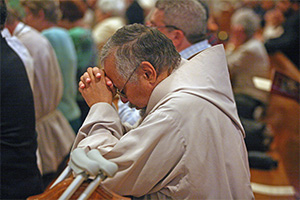
Our effort is sustained by the common recitation of the Divine Office (Liturgy of the Hours), Lectio Archbishop Thomas Wenski celebrates Mass for Nascent LifeDivina, spiritual reading, silent prayer in solitude, keeping a log of our faults (the Culpa) and keeping a journal of God’s activity in our lives.  Community worship, prayer, Eucharistic adoration, meals, recreation and apostolate are essential to the primitive Franciscan life. 

Discipline is an essential element of our life.  Every night, we proclaim our faults before our brothers and open our hearts and minds to hear and heed whatever correction they may offer in charity. 

Blessed is the servant who bears discipline, accusation, and blame from others as patiently as if they came from himself. Blessed is the servant who, when reproved, mildly submits, modestly obeys, humbly confesses, and willingly satisfies. Blessed is the servant who is not prompt to excuse himself and who humbly bears shame and reproof for sin when he is without fault, (Admonition 23)clock

We make proper use of the time that God has given us, with full knowledge that only God is the Lord of Time, not man.  Therefore, time is not man’s property to waste. 

St. Francis taught the first-generation Franciscans that silence is a necessary part of our way of life.  While we do not observe a strict silence as do Cistercians, we do observe exterior silence to achieve interior silence.

“Blessed is that servant who does not speak through hope of reward and who does not manifest everything and is not ‘hasty to speak,’ but who wisely foresees what he ought to say and answer,” (Admonition 22).wp_20150118_016

Finally, fasting and abstinence on Wednesdays and Fridays are essential to the way that we live and to the discipline in which we need strength to grow in virtue. 

“Living this Rule transforms us in, with, and for, the Love of God so that we, in humble ways, begin to transform our world by serving as the voice of the voiceless and offering penance for those who do homeless mothernot do penance. A penitential life resounds a constant invitation to prayer and self-mastery

 Prayer, fasting, abstinence, temperance, and a solid, family based Christian response to others drive all our daily activities in the home, fraternity and the world,” (Constitutions, Part II, Chap Six, Parr 49).

 As Jesus said to the first disciples, “Come and see.”  http://franciscansoflife.org/

An installment of the life of the Extern Franciscan of Life will soon be available.  Check in with us as often as possible so that you don’t miss it.

_____________________________________________________

Help us extend our apostolate.  Visit our  home page to donate through PayPal.  God Bless you!


Published in: on March 8, 2017 at 3:34 PM  Leave a Comment  

David and John


How-The-Human-Nervous-System-WorksDuring Lent, many of us agonize over what we should sacrifice during this holy period in preparation for the celebration of Easter.  Chocolate seems to be the most common “expiatory lamb.”

I’ve always wondered how giving up chocolate is a real penance.  I realize that for some people, chocolate is addictive, as is smoking for others.  But is the idea of penance to make ourselves miserable for misery’s sake or is the idea of penance to offer God something in atonement for our sins?

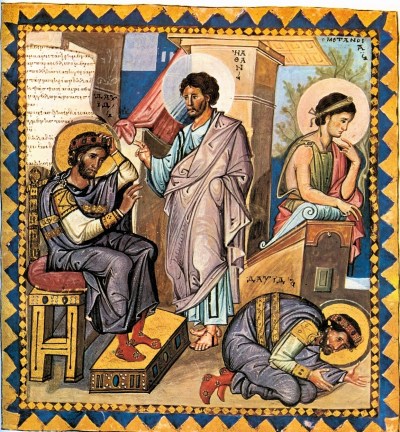
If we look at the Old Testament, David dressed in sackcloth and ashes as a sign of atonement and

paris_psaulter_gr139_fol136v

NATHAN REBUKING DAVID FOR HIS SIN

was excoriated by Nathan.  But it was a sign.  His atonement included much more than making a fashion statement.  David fasted.  He dealt more justly with his people, especially those whom he had offended.  He offered the animal sacrifice prescribed in the law.  Above all, he prayed.  Many of the psalms are the product of David’s intense life of penitential prayer.  David has become the model penitential man for the Jewish and Christian people.


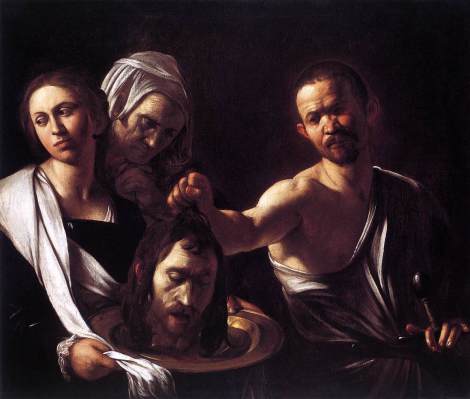
Another personality that jumps out at us as a model penitent is John the Baptist.  The New Testament tells us that he came dressed in animal skins and ate bugs.  Yuck!  He preached conversion from sin.  His fight against sin cost him his head when he pointed out that Herod was living in an adulterous relationship with his sister-in-law.  David and John are still relevant penitent models.

musc3a9e_de_lille_p-_f-_de_grebber

JOHN REBUKING HEROD ANTIPAS

David teaches us that atonement for sin goes beyond, “I’m sorry.”  There are consequences that the responsibly contrite person must assume.  This was the king who walked through his kingdom in sackcloth and ashes, dressed as a pauper instead of royal robes.  This was the king who humbled himself before his people admitting that he had sinned against God and against man.  He tried to do something to make it up to both God and man.  David understood and taught that true penance must cost us something and that it should offer a gift to God and man; but it had to be a gift that came from the penitent’s heart, not from his wallet.

John, on the other hand, had no sin for which to atone.  But he knew that many people around him needed to atone for sin.  He did penance for those who didn’t do penance for themselves.   Essential to a penitent life is to bear witness to the Truth.  John proclaims,

caravaggiosalomelondon

“Behold the Lamb of God, and I must decrease so that he can increase.”  By decreasing, John, like David before him, surrenders the glory that comes from attention and admiration and directs it to God.

Our life should be an on-going Lent.  But during the Great Lent, 40 days before Easter, let us be truly sorry for our sins.  David and John are our models of penance.  We must present ourselves to the world, not in the best possible light, but as we really are, men and women who struggle with human weakness and sin, one hour at a time. True penance reaches out to those around us, especially those who are most in need of our compassion, the man and woman involved in abortion, the adolescent who is rebelling out of control, the neighbor who has lost a loved one, lost a job or is in deep financial crisis.  The person whom we fear is also worthy of our love and prayer, especially those who engage in acts of terrorism, those who molest children, or those who abuse their spouses.

In our family, there is always the one person who is the thorn in the side.  We must have the courage of

dscf1003

THE INEVITABLE THORN

John and denounce his or her sin.  But we must also have the humility of David and admit that we too are sinners. Finally, let us not forget to proclaim the Truth.  God forgives and embraces a humble man.  Humility is being who we are in the sight of God.  Nothing else.


Published in: on March 2, 2017 at 12:23 AM  Leave a Comment  

You’re invited to a Lenten walk


san damianoIt feels as if we just took down the Christmas decorations, lights and trees.  Yet, Lent will be here in less than two weeks.

Lent is a time of penance.  For many people, the word “penance” is a negative word.  They choose to refer to Lent as a time of “conversion.”  The assumption being that every Catholic knows that the Church means conversion from sin to virtue; which has an a priori condition to it.  One must acknowledge one’s sins, ask for absolution in the Sacrament of Confession and have a firm resolve not to sin again.  Being human, we often fall into the same sinful hole from which we were just rescued by the Sacrament of Penance.  However, we keep trying.

Sorrow for our sins, confession, absolution and a firm resolution to avoid sin brings many graces.  The early Fathers of the Church taught us that the only way to overcome sin and not end up confessing the same sin time and time again was through concrete acts of penance, as we shall see below.

“Convert and believe in the Gospel” in plain English means, stop sinning and live per the Gospel.  The idea of believing in something with which we are unfamiliar and we don’t follow, is silly.

The Franciscans of Life suggest that you to try one or more of the following this Lent.  Don’t overwhelm yourself.  Usually that leads to failure, which leads to frustration and abandonment of our good intentions.  It’s like overfilling your plate at an “all you can eat buffet”.  You can only eat so much; the rest is thrown into the garbage.

We invite you and your friends to join the Franciscans of Life this Lent.   You can join us from your home.  If you you’re male and live in South Florida, you can join us on a Monday night family meeting.

First:  We’re going to begin with a good examination of conscience.  This means that we’re going to take inventory of the sins we have committed as well as the things that we should have done, but failed to do.  If you have poor memory, make a little list for yourself.  Make sure to dispose of it properly when you no longer need it.

Second:  We’re going to Confession as soon as we can get there.  As soon as we can get there means exactly that.  Go to confession as soon as there is a priest to absolve you.  Never put off what may never happen, if you get hit by a bus the day after tomorrow.  You had better go to confession tomorrow instead of postponing it until next week.

Third:  The Franciscans of Life invite you to join us in doing penance to atone for our sins.  The keyword here is ATONE.  We don’t do penance to feel good. We do penance, because we know that we have sinned and that we must make up for it.  If you steal from me, you must ask for forgiveness.  Justice demands that you return what you took or offer to pay for it.  The same is true with God and sin.  God forgives, but his justice demands that you make retribution for your sins.

Our first commitment this Lent is fasting and abstinence.  Every Wednesday and Friday, from Ash Wednesday to Good Friday, the brothers observe a fast and do not eat any kind of meat or meat product.  This does not mean that we replace steak with crab, lobster or baked salmon.  You may as well have the steak.  It’s probably cheaper.  Tuna, eggs, or simply a nice soup with bread is enough.  It’s not as if we were going to do this forever.    Obviously, we use common sense.  People with certain health conditions or those who are too young or too old should not engage in a fast. Maybe they can abstain from something else, such as the Internet.

Fourth:  Try to get an extra mass in at least once during the week.  If your schedule does not coincide with your parish’s daily mass schedule, make a visit to the Blessed Sacrament at least once or twice a week.

Fifth:  Pray with your bible.  You can pray a psalm or two every day.  You can read a short passage from the scriptures and ask yourself how you would respond in a specific situation in the Bible.  Ask God for the grace to do so.  Storing up on grace for when we need it is the best savings plan around.

Sixth:  We’re going to be doing something concrete for those who are not as fortunate as we are.  We’re going to collect money to purchase soap, shampoo, toothpaste and toothbrushes to those who have none.  We’re also going to be praying a weekly rosary for those who are being persecuted and those who are refugees and have no place to go.  We’re going to beg the Immaculate to help us help them.  If she wants to help them in her own way, that’s good too.  But we must never dump on God, Our Lady and the saints asking them to solve problems that we can help solve.  We start asking for the grace to find ways to reach out to our neighbor and we conclude by asking God to find another way, if He believes that it’s the better way to go.

You don’t have to live in our community house to join us.  If you care to join us in one or more of these penances during Lent, please let us know by writing to us at

email

Please include your first name only, age (so that we can offer you appropriate support) and anything else that you want to tell us about yourself.

Always your brother and servant,

Brother Jay, FFV, Superior

JPII W EUCHARIST
In a few weeks, we will be announcing the time and day for our evening of contemplation that we call Carceri (Prison) in honor of the Prisoner of Love.  Stay tuned in to this blog for that information.


Published in: on February 18, 2017 at 5:02 PM  Leave a Comment  

Sequel to a Canine Homily


After mass this morning, I left thinking about the deacon’s homily.  Before I go any further, this is not a criticism of the homily.  As a matter-of-fact, the homily triggered the grey matter between my ears.   The result is that I have found that I can build on the foundation that the deacon laid out this morning.

The Gospel has one line that struck me like Thor’s hammer, “your light must shine in the sight of men, so that, seeing your good works, they may give the praise to your Father in heaven.’ (Mt 5:13).  Today’s homily reminded us that the Christian vocation is to be a light for the world.

There are probably as many interpretations of the “light” imagery as there were people at mass.  For each of us our interpretation may meet our spiritual needs.  We must hang on to it.

However, we are not a Church of individuals.  We are a Community of Shared Meaning.  We believe in one set of absolute truths.

A light is that which illumines the darkness.  St. Ignatius of Loyola, one of the spiritual masters in Church history, teaches us that man is in a constant state of tension between two angels, the angel of light and the angel of darkness.  The angel of light leads us away from sin toward God.  The angel of darkness leads us in the opposite direction.

If we apply what St. Ignatius teaches us to what Matthew the Evangelist quotes from the mouth of Jesus, it becomes clear that we are called to be the light of the world.  But we can only be a light to the world when we choose to be led by the angel of light, not the angel of darkness.

The angel of light is the Angel of Truth.  While the angel of darkness, is the Angel of Sin.

To be a light in the world, we must be very aware of what sin is and the natural consequences for those who follow the Angel of Sin.  Sin is not a matter of personal feeling.  It’s not even a matter of personal belief.  I can’t say to God that I did this or that, because I believed it was the right thing to do, when God has clearly spoken through the scriptures, through the Fathers of the Church and Sacred Tradition and through the Magisterium (the teaching authority of the Church).  That will not fly with God.  We cannot justify ourselves because we disagree with God and believe that our opinion is better than His or that He always agrees with us.  The man who is a true light of the world is the man who knowingly chooses to follow the Angel of Truth, even when truth is hard to swallow.

The man of darkness, is he who follows the Angel of Sin, because he has decided that his personal belief about what’s right and wrong trumps the truth that God revealed about right and wrong.

This morning the deacon said that we can choose to “feed the good wolf or the bad wolf.”  For people who suffer from cynophobia (look it up), there is no such thing as a “good canine”.    So, let’s use St. Ignatius, who said the same thing using language from the great Catholic mystics.

If you choose to do and to support truth that has been revealed by God through the Church, the Scriptures and Sacred Tradition, you are a powerful light to those who care to look.  People like St. Francis of Assisi were not small lights.  Their fidelity to God’s moral law and to the Truth taught to us by God through the Church and Scripture turned them into bright stars that continue to shed light hundreds of years after their death.

To be a light, there is only one choice.  Run away from sin.

Published in: on February 5, 2017 at 2:40 PM  Comments (1)  

The Power of Words: Word Control


Nothing on earth does greater harm to the human community than the absence of “word control”.  Word control applies to the written word as well as the spoken word and thoughts.  Those who use social media to express their feelings and opinions can do just a much harm as those who speak recklessly.  We can’t examine every possible situation in life, but we can look at some of the more common misbehaviors and learn what the proper behavior should be.

So, you’re in a bad mood.

One can be in a bad mood for many reasons: fatigue, sleep deprivation, illness, worries, or the aftermath of a conflict.  Being in a bad mood for any of these situations or others is not out of the ordinary for any animal.  Even dogs and cats have good days and bad days.  Is it OK to snap at people, ignore others, command those whom we should not command or simply whine?  Would you allow your dog to snap at you, because he’s in a bad mood or your cat to dig his claws into you?

Alternative appropriate behavior:  The first appropriate behavior is silence. One must bite one’s tongue rather than use it as a sharp cutting edge.

The second appropriate behavior is to be reasonable.  Not everyone around us is our enemy.  Why push others away with our caustic remarks and behaviors?  Remember, everything gets old, even if it comes from people we love.  How long can a parent or a spouse tolerate such behavior?

Body language that sends very clear signals, “Beware of dog,” doesn’t delete our bad mood and certainly does nothing for others.  This can be an open window that allows divisive evil to enter the scene. Smiling at someone who has done no harm can be an act of heroic charity.

Spouses are neither our property nor our children.

There seems to be a mistaken notion, in some homes, that a spouse can be spoken to as if he or she were an indentured servant or a child.  A spouse who believes that he can rattle the other is setting a very poor example of social skills, justice, and charity.  No spouse has the right to command the other to do or not to do something.   Much less does any spouse have the right to lay a hand on the other.  It’s immoral.  It makes a bad situation worse.  Someone can get hurt.  In a home with children, it teaches children that the only way to win is to shout and strike.

Appropriate behavior when you disagree with your spouse:  The best thing to do is to say nothing, initially.  “Let me think about this,” is a perfectly respectful response.  Then you put some distance between you and the other person.  Avoid, if you can, leaving the house. Nothing is as offensive to a human being than to see a door closing between the person he loves and the self.  At this point, disagreement can feel like dismissiveness.  Taking the dog for a walk is OK; but let the other spouse know that you’re going to walk the dog.  You’re not running away from the disagreement.  Besides, disagreements don’t go away, because we leave.

Once you’re alone, you must be honest with yourself.  You must ask yourself what is that you find disagreeable and why?  Finding something disagreeable, because it’s not the way that I think things should be is not much of an argument.  On the other hand, if the way I think things should be is better for the good of the marriage and the household, then I need to communicate that.  It’s more effective than saying, “I don’t agree,”  “Nope!”

There is a big difference between commanding and bullying a spouse and requesting, suggesting, or simply disagreeing.

Gossiping with yourself

We do this more often than we care to count.  Spreading gossip, where one is telling the truth, exaggerating it or simply lying, is sinful.  It violates several moral laws, the first one being justice.  Everyone has a right to a good reputation.  Not everyone has the need to know about another person’s life.  If someone’s good reputation is damaged, let his actions speak for themselves.  They don’t need your help.

Back to gossiping with oneself. We engage in what I call loop talking.  Loop talking is when we repeat to ourselves every fault that we find in another person.  We repeat it so often that it becomes a loop.  We do it without pushing the play button.  The evil part here is that in time our souls becomes darker and darker with resentment.  When we cross a certain point, it’s very difficult to undo the program that we have installed in our minds.  We need help.

Alternative and appropriate behavior, rather than gossiping to yourself:  If there is someone whom you trust not to spread gossip, such as a confessor, spouse, superior or spiritual director, they may be a good place to “dump” your feelings.

If you find that you’re repeating the same negative thoughts about another person more than 24-hours, it’s time to have a talk with the other person, not a confrontation.  Sometimes, it’s difficult to talk to someone who does not listen or fails to understand.  An attempt to speak to such a person can lead to frustration, anger, hatred and even vindictiveness.  Best not to have that heart-to-heart talk, without a mediator, never alone.

Unless the other person is Satan himself, every human being has something positive that he or she brings to the table.  Very often, these persons have done something good for us.  Taking an inventory of the good that this person has contributed to the group or to my life can be a way of changing the recording.  I’m engaging in a more positive dialogue with myself.

I must always remember, none of us can change another person.  But all of us can do something to change what we think, what we say about others and how we deliver the message.

Everyone disagrees with authority figures at some point in one’s life.

This is not unusual.  When an authority figure asks for something against God’s law, one has no obligation to agree or obey that specific request or command.   People in positions of authority make mistakes.  One can even say that they often make foolish mistakes.

Appropriate response to authority:  We must make sure that the person has the right to command that which he or she commands.  Never forget that those who exercise authority legitimately, have the right to command what is within the scope of their role. This includes things that make no sense to us.  There is no rule that says that people in authority must always make sense.  We hope they do make sense.  But don’t expect that to be the case all the time.

Ask yourself, “Is this request a violation of God’s moral laws?”  You should also ask yourself, “Does this request undermine a command from a higher authority, a person higher in the hierarchy of authority?”

When this is the case, you have a moral duty to explain why you cannot comply.  But you do not have the right to use an aggressive tone of voice, vulgar words, raise your voice, or walk out before the person in authority has the final word.

Remember, your issue is with a very specific command that violates moral duty.  Your issue is not with the person giving the command and much less with the office that he or she occupies.  You must remain close to that person and that office.  Otherwise, you break communion with the person in authority.  What do you do now that you have severed your ties with the person at the top?

Bossy People

There are some people who have difficulty suggesting, requesting, asking for, and least of all persuading others.  They simply speak to others as if they were the authority and the other person the subordinate.

Appropriate behavior for bossy people:  The first suggestion is that if you can’t say it without commanding, being quiet may be a good idea.

Take careful note to whom it is that you’re speaking.  If the other person is the authority and you’re the subordinate, but you’re doing the commanding, you’re probably being rude and in violation of justice.

If you’re the person in authority, remember this.  The most effective person in a position of authority is not authoritarian.  Good leaders are frank, respectful, assertive, kind, and flexible.  They know how to listen and to how much they should listen.

The subordinate person would be wise to let the person in authority have the last word.  If you try to have the last word, you’re letting your pride do the driving.  Humility goes a lot further than arrogance.

Language must be used responsibly.  Language was given to man to express the wonders of life and to communicate Divine Truths.  The world was created when “God said”.  (Genesis).  “In the beginning was the Word”. (John)
Published in: on February 4, 2017 at 3:02 PM  Leave a Comment  

To Women of Faith


This year we have heard much talk on women’s rights and women’s healthcare.

Unfortunately the natural and divine rights of women never form part of the discussion.

When God created woman using whatever method served the ultimate good of women, He instilled into natural law His divine plan for women. Believers and non-believers who are properly educated know of the existence of Natural Law. Human logic cannot deny the existence of Natural Law. Nothing that follows a fixed process is random. It submits to a series of laws that allow the process to repeat itself. These fixed processes are laws that exist independent of human will.

ngc1300_hubble

The first and most significant process is conception. Without conception, a species becomes extinct. The conception of a human being secures the continuity of humanity. The child that is conceived has a purpose, to secure the future of the human race. To fulfill his or her mission, the child must emerge from the womb into the greater world of man. Therefore he follows the logic.

begin_beginning

A human being in the womb has a mission and a place in society. To fulfill that mission and fill in the place that only she can fill, because of her singularity, she must emerge from her mother’s womb. Therefore, we can logically conclude that a human being has the right to be born.

The right to be born is inseparable from a woman’s right to bear children. But a right that is a burden is not much of  a right, unless we understand pregnancy as a burden. If pregnancy were a natural burden, how can it also be nature’s way of securing the continuity of the human race? Can we honestly say that the preservation of humanity is a burden imposed on the female of the human race? Such a conclusion is absurd to the extreme. The conception and birth of a child, under any circumstance and with whatever abilities or disabilities, is not a burden placed or imposed on women.

2017_01_25_christmas_babyConception and pregnancy is one right and at the same time a duty belonging to mother and child. Women who conceive have a right to carry a child to term. They also have a duty to protect the child’s right to be born. A child comes into the world to fulfill a mission, to occupy a place in society that no one else can occupy, and to secure the generativity of the human race.

Therefore, women have a natural right to be mothers. To shame them or frighten them to avoid motherhood is a heinous violation of a natural law that is given only to women. It is a covert form of mind control.

familyThe right to motherhood must be protected by other rights: healthcare, education, safety, protection from abuse and exploitation, equal pay for equal work, and the right to extend herself to family, friends, public service, and to participate as an equal partner with men in business and governance.

For the sake of clarity, equal does not mean the same. A ten-year-old child has the same rights as her mother, but they are also very different. The ten-year-old only gets to exercise these rights when she has the physical, intellectual, and emotional ability to do so.

So too it is between men and women.. Each has the right to those life domains in the measure that he or she is able to do so. The measure of a woman’s ability to exercise other rights is never determined by her male counterpart. The measure to which a woman exercises her rights is dependent on her natural abilities. Neither women nor men can interfere with or deprive one of abilities endowed by nature and by nature’s Creator.

prolife_feminist


Published in: on January 26, 2017 at 7:28 PM  Leave a Comment  

Our Forefathers Have Been Betrayed


As we approach the inauguration of a new presidency and the anniversary of Roe vs Wade, I assume that many of our friends expect the Franciscans of Life to say something wise and uplifting.  Try as I did, I was unable to come up with anything wise to say.  Perhaps is the fact that I fell today and lacerated my forehead.  Thank God that my cranium was not currently occupied.  In any case, I can’t come up with some wise and profound comment to make.  So, I’ll let my simple country logic do the talking.

Roe vs Wade must never be forgotten, not only because it made abortion a constitutional right in our country, but it did much more.  It stripped the preborn human being of the right to be born.  Roe vs Wade was one of the most selfish acts that the American people have ever perpetrated on its citizens.

Our Founding Fathers rebelled against a monarchy and parliament that was tyrannical, a king and government that had no respect for the basic human rights of its citizens on the western side of the Atlantic.  As far as the English crown was concerned, the colonists and their descendants were to be silenced when it came to matters that affected their lives, the lives of their families and the future of the kingdom.  We must say “kingdom”, because on July 3, 1776 there was no United States.  There was simply the American colonies and territories of the English Kingdom.

But our forefathers changed all that.  They fought and many gave their lives for the right to live, the right to have a voice about their lives, and the right to choose their future.

Hilary Clinton once said that the unborn CHILD has no constitutional rights.  The issue on the table is not whether the being in the womb is a person, human being, child or other.  The question has been settled.  The being in the womb is a CHILD.

The laws of nature dictate that the child of two human beings cannot be a chimpanzee.  He must be a human being, regardless of his parents’ faults and virtues.

Yet, this human being, who lives in our midst, is denied the right to be born.

We have dared to do the unimaginable.  We have dared betray the memory of those who fought for our right to life, liberty and the pursuit of happiness.  We betrayed their dream of a nation where people were given the right to live according to the graces endowed by their Creator, as Thomas Jefferson so eloquently wrote.

We have misrepresented the mind of the Founding Fathers, the Declaration of Independence and the Constitution.  In other words, we have hijacked the American dream.

Roe vs Wade limits the right to life, freedom and the pursuit of happiness to those who have the power and cold-heartedness to terminate the life of one who is weaker and defenseless.

Br. Jay, FFV

Video by youtube user on ultrasound of their 8-week baby.

Watch full-screen!

See and hear baby’s heartbeat, watch the 1-inch baby wiggle,
and see description for link to video of 1st year birthday.

Vita ad vitam vocat – Life calls out to life

Learn More