Celibacy: a Jewel of Great Price
The question has often been raised by parents and friends. “Why would a ‘normal’ healt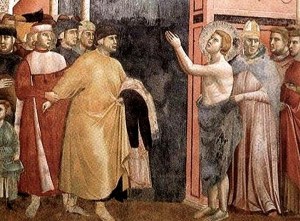 hy man choose celibacy and chastity over a woman?” Another popular question, “How can you live without a woman?”
There are people who believe that such men do harm to themselves and eventually to others by engaging in gay sex or pedophilia. Nothing can be farther from the truth. There are married men who engage in both behaviors. Neither promiscuity nor marriage are “cures” for gay sex or pedophilia. In fact, these two behaviors do not belong in the same sentence, because they are not related.
To understand celibate chastity one has to understand love, marriage, and covenant. The man who chooses a celibate chaste life is not running away from marriage, love, and commitment. He is turning to something that he has found, that being the jewel of great price. He is overwhelmed by the love of God.
He can love another person and be intimate. However, when he experiences the love of God, he is filled with peace, interior silence, joy, and courage that he has never experienced. His life is different and he wants more. He cannot turn back to the love and intimacy of human romance, not because human romance is bad, but because he has found something even better than good. He has found Him who is the perfect lover: God.
When he compares his current state with his previous life, he discovers new things about himself. The first thing he discovers is that he has a courage that he never knew he had. He can stand up to those who try to control him. He is no longer afraid of bullies. And he makes choices and takes risks that he never took before.
Secondly, he finds that those romantic feelings he once had were truly beautiful and profound shadows of what consecrated life would later offer. Those experiences foreshadowed his romance with God.
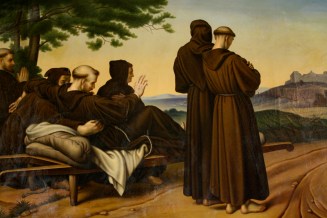 How does he know this? He no longer question himself or his relationship. He is truly loved by God and he freely returns that love. He no longer wonders whether his beloved will change his mind. His relationship is no longer about liking what he feels or what the other feels for him.
His relationship with God is dynamic, because it is about surprises. God surprises him by filling his time, so that time seems to stand still God also surprises him when he looks back on his life and sees how much he has grown and how far he has moved from where he was.
Former relationships are now the old school where he learned the joys and sorrows of love. Now he feels ready and willing to live with the joys and tears that are part of loving God and being intimately loved by Him. Those old relationships were a training ground for what was to come.
One does not choose chastity and celibacy because he failed at romance, though it may have felt that way in the past. In hindsight, we realize that the past taught us that we could experience the joys and tears of love and continue loving and giving ourselves by the grace of the Beloved with whom we finally settle down.


Experiencing the Proximity of God

All too often we go looking for God only to experience frustration at not finding Him. Hence the temptation to think that “God has more important concerns than me” begins to grab hold of us. We begin to believe that the habitual sins that torture us will always be our masters, because “God does not care. God is angry at me or I’m a lost cause”.
The real problem is that we go looking for that which is right next to us.
Imagine the man who tells you that he has lost his mind. Have you ever considered how ridiculous this expression sounds if it’s taken literally? In order to make such a statement as “I’ve lost my mind” one must make use of the very thing that he believes has been lost.
The proximity of God is very similar.
Man cannot look for that of which he has no idea what it is and no experience. If we are looking for God, it’s because we have a sense of His existence. We can’t have a sense of His existence without knowledge. Finding God is not about feeling His presence. Sensual perceptions of God are gifts for a select few who can handle them. Finding God is about knowledge. Only the man who knows that God is closer to him than his own mind can find God, because he knows that God never lost sight of him.

Disagreement ≠ Aggression
The Holy Mass in the Extraordinary Form, Gregorian chant, the Holy Rosary, Benediction and Adoration, and many other devotions has been part of our Catholic tradition for centuries. They should be allowed to live, encouraged and be made available when possible. These are part of our Catholic patrimony, just as is the Mass of St. John Chrysostom, the Ambrosian Rite, the Maronite Rite and the Ordinary Form of the mass. At some point in history, all of these were in their embryonic state. As time passed, the traditions became more ingrained in the Catholic community and the rites and customs became more polished. In other words, none of the older forms and rites was born as we know them today. Truth and mystery don’t change, but structure and order do. It is foolhardy to believe that the Ordinary Form of the Mass, the change in styles in how the papacy operates and the birth of newer devotions should be perfect and without need for adjustment here and there.
Imagine what would have happened if Pope St. Pius V had decided to throw out the different rites and forms of the mass of his time. But he didn’t choose to do that. On the contrary, he chose to take what was the best of the tradition, polish that which could be polished and jettison that which did not reflect the faith of the Church and the true nature of God. All of this took time and painstaking labor. Rumor has it that while St. Pius V was in the process of consolidating the Tridentine form of the mass that we often refer to as the TLM or the Extraordinary Form (EF), he was not popular with everyone. He faced some resistance. Very often, those who resisted him sinned not because they disagreed with the reforms and ideas of St. Pius. Their sin was worse. It was the sin of detraction. They didn’t simply disagree with Pope Pius; they tried to make him look like a fool.
Unfortunately the are elements in the Traditionalist Movement that don’t simply disagree with the Holy Father’s style, his projects, his manner of proceeding or even his way of life. There are elements in the Movement that have taken it upon themselves to destroy a good man’s reputation. If one reads some of the Traditionalist sites, one find sentences such as these.
On the Pope’s meeting with the Patriarch of Moscow
“Pope Francis needed the Moscow Patriarch to force him to say some obvious things”
“An Orthodox Patriarch was needed to make the Church speak up on the family, Christian roots, abortion, and the persecution of Christians…, to make us Catholics say that leaves are green or that two plus two makes four.”
Reaction to the commissioning of the the Missionaries of Mercy by Pope Francis
“Missionaries of Mercy….Another Round of Stupidity from His Humbleness”
“The Missionaries of Mercy, Coming Soon to a Theater Near You”
“Pope Francis is setting in motion an action which will result in a predictable reaction and he is using his masterful knowledge of psychology to manipulate poor simple minds who are convinced that the Pope is doing the world a favor.”
On the Holy Father’s vision for the Church and his “ulterior” motives
“For Pope Bergoglio, the papacy is a vehicle for achieving what he dreams, what he wants, what he prefers, as opposed to what has been handed down to him for safekeeping. He intends to leave his personal stamp on the Church in a manner he hopes will be irreversible,”
On the Holy Father’s dignity
“Then, under a cloud of mystery and bafflement, came Jorge Cardinal Mario Bergoglio . . . and this is what we saw: Francis on [the] logia”
“It was a man dressed as a simple bishop, whose first words were a thudding banality: “Brothers and sisters, good evening!” A bishop dressed in white, waving to the crowd and telling them, strangely, that he had been elected “Bishop of Rome” for “the evangelization of this beautiful city,” for which he pointedly requested “the prayer of the people for their Bishop.” He was denuded of the traditional symbols of papal authority, later donning the papal stole only long enough to bestow the Apostolic Benediction, promptly removing it once the words were uttered. Even his dull metal pectoral cross was the same one he had worn in Buenos Aires.”
“Bergoglio is such a loose cannon he’s careered right through the deck and smashed through the hull. A (bleep) from a (bleepin’) country.”
“But Francis does not think like a Catholic. . . . his pronouncements appear so dated as to be almost deranged”
This not the way that a virtuous man disagrees with another man; the key to healthy disagreement is respect for the dignity and position of the other person. These comments not only show a lack of respect for the Vicar of Christ, but they incite anger and even hatred. These are not statements of disagreement. These statements sound like deliberate attempts to disparage the reputation of none other than the Vicar of Jesus Christ.
One can place the points of disagreement on the table and proceed to present one’s objections to each point, without bringing down the person. Our holy father St. Francis never allowed the brothers to speak against authority. But he did allow them to disagree with anything they felt was dangerous to the soul. He set the example for Christian debate.
I feel sad having to warn our brothers and our friends to be careful of the evil mindset that very often invades extremes, be they extreme liberalism or extreme conservatism. There is nothing wrong with the traditional elements of our faith. There is nothing wrong in preserving and making use of the richness of these elements, because they move thee soul closer to God.
Beware of the poisonous talk and accusations that often hide underneath the shroud of righteousness. Do not be sucked in to such way of thinking, be it from the right or from the left. Poison is poison, no matter what flavor it comes in. Anything that detracts from the dignity of another person, calls into question his integrity without proof, and does damage to the reputation of one who is doing good for so many is evil. Unfortunately, those who are posting these and similar comments all over the Internet do not realize that they are cooperating with evil, rather than defending the holy, which is what they really want to do.
There is nothing to prohibit the Franciscans of Life from participating in activities and services within the Traditionalist community. These things are part of our Catholic heritage and they serve as channels of grace. Franciscans of Life are never to participate in detraction of any kind and anyone, especially the Vicar of Jesus Christ, nor are they to associate with those who engage in such evil behavior. They may disagree and engage in intellectual debates about points of disagreement, always speaking of and treating the person with the opposing point of view as a son or daughter of God and our brother whom we are sent to serve, not to judge.
Atonement or chocolate?
Lent is about to begin and many of us are thinking about what we want to give up. Here is the irony of it all. Some people give up chocolate. In fact, chocolate is the most common Lenten sacrifice, followed by dessert.

Let’s take this in baby steps. The whole idea of Lent is that it is a time of atonement. Now let’s get this straight. We sin against purity, honesty, loyalty, charity, faith, justice, detachment and many other things and virtues. Then we try to atone for all of this by giving up Hershey’s Kisses or ice-cream and apple pie? Sometimes we have to ask ourselves whether our Lenten sacrifices are somewhat presumptuous. We hope to atone for a multitude of sins with a few candy bars and some dessert; if we remember, we abstain from meat on Fridays during Lent.
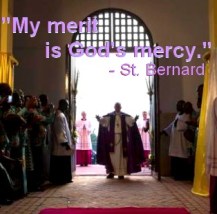
“My merit is God’s mercy.” -St. Bernard
Fortunately for us, God’s mercy far exceeds our foolishness. We often forget that Lent is a time of penance. Penance means atonement and conversion of manners.
We can never atone for our sins on our own. For this reason Lent culminates in Passion week, when Christ enters Jerusalem to be executed for our sins. Only the perfect man can offer the perfect act of atonement.
Our Lenten sacrifices must be offered with the ultimate sacrifice that Christ offered. During Lent we must be able to answer several questions with honesty.
1. Whether I am giving up chocolate or something else that I like, am I aware that I must also give up a specific sin? The external sacrifice is only a reminder of what we have to change. It does little good to give up a goody that we like while continuing to fall into the same sin.
2. If I add extra prayer or an extra mass to my weekly schedule do I take the time to meditate on the sin that I am trying to atone? Or do I offer the mass and prayers without much thought to what I have to change? The purpose of the extra mass and prayers is to bring us closer to God and draw us farther away from sin.
3. Finally, do I remember that Lent is to the Church what novitiate is to religious formation? During Lent I take a closer look at what needs improvement in my life and I work toward a conversion of manners. That is, a change in how I live my life with God and neighbor.
One cannot enter Lent with heart and soul without acknowledging one’s sins and the Passion of Christ, which restored to man the necessary graces to change and become like Adam before the Fall. If we ignore sin and the fact that we are sinners, Lent becomes just another tradition that leads nowhere. If we recognize sin, the Cross, and our need for a conversion of manners, Lent becomes a season of extraordinary grace.
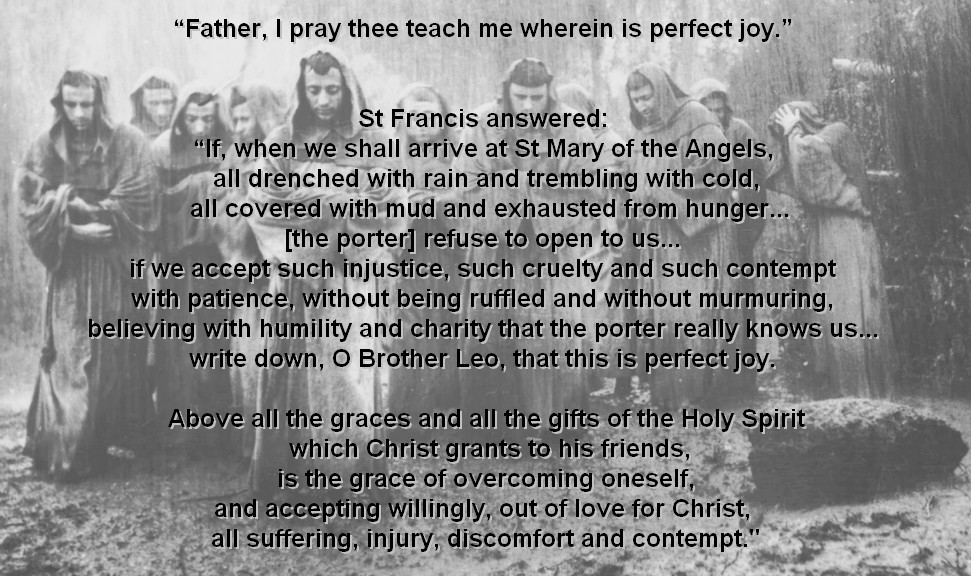
The Perfect Joy of Saint Francis
What happens to a man who enters the Franciscans of Life?
To answer the first question, NOTHING. We stopped torturing people a long time ago. Having said that, you may find that you go through a transformation that you never thought was possible. “I can never do that.” Many people say.
The first thing one learns is to share. For us, this means living in very small spaces. You thought that an airplane bathroom was small? Check out our sleeping arrangements.
 These are our sleeping quarters, also called cells. No brother owns anything, not even a room of his own. A large room is divided by curtains, as you would see in a hospital. Behind each curtain there are two beds for two brothers, bunks. There is an aisle along the length of the bed that is 18 inches wide and another curtain, behind which there is another cell with two more beds the same size. The brothers always remember Jesus’ words, “The Son of Man has no place to lay his head.”
 Every brother is assigned a flat sheet and a single blanket. We use only what we need, not what we like. We don’t use comforters or fancy bedspreads. The money that can be spent on those items can just as easily be put into our apostolate among the voiceless, even if it’s just paying for gas to get from point A to point B. After a few days, one becomes so accustomed to this arrangement, that we no longer miss our old bedroom in our former home. The community house becomes home and the cells become our bedrooms; but they are more than that. It is here that we experience the intimacy and poverty of the fraternal life that St. Francis so loved. Like Christ and his Apostles and like Francis and the early brothers who shared huts, the brothers practice charity and detachment.
The cells are in the enclosed part of the house where no outsiders may enter, male nor female, not even our moms. While in the cells, we avoid unnecessary conversation so that in solitude and silence the soul may be more attentive to the voice of God speaking from within. The cell and the enclosure are only external reminders of an internal attitude that every brother should have. Each of us carries within him an interior cloister where only the soul and God interact. This awareness is the summit of poverty, when you own nothing, not even your inner space . . . everything belongs to the Beloved.
 In the sleeping area there is always a small oratory. An oratory is not a chapel. The Blessed Sacrament is not reserved there. Oratory comes from the Latin word oratio, meaning to speak and to pray. Oremus,”Let us pray. Let us speak with God.” The brothers last conversation before retiring is with Jesus and His Immaculate Mother. His first conversation of the day is also with the beloved Mother and Son. During the day, the brother sneaks into the oratory, like a lover sneaking along the hedges to have a quiet words with his sweetheart. Christ and the Immaculate are our sweethearts.
 We don’t have closets, since we don’t have many clothes. We share a row of hooks where we hang up our formal and work habits. We also have a pair of grey pants and a grey banded shirt. Here you see a typical work habit for a postulant. Novices and professed brothers wear it with a cord or without a cord, depending on the task at hand. The work habit it short. It does not reach the knees. It’s our version of grunge clothing. Nothing is ever wasted. Our Constitution reminds us that like St. Francis, we follow the poor and suffering Christ who walked to Calvary in shredded clothes, except for his sacred seamless tunic. When a garment is too damaged to wear, it is cut up and used to patch up other work habits. It is not unusual to see our brothers wearing patches on their work habits or displaying grease stains from an engine. These stains are tough to wash out. But we manage.
 We don’t have cooks or housekeepers. Those are chores that we do ourselves. The brothers take turns cooking, scrubbing and cleaning. Those brothers who have never done it before or don’t know how are taught by more experienced brothers.
 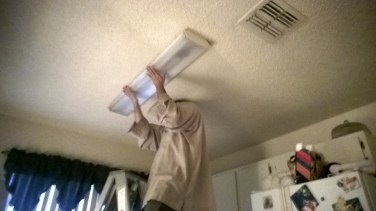 St. Francis said that we are to be “minors”. During the Italian Middle Ages there was a social class known as the Minores. It seems that these men and women were of the lower class of serfs and peasants. Even among the peasants, there was social stratification. Christ reminds us that we have been sent to serve, not to be served. “Go out and do what I have done for you.”

It’s time to leave. A brother may be going to class at the university, while another is going to the hospital or to hospice and another brother is on his way to do counseling or education with dads in crisis pregnancies or going to visit a newborn baby that was going to be aborted. The brother is always there to say “Hi Little One”
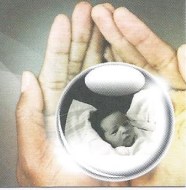 We even have two pups. The black and brown handsome fellow is Max, named after St. Maximilian Kolbe.
  The little fawn cutie is Tasha, named after a character on Star Trek Generations. Yes, we have former Trekkies among us. The brothers may not watch television. Start Trek is out of the question. Besides, who has time.
No day is complete without prayer and the
Holy Eucharist.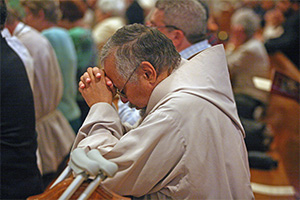
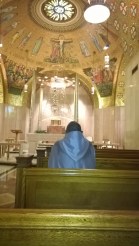
In between we manage to insert
an hour of private prayer at 5:30 AM, the Liturgy of the Hours: morning, midday, evening, night and midnight. There is always time for the Holy Rosary.
I VOW AND PROMISE . . .

COME AND SEE
Who said that you have to like the Pope?
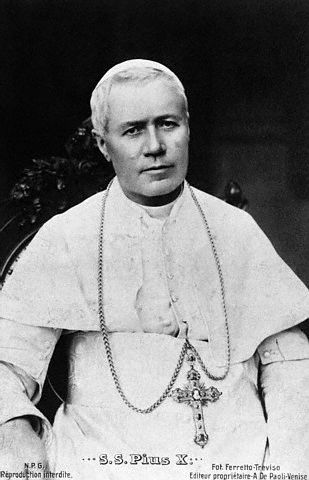 I found this article to be very helpful and supportive of what I presented in an earlier post, “Under Whose Authority “
Apparently, I’m not the only one who is noticing that people are not making a distinction between what they like and what they don’t like but must learn to live with.
When I was growing up I hated almost every rule that my father imposed on us. As far as I was concerned, he was a totalitarian despot. I’ll let you in on a little secret. I had no idea what a “totalitarian despot” meant. But I had read the term in a social studies book in school and it sounded like an appropriate label for my dad.
As the years passed and I transitioned from a child to an adult, I came to realize that my father was just a very conservative man from a different generation. The truth of the matter was that nothing that he imposed on us did any harm to our bodies, mind or souls. Some of his rules and statements were arbitrary and others were right on the money. As I became an adult, I jettisoned that which was arbitrary and incorporated into my script that which was truth.
The same applies the pope and others in the hierarchy. Many times, just like our parents, they say things that are right on the money, but we don’t like what we’re hearing. That does not mean they’re wrong. Other times they say things using a language that is different, one that we’re not used to. That does not mean that they’re wrong. It simply means that we have to pay close attention to the nuances. Finally, they may even say things that sound silly to us or not consistent with what came before. That does not mean that they’re wrong either. It means that they are speaking to a different generation, at a different time in history, using a different language, and building on what came before, not denying it.
If we don’t understand, it’s like not understanding our fathers or mothers. We have to learn to respect the person and the office. The rest is a matter of biting the bullet. How many people would belittle their parents with such labels as “modernist, apostate, heretic, infidel, devil incarnate” and more, because the parent does not seem to tow the line with what we believe our parents should be saying or doing, in matters of home management, discipline and even faith formation of the children?
I remember that my father was a twice a year mass attendant. It was not until my mother converted that he started to attend mass every Sunday. My mom was a formidable woman. If she said “We’re going to mass,” we were going to mass. No discussions. Having said that, I wouldn’t dare place my father on the stand and accuse him of being any of those things that some people attach to the Holy Father. Respect and love do not depend on being right or being lovable. Respect and love are a choice that we make to treat every man and woman as Christ did. Let us never forget that even though Pilate was wrong, he was given authority from above to judge and execute Jesus. Jesus acknowledged that authority. He was not a fan of Pilate, but he was a loyal Son of the Father.
We too must learn to live in the Church as loyal sons of the Father.
One last note, this is not an attempt to bash Traditionalist Catholics or the Traditionalist movement. There are many Catholics in the movement who are very holy people and exercise great self-control when they don’t like something and know how to speak with firmness and respect. They are to be admired and applauded.
Some of you may like this article. I thank Scott Eric Alt for sharing it.
Under what authority . . . ?
 I will never forget what a 10th grade student taught me a long time ago. I was teaching social studies in a high school. Mind you, I’m not a sociologist or social scientist. Our social studies teacher was on maternity leave and I was elected to cover for her. That being said, the lesson was on the United Nations’ declaration on human rights. As we were going through the highlights of the document, Chris asked me a very serious question.
“Why doesn’t this say that everyone has the right to be born? If you don’t have the right to be born, the other rights are useless.”
I have never forgotten that question or that lesson.
Today, thousands of people prepare to march for life in many cities in the country, the largest march being in Washington, DC, despite the horrible weather. Why are these people willing to suffer freezing temperatures, numb fingers and toes and 12 inches of snow and ice? The answer is simple. They believe in the right to be born.
It is true that many attend the march for life in protest of abortion. However, there is more to this issue. We must put abortion in context. The medical community refers to abortion as the “termination of pregnancy.” It’s actually a very accurate statement. Many people prefer to call it murder, holocaust, eugenics, and many other terms. None of these are wrong.
Nonetheless, the principle behind abortion is flawed, not only because the procedure takes the life of a vulnerable human being. It is flawed because the right to terminate a pregnancy presumes that society can deny any human being the right to be born. Birth is not possible, if you terminate a pregnancy.
This puts us on a very slippery slope. If human beings can lose the right to be born, what is there to say that we can’t lose the right to remain alive? Why are we crying over the extermination of Syrians, other groups in Eastern Europe, the Middle East and Africa?
Why doesn’t it follow that a society with the authority to withdraw someone’s right to be born can deny the right to stay alive after the fact?
The answer has to do with vision. We can see the carnage in the Middle East, Africa and parts of Eastern Europe. We don’t see the carnage behind the doors of an abortion mill.
When I was a graduate student, I learned about a concept called “object permanence.” A young child believes that an object exists only when he can see it. When mom says that the toy flew away and hides it behind her back, the toy ceases to exist. In simple English, the permanence of an object depends on the subject’s ability to see it. If one can’t see it, it does not exist. It’s a more primitive version of “out of sight, out of mind”. Except that this primitive version is normal in human development. As the person matures, the brain’s functions become more robust and object permanence is no longer dependent on perception, but on knowledge. “The thing exists, because I know it exists even when I don’t perceive it with my senses.”
For many people, a crime against human life exists only when the human being is perceptible. When you don’t see the human being, the crime ceases to be. Therefore we do two things in contemporary society.
First, we look at the fetus and we fail to see a human being who is a real person. We only see tissue and cells, because that’s what we want to see.
Second, we look at a fetus who is over 30 weeks old and we see what “looks like” a baby. It only looks like a baby. It’s not a baby, because we fail to see the baby.
To understand abortion in context, we must keep in mind that human beings often fail to see what they don’t want to see. It’s called selective blindness. They convince others that the thing they cannot see does not really exist. The baby that we cannot see is not really there. It’s just a “fetus” or tissue. When I was growing up, they called this “turning a blind eye.” Today, some people call it “reality”.
ISIS is murderous, because it kills people whom we can see. We cannot deny their existence, as much as we would like to ignore them. We have to call such barbaric acts what they are, the murder of innocent people. In our distorted way of thinking, abortion is not murderous, because no one visible to us is being killed. At the end of the day, what are we saying about choice and abortion?
It looks like we’re telling ourselves and our neighbors that man decides who has the right to live. Such a decision depends on the individual’s perception. If he does not see a human being, terminating a pregnancy is not murder.
The problem with this concept, besides the attack on innocent life, is that every individual can see whatever he or she wants to see and be blind to whatever he or she does not want to see. The right to be born becomes subjective, no longer an absolute. The right to be born is determined by the subject who has the power to terminate a vulnerable life. . . the power to see only what he wants to see.
This begs the question. “Under what authority can man grant or deny another human being the right to be born?”
We must ask ourselves this question as we remember Roe vs Wade in 2016.
Brother Jay Rivera, FFV
A Tradition of Hopelessness?
I’ve been reading certain blogs and newspapers online by Catholics who believe that the Church has lost her Catholic identity and her traditional roots. I must admit that the reading is very depressing; but not because of the alleged crisis in the Church. This is not to deny that there is a crisis of faith in the world, which affects people of all faith traditions. We can address that in a later post in this blog. For the time being, allow me to speak about the blogs and periodicals that are being posted online by Catholics.
When I was growing up, I was taught that in a democratic society, disagreement is a sign of health. When disagreement triggers dialog, the possibility for growth is endless. Along with such sage advice, my mother also taught me that disagreement must never rise to the level of disrespect for a person or his office. Crude, disrespectful, dismissive or condescending behavior is simply arrogance. Arrogance, like any other evil, has no rights. Therefore, the arrogant person forfeits his right to a dialog with civilized and intelligent human beings.
What we have is certain Catholic journals and blogs publishing articles and posts that disagree with much of what Pope Francis does and say. There is nothing wrong with that, as long as the Church is open for dialog, which she is on certain points. However, they take the liberty to apply such terms as Modernist, apostate, heretic, Marxist, sacrilege, indifferentism, syncretism, and more to the Vicar of Christ.
Everyone knows that there has never been such a person as the perfect pontiff. From the first day of its existence, the pontificate has been plagued by human weakness. Yet, it has survived. It has survived, because Grace has never been absent in the Church, especially in the Petrine Ministry. The first pope denied his master three times. He behaved with certain prejudices toward Jews and Gentiles, causing Paul to “lose it.”
However, when Paul lost it, he challenged Peter’s behavior and position. But he also addressed him by his proper title, Cephas or Rock. Paul did not cease to insist that Simon was the Rock upon which Christ built his Church. Paul was smart enough to see the weakness in Peter’s behavior when it came to the conversion of Gentiles and smart enough to remember that despite it all, Peter was the Vicar of Christ, not him. So . . . he took his argument to Peter and to the Council of Jerusalem. But not once did he stick disparaging labels on Peter.
Some “Traditional Catholics” invoke Irenaeus as their model or Catherine of Siena. Both of these people held on to the faith during times of crisis in the Church and the world. Both were honest enough to speak their mind to the pope and point to the errors in the pope’s thinking. Maybe, the reason why Irenaeus and Catherine share the label “saint” in front of their names, is not because they challenged and questioned, but because they loved and respected. They acknowledged that whatever they saw as mistakes didn’t change the fact that the pope was the legitimate successor of Peter who was the Prince of the Apostles and the Vicar of Jesus Christ. They spoke up without mocking, insulting, and labeling the pope or encouraging others to do so. They communicated their protest with dignity, charity and humility. I often find this lacking when writers in blogs and periodicals apply hurtful labels to the person of the pope and to his ministry.
Surely, we can learn from Catherine, Irenaeus and many other great men and women in Catholic history, how to speak about those things that are difficult and disturbing without arrogance, rudeness, and hopelessness.
Brother Bernardo Makes Vows
After three months as an aspirant, three months as a postulant and 12 months as a novice, Brother Bernardo D’Carmine made temporary vows as a Franciscan of Life.
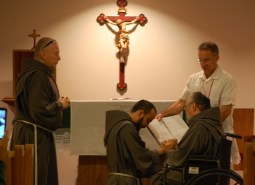
The vows are obedience, poverty, chastity and a fourth vow to proclaim the Gospel of Life. Brother made vows during a solemn celebration of evening prayer (vespers) on January 18, 2016 at St. Maximilian Kolbe Chapel in Pembroke Pines, Florida.
Presiding over the Liturgy of the Hours was Rev. Mr. Scott Joiner. Deacon Scott also preached the “exhortation” reminding us all that one man’s conversion can change the Church and history, referring to the Seraphic Father, St. Francis of Assisi. 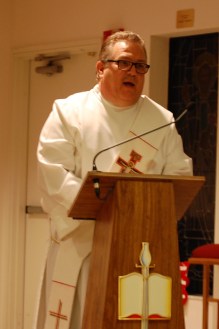
The first step is to embrace the poverty of Christ and his most blessed mother. He also reminded the Franciscans of Life that we are an outgrowth of a long and venerable family that is more than 800 years old, with more than 100 different congregations, orders, societies and institutes. Today, there are almost one million Franciscan men and women around the world, secular and religious, lay and cleric, men and women. It all began with one man who responded to Christ’s call to “rebuild his house.”
Deacon Scott witnessed the profession, but he did not receive the vows. Brother Jay Rivera, superior of the Franciscans of Life, received the vows. Mrs. Tina Handal led the singing with the litany of Franciscan saints and blessed. She did an outstanding job for the Lord and the community that was present. She has an incredible spirituality and a voice that expresses it beautifully. Extern brother, Chris Handal and regular brother, Leo Belanger were the witnesses to the profession. Present were friends of  Brother Bernardo’s from his days at university, other friends from the area and his mother, Mrs. Angela Torres. The group was small. The ceremony was simple, dignified, reverent and above all, prayerful.
Brother Bernardo will continue graduate studies in computer science, computer engineering, theology and philosophy. In addition, during the period of temporary vows, the brother continues his Franciscan formation with studies in Franciscan history, spirituality, rule and constitutions, Franciscan pastoral practices, and Sacred Scripture. Along with classes at the university, several hours per week active in the apostolate, a life in community, the brother is also homeschooled in Franciscan studies and Scripture. The years as a “student-brother,” as we call those in temporary vows, are very busy and exciting years. The most exciting part of all is the brother’s knowledge that his life now belongs to Christ and to the voiceless.
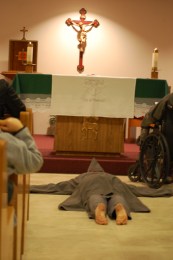
Litany of Saints
 3.
3. Franciscans of Life