We Fail to See the Light


Very often we hear people say, “That’s good for you guys, because you’re in vows; but the rest of us are not.”  This comes from practicing Catholics.  I believe that people who make such a comment do not understand the temporal purpose of the vowed life.

The vowed life is for the benefit of the person who makes the vows, but also for the benefit of the whole body, the Church.  Married couples also make vows.  Imagine what would happen if people of faith adopted the belief that the marriage vows are for the benefit and responsibility of the couple, but have no bearing on the rest of Christ’s Mystical Body.  Marriage would make no sense.

A vowed life, whether one vows to observe chastity, poverty and obedience or one vows to be faithful to one’s spouse until death, in good times and in hard times, is not wp_20150118_016a private relationship between the person who makes the vow, the people in his life and God.  God does not call people into private relationships with him to the exclusion of everyone else.  Even hermits, such as the Carthusians, embrace the cross in silence and solitude for the benefit of the Church as well as their benefit.

The vows of consecrated life (chastity, poverty and obedience) have a transcendent quality to them.  The individual making the vows renounces everything that the world has to offer in order to live more perfectly the vows made at Baptism.  He or she does not promise to do profession-of-vowssomething different from the rest of the baptized.  He promises to do the same, but more perfectly or as close to perfection as is possible for him.  In doing so he becomes a sign of life in the Kingdom of God.

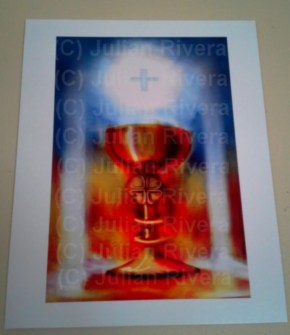
This leads us into the temporal quality of the consecrated life.  God chooses to place consecrated men and women in the middle of His people for the benefit of the Church.  Through their life of prayer, sacrifice, service and love, God’s grace pours into the world.  God is willing to do Julian_Corpus_Christicartwheels to save us.  He gives us the Scriptures.  He gives us Himself through the Incarnation and the Eucharist.  He shares His life with us through the sacraments.  And he places many other sources of grace in the middle of the marketplace for the salvation of his people.
If one assumes that the life and works of the man or woman in vows or the married couple does not affect us or commit us in any way, then one is ignoring and possibly bride-groomrejecting the grace that God wishes to share with us through these states in life.

We need not be married to learn to love without holding anything back.  Everyone is called to love without restrictions on his love. JEANNIE 31 WEEKS PREGNANT

The married couple is God’s sign of such love.  We can’t simply turn away and say, “Love without reservation is for you, because you’re married.”

We need not to vow chastity, poveuntitled-4rty and obedience to learn how to think and act with a pure heart, how to let go of the many things, people and places that redirect our attention away from God and we don’t need to be in vows to be bound to obey God as he reveals His will to us through Sacred Scripture, Jesus Christ and the Church.

This last one is key, obedience.  Obedience to what God asks of us at any given moment is not for a select few.  oratoryThose bound by a vow of obedience are to be the models of submission to the will of God, not the only people bound to submit to God’s will.
Maybe one of the reasons why vocations to the consecrated life are down and the reason that some consecrated persons are lukewarm in the way they live out the vows, is because we have separated the vowed state in life from the secular man and woman. When we separate the Evangelical Counsels from the secular sphere, what counsels are left to guide the secular man and woman to fulfill his or her baptismal promises?  Chastity, poverty and obedience are the yard-lines that lead to the final goal, the perfection of charity.

How does one know how close or how far he is from the goal without the yard-lines?

When the vows of chastity, poverty obedience and hurricane_matthewthe
vows of marriage are lived as they should be lived, they become a torch that is a sign of God’s light in what sometimes seems like a dark and scary world.flame

Increasing in more ways than one


Our little family seems to be going into a growth spurt.  The first shot . . .

JEANNIE 31 WEEKS PREGNANTBrother Jay’s granddaughter is inside.  NO . . . not in the box.  🙂
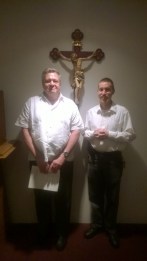
IVERSON HOLMBERG ASPIRANTSNext . . . meet the new aspirants.

Right:  Thomas Holmberg

Left:  Andrew Phillip Iverson

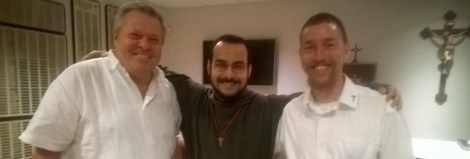
Tom has entered as an aspirant for the Extern Brothers.  He is a husband, a dad and a grandfather.  Welcome to our family, Tom.  Our prayers are always with you.

Andrew is an aspirant for our Regular Brothers.  He will live in community, make private profession of obedience, poverty, chastity and fidelity to the Gospel of Life.  We’re happy to have you among us, Andrew.

Observe the difference in the aspirants’ uniform.  The Extern Aspirant wears a white Habanera shirt with a TAU pin on his left lapel, while the Regular aspirant wears a white button-down shirt (short or long sleeve) with a TAU pin on his left lapel.

The aspirant phase is an optional step before a man requests to be admittedIVERSON INTERROGATIONd as a postulant.  The usual duration is no more than three months.  The aspirant and the formation team discern when it’s time to take the next step.

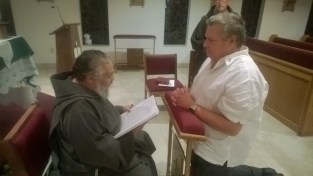
Each candidate is publicly interrogated by the superior.  He must swear that he understands what he’s doing and that he’s doing so freely.

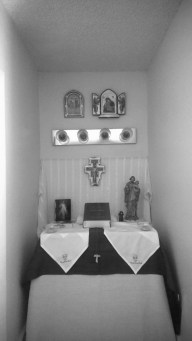
ASPIRANCY ALTAR

On the altar are the TAU pins, symbol of the Franciscan family, the breviary for the Regular aspirant and the register that each aspirant and the superior must sign, witnessed by at least one brother.

Tom kneelsHOLMBER SIGNING in front of the superior to sign the register of admission.
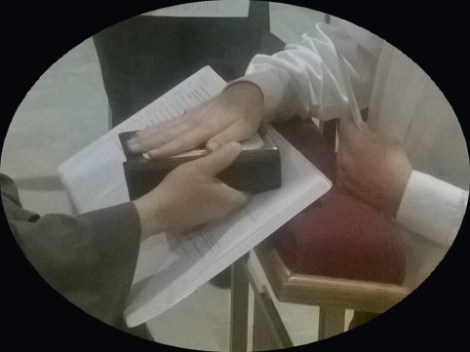
The  new aspirant is received in a private ceremony that takes place during Vespers.  Only Franciscans of Life attend this ceremony.  Profession of vows takes place with a few invited guests, such as relatives friends and clergy.

Because the Regular Brothers are bound to pray the entire Divine Office, the Regular aspirant is given a breviary.  During this phase he becomes familiar with the Divine Office and begins to pray Lauds and Vespers.  Eventually he will pray Matins Lauds, Sext, Vespers and Compline.RECEPTION OF BREVIARY 1

The Regular aspirant places his hands on the breviary before receiving it from the superior who says to him, “Believe what you pray and pray as you believe.”

BERNARDO AND ASPIRANTS.jpg

Brother Bernardo D’Carmine was the sponsor and witness for both aspirants.

We must give special thanks to the Latin Mass Community of Miami for Brother Bernardo and Aspirant Andrew Phillip.  The community cultivated both vocations.  This is an example of the “oneness” of our Church.

The Franciscans of Life do not bear the label, “Traditionalist” nor are we part of the Ecclesia Dei Community, those institutes committed to the Extraordinary Form of the mass and to the Divine Office as it was prayed in 1962.  Nonetheless, Franciscans of Life is traditional in a very different sense.

Our Constitution mandates that we recover and imitate the life of the first generation Franciscans.

If you aspire to go forward, you must first look back.


Published in: on August 25, 2016 at 10:06 AM  Leave a Comment  

Pesky Flies Don’t Rant


Have you ever listened to someone when they are angry and ranting? If you have never had such an experience, you’re either deaf or you live under a rock. Rants are part of the human condition. I would say that rants are part of human communication. They allow the listener a peek into the heart and soul of the other, the person who is ranting.

ranting

You see, when people rant, they are only partially in control. Very often the emotions move faster than the rules that govern social discourse; the result is that you reveal yourself in not so politically correct ways, but probably in the most humble way possible. Humility is the exercise of truth governed by trust. You trust that the person who sees and hears you as you truly are also loves you as you are, not as he or she imagines or desires you to be.

Having been at the receiving end of rants many times in my life, rants by family members, colleagues, superiors, and even brothers in my own community I have learned to appreciate them rather than build a wall between the frustrated ‘ranter’ and me.

OK, I confess. I just made up a word: ranter. Now get past your linguistic indignation and stay with me.

While I’m sitting there listening to my brother rant on about something, it can be the flavor of ice cream, I’m aware that rants don’t have to be rational. But while I’m apparently listening to the rant, the truth is that I’ve learned to close my ears off to the rant. I open my eyes to other things and listen to those instead. It has often been a humbling experience. Allow me to explain.

My brother is ranting because something is bothering him. Why else rant? This does not mean that his annoyance is justified. Sometimes our annoyance is either irrational or exaggerated. But that’s not important and this is where we go wrong. We begin to look for the rationality in the other person’s discourse and being unable to find it, we return rant with rant.

Ignore the steam and focus on the heart...

Ignore the steam and focus on the heart…

On the other hand, observing Jesus in the Gospels and St. Francis of Assisi in his dealings with the first generation Franciscans, I noticed that they look at the heart of the ranter and listen to his inner voice.

Christ, very often, tells the Pharisees that they are closed minded, hard-hearted, proud and ignorant. But he never tells them that they are irrational, exaggerating, rude, or obnoxious. That’s not to say that they were not. It just means that Christ finds the truth about a man in his heart, not in his emotional outbursts. When he looked into the hearts of some of the Pharisees, he saw some serious character flaws.

At the same time, when he looked into the heart of some other ranters and whiners, he saw an innocence, ignorance, or uncertainty that kept him coming back to them and inspired him to call his apostles, “Friends”.

I noticed the same behavior in our holy father St. Francis when dealing with the early brothers. While one group ranted about the rule being too impractical and another group ranted about the first group being too liberal, Francis never returned a rant with a rant. He never lost his cool. He never told them to go away. He politely listened and said what he felt needed to be said and went on his way.

Through the years I’ve contemplated how Jesus and Francis responded to rants. I’ve integrated these observations along my parents’ style of communication; I’ve come to the conclusion that a rant can be like heart surgery . . . usually a great discomfort, but lifesaving.

Recently, one of my brothers was ranting at me (the reason is irrelevant and no, I did not kill the cat…). As he went on and on, I heard what he was not saying. He was hurt by something. I had failed to respond in the manner that he felt I should. Therefore, he was hurt by my behavior, because I came across as indifferent to something important to him. While we all claim that we are not concerned with what the world thinks, we all know this is not true. We care very much, especially those people with him we share the world the closest. As I thought of this, I realized that had it been someone else who ignored that which was important to the brother, it may have annoyed him or even made him angry, but it would not have hurt. What I was listening to was not a rant. The rant is the noise made by pain.

Before we go on to think that we must yield to everyone who rants, out of pity for their pain, let’s clarify something. Some people are in pain because their expectations are unreasonable or even irrational. Others are in pain because they never bothered to share their expectations, concerns, fears and loves with the other person. Suddenly, something goes wrong and they explode, leaving the other person feeling confused or even angry in return.

The point is that when someone rants at you, try to see his heart and listen to his pain. Then you can decide for yourself whether he is being reasonable or not.

In my particular case, during my last encounter with a rant, what I saw was a wounded heart, because I had failed to do something that would have validated my brother. As he ranted, I examined my conscience and realized that I had failed in spiritual friendship. I know this mean intimately. I should have responded to a sensibility of which I am well aware. I also heard, “I love you,” under his rant. “If I didn’t love you, I could care less how you respond to my feelings.” To me, there is nothing more humbling than being loved.

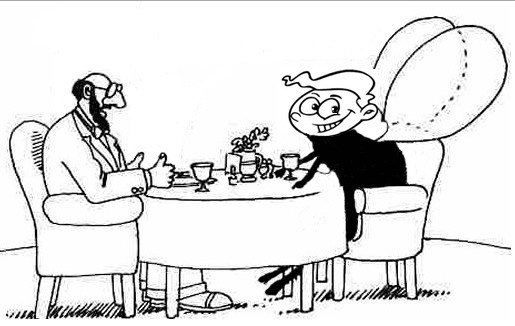
The next time that someone rants at you, try to SEE what’s in the heart and HEAR the emotion communicated by the soul. You may find that the person ranting at you is your best friend, not a pesky fly.

friend_the_fly

Br. Jay

No Bikes Allowed In Heaven


I realize that it’s a little late to write Mother’s Day messages.  In my case, it may be a little late to write a eulogy for my mom who died 15 years ago.  Nonetheless, there is something that I would like to share with all of you who are parents and those who will be parents.

When a parent approaches the Lord for the final judgement, the most important question that he must face is whether or not he fulfilled his duty as a Christian and passed on the faith to his children.

Passing on the faith is more involved than sending kids to weekly CCD and putting them through the drills for First Confession, First Holy Communion and Confirmation.  The sacraments are not graduation ceremonies.  The sacraments are part of a journey.  This is where my mother comes into my spiritual picture.FLAMES

Whatever her faults, were many things that my mom did well.  But the one thing that she did with outstanding fidelity, love, courage and concern was to hand down the faith.  From the moment we were born we were incorporated into the faith community.  I say incorporated to mean that we didn’t just get dragged down to the church to be baptized or the temple to be blessed and “Goodbye”.  There was much more.  Faith was part of our domestic culture.

I remember that the first picture book that I ever read was the story of Moses.  From there, I read every other story in the bible.  Faith was part of our recreation, because bedtime reading was a ritual and a fun time for me.

Religious symbols were present in every room in our house.  I was taught to pay attention to them.  I remember my mother insisting that I bow my head each time I passed a crucifix that was in the entry foyer.  Bowing to the crucifix and altar in church were not new to me.

Morning, evening and night prayers were part of our family schedule.  We prayed before going to school.  When I was older, I prayed the Holy Rosary with my mom every day at 7PM.  I have no idea why it had to be at 7PM.  I can tell you this.  I have no idea what wasrosary on TV at 7PM.  That was time for evening prayer.  Then there were night prayers that were said at bedtime.  The very first prayer that I learned to say was the Lord’s Prayer.  Because I grew up in a bilingual home, my mother made sure that I could pray it in two languages.  After that, other prayers were added, including prayers at the table.

My mother taught us Judeo-Christian morality without proselytizing and without nagging.  I would come home and tell her about something I saw at school or on the street.  My mother would stop to listen.  If the action was good, she explained how I should imitate it, because it pleased God.  If the action was bad, she explained the importance of avoiding it, because it was a sin and sin could land you in hell.  My mom was not afraid of words like “sin” and “hell”.  Despite her use of those terms, I don’t suffer from PTSD.  If anything, I suffer from a guilty conscience when I mess up.

Not to drag this on too long, which I already have, when I was about 11 we had a fire that destroyed a good portion of our home.  It took several months to rebuild, paint and do whatever else they do when they rescue a house.  How would I know?  I was only 11.

I’ll never forget standing outside at 3:00 AM on a very cold March morning, in my PJs and a blanket, watching flames come out of one of the upstairs windows.  When the fire was finally out, I asked my mother, “What are we going to do?”  My mom was very quiet for a moment.  Then she said, “I have no idea.  Let’s not worry about that now.  Let’s find a warm place to sleep.  God always has a plan and he will tell us what to do when the time is right.”  This was a belief that she instilled in us from childhood.  “God has a plan.”  And “Only God knows.”  We were always assured that Providence was taking care of us.

Like any good Judeo-Christian, we worshipped every weekend and on holy days as well.  There was  no such thing as sleeping in and not going to Church until you were old enough to pay your own bills.

The best thing that I learned from my mother was love of God and love of neighbor.  I saw my mom take in kids whose parents could not care for them and they would live with us until the parents were ready to take them home.  One child lived with us about three months.  I saw my mother stop inside the church on her way home to visit the Blessed Sacrament.

12313767_1724552867778905_4437807418574257125_n

I was not asked if I wanted to come in.  I just naturally followed and knelt in front of the tabernacle.  There was no doubt that Christ lived in that little box.  There was no excuse for driving or walking by the church and not stopping to say hello to its sovereign resident.

Remembering these things, I believe that at the moment of her death, whatever faults my mother had were outshined by her perseveration when it came to handing down the faith to her children.  This is the first and most important vocation of parenting.

The roof over the head, the food on the table, the school tuition, and medical bills were all covered.  But as my mother once said, “Giving your kids the material things they need won’t get them to heaven.  No bikes allowed in heaven.  You have to give more.”

Three Peas in a Pod we’re not – Scott Eric Alt, Robert Spaemann and I – Maybe two


To better understand this comment, I would refer you to the excellent post by Scott Eric Alt on Interacting With the Spaemann Interview on Amoris Laetitia ,

three peasNow my two cents.

I’m having a problem with the Professor Spaemann’s answers and those of others of the same way of thinking.  It is not impossible for anyone to disagree with something in an Apostolic Exhortation.  This much is true.  They are written to offer some guidance, not to teach.  One can always disagree with the guidance that is offered.  Before I continue, allow me to say that we can and often do teach through the guidance that we offer.  Anyone who’s a parent knows exactly what I mean, but back to the professor.

I never trust these reports.  It is often the case that the gaps between what the subject said and the reporter wrote are as numerous as the craters on the moon.  For the sake of this discussion, let’s give the interviewer the benefit of the doubt and accept that he is reporting without too much editing.

It is my opinion that the Professor’s responses are not helpful on two fronts.

First:  They present a dark side of the exhortation, but the speaker fails to give you observable results from past experiences that prove the existence of such a dark side.  Philosophy works with and based on systems.  I could not find that system that the professor uses to arrive at his conclusions.  Therefore, I can only assume that the systems are not reported, which does not allow those of us who know some philosophy to question the methodology leading to his conclusions.  The other possibility is that he is not using systematic thinking, but it projecting his predictions based on subjectivity (gut feeling).

Second:  I caution people to be careful with those who claim to love the Church and to have been a consultant to this pope and a friend to that one.  This can be and probably is true.  Sometimes, these relationships can obscure one’s sense of duty.  Even though the Professor was an advisor to St. John Paul II and a friend to Benedict XVI, as a faithful Catholic philosopher, his first allegiance is to the Church, not the individual popes.  Therefore, I would expect him to use his skills and his intimate experience with these two giants to help his audience see the points of contact and continuity between AL and tradition.  In no way does this detract from his right to use his intellect to say, “This can be said more clearly,” or “This raises this question that we need to submit to someone in authority to respond.” 

In doing so, one is faithful to the Church, does not throw the current pope under the bus, is not sucked into the typical Church politics of “conservative vs liberals”, and helps people see the good in the exhortation while encouraging them to ask questions respectfully and with trust in the integrity of the person answering.

BA Degree for Sale (Bachelor of Abortion)


not_disposableThere was a recent event at one of the major Catholic universities in the United States that hosted as the ‘only speaker’ the national director of Planned Parenthood.  Someone said that the invitation was made by a student organization with the organization’s money.  This is probably true.  Why would anyone lie about it?

The question is not who issues the invitation, the question is to whom and for what can student organizations in Catholic colleges and universities issue invitations?  The idea that those who run our Catholic colleges and universities have little or no authority to veto such decisions raises another question.  Who’s running our Catholic colleges and universities?

If a school, of any level, is run like a good business, it surely has a business plan, company policies that protect the interest of the business.  Of course, every good business man or woman knows that the best interest of the business is to produce the product that is offers.  In Ex Corde, Pope St. John Paul II, reminds us that

“It is the honor and responsibility of a Catholic University to consecraJOHNPAUL-BABYte itself without reserve to the cause of truth. This is its way of serving at one and the same time both the dignity of man and the
good of the Church.”

This begs the question, “What truth does Planned Parenthood bring to the halls of Catholic academia?”  The very notion that students should be exposed to the arguments for abortion and contraception, as they are exposed to the arguments for natural family planning and the right to be born is ludicrous in the extreme.

A child in school goes through fire drills several times a year; but never through the actual flames.  Why?  Because the idea is to teach the children safety before they are ever exposed to flames, not after.

How many of our college age students have never been exposed to the pro-abortion and pro-contraception ideology that they need to bring in a “prestigious” proselytizer against the right to be born?

lighthouses-lighthouse-looking-wide-open-sea-horizon-cloudThey would be better served by an influential evangelist who proclaims the Gospel of Life without compromise.  After all, don’t we send out young to Catholic colleges and universities to learn the truth or has parenting succumbed to the god of money?  Do parents send their youth to college to learn how to make money or to serve society and save their souls?

AMORIS LAETITIA: Advice for Mature Catholics


FRANCIS COAT OF ARMSI’ve been reading some commentaries on the Holy Father’s apostolic exhortation, “Amoris Laetitia”. I’d like to point out some errors that we have to avoid.

First — we need to read the document very carefully, pray over it, and read it again before we comment on it.

Second — let us remember that an apostolic exhortaion is not a catechism. Do not expect an apostolic exhortation to repeat what is already stated in every catechism of every generation. I use the admonitions of St. Francis of Assisi as an example. If you read them, you’ll not find anything in his admonitions that is already stated in the Rule and Constitutions. The admonitions are reflections that flow from the study and observance of the Gospel. The same principle applies to an apostolic exhortation.

Third — Do not let others determine what you should like or not like about the exhortation. Nor should you allow others to tell you that something is great or something is bad without giving you a specific example.

Fourth — If there is something that you find problematic, quote it when you share it. Dissect it so that others know what you find to be a problem. Leave an opening for others to agree or disagree with you. Dialogue is essential in understanding these writings.

Fifth — Because something is not mentioned in the apostolic exhortation, it does not mean that the Church has neglected a particular point or doctrine. Apostolic exhortations, like any other writing, must flow. Sometimes a specific statement or subject makes the writing sound awkward and does not add to what the Holy Father is saying.

Sixth — Remember, extreme reactions, to the left or to the right, are equally misguided. Extremes are circular. Eventually, the extreme left meets the extreme right at some point on the other side of the circle.

Seventh — Pay close attention to the citations that the exhortation includes from the writings of Blessed Paul VI, Saint John Paul II and other Church documents. This is an attempt to connect the present with the past. To understand the connections, one needs to read carefully.

Eighth — Notice that the exhortation makes three kinds of statements: admonitions, doctrine, and pastoral recommendations. We are used to apostolic exhortations being admonitions, pastoral or dogmatic. This particular exhortation blends the three.

Ninth — Remember respect. One is allowed to disagree with the pope. Saints and other theologians have done so in the past. However, none of them have ever been disrespectful in expressing their disagreements. We don’t hear them calling popes: Modernists, eretics, diabolical, dumb, mentally ill, or apostates. Name calling is never appropriate, especially when it applies to our parents, spouses, children and popes. Who of us would dare apply any of these labels to a loved one, because we believe him or her to be in error? Usually, we try to point out the error. This may lead to heated discussions, but the conversation limits itself to the subject on the table, not the character of the participants. We owe the Holy Father reverence, obedience and respect.

Tenth — Let us be humble and keep in mind that our opinions are not absolute truth, even when we quote truth. That which we quote may be true, but our understanding and application of said truth may be mistaken. We must be open to hearing opinions of those who do not think as we do. We must discuss our concerns with those who are knowledgeable in theology and who are authorized to teach it: parish priests, religious educators, Catholic theologians, Catholic theology teachers, many religious brothers and sisters who are trained in theology and Christian Spirituality.

I hope these points will help you as you navigate through this or any other papal writing.

http://w2.vatican.va/content/francesco/en/apost_exhortations/documents/papa-francesco_esortazione-ap_20160319_amoris-laetitia.html

Schizophrenic Mercy and Pregnancy Don’t Belong in the Same Sentence


The brothers have bSt_Francis_embraceeen following the development of a bill in Utah that requires anesthesia for any ‘fetus’ 20 weeks or older, before an abortion can take place.

Let’s get this right. According to these legislators and their medical advisers, the child in the womb, whom they choose to call by his developmental stage, fetus, instead of human being or child, . . . this child feels pain when being killed during a ‘late term’ abortion. The merciful thing to do is to dull the child’s brain so that he feels no pain as he is being killed.

This begs the question, “Since when do mercy and murder belong in the same sentence?”

If legislators and healthcare professionals believe that the fetus feels pain, then they know that it is very much alive and very much like any other child, just physically immature. Physical immaturity has never been a criterion for killing someone who has done no wrong to anyone, nor threatens anyone.

The weak argument ‘the health of the mother’ does not justify killing a child. If the mother’s life is in danger, it is not the child in the womb who has hurt her or made her sick. She is ill and in danger because of some biological problem that may have surfaced during the pregnancy or was present before the pregnancy. The mother is not under attack by the child.

Chucky is a fictitious and probably diabolical character. Pregnant women do not carry demonic little boys or girls in their womb.

Therefore, the idea that an abortion, especially a late term abortion, may be executed after the 20th week of pregnancy if the life of the mother is in danger is not merciful to the mother or the child. The child is not the cause of the danger. The medical problem does not necessarily go away once you kill the child. You may find yourself having to kill every child the woman conceives, unless the medical problem is addressed and remedied. The other option is sterilization or celibacy to avoid future pregnancies.

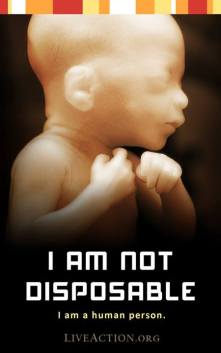
The very idea that we can kill a child in her mother’s womb, when she is not_disposableold enough to survive outside the womb, as an act of mercy toward the mother is crazy. To compound the insanity, this group in Utah has agreed to extend mercy to the little girl by passing a law that requires that the abortionist anesthetize the child before killing her.

This kind of mercy defies all logic. It defies human rights, the right to be born. It defies the natural end of medical care, “Do no harm.” It defies the advancements that we have made in technology and medicine that gives a little girl a fighting chance to live and would protect the life of a mother in danger.

Physicians can induce labor at 22 weeks of pregnancy or they can resort to Divine Physiciansurgically removing the baby from the womb and provide an artificial environment for her to thrive. We have the technology.

If universities and government spent less money on technology to spy on people and medical schools spent less money testing how to manipulate a human being’s genetic map, to please the parent who wants a little boy rather than a little girl, and invest money and time in artificial environments and other life preserving technology, we would not be having this discussion. We would simply do the second best thing to natural labor, remove the little boy from his mother’s womb and place him in an environment where he can mature.

Instead, we bastardize the word ‘mercy’ for the mother whose life is in danger and for the baby about to be executed by numbing an infant in order to kill it painlessly.

The truth of the matter is that the only thing being numbed is the conscience of legislators who are too cowardly to face the pro-abortion lobby and those abortionists who make a living from the exercise of “schizophrenic mercy.”

Life calls out to life

Life calls out to life

Disclaimer: I take full responsibility for the content of this post. None of the brothers contributed to it, nor did they know that I was going to write it.

Fraternally,

Br. Jay

Published in: on March 31, 2016 at 12:04 PM  Leave a Comment  

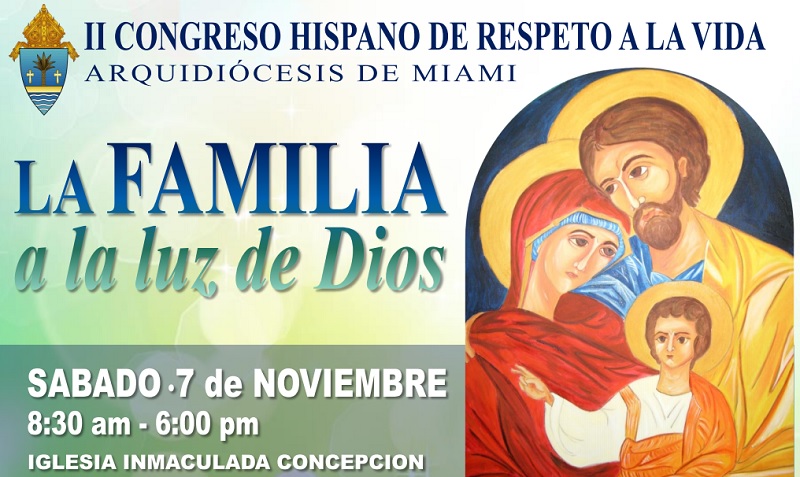
First time in Miami: Respect Life Hispanic Conference


flyer

On Saturday, November 7, the Franciscans of Life attended the Second Statewide Respect Life Hispanic Conference. This is the first Hispanic pro-life conference to take place in the Archdiocese of Miami. The location – Immaculate Conception Catholic Church – was no coincidence: Hialeah is the city with the highest number of abortions in the State of Florida, and the Catholic pro-life efforts in its territory are still limited.

Featuring an impressive panel of speakers, the Conference covered topics such as: “Christian Matrimony: God’s master plan”, “The truth on abortion”, “Recovery after abortion”, “The ethical care of human life from conception to natural death”, “Moral medical methods for the treatment of infertility”, “Spiritual and practical support for couples suffering infertility”, and “Plan of action for the family”.

Hispanic_Conference_talkOne of the talks was titled: “Project Joseph – for fathers”. This was the first time that we presented in Spanish the work carried out in Project Joseph – a joint effort between the Franciscans of Life and Respect Life Ministry Archdiocese of Miami to serve fathers in unexpected pregnancies.

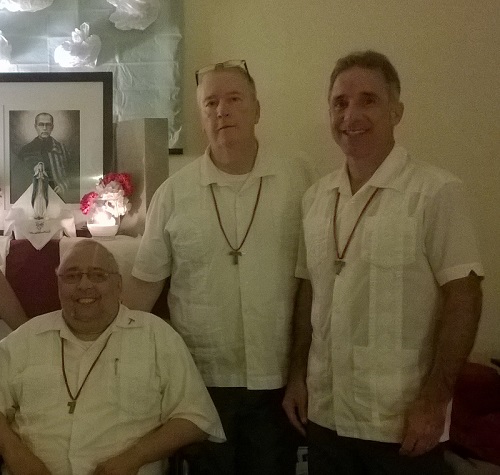
The talk was delivered by our Father Superior, Br. Jay, who founded the program 6 years ago and currently directs it. He was accompanied by Br. Bernardo, Project Joseph mentor at the North Dade Pregnancy Help Center.

The talk – which we will feature in an upcoming article – began by describing how Project Joseph is relevant to the Ibero-American culture, in which too often women, and particularly mothers, are treated as if they were servants or nannies, rather than with the respect they deserve. This leads to the development of dysfunctional environments. As a consequence, there are many situations in which few rights are recognized to the women but many burdens are imposed on her if she becomes a mother, while the father on the other hand retains many rights and few responsibilities. On this note, the origin of Project Joseph were described.

(c) Ana Rodriguez-Soto | FC

(c) Ana Rodriguez-Soto | FC

“Don’t let me catch you talking badly about my Project Joseph dads!”, admonished Br. Jay. “These men are good people. Project Joseph offers them the opportunity to mature and grow as men and as fathers.”  Over 200 fathers have participated and become mature men, responsible and prepared to face the challenges of life.

Br. Jay mentioned that the success of the Project is due to the intercession of St. Joseph, patron of all fathers. His role in the Holy Family, described in a few examples, shows why it is so important to help these men walk in the footsteps of St. Joseph.  The Franciscan charism is also behind the success of Project Joseph, a charism that originates in the Seraphic Father and finds worthy example in the martyr St. Maximilian Kolbe, patron of the pro-life movement.

It was a beautiful, well organized, well attended event. We were glad to be there and have a table set aside for us to raise awareness of the work carried out by the FFV.

Hispanic_Conference_tableOur apostolate to the preborn children and their parents has developed significantly through Project Joseph, and we are particularly interested in recruiting Hispanic or bi-lingual mentors, since many of our dads speak Spanish as their primary language. However, we also serve the chronically and terminally ill and their families and caregivers, as well as the immigrant poor – populations that are very much in need of attention as we look to “The Family in light of God”.

The Conference came to a closing with Holy Mass celebrated by H.E. Thomas Wenski, Archbishop of Miami. During his homily, he underscored the important role of St. Joseph in God’s plan for the family. Here is our translation:

“The theme of this conference has been “The family in light of God.” Here, in Mary, Joseph and the child Jesus, that is, in the holy family, we see reflected God’s plan for the family when there is no stain of sin.

May the prayers and example of the Jesus’ parents strengthen today’s parents in their efforts to raise their children according to God’s will. In thefulfillment of His plan of salvation for mankind, God did not need the participation of Joseph to create the child Jesus. Nevertheless, God decided that the help of Joseph was indeed necessary in raising the holy child. Joseph, as chaste spouse of the Virgin Mary, played an indispensable role in the life of Jesus as his foster father. He was not an absent or indifferent father. In fact, to him was entrusted the safety and well-being of Mary and of Jesus. We see this in the episode of the flight to Egypt. We perceive this in the narration of the child lost and found in the temple of Jerusalem. We can deduce that Joseph played a crucial role in the life of Jesus before he began his public life by the fact that his fellow citizens knew him as “the son of the carpenter”.

God wanted the best for his Son, and thus made it possible for Mary to marry Joseph, for only matrimony ensures the commitment between the parents and for the children. The children are raised better when the effort is carried out by a father and a mother. Thus was then and thus is now: every child needs a father, every child deserves a father – a father like Joseph. For this reason, the Church proposes the family of Nazareth as a model; and if for some reason our earthly family does not count with the presence of a mother or father, the Church invites us to count on Mary and Joseph. They will not disappoint us.”

The event was featured on the Archdiocesan News. Click here to read the article, which features the Project Joseph talk.

If you wish to see some more pictures, courtesy of Respect Life Ministry Archdiocese of Miami, follow this link 🙂

If you have any questions or comments, feel free to reach out to us! We will be glad to help you explore and discern if the Lord is inviting you to proclaim the Gospel of life with us.

FFV Highlights


Pax et bonum!

The past few months have been quite busy 🙂 We wish to share with you some highlights, hoping that you will enjoy them and pray for us! Also pray for vocations. The Year of Consecrated Life is not over yet. Could the Lord be inviting you to build with us in the footsteps of St. Francis…?

20150906_004_X

The regular brothers wear the “corona” as a sign of consecrated celibacy.


20150814_004_X

Extern Brother Chris Thomas More (right) renewed his Solemn Promise, and Regular Brother Leo (center) made his First Profession.


20150911_004_X

In September we celebrated the birthday of Father Superior by throwing a “surprise puppy”… 😉


20150921_121823_X

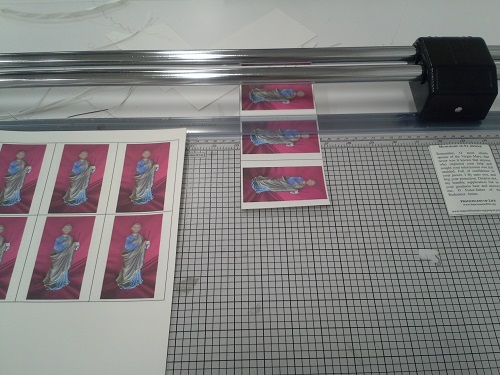
We crafted our first holy cards featuring a statue of St. Joseph donated to us by a generous benefactress. Some of the cards were blessed in Philadelphia by the Holy Father.


20150929_IMG_3531_X

We went in pilgrimage to D.C. and Philadelphia following the footsteps of the Holy Father. In the picture: Pope Francis preaches the homily at the closing of World Meeting of Families.


20151004_IMG_3560b_X

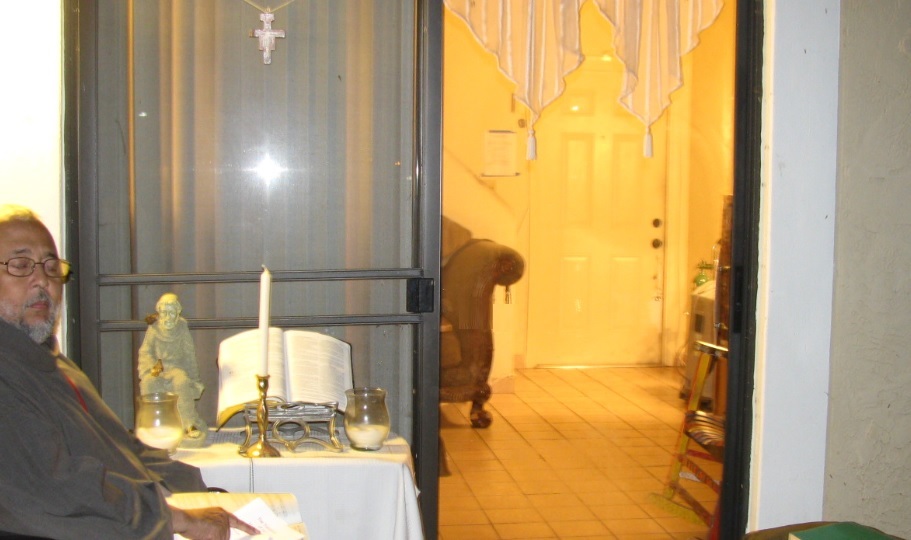
On the evening of October 3rd we celebrated the Transitus of our Seraphic Father, St. Francis outside of our mother house.


20151017_080043_X

The brothers worked hard to raise funds at the Flea Market of St. Maximilian Kolbe Catholic Church. Most of the objects were donated to us for this purpose!


20151024_003_X     20151024_005_X

20151024_010_X

Tailor and cobbler workshop at the mother house 🙂 In the pictures, a brother sows a pair of pants and admires its seam, then proceeds to repair some sandals.


20151030_009_X

A big “thank you” to the generous donor who helped us purchase much-needed front tires for the community car!


20151031_001_X

Boo! 😀 On Halloween we “dressed up” the front door of the mother house for the joy of the little children who live in the neighborhood.


20151107_015_X

Franciscans of Life presented Project Joseph (Proyecto Jose’) at the II Respect Life Ministry Hispanic Conference.


20151107_V__E574_X

Mrs. Joan Crown, Executive Director of Respect Life Ministry Archdiocese of Miami, along with our Superior and Director of Project Joseph.


20151108_004_X

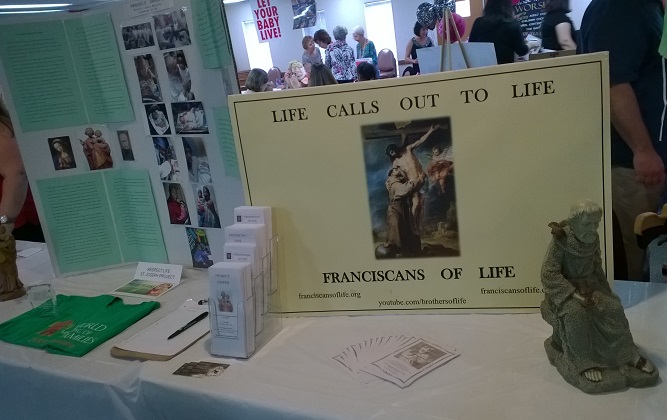
Franciscans of Life attended the Ministry Fair at St. Maximilian Kolbe Catholic Church, raising awareness for Project Joseph and its great need for mentors.


[How to Help]