On Friday, 14 August, the Church celebrates the feast of Saint Maximilian Maria Kolbe. Many know that Saint Maximilian Kolbe was a Conventual Franciscan friar who gave his life, in a concentration camp, to save the life of a young man who was a husband and father. More here
Maximillian, along with the Immaculate and Saint John Paul II, is patron of the Franciscans of Life. Maximilian also founded the Knights of the Immaculate, movement to promote devotion to the Mother of God, devotion that allows her to point to Christ as she did at Cana. This he did after he consecrated his life to the Immaculate. The Church has named Maximilian the Patron Saint of those who work for the Gospel of Life.
In honor of Saint Maximilian, the Franciscans of Life will gather for a festive supper and solemn vespers on the evening of August 14th. There will be food, music, pictures, games and a great deal of fraternal spirit. Please keep the Franciscans of Life in your prayers this day.
“Man is called to a fullness of life which far exceeds the dimensions of his earthly existence, because it consists in sharing the very life of God. The loftinessof this supernatural vocation reveals the greatness and the inestimable value of human life . . .” (Evangelium Vitae).
Cardinal Sean O’Malley, OFM Cap., archbishop of Boston and chairman of the Committee on Pro-Life Activities of the U.S. Conference of Catholic Bishops, has issued a response to recent videos showing leaders from Planned Parenthood discussing the provision of fetal organs, tissues and body parts from their abortion clinics. You can read the full statement on the website of the Archdiocese of Miami.
After a month in the hospital, I’m finally home. My old pastor said that I had used up another of my nine lives. He’s known me since I was a teen. Now he’s retired and living nearby.
Some people would say that I’m “confined” to a wheelchair. I don’t know if that’s the term that I would use. I am certainly in a wheelchair. I can no longer feel my legs. However, there is an inner joy that comes with this. I remember being at the hospital and receiving the sacraments of Penance, Eucharist and Anointing of the sick. Anointing of the sick is a sacrament that many of us know about, but we rarely speak about it. Not too many people report anything extraordinary after receiving it.
The day that I was anointed, I felt that it was my last day on earth. I was sure that by the next morning I would be pushing daisies. That night, I went to sleep as usual, still in the hospital. After a few hours of sleep I awoke. Without thinking I grabbed a sock and put it on. I suddenly realized that I was putting on a sock and enjoying the challenge. When your legs no longer work as they did before, you have to plan how to put on your socks, pants, shoes and so forth. Activities that the brain would plan, coordinate and execute in nanoseconds now become projects that you have to figure out and plan before you begin. “If I put this there and pull my leg that way, then I can slide this over here,” and so forth. In my line of work we call this motor planning. You literally plan every movement before you engage. We all do it, but we don’t pay much attention to the brain. The brain does it so quickly that we don’t notice.
I’ve found out that all of the things I did before were not just random actions. There are physical laws that the body must follow or you can get hurt. The more I analyze and problems solve, the happier I feel. I’m finally finding out the beauty and harmony that God created when he created man. We function like a miracle. We can dance and hold a conversation at the same time or get dressed and plan tomorrow’s dinner.
I am more convinced than ever before that there is a God. This well-orchestrated body of ours cannot be a random accident. The fact that we can compensate when we lose a function, means that someone created laws that allow the physical world to function either on high speed using the brain body alone or on a slower speed using the brain, body and adaptive devices. Because these things work each and every time, they can be considered laws.
However, I have discovered that where there is a law, there is also a law giver. Whenever I have to face a new challenge these days, I begin to analyze the laws of physics and body movements. This way I can execute whatever it is with a certain degree of confidence and order. This knowledge that there is a law giver brings me a great sense of peace and gratitude.
It also brings me a little shame, because I have taken so many little things for granted. I used to think that putting on a pair of shoes was not a big deal. Now I know what the brain has to do in fractions of a second just to meet our demands. This understanding increases my awe in the presence of God.
I don’t know how much of my legs I’m going to recover. But I do know one thing. Nothing is an accident. Everything is part of a divine plan. The more I see myself as part of this plan, the happier and more peaceful I feel, even though my body seems twice my age. LOL
I need to get back to rest. Please keep me in your prayers and let us not forget to pray for those who take God’s gifts for granted, as if they were random accidents. Nothing is random. Everything is a sign of life calling out to life.
A couple of months ago we mentioned that there would be some upcoming articles focusing on Project Joseph and on our family, the Franciscans of Life. The former we addressed in April. Today we continue this “mini series” by answering the question…
Who Are The Franciscans Of Life?
The Franciscans of Life is a private association of Catholic laymen who are celibate, singler, or married. It is the hope of the society to become a public association of the faithful someday, maybe an institute of mixed life, where regular and secular meet.
We exist with the permission and blessing of the Archbishop of Miami, the Most Reverend Thomas Wenski. Men from six countries, four language groups and three generations make up the fraternity.
We attempt to replicate that brotherhood that grew up around Saint Francis of Assisi in the thirteenth century, where there were friars, nuns, married men and women, diocesan priests, widows and single people who followed the Gospel according to the Rule of Penance written by Saint Francis. Today, our fraternity is comprised of men only. There are “regular” brothers who live the evangelical counsels in private vows and “extern” brothers who live the evangelical counsels as single or married men.
Our Way of Life
The Franciscans of Life make a covenant to live the Gospel according to the Rule of Penance and the constitutions of the society. Every brother, celibate, single, or married is a full member of the fraternity. Therefore, each one binds himself to observe obedience to the Church and the superior of the fraternity, to live a life of detachment from material things and temporal honors, and to persevere in chastity in the celibate, single, or married life.
While all of the brothers in Franciscans of Life are lay and secular, we use the term “extern” to identify those brothers who are married or single and hoping to marry, and the term “regular” to identify those brothers who live in community, are in private vows and are celibate.
Eucharist, Liturgy of the Hours, private prayer, fasting and abstinence are the guiding lights for the brothers. Fraternity is a hallmark of Franciscan tradition. Therefore, the brothers look to Christ and the apostles and endeavor to follow that model of fraternal life and service.
Common prayer, sharing, openness to each other, our families, and support for each other along the journey toward the perfection of charity are the means by which the brothers sanctify their lives and the lives of those they touch. The brothers are faithful and obedient to the Catholic Church as she speaks to us through the successor of Peter and the local bishop.
Our Mission
The mission of the fraternity is to proclaim the Gospel of Life through service to the voiceless, in particular the preborn child and his family, the terminally ill and the elderly, the immigrant poor who feels hopeless, and the person living with disabilities.
The brothers engage in a variety of apostolic activities in the Archdiocese of Miami. These include catechesis, campus ministry, Respect Life, prayer vigils at abortion mills, and serving fathers in crisis pregnancies through Project Joseph. Other apostolates are hospice and linking immigrant poor with community resources.
The invisible dimension of the brothers’ mission is a life of atonement for those who embrace the culture of death.
Extern Brothers
The extern brothers live in the secular world, but are not of the world. They are husbands, fathers, and single men. The fraternity is also open to deacons and diocesan priests who have the permission of their bishop to join.
These brothers hold typical jobs in the world and belong to different parishes in the Archdiocese. However, they come together with each other and the regular brothers at the weekly family meeting, liturgical functions, prayer, and apostolic activities.
Those who are husbands and fathers include their spouses and children in as many of the fraternal activities as possible. In this way, the Franciscan spirit is carried into the family and the family is embraced by the fraternity.
The extern brothers and their families engage in the proclamation of the Gospel of Life through participation in activities that promote the sanctity of life.
Regular Brothers
These brothers live in community under the leadership of a superior. They make private vows of obedience, poverty and chastity and are celibate for life.
None of the brothers owns anything individually or in common. They rent their home, share their material resources, and work to provide for their material needs as prescribed by Saint Francis in his Testament. When the income is not enough, the brothers beg as did the early Franciscans.
The daily life of these brothers is comprised of prayer, apostolic service to the voiceless, study, and labor that generates enough income to support the brothers and their work for the poor.
Under the guidance and encouragement of a superior also known as a guardian, the brothers strive to live as a family where brother serves brother as Christ served the apostles when he washed their feet at the Last Supper. These brothers spend a great deal of time together at prayer, work, ministry, study, recreation and rest.
Trinitarian
Like Saint Francis and the first generation Franciscans, the Franciscans of Life look to the Trinity for guidance and example in community, intimacy, love, unity and holiness.
Marian
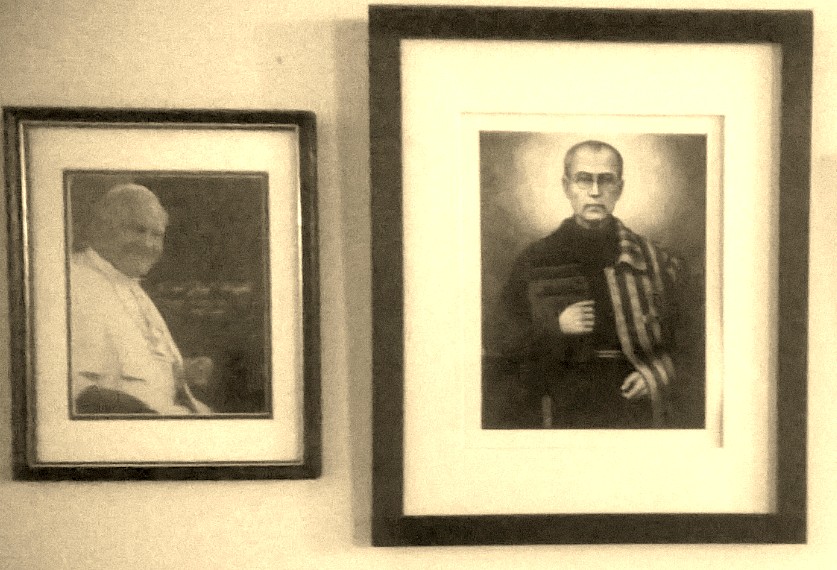
Saint Maximilian Kolbe and Saint John Paul II are the patrons of the Franciscans of Life. From these saints we learn to live under the mantle of the Immaculate and to protect the sanctity of life from conception to death.
“Vita ad vitam vocat…”
Prayerfully consider whether the Lord is inviting you to walk the way with us. In doing so, bear in mind the sayings of our patron saints: “Do not be afraid…forget not love!”
As some of you may already know, I’m back in the hospital. I’ve been here almost two weeks and there is no discharge on the horizon. My major body systems are not cooperating with each other. You fix one and the others go into distress (kidneys, lungs, pancreas, heart, and circulation).
It is a very challenging week in our fraternity. First, I became ill. Then Brother Leo’s sister died this weekend. Please keep him and his family in prayer. He had to fly to Boston. We miss him dearly.
As if that were not enough, Brother Bernardo was left alone to care for me since Leo is in New England. The challenge . . .? Brother Bernardo has come down with his own case of tonsillitis and has final examinations this week. The poor man is trying to recover, to help me and to prepare for finals. Pray that God will reward him with peace and trust.
On the positive side, patients, staff and guests at the hospital are very curious about Franciscans of Life. They don’t get to see much of us, because we don’t do traditional parish work. Our day is broken down into segments of prayer, teaching and preaching the Gospel of Life through a variety of apostolates, atonement for the culture of death, and fraternal life among us, like that of the early Franciscans.
People are fascinated when we explain that we’re looking back to go forward. I believe this has caused some Catholics to look back as well. We get many people who suddenly remember being influenced by a Franciscan here and there. If these memories transport people into the presence of God, then it must be the good spirit’s leading. One never knows the extent and power of redemptive suffering.
If you abide in me, and my words abide in you, ask whatever you will, and it shall be done for you. 8 By this my Father is glorified, that you bear much fruit, and so prove to be my disciples. 9 As the Father has loved me, so have I loved you; abide in my love. 10 If you keep my commandments, you will abide in my love, just as I have kept my Father’s commandments and abide in his love. 11 These things I have spoken to you, that my joy may be in you, and that your joy may be full. (John 15:7-13).
Our other concern is finances. God has plenty of money but the service providers want the money from us. Flying to funerals, going to doctors’ visits, paying for meds and paying for co-insurance for my inpatient is a toll.
Saint Paul reminds us that we can do everything in Him who strengthens us. Jesus reminds us that with him all things are possible. As a fraternity, we are willing and able to weather this storm. But we have to be together again in South Florida. All of us over the map does not lend itself to presence. To be together to pay bills and have enough to share with voiceless. We need to be together to preserve the Trinitarian Communion that is essential to our way of life.
Pray for Brother Leo and his family that God will give them peace and bring him home soon. Pray for Brother Bernardo that God will give him spiritual and physical strength to follow His lead and that his condition improves so that he can do well on his final examination, this week.
As for me, pray that as superior I may lead by the example of the Suffering Servant.
God bless you.
These days there are many discussions inside and outside of Church circles that boil down to sex. When we speak of empowering women in the Church, what exactly are we looking for if not Holy Orders.? In the mind of many people the only way to empower women is to assign them roles that are reserved for males, such as deacons, priests and bishops.
“Go tell my brothers that I will meet them in Galilee.”
This example begs the question. Do we really understand the difference between empowering and commissioning? There is a difference between someone having the power to consecrate the Eucharist and being sent to do so. When you ordain a class of ten males, they receive certain sacramental powers that they can exercise only with the authority from the bishop, not only because they are males. From here comes the term “to grant faculties.” Only a bishop can grant you a license to legally celebrate the Eucharist. You have the sacramental powers, but you lack the legal authority to use those powers. Without the bishop’s permission, you cannot exercise those faculties be you male or female.
Let’s look at the exercise of authority. “Go tell my brothers to go up to Galilee where they will see me.” But to whom does Jesus commend this great message?
Who else was in the garden on that first morning of the week: the angel, Peter, John and three Mary’s. However it is Mary is commissioned to deliver the message “The tomb is empty and I have seen the Master.”
We have all known our fair share of deacons, priests and bishop unable to deliver message as did Mary, with the power that comes only from Truth.
In 2009 Brother Jay Rivera, founder of the Franciscans of Life, was volunteering at Respect Life’s Pregnancy Care Center in Hollywood, Florida when he began to notice that the fathers of the infants in danger of being aborted were not being served by Respect Life Ministry.
It was not that the Archdiocese had anything against the dads. Simply . . . no one noticed. Men dropped off the expectant mother at the center, be it for class, counseling or material assistance, and sat in their cars, drove away or waited in the waiting area. The volunteers who served at the center would eagerly jump to the assistance of the expectant mother, but would have little or no interaction with the father. As Brother Jay watched, the thought hit him. “This is very much like Planned Parenthood and other ‘pro-choice’ organizations. Pregnancy is a woman’s issue.”
Like many other Franciscan fraternities, the Franciscans of Life place themselves under the protection of the Immaculate. Brother began to pray to the Immaculate for guidance. He also spoke to Joan Crown, Archdiocesan Director of Respect Life Ministry for the Archdiocese of Miami.
He laid out before them his concern that the fathers of the preborn babies were out of the loop. They didn’t know what to do or what was expected of them. Many of them were frightened by the sudden news of a pregnancy, wanted to walk away from the situation in the hopes that it would go away or offered to pay for an abortion as one would pay someone compensation for damages in an accident. The mothers were holding on to their preborn babies, but uncertain whether to go forward with the pregnancy.
Thanks to the support from the volunteer counselors and teachers at Respect Life, most of the mothers were determined to give the pregnancy a chance. However, giving your preborn child a chance is not the same as eagerly awaiting his birth. That chance can be revoked at any time.
Brother began walking up to the dads in the parked cars and invited them to come into the center. The men seemed friendly enough, but not too sure what to do about this invitation. They were hesitant. Of course, Brother Jay had no idea what he was going to do with the men either. He knew that he had to offer them something.
Finally one father, whom we shall call David, came inside. He was not too eager to be there, but he seemed curious to find out what this older gentleman who looked like a monk wanted. The first time that he entered the center they spoke for about 45 minutes about anything that came up.
That night, Brother again knelt in prayer asking for guidance. He prayed to St. Francis of Assisi, founder of the Franciscan family, to the Immaculate, patroness of the Franciscans, and to St. Maximilian Kolbe, a Franciscan saint who is the patron of pro-life workers. Simply put, he called a team meeting and placed the situation on the table.
“We have preborn children who are at risk for abandonment and death, if both father and mother don’t step up to the plate. But they don’t know what to do and I don’t know what to teach them, because there is so much information out there and such little time here.”
While at prayer he felt someone saying, “Give it to St. Joseph.”
The next day would be the first Sunday of the month, the day that the Secular and Regular Franciscans have their local community gathering. Brother went to bed and dreamed. He was in a small room that was illumined, but there were no signs of electricity, no flames, or windows. The room just glowed. In the room stood a friar with his back to the door. Brother Jay recognized this friar as Brother Francis of Assisi. Brother Jay saw the grey sleeve of Francis’ habit rise as he raised his arm pointing to something in front of them. When he looked, Brother Jay saw a wooden statue of St. Joseph, about 10 inches tall, holding the child Jesus in one arm and something green in the other hand.
The next day, he attended the fraternity meeting and shared his concern with his Franciscan brothers and sisters. He mentioned the dream as well. A Franciscan sister who was at the meeting got up and left the room.
She came back with a white box. As she handed the white box to Brother Jay, she said:
“Someone gave this to me about 12 years ago. I have another, so I put it in my closet waiting to find someone to whom I could give it. This morning, as I was getting ready to come to the gathering, something told me to put this in my car. I think it’s for you.”
When Brother opened the box, there was the wooden statue that he had seen in his dream. It was 10 inches tall. St. Joseph was holding the child Jesus in one arm and something green in the other hand. They were lilies.
This was the confirmation. Saint Joseph had accepted the challenge. He would walk with Brother Jay and the expectant dads in crisis pregnancies.
Where Is Project Joseph Today?
Today, Project Joseph has evolved into an archdiocesan network of formation and service for men who are in crisis pregnancies.
The program operates out of four of the five archdiocesan pregnancy help centers: Hollywood, North Dade, South Dade and Fort Lauderdale.
At each center there is at least one trained mentor who provides small group education to fathers, counseling and material assistance.
Fathers may attend an entire program of 18 modules divided into three blocks of six: Becoming a Better Man; Parenting; Future Planning.
After completing this set of modules, fathers are invited to continue in the program where they receive education and support in other areas of fatherhood such as:
community resources,
behavior management,
infant development,
chastity and human sexuality,
legal rights of fathers,
faith and parenting,
marriage and family,
and safeguarding children.
Dads are “paid” Parent Dollars for every session they attend. They can cash in these parent dollars for anything from diapers to cribs and mattresses. A father may join Project Joseph at any point from the moment of conception until the child is one-year old. Project Joseph is always there to help if a father needs to return later.
There is no charge for the services that we provide, nor do we charge the Archdiocese of Miami for such services. Project Joseph is financed through grants and donations.
Through the year, Project Joseph serves approximately 20 fathers per week, 50 weeks out of the year. The only time the program is closed is during Holy Week and Christmas week.
It is run by men for men. Our mentors are volunteers from the community. They are Catholics in good standing with the Church.
The Franciscans of Life provide initial and ongoing formation for the mentors.
Project Joseph is grounded in the spirituality of St. Francis of Assisi.
Fathers and mentors are brothers who walk side by side on this journey, as did Saint Francis of Assisi and those whom he and his brothers served. The mentors approach the fathers from the “bottom up”. Like Saint Francis, they are here to serve, not to preach, teach, correct, discipline or be heard. They preach the Gospel through their lives and through their unconditional love for every man whom they serve. We train our mentors in the pastoral methods of Saint Maximilian Kolbe, a Franciscan Friar and patron of pro-life workers.
Like his spiritual father, Saint Francis, Saint Maximilian placed his trust in the Immaculate. He planted the seed and allowed her to guide him and those with whom he walked. Like Christ, he was willing to lay down his life for his brother, especially if that brother was the father of a family. Our mentors are formed in the spirit of total detachment from self and confidence in the Immaculate and Divine Providence. We do what we need to do for the dads and we get out of God’s way.
If you are a man in the Archdiocese of Miami, ask yourself if God is inviting you to help us proclaim the Gospel of Life by walking with your brothers. Do not worry about not knowing what to do. We in the apostolate will walk with you and our brothers. Contact us to find out more!
We had a great couple of days for Project Joseph and the Franciscans of Life!
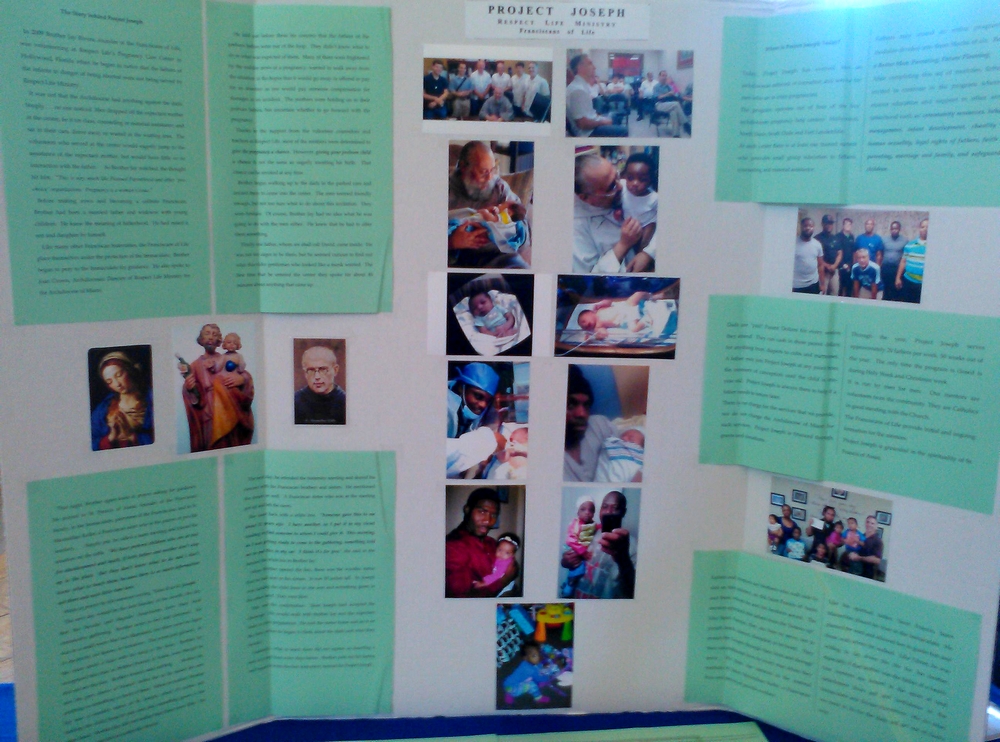
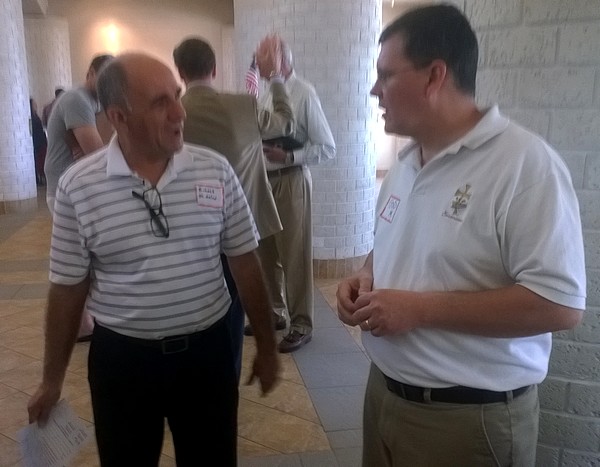
On Saturday, March 21st, the Franciscans of Life attended the 5th Catholic Men’s Conference of the Archdiocese of Miami. The event, which featured Catholic apologist Tim Staples, took place at St. Mark Catholic Church. We represented Project Joseph along with some of the mentors of Respect Life Ministry.
Our display included some literature and a poster describing the roots of Project Joseph and where it is today. It also featured pictures that the Project Joseph dads allowed us to share, either of their classes or of their beautiful children.
The event was well attended, and we had a chance to talk with several men, some of whom were dads themselves, and present to them information about Project Joseph, as well as invite them to our upcoming workshop.
On Monday, March 23rd we had the joy of receiving Brother Luis as a novice. He received the name Brother Luis Charbel, FFV.
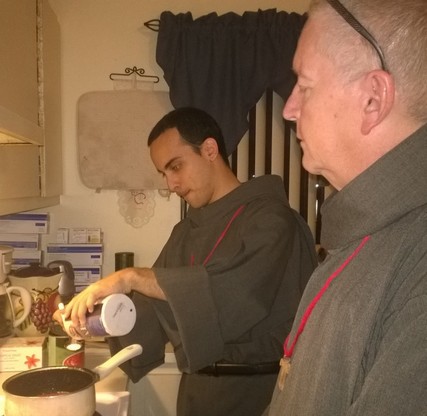
As a secular brother, Br. Charbel exchanges the cord that holds the wooden tau around his neck from a brown one to a red one. The red signifies the Sacred Blood shed by Christ during His Passion, and constitutes for Br. Charbel a reminder that he is called to “obey as Christ obeyed, without murmuring, complaints and resentment”, in order to “live perfect charity as Christ taught us on the cross”.
The exchange of the color and the reception of a new name are for the secular Franciscan of Life “an outward sign of his desire for transformation from the old man enslaved by sin to the new man, liberated by the Passion and Resurrection of Jesus Christ”.It was a beautiful and moving reception, attended by the regular and secular Franciscans of Life and their families. Brother Jay directed the ceremony, and Brother Bernardo offered a reflection on the call and life of the secular brothers.
In the next days we will feature more news about FFV and Project Joseph…stay tuned! 🙂

 Cardinal Sean O’Malley, OFM Cap., archbishop of Boston and chairman of the Committee on Pro-Life Activities of the U.S. Conference of Catholic Bishops, has issued a response to recent videos showing leaders from Planned Parenthood discussing the provision of fetal organs, tissues and body parts from their abortion clinics. You can read the full statement on
 remember being at the hospital and receiving the sacraments of Penance, Eucharist and Anointing of the sick. Anointing of the sick is a sacrament that many of us know about, but we rarely speak about it. Not too many people report anything extraordinary after receiving it.











 3.
3. Franciscans of Life