“Saint Francis Praying before the Crucifix at San Damiano,” Giotto, c. 1295, fresco
Francis was asked by Jesus to rebuild His house. Francis thought it referred to the chapel of San Damiano.
As time passed, after Francis had rebuilt San Damiano, his emptiness and his desire for truth continued to burn in his heart. It was only when his father dragged him to be judged by the Bishop that Francis realized that the house he was meant to renew was within him.
Francis stripped himself of his past when he returned to his father his money and everything he was wearing. Only when we strip ourselves of the past and the present do we realize how small and insignificant we are. When we strip ourselves of attachments, prejudices, opinions, material possessions, and past dreams and desires, we become like a vacant lot of land ready for a new building, a new house, a house where God is the master.
To realize that God is the master, we must realize our sinfulness. Sins that only God can blot away. No matter if we have been absolved in Confession, our attachment to sin has become part of the soil where God is to build His house. The previous house has been demolished and the surface of the field is clear, but beneath the top soil are the roots of sin, which, if not acknowledged, cannot be dug out like the weeds they are. Being absolved cleanses us of the eternal punishment we deserve, but the attached roots that remain must be acknowledged and God’s help must be begged to weed them out.
“Without me you can do nothing. If anyone does not remain in me and I in him, he is like a branch that is thrown away”.
– Jn 15:5
This is the most difficult truth that Francis had to face, if he was going to be raised as a living stone in Christ’s Church. It’s the lesson that Francis leaves for his followers. Live aware of the roots of sin in you, also remain aware of Christ’s presence through whom all things are possible.
“With men this is impossible, but with God all things are possible.” – Mt 19:26
“The stone the builders rejected has become the cornerstone.” – Ps 118:22
“Nothing is impossible for God” (Lk 1:37). He is more powerful and closer to us than the roots of sin. When we
see our nakedness, where the only thing left are the roots of sin, God is closer than those roots. Unlike the roots of sin, God is alive.
May the Immaculate always light our empty lot so that we may see our attachments to sin and her living Son always willing to clear the ground and help us build his house.
At the same time, we have recently become aware of some “pro-life groups” rising to the spotlight not for their sacrificial, redemptive suffering, but for their controversial, divisive efforts to bash pro-life laws and to demand legal prosecution of mothers who have had an abortion. Examples include “End Abortion Now International”, “Not A Victim” (who were kind enough to address a response to us here), and “Free The States”.
One has to wonder whether any such supposedly Christian group is merely a “bona fide” extremist fringe of the Pro-Life Movement, or if some are actual “fifth columns” of the opposition, started with the intent to bring disrepute to the Movement and cause disgregation from within…
Such an attitude is reminiscent of those who, at the foot of the Cross, believed themselves righteous in the eyes of both God and men in crucifying the Lord of glory.
The Gospel of life is life-saving and life-changing. Holy Mother Church has never endorsed such zealotry.
We are called to approach the Crucified Christ with compassion and empathy – like Our Lady and St. John – not with insidious intents, like those who scorned Him, or pierced the Sacred Heart with a spear.
The Pro-Life Movement has always focused on providing men and women in crisis pregnancies with the support they need to choose life, as well as post-abortion healing.
That is not a denial of basic truths. The Church has firmly declared that abortion is intrinsically evil, a position that “has not changed and remains unchangeable“. Those who procure an abortion not only commit a mortal sin, but incur automatic excommunication (can. 1397).
That being said: excommunication is not “shunning”, but a “medicinal penalty”…a call to repentance and conversion, so that the healing process may begin, and the person may be successfully reintegrated within the heart of the Church, the mystical body of Christ.
Furthermore, the Church – imitating Her Spouse in great mercy and compassion – has highlighted several factors that may prevent automatic excommunication (can. 1321-1325). For example:
“No one is punished unless the external violation of a law or precept, committed by the person, is gravely imputable by reason of malice or negligence.”
Also: “a person who acted due to physical force [or] coerced by grave fear” or “a person who has not yet completed the sixteenth year of age” do not incur this penalty.
As far as sin goes: there is a significant difference between objectivity and subjectivity.
We agree that a person is a person from the very instant of conception – this is not a religious dogma, but merely a common scientific fact – therefore the taking of an unborn person’s life is, objectively, murder.
For subjective guilt, however, the person must have full knowledge of the sin and deliberately consent to it – factors these that are often lacking when the mother is very young and/or subject to grave pressure (even abuse) from family or partner, or psychological pressure and fear due to abandonment, isolation, and poverty.
We do not wish to deny justice, but we do wish to affirm mercy and compassion.
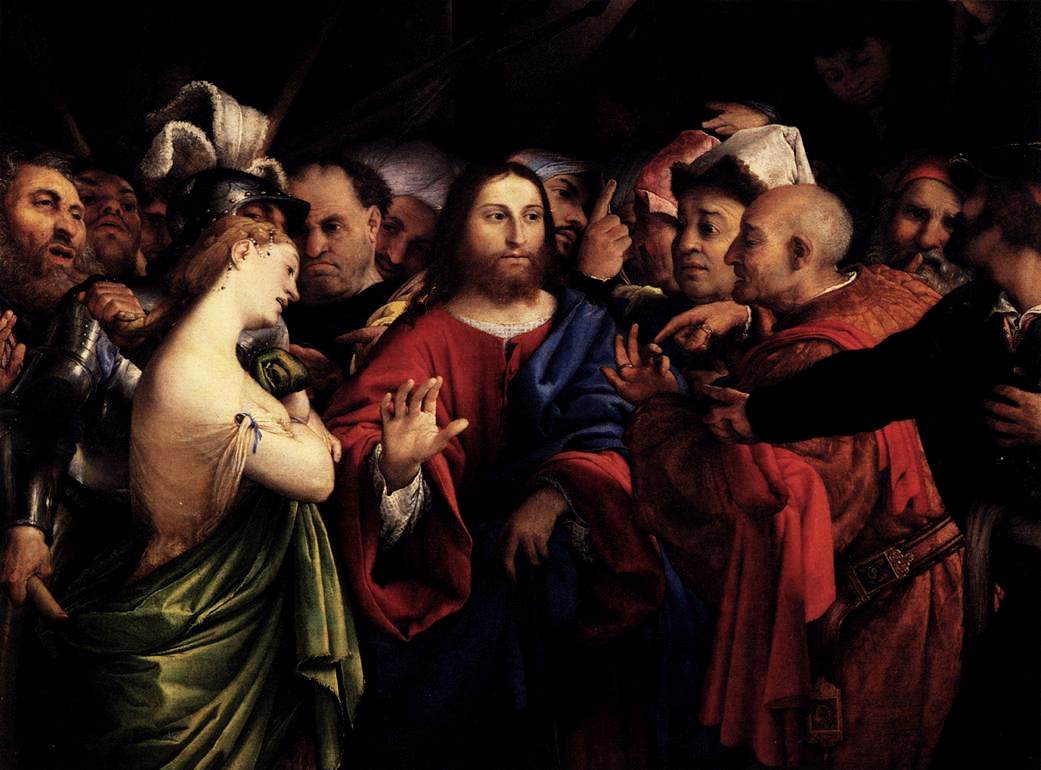
Meditate on how Christ kept the crowd from passing the sentence of law on the adulteress who stood guilty, and personally forgave her, commanding her to “go and sin no more”.
We are frankly much more concerned with those who profit from the death of the unborn, and in particular those who enable or commit such murder, failing to uphold the fundamental ethical standards of the medical field (doctors and nurses involved in the practice), and those who – as hard to write as it is to read – sell the aborted unborn’s body parts, or (mis)use them for unethical scientific research.
We constantly pray for, and invite them to practice medicine and scientific research in a life-affirming way. We also support organizations (such as And Then There Were None – Prolife Outreach) that specifically help abortion workers quit and find a different job that does not involve the killing of unborn children.
May the Lord of life strengthen us, protect us, and unite us, through the intercession of the Ever-Virgin Mary, our Immaculate Mother!
<<How good and pleasant it is when brethren live together in unity!>> – Psalm 132
Disclaimer: the information on this site is not intended or implied to be a substitute for professional medical or spiritual advice, diagnosis, or treatment. For physical / psychological issues, please discuss the matter with your P.C.P. and/or seek anger management or mental health counseling. There is absolutely nothing wrong with doing so, nor are you “crazy”, if you take proactive steps for the sake of your health and of your mind. For spiritual issues, please amend your life, increase your life of prayer (particularly Confession and Mass attendance, as well as reading the Gospels and praying the Rosary) and discuss matters with your pastor.
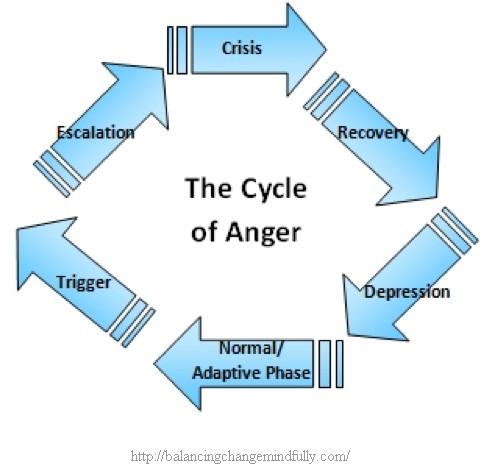
Hot-button issues bear one characteristic aspect: they incite emotional responses from the reader. Such responses can easily escalate into violence, either overtly or covertly, as we have been witnessing recently across the Nation.
We have to be very careful to monitor our emotions and regulate them so as not to lose control of ourselves and do things that will hurt ourselves – as well as others – and fuel our rage as time passes and our control over our passions becomes weaker.
Rage has a way of leading one to self-destruction in the search for peace. Sometimes it can lead to “self-medicating” with drugs or alcohol, or other addictive substances and behaviors. Their relief is short. The person then moves on to bigger and more “efficient” ways of expressing the anger. That is when anger can become physical: the destruction of property, for example.
If one is not stopped, such action only feeds the fire of Hell within, which keeps the anger burning with a flame that never runs out of fuel.
When destruction of property fails to suffocate the interior rage, the person then turns on living beings – animals first, then human beings – trying in every possible way to control them, provoke them, or bully them.
By that point, Satan is satisfied: he has been allowed to lead the person into serious evil. At this level, the person starts to make excuses instead of working on recovering interior peace. “See what you made me do?” or “If you had done it my way, we wouldn’t be having this problem“.
The demons sit back and laugh: the more one deflects the less they resolve their problem. The rage that has grown in the interior life distorts reality. If a real problem is distorted, any attempt to solve it is severely crippled.
To avoid all of the above, we must begin with ourselves. We must sit back and try to understand what is it that is truly provoking our rage. We usually see that what we are seeing is really the outer shell of a rotten egg… that rot can be something that has nothing to do with the target of one’s fury. It is only when we identify what really makes us angry that we can determine whether it has anything to do with us, or even if we are rightfully angry at all.
If we are justifiably angry, we have regained control over our emotions. Those feelings may not go away, but at least we can exert our free will and authority over our mind and emotions.
Any action that blinds our intelligence can lead us to the behaviors and damage that we described above.
Here are some additional online resources related to this topic.
In this videoMsgr. Rossetti – licensed psychologist and appointed exorcist – outlines in an introductory fashion what to do if you think you have demons affecting you: he discusses effective spiritual practices, including the use of sacraments, sacramentals, and appropriate deliverance prayers.
note –while this link has prayers cleared for laity, their website does have resources specifically intended for (and restricted to) clerics, whom we humbly encourage to read.
On this Solemnity of the Most Sacred Heart of Jesus, the Supreme Court of the United States has formally held that the United States Constitution does not confer a right to abortion.
Furthermore, SCOTUS overruled both “Roe v. Wade” and “Planned Parenthood v. Casey” and stated that, in the United States, “the authority to regulate abortion is returned to the people and their elected representatives“.
We wish to quote some salient points from the Statement:
the Constitution makes no express reference to a right to obtain an abortion
procuring an abortion is not a fundamental constitutional right
the right to abortion is not deeply rooted in the Nation’s history and tradition
the Fourteenth Amendment clearly does not protect the right to an abortion
Roe and Casey have led to the distortion of many important but unrelated legal doctrines…that effect provides further support for overruling those decisions
The Court emphasizes that this decision concerns the constitutional right to abortion and no other right.
A few more points worth quoting from the SCOTUS Statement:
until a few years before Roe, no federal or state court had recognized such a right. Nor had any scholarly treatise. Indeed, abortion had long been a crime in every single State.
by the time the Fourteenth Amendment was adopted, three-quarters of the States had made abortion a crime at any stage of pregnancy
Finally, the Court considers whether a right to obtain an abortion is part of a broader entrenched right that is supported by other precedents. The Court concludes the right to obtain an abortion cannot be justified as a component of such a right.
The nature of the Court’s error. Like the infamous decision in Plessy v. Ferguson, Roe was also egregiously wrong and on a collision course with the Constitution from the day it was decided. Casey perpetuated its errors
An even more glaring deficiency was Roe’s failure to justify the critical distinction it drew between pre- and post-viability abortions. The arbitrary viability line, which Casey termed Roe’s central rule, has not found much support among philosophers and ethicists […] viability has changed over time and is heavily dependent on factors—such as medical advances and the availability of quality medical care—that have nothing to do with the characteristics of a fetus.
Mississippi’s Gestational Age Act is supported by the Mississippi Legislature’s specific findings, which include the State’s asserted interest in “protecting the life of the unborn.” These legitimate interests provide a rational basis for the Gestational Age Act, and it follows that respondents’ constitutional challenge must fail.
Today’s decision of the US Supreme Court overturning the fateful Roe v. Wade is certainly welcomed by all those who recognize that human life begins at conception and that this is a scientific and biological fact and not merely a religious belief or ideological theory. As such the unborn child should be welcomed in life and protected by law. […]
We hope that dismantling Roe will allow legislation protecting the unborn to move forward in our state legislatures and to survive constitutional challenges in the future.
Abortion too often is seen as the solution to an unforeseen problem, a fall back position if contraception failed or was not used. But abortion is no solution — and it is no right. It is a wrong, a grievous wrong that has prematurely ended the lives of more than 60 million souls in this country alone since 1973.
A number of sources, among which we quote this one(without by this intending to endorse in any way the source) have summarized the current situation as far as individual States banning abortion:
Would ban most or all abortions.
Bbortion bans within one month
Abortion bans within weeks or months
Abortion bans uncertain
Abortion likely to remain for a while
(Click on map to enhance)
We encourage you to continue praying – in private, with your community, even with us – and to find out locally (as well as through the major Catholic institutions and associations) how you can continue supporting this aspect of the pro-life ministry at this crucial moment in the history of the United States.
The date chosen by Divine Providence is very fitting indeed. Today we celebrate Our Lord’s Most Sacred Heart, and tomorrow we celebrate the Immaculate Heart of Mary, ever-virgin, the most pure Theotokos who, when in her kindness she appeared at Fatima, promised triumph!
We continue united in prayer and action, against all violence and evil, proclaiming the sanctity of human life and reaching out – as much if not more than before – to women and men facing a crisis pregnancy.
Most pro-life eyes are currently focused on one particular issue, namely the reversal of Roe v. Wade, etc. Surely this is due to the great hopes it has generated, after decades of prayer, penance, and advocacy…but also in no small part because of the dismal violence ensuing from the pro-abortion hordes (even locally), for which we have started a Rosary Crusade.
However, there is another critical pro-life issue that is spreading subtly, like poison, throughout several U.S. legislatures: euthanasia (assisted suicide).
The letter below comes from Mr. Alex Schadenberg, Executive Director of the Euthanasia Prevention Coalition (which has a USA chapter). It provides an excellent summary of the situation here in America. With his permission to share, we invite you to read it in detail, bearing in mind that what we are beginning to witness in our Country is merely the tip of the iceberg.
Other countries either already have, or are in the process of approving laws that legalize this killing, not only of adults with full faculties but also of:
[For clarification on the map above, passive euthanasia refers to denying someone, who is not otherwise dying, the basic necessaries of life to intentionally cause their death – and it is notmorally acceptable. We will have a more in-depth article on these teachings published in the near future. ]
If we do not take action now – primarily and particularly through prayer and penance, followed by being proactive on these life issues in our ministries – when will we? Will we wait for euthanasia to (continue to) be legalized across the USA? Will it take a new kind ofRoe v Wade, this time Euthanasia-centered, for the pro-life movement to stand up and speak up in unison against these evils?
Bear in mind that the Church infallibly upholds the sanctity and dignity of all human life – from conception to natural death!
Without further ado, here’s the letter (click on each page to enlarge!)
More than half of the Justices of the Supreme Court of the United States have agreed on a draft that reviews the constitutionality of Roe v Way as it was written in 1973. The conclusive verdict is to be handed down later this spring or early summer.
As Franciscans of Life, this review has captured our attention. More importantly, we have become aware that people who object to this review have gathered to protest in front of the Justices’ homes, without regard for the safety of the families who live inside. As citizens, we have the right to protest and communicate our demands to the government in peaceful and safe demonstrations. There is, however, no moral justification for the dangers arising when angry mobs gather, especially before the homes of private citizens. Spouses, children, grandchildren, seniors living in the homes are not public figures. They have the right to a quiet and peaceful life as the rest of us. Disturbance of the peace and instilling fear in private citizens is immoral and – as we have stated above – dangerous to the collective safety.
I’m saying all of this because, as Franciscans of Life, we know that human life is sacred from conception to natural death. Life is the supernatural act of God in favor of humanity, a humanity that His Son, Jesus Christ, would assume at a precise moment in history, society, and ethnicity.
We believe that the Second Person of the Holy Trinity became man, developed in the womb of a human mother, was born of her, and was unjustly executed on the cross. Taking on our human nature side by side with His divine nature, and being executed, was an act of God’s love for humanity.
Our Country fought a civil war for many reasons, the most important being the belief that no human being can own another human being – not even one’s mother. We have no ownership of the person in the womb, thus killing an unborn baby is claiming ownership and authority that is not ours. Abortion is a false belief that the preborn child has less rights than a slave, and that the child in the womb is as much the property of the mother as a lung.
The Franciscans of Life are inviting everyone we know to join our Rosary Crusade, to pray that Congress and state governments will pass laws that protect the right to life of every person, from conception to natural death.
We invite you, your family, and friends to pray the Holy Rosary every Saturday, starting this Saturday, which the Church reserves for Our Heavenly Mother, until the Saturday before the Feast of the Assumption (August 13).
You don’t have to go to the parish church. You can pray from your home, car, or any quiet place. Just pray. The Rosary is the most powerful private prayer in our armory. Popes have called it “scourge of the devil,” “treasure of graces,” “heavenly instrument,” “glory of the Church”.
“[A] lovely, subdued melody floated through the forest above the solitary and forsaken little chapel of Our Lady of the Angels, just when a shepherd was passing by with his sheep. The shepherd turned pale and looked up at the fallen-in roof, but there was nothing to be seen. “Have they got an organ now?” he wondered. He pushed the little door open. All was dark and still within. Overhead the music was becoming more and more heavenly, as a hundred golden voices seemed to mingle in counterpoint. “Lord, how beautiful! It’s enough to make one want to die, it’s so beautiful!” he thought, for he was so moved that he could not utter a word. His heart told him what was happening…”
August 2nd is coming along, and with it, two happy occasions – the “Great Pardon” (as the Portiuncula Indulgence is known in some places) and the “flocking” of the Franciscans of Life (regulars and externs) to the Motherhouse after a bit of a hiatus from community gatherings.
There will be a note of sadness, as our dearest brother Leo will not be with us for the first time…since his passing on May 26th of 2020. Four hundred years earlier, St. Philip Neri passed away on the very same day. Let’s pray for the repose of our dear brother Leo, and ask in a special way for the intercession of St. Philip, “Pippo Buono” as the Romans called him due to his kind and gentle disposition… All who knew our Brother Leo knew of his natural gentleness and kindness, which is what, perhaps, inspired our Superior to name him Leo at Novitiate, in honor of that first brother Leo, a gentle soul whom St. Francis used to call “ you little lamb of God”.
But this article – which from its prolixity you will most likely know is authored by brother Bernardo – is not so much about our community as it is about the Portiuncula Indulgence! We will go over the Porziuncola, “Santa Maria degli Angeli”, and then we will dig a bit more into the matter of indulgences – a matter of heavenly and motherly love – and its relationship to the wonderful Sacrament of Confession – so, please, stay with us!
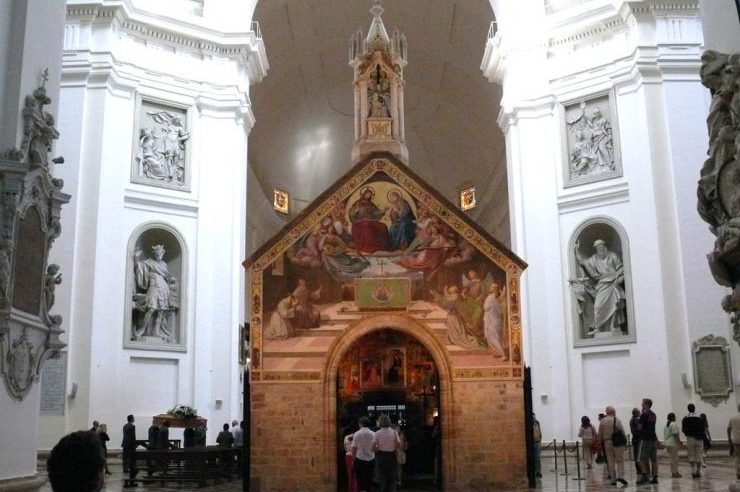
On Saint Mary of the Angels, called Porziuncola (“little portion“)
1704 illustration from “Collis Paradisi Amœnitas, seu Sacri Conventus Assisiensis Historiæ“, as found on p.107 of “The Story of Assisi” by Lina Duff Gordon
If we dig a bit, we find a nice summary by Pope Benedict XV on the salient points regarding this very special place, which we summarize below:
It is taught that in the days of Pope Liberius (IV century) pilgrims from Palestine brought here a fragment of the sepulcher of the Blessed Virgin Mary, that is to say, the place of the Assumption, and thus was the place named Saint Mary of the Angels.
Here St. Francis wrote the rule approved by Pope Innocent III (“admonished by divine vision”, writes Benedict XV).
Here Clare, the noble virgin of Assisi, having forsaken the world, was clothed in the poor Franciscan habit, and instituted the second Order.
Here also originated the Third Franciscan Order [note of clarification: that of the Penitents, whose ancient rule we follow].
By this place were the first Chapters of the Franciscan order, including the famous “Chapter of Matts” of Pentecost.
Here St. Francis, after refusing six times, finally agreed that he and the brothers would share a meal with St. Clare and the sisters. It is recounted that their souls glared so brightly that the people from the surrounding areas thought the forest was ablaze.
Here St. Francis had a vision of the Lord and Our Lady, and went to Perugia to implore Pope Honorius III in 1216 for a most extraordinary and unusual favor: “that anyone who comes [to the Portiuncola] confessed and penitent be absolved from the punishment and guilt from the day of baptism to the day and hour of entrance in said church”. Such an indulgence was unheard of in those days! Yet, three times did the Supreme Pontiff give his assent. Upon the Saint rejoicing and departing his presence, came the Pope’s affectionate remark and the Saint’s moving reply:
“You simpleton, where are you going? What proof do you carry?”
“Your word suffices to me! I seek no further instrument, other than the Virgin Mary be the parchment, Christ the notary, and the Angels the witnesses!”.
There is a pious story coming from the nephew of one of the early brothers, who accompanied Francis back from Perugia to Assisi. They stopped to rest a while and, upon awakening, St. Francis said: “Brother Masseo,I tell you from God that the Indulgence that the Supreme Pontiff gave me is confirmed in heaven!”
Here Francis stood by the entrance after returning from Perugia and, stretching his fatherly arms, said to all:
“I want to send you all to heaven!
I announce to you an Indulgence
which I obtained from the mouth of the Supreme Pontiff…”
St. Francis at the Portiuncola, 1226
Here Francis implored his Guardian and his brothers to take him to die.
“No, no! To Our Lady of the Angels! – Francis begged – I want to die where I began!” (from “The Perfect Joy of St. Francis”, by Timmermans)
Finally, here he died, naked on the floor (ref. Job 1:21), a broken, small 43-year-old man, marked with the Stigmata of the Lord he so loved, surrounded by his brothers who so loved him, under the loud warbling of hundreds of larks soaring heavenward…St. Francis of Assisi, whom Holy Church would call the Seraphic Father, the Alter Christus, but who, in his letters, introduced himself as little brother Francis….the little one….your servant…a worthless and weak man.
On the Great Pardon, or the Portiuncula Indulgence
One scholar wrote:
“it seems incredible that a perpetual plenary indulgence with no attached condition of almsgiving or personal sacrifice should have been granted in favor of an obscure chapel in Umbria. Yet we have six sworn statements of contemporaries, regulations of the General Chapters of the Order, and 53 pontifical acts of the XIVth century either confirming it or defending it”.
The Catholic Historical Review, Vol. 24, No. 4 (Jan., 1939), p. 466
This is just as St. Francis had told Pope Honorius: “If it is the work of God, He will make it manifest” – and this He has done – through His Church – through the centuries!
Of this plenary indulgence can benefit the faithful – for themselves or for a deceased as suffrage –
(a) either by directly visiting Santa Maria degli Angeli and the Porziuncola shrine it contains (in Assisi)
…and they will recite a Pater (Our Father) to reaffirm their dignity as children of God received in Baptism
…and they will pray for the intentions of the Supreme Pontiff, condition which is satisfied by reciting one Pater and one Ave, although one may also recite any other prayer if recited for this intention. This would also be fittingly performed on the same day.
On Indulgences in general, and Plenary Indulgences in particular – or, how to gain one
To benefit from an indulgence, the person must be baptized, must not be excommunicated, and hopefully in the state of grace. Furthermore, one must have the general intention of gaining the indulgence, and of course carry out the works mentioned above.
Most importantly, however, for the indulgence to be plenary and not partial, it requires the exclusion of all attachment to sin, even venial sin.
This has been historically considered the most complex of the conditions: no man, however holy, can call himself free of sin, but many can honestly call themselves free of affection towards sin, to the best of their knowledge!
In 2004, the Apostolic Penitentiary used the following language:
…as long as they are totally free from any desire to relapse into sin…
“The requirement is not “freedom from all sin“, rather, that “there is no sin which the soul is unwilling to renounce”.
A person should know if he’s in compliance, because an attachment implies a refusal to fix a situation – as when sometimes, deep down, we don’t want to let go of certain sins, even if “small”.
This is quite different from weakness, or habitual sin that is being battled…to souls in these situations, the Church is ready to aid!”
Confession, Reparation…and Indulgences – or, how they are closely related!
Pray to the good Lord to take away any desire, albeit small or hidden, for sins both grave and venial, and go as far as to bring forth in your heart a salutary hatred of sin, remembering that God is all-good and all-loving and that even the smallest sin displeases him.
After all, what is an indulgenceif not but a “continuation” of the Sacrament of Penance? That is to say, “a remission before God of temporal punishment for sins whose guilt is already forgiven”?
We know that the matter of sacramental Confession is the acts of the penitent: contrition, confession and satisfaction.
say NO to sin!
We should strive to a perfect contrition (CCC 1452) and perfect contrition builds more and more on detachment from sin, first from the “great” sins and then from the “small” ones! A devout soul, then, should not find much difficulty in complying with the requirement to be detached from all sin. The rest of us should simply keep working our way there, knowing that it is entirely up to us to not want to sin, while it is entirely a gift of God to bless us with the grace needed to overcome sin. “Without me – says the Lord – you can do nothing” (Jn 15:5), but He also says, “be perfect, as your heavenly Father is perfect” (Mt 5:48), and later, to St. Paul, “my grace is enough for you” (2Cor 12:9).
In the form of the Sacrament, “I absolve you”, assuming the penitent did not put any obstacles, such as willfully lying or withholding, or later failing to do any satisfaction, but rather that the penitent had a sincere sorrow for their sins and a firm resolution to avoid them in the future, all their sins from the very moment of Baptism (or from their last Absolution) till that moment are forgiven and remitted through the power of the Keys – even sins that you may have forgotten to mention!
Yet, such forgiveness and remission of sin does not imply the forgiveness of the temporal punishment due to every sin.
Sin carries both a stain and a punishment. When the stain is cleansed from the soul by sacramental absolution, the temporal punishment is not always remitted, except through the remedy of satisfaction, by avoiding near occasions of sin, resolving to sin no more, and doing works of penance. Such satisfaction also atones to our Mother the Church, whom we often forget is injured by our sins, and it also deters others from sin by way of example.
Last but not least, temporal punishment is the reason for Purgatory…the ecclesia dolens… Someone reported that St. Padre Pio once said: “let us do our Purgatory here on earth…by accepting everything from God’s hand“. (ref. Job 1:21…again…)
Interiorly, satisfaction heals the wound caused by sin. St. Bernard taught that “the stain is removed from the soul by God’s mercy, while the wound is healed through the remedy of penance…and even then, some scar remains”.
In this we see the great love and care of Holy Mother Church, Bride of Christ and as such minister of Redemption, custodian of that great treasury of expiatory works of Christ and the Saints! By granting an Indulgence, our Mother the Church is coming to our help in ridding us of the temporal punishment we have accumulated by our sins – or, when we apply the indulgence to a faithful departed, to help us help one another!
St. John Paul II summarized this wonderfully in 1999:
“[indulgence] is a sensitive subject, which has suffered historical misunderstandings […]
The starting-point for understanding indulgences is the abundance of God’s mercy revealed in the Cross of Christ. The crucified Jesus is the great “indulgence” that the Father has offered humanity through the forgiveness of sins […] in the logic of the covenant, which is the heart of the whole economy of salvation, this gift does not reach us without our acceptance and response. […]
[I]t is not difficult to understand how reconciliation with God, although based on a free and abundant offer of mercy, at the same time implies an arduous process which involves the individual’s personal effort and the Church’s sacramental work.
For the forgiveness of sins committed after Baptism, this process is centered on the sacrament of Penance, but it continues after the sacramental celebration. The person must be gradually “healed” of the negative effects which sin has caused in him (what the theological tradition calls the “punishments” […] Precisely for the sake of complete healing, the sinner is called to undertake a journey of conversion towards the fullness of love.
The temporal punishment itself serves as “medicine” to the extent that the person allows it to challenge him to undertake his own profound conversion. This is the meaning of the “satisfaction” required in the sacrament of Penance.
The meaning of indulgences must be seen against this background of man’s total renewal by the grace of Christ the Redeemer through the Church’s ministry.
The Church has a treasury, then, which is “dispensed” as it were through indulgences. This “distribution” should not be understood as a sort of automatic transfer, as if we were speaking of “things”. It is instead the expression of the Church’s full confidence of being heard by the Father when – in view of Christ’s merits and, by his gift, those of Our Lady and the saints – she asks Him to mitigate or cancel the painful aspect of punishment by fostering its medicinal aspect through other channels of grace. In the unfathomable mystery of divine wisdom, this gift of intercession can also benefit the faithful departed […]
We can see, then, how indulgences, far from being a sort of “discount” on the duty of conversion, are instead an aid to its prompt, generous and radical fulfilment. This is required to such an extent that the spiritual condition for receiving a plenary indulgence is the exclusion “of all attachment to sin, even venial sin” […]
Therefore, it would be a mistake to think that we can receive this gift by simply performing certain outward acts. On the contrary, they are required as the expression and support of our progress in conversion. They particularly show our faith in God’s mercy and in the marvellous reality of communion, which Christ has achieved by indissolubly uniting the Church to himself as his Body and Bride.”
Our Catholic Faith is a gift of the Father given to us by the Son through the Holy Spirit. We often forget that it is thanks to the blood of the martyrs that the Faith was strengthened.
The Faith is built on the blood of the martyrs. For centuries, Catholic men, women, and children have chosen death rather than deny Christ. Yet, how easy it is for us, in our politically correct world and our inclusive society, to hide our Faith or misrepresent it.
It is not that we are opposed to inclusion and to social graces. But there is a right way and a wrong way to welcome those who believe differently from us.
Political correctness and inclusion must never deny or hide the truth. Christ demands that we treat everyone with respect. Even in the case of a non-believer there exists a hunger for the transcendent. The transcendent points to God, even when people profess to deny the existence of God. That little light that seeks to understand a God who is denied, that little light is actual grace that God gives to humanity so that we may seek and find Him.
Justice demands that we speak up for Christ and the Catholic faith when societal norms and politeness try to impose upon us that which is contrary to God’s plan for humanity. It is not within our ability to question God, much less to re-design truth so as to include everyone. Inclusion and political correctness must be built on justice and fidelity to God.
As we approach Holy Week it’s important to examine our conscience and to ask ourselves, “Have I looked at mothers and fathers who submit to abortion with kindness or with aversion?”
God gives us rights from the moment of conception
Abortion is a heinous crime that cries out to God for vengeance. While it is true that the unborn child is the innocent
victim whose life is taken during the early stages of human development, one must ask, what of the mothers and fathers who agreed to abort their unborn child? Are they aware of the gravity of their choice? If so, do they mourn the death of their unborn child? Do they hide their grief and their guilt so as not to be judged by others?
Saint Francis of Assisi wrote in one of his admonitions,
“Blessed is the man who bears with his neighbor according to the frailty of his nature,” (admonitions of St. Francis).
To be aware of the deep-seated guilt in the conscience of the post abortion parent, instead of judgment and indignation, requires spiritual sacrifice and often the courage of the crucified Christ who forgave rather than condemned. This kind of courage requires sacrifice and strength to go against our natural temptation to lash out at such people.
Why does Saint Francis say that we’re blessed if we bear with [our] neighbor’s human frailty? If we look at the story of the woman caught in adultery, we will find the answer to this question.
Jesus asks her, “Woman, where are they? Has no one condemned you?”
“No one, sir,” she said.
“Then neither do I condemn you,” Jesus declared.
“Go now and leave your life of sin,” (John 8:10-11)
Kindness toward the post abortive parent, along with encouragement to avoid this and other sins, is to do as Christ does. That is how we become blessed. Along with blessings that God may bestow on us for such mercy and kindness, to behave toward the sinner as Christ did draws us closer into his blessed nature.
Infra-red photo of the hurricane
Men and women who struggle with the guilt of abortion are carrying a cross, but they’re not moving in a forward direction. Each day is another walk around the same circle of grief, shame, and guilt. People of faith have a moral duty to point those who carry such a cross in the right direction. This is a spiritual work of mercy.
We must remember Christ’s words, “Whoever wants to be my disciple must deny themselves and take up their cross daily and follow me,” Luke 9:23.
We cannot erase a chapter from another person’s history book, nor should we want to do so. However, we can point the sinner toward Christ. We have a duty to counsel the sinner to carry the cross that that’s a consequence of abortion and turn it into a holy life, denying themselves of self-pity, instead following Christ through the Sacrament of Reconciliation, Holy Mass, and daily prayer.
Those who treat their neighbor as they would want to be treated are truly blessed. Christ’s love and mercy shines through us.
The word “euthanasia” used in a medical context refers to an easy, painless, happy death, during which it was a “physician’s responsibility to alleviate the ‘physical sufferings’ of the body.”
The ethical problem with this definition, from a non-religious point of view, is found in the word “happy”.
– Who guarantees that the person will be happier dead than alive?
– Even the patient cannot know what lies on the other side of death. He or she can’t choose a “happiness” that is not guaranteed. It is unethical for one to desire that which conflicts with natural law. Nature has a time and a means for each of us to die. In choosing euthanasia we’re assuming greater authority over life and death than nature. If humans can have greater authority over life and death than nature, how do we explain that human beings can reproduce naturally or with medical assistance, but cannot create life out of nothing?
– Reproduction technology such as in vitro fertilization (IVF) replicates nature. Therefore, the laws that govern life are built into nature, not man or his technology.
How many forms of euthanasia are there?
We can identify 3 types of euthanasia.
voluntary euthanasia (euthanasia performed with the patient’s consent).
We cannot govern when and how we are conceived; how can we determine when and how we are to die? Man is naturally oriented toward the greater good. If he or she chooses euthanasia, it’s because he or she has become convinced that death is a greater good than life. But why?
Mental health professionals will tell us that a person who commits suicide is unstable. Is the person who allows another to kill him, emotionally stable? What is the difference, between me holding the gun to my head and me handing to another person a lethal injection and passively allowing him to inject a deadly chemical into my blood stream?
People who are advanced in years, or very ill, may desire death. Usually, they don’t desire to be killed. There’s a big difference between yearning for the end of suffering and paying a medical professional to end his suffering by killing him. The emotional stability of those who give a medical professional the authority to kill them can, and should, be questioned. Is this not abdicating one’s right to experience the human condition? Is this truly choosing to end pain or feelings of neglect, or is it taking the quick way out, so a not to deal with pain or old age, especially if the senior feels abandoned by his loved ones?
If the older person feels that life is not worth living, there has be a process that led him or her to this conclusion. What is that process? Is this valid reasoning? There are many false conclusions derived from false premises. These constitute invalid reasoning.

 To realize that God is the master, we must realize our sinfulness. Sins that only God can blot away. No matter if we have been absolved in Confession, our attachment to sin has become part of the soil where God is to build His house. The previous house has been demolished and the surface of the field is clear, but beneath the top soil are the roots of sin, which, if not acknowledged, cannot be dug out like the weeds they are. Being absolved cleanses us of the eternal punishment we deserve, but the attached roots that remain must be acknowledged and God’s help must be begged to weed them out.
















 Franciscans of Life