Spiritual aridity is as different from spiritual apathy as Rome is from Tokyo. There can be many causes for spiritual aridity, but explaining each cause would turn this into a book of Christian spirituality and psychology, Let’s settle for the existential experience of spiritual aridity.
Existentially, spiritual aridity can best be described as thirst in a sandy desert. Once looks for a connection with God in prayer, the Sacraments, the Church, even the Gospel. At the end, not finding that spring that we once experienced in the spiritual life, we become despondent. We argue that there is no spiritual gain in prayer, the Mass, the Church, or even those around us.
The biggest problem is that we fault all religious activity as falling short and not meeting our spiritual needs. We fail to look into our soul. We are afraid of the darkness we might find there. Our reasoning ability becomes weak.
But God is not found through human reasoning, As complete and perfect, God is far superior to the collective of human wisdom.
God is that body that illuminates the night. The darker the night, the more visible are the stars of space. The stars that shine in the night are the sunlight that light up our day. Do we give up on prayer, the Sacraments, and the Church because of the human weakness that we find there, or the catastrophic mess that we are?
We need to remember that through the centuries, many have seen the weakness that we see…however, some of those people cry out to God to brighten the darkness that they see around them. Some of our most admirable saints have spent years calling out to God, the light of the night and the water in an oasis.
The more the cry out to God, “come be my light,” the stronger we become without realizing it. Grace is not a human feeling. It’s a seed planted in the soul where the Divine Gardener will water it and protect it from death as long as we persevere, “Come be my light”.
We carry on with whatever good the Church, Sacraments, and the Sacred Scriptures will offer. But each time we come into contact with the cold desert night, we call out to Him who can be the light we seek. The search for the light of God, however, requires that we never give up on calling, “Come, be my light”. God has never abandoned one who called out to Him. Those who give up calling out to God will be burned by the light of the Son whom they have given up. Man gives up hoping for the light. The Light for each man will always allow Itself to be seen; but only when God knows that it will do some good for us and through us.
We can never forget that we are the sheep that can’t find the Good Shepherd. But He is always closer to us when the desert looks the darkest or feels the coldest.
May the Immaculata always guide us through the dark desert.
The Immaculate Conception is an event that happened only once in history. The Immaculate Conception is God’s power to create a person free of original sin. That person is Mary, the mother of Jesus who is the Son of God.
When the Holy Spirit overcame Mary, Jesus’ humanity and divinity were placed in her womb for protection and the necessary space for the divine seed which had been planted – with a human nature alongside the divinity. In her womb, the God-man grew and, at the right time, he was born like any other child, except this child had two natures: human and divine, without blending.
To plant such a divine seed, who was His Son, God first created a woman who never experienced sin, because she had been conceived Immaculate, so that the Messiah that had been promised to Israel would acquire His human nature in a womb that did not know sin.
Mary has the protection of the Holy Spirit. The Holy Spirit was so powerful in Mary that we first became aware of the Third Person of the Most Holy Trinity when Gabriel said the Holy Spirit would act in her, without any human intervention.
It’s through the Virgin conceived without sin that man is first introduced to the most powerful and glorious being: the Triune God.
“Saint Francis Praying before the Crucifix at San Damiano,” Giotto, c. 1295, fresco
Francis was asked by Jesus to rebuild His house. Francis thought it referred to the chapel of San Damiano.
As time passed, after Francis had rebuilt San Damiano, his emptiness and his desire for truth continued to burn in his heart. It was only when his father dragged him to be judged by the Bishop that Francis realized that the house he was meant to renew was within him.
Francis stripped himself of his past when he returned to his father his money and everything he was wearing. Only when we strip ourselves of the past and the present do we realize how small and insignificant we are. When we strip ourselves of attachments, prejudices, opinions, material possessions, and past dreams and desires, we become like a vacant lot of land ready for a new building, a new house, a house where God is the master.
To realize that God is the master, we must realize our sinfulness. Sins that only God can blot away. No matter if we have been absolved in Confession, our attachment to sin has become part of the soil where God is to build His house. The previous house has been demolished and the surface of the field is clear, but beneath the top soil are the roots of sin, which, if not acknowledged, cannot be dug out like the weeds they are. Being absolved cleanses us of the eternal punishment we deserve, but the attached roots that remain must be acknowledged and God’s help must be begged to weed them out.
“Without me you can do nothing. If anyone does not remain in me and I in him, he is like a branch that is thrown away”.
– Jn 15:5
This is the most difficult truth that Francis had to face, if he was going to be raised as a living stone in Christ’s Church. It’s the lesson that Francis leaves for his followers. Live aware of the roots of sin in you, also remain aware of Christ’s presence through whom all things are possible.
“With men this is impossible, but with God all things are possible.” – Mt 19:26
“The stone the builders rejected has become the cornerstone.” – Ps 118:22
“Nothing is impossible for God” (Lk 1:37). He is more powerful and closer to us than the roots of sin. When we
see our nakedness, where the only thing left are the roots of sin, God is closer than those roots. Unlike the roots of sin, God is alive.
May the Immaculate always light our empty lot so that we may see our attachments to sin and her living Son always willing to clear the ground and help us build his house.
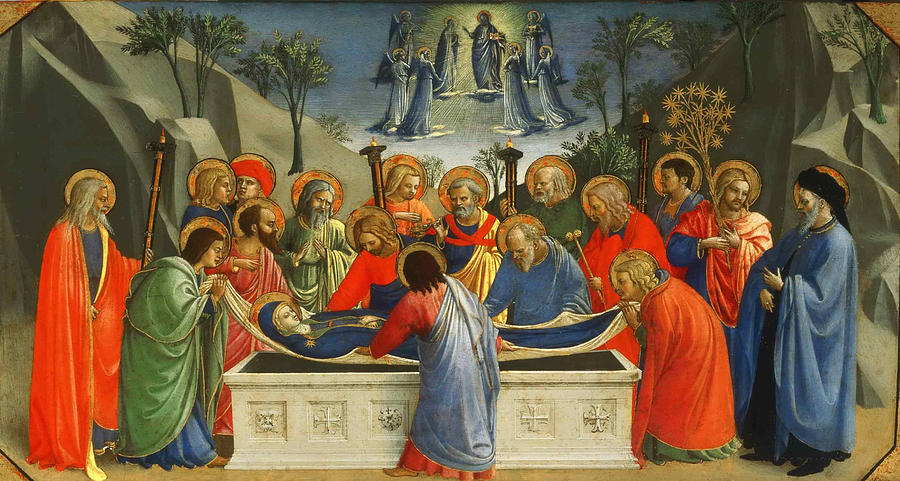
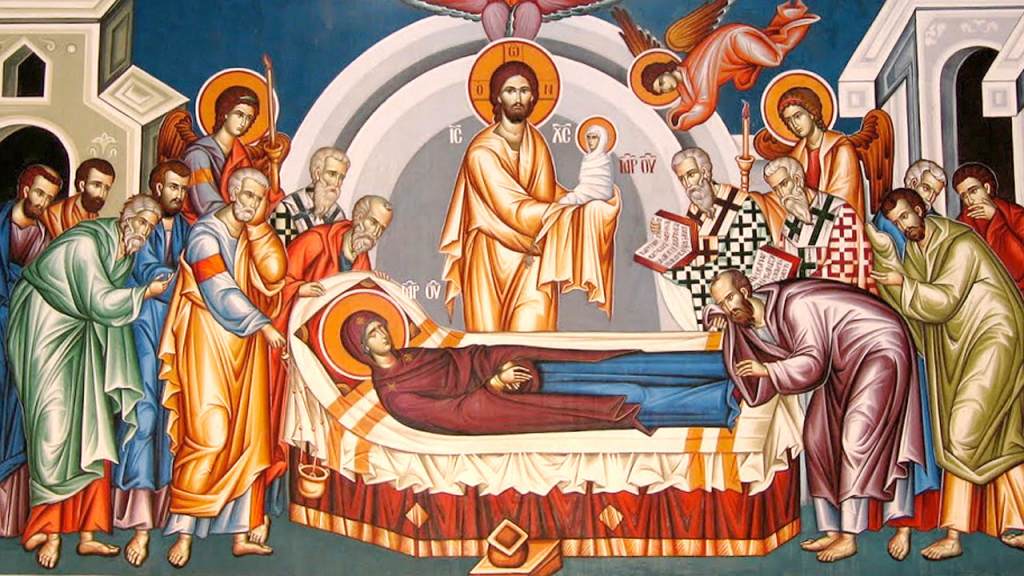
Today we celebrate the glorious Assumption of the Blessed Virgin Mary, Mother of God! Our Eastern brethren refer to this historical event as the Dormition of the Theotokos.
What a solemn moment in the history of humanity and in the economy of salvation! “The Immaculate Mother of God, the ever Virgin Mary, having completed the course of her earthly life, was assumed body and soul into heavenly glory“! (“Munificentissimus Deus“)
Humanity joins angelic choirs in singing with you:
<<O death, where is your victory? O death, where is your sting?>>
1Cor 15:55
This was fitting, for Our Lady alone, “in the first instance of her conception, by a singular privilege and grace granted by Almighty God, in view of the merits of Jesus Christ, the Savior of the human race, was preserved free from all stain of original sin“. (“Ineffabilis Deus”, IT EN)
Of both historical events Our Lady herself gives witness when, appearing to little Bernadette (St. Marie-Bernard), identifies Herself with the words:
These words, this identity, becomes so near and dear to the heart of that great lover of God and knight of the Immaculate, Saint Maximilian Maria Kolbe, that he would write:
“It is a question of drawing nearer to [the Immaculata] through the will, of letting our wills become one with hers, just as her will is united in a most perfect way with the will of God. Beyond this nothing else is necessary. Let us intensify continuously, every day, every instant, our love for the Immaculata, and let us do our best so that others may love her as we do and even more than we do.”
Indeed, Lord Jesus Christ, we praise and glorify you with the words of St. Ephraem:
“Certainly you alone and your Mother are from every aspect completely beautiful, for there is no blemish in you, my Lord, and no stain in your Mother”.
Hymn.B. Maria 13:5-6 (quoted by Rev. Matthew Mauriello in the Fairfield County Catholic on January 1996, in turn quoted here).
Truly St. Germanus wrote well when he wrote about the Immaculate:
“You are she who, as it is written, appears in beauty, and your virginal body is all holy, all chaste, entirely the dwelling place of God, so that it is henceforth completely exempt from dissolution into dust. Though still human, it is changed into the heavenly life of incorruptibility, truly living and glorious, undamaged and sharing in perfect life”
“It was fitting” – writes St. John Damascene – that
“she, who had kept her virginity intact in childbirth, should keep her own body free from all corruption even after death. It was fitting that she, who had carried the Creator as a child at her breast, should dwell in the divine tabernacles. It was fitting that the spouse, whom the Father had taken to himself, should live in the divine mansions. It was fitting that she, who had seen her Son upon the cross and who had thereby received into her heart the sword of sorrow, should look upon him as he sits with the Father. It was fitting that God’s Mother should possess what belongs to her Son, and that she should be honored by every creature as the Mother and as the handmaid of God.”
Encomium in Dormitionem Dei Genetricis Semperque Virginis Mariae, Hom. II, n. 14 (quoted in Munificentissimus Deus)
Holy Mother Church has traditionally ascribed the chant of Psalm 44:11-12,14 to the Holy Mass for the Assumption:
<<Hear, O daughter, and see; turn your ear; for the King shall desire your beauty. All glorious is the King’s daughter as she enters; her raiment is threaded with spun gold. Alleluia, alleluia!>> “Mary is taken up into Heaven: the choirs of the angels rejoice! Alleluia!”
There also exists a solemn Preface to the Blessed Virgin Mary that was traditionally chanted on this Solemnity, and is still occasionally used (known as “Preface I of the Blessed Virgin Mary” in the current editio typica of the Roman Missal):
It is truly right and just, our duty and our salvation, always and everywhere to give you thanks, Lord, holy Father, almighty and eternal God, and to praise, bless, and glorify your name on [the Assumption] of the Blessed ever-Virgin Mary
For by the overshadowing of the Holy Spirit she conceived your Only Begotten Son, and without losing the glory of virginity, brought forth into the world the eternal Light, Jesus Christ our Lord.
Through him the Angels praise your majesty, Dominions adore and Powers tremble before you. Heaven and the Virtues of heaven and the blessed Seraphim worship together with exultation. May our voices, we pray, join with theirs in humble praise, as we acclaim:
[Holy, Holy, Holy Lord God of hosts…]
Preface of the Blessed Virgin Mary (chanted in Latin by H.E. Archbishop Alexander Sample at the Basilica of the National Shrine of the Immaculate Conception in 2018 )
Our Eastern brothers have some beautiful prayers and chants “remembering our most holy, pure, blessed, and glorious Lady, the Theotokos and ever virgin Mary” that testify, if not directly at least indirectly, to this “day of joy” on which “mors stupebit et natura” in observing a human being rise in body and soul to the glory of Heaven… For lack of time and space, we shall only quote a couple:
<<It is truly proper to glorify you, O Theotokos! The ever blessed, Immaculate, and the Mother of our God!
More honorable than the Cherubim, and beyond compare more glorious than the Seraphim! Who, a virgin, gave birth to God the Word! You, truly the Theotokos, we magnify!>>
<<Beneath your compassion we take refuge o Virgin Theotokos! Despise not our prayers in our need but deliver us from danger, for you alone are pure…. for you alone are pure… for you alone are pure and blessed!>>
Let us rejoice and fully entrust Holy Mother Church, our souls, and the entirety of creation to the maternal care of the Blessed Virgin Mary, Mother of God and, as St. Maximilian Kolbe reminds, us, “a loving mother [to whom God] entrusted the whole economy of mercy….. He made her so good that she is unable to abandon even the worst of sinners who has recourse to God’s Infinite Heart“ (KW 1248).
<<Arise, O Lord, into your resting place:
you and the ark, which you have sanctified>>
– Psalm 132
<<My soul proclaims the greatness of the Lord,
my spirit rejoices in God my Savior
for he has looked with favor on his lowly servant!
More than half of the Justices of the Supreme Court of the United States have agreed on a draft that reviews the constitutionality of Roe v Way as it was written in 1973. The conclusive verdict is to be handed down later this spring or early summer.
As Franciscans of Life, this review has captured our attention. More importantly, we have become aware that people who object to this review have gathered to protest in front of the Justices’ homes, without regard for the safety of the families who live inside. As citizens, we have the right to protest and communicate our demands to the government in peaceful and safe demonstrations. There is, however, no moral justification for the dangers arising when angry mobs gather, especially before the homes of private citizens. Spouses, children, grandchildren, seniors living in the homes are not public figures. They have the right to a quiet and peaceful life as the rest of us. Disturbance of the peace and instilling fear in private citizens is immoral and – as we have stated above – dangerous to the collective safety.
I’m saying all of this because, as Franciscans of Life, we know that human life is sacred from conception to natural death. Life is the supernatural act of God in favor of humanity, a humanity that His Son, Jesus Christ, would assume at a precise moment in history, society, and ethnicity.
We believe that the Second Person of the Holy Trinity became man, developed in the womb of a human mother, was born of her, and was unjustly executed on the cross. Taking on our human nature side by side with His divine nature, and being executed, was an act of God’s love for humanity.
Our Country fought a civil war for many reasons, the most important being the belief that no human being can own another human being – not even one’s mother. We have no ownership of the person in the womb, thus killing an unborn baby is claiming ownership and authority that is not ours. Abortion is a false belief that the preborn child has less rights than a slave, and that the child in the womb is as much the property of the mother as a lung.
The Franciscans of Life are inviting everyone we know to join our Rosary Crusade, to pray that Congress and state governments will pass laws that protect the right to life of every person, from conception to natural death.
We invite you, your family, and friends to pray the Holy Rosary every Saturday, starting this Saturday, which the Church reserves for Our Heavenly Mother, until the Saturday before the Feast of the Assumption (August 13).
You don’t have to go to the parish church. You can pray from your home, car, or any quiet place. Just pray. The Rosary is the most powerful private prayer in our armory. Popes have called it “scourge of the devil,” “treasure of graces,” “heavenly instrument,” “glory of the Church”.
We are now in November (where has the year gone??) and, as usual, we dedicate special prayers and penance for the Holy Souls in Purgatory. This year, Holy Mother Church graciously extends the related indulgences through November, just as it was done last year, for similar reasons. One of our brothers found out via the FSSP newsletter, and we gladly share here the good news. Please see below the details!
“a.- the Plenary Indulgence for those who visit a cemetery and pray for the deceased, even if only mentally, normally established only on the individual days from 1 to 8 November, may be transferred to other days of the same month, until its end. These days, freely chosen by the individual believers, may also be separate from each other;
b- the Plenary Indulgence of 2 November, established on the occasion of the Commemoration of all the deceased faithful for those who piously visit a church or oratory and recite the “Our Father” and the “Creed” there, may be transferred not only to the Sunday before or after or on the day of the Solemnity of All Saints, but also to another day of the month of November, freely chosen by the individual faithful.
The elderly, the sick and all those who for serious reasons cannot leave their homes […] will be able to obtain the Plenary Indulgence as long as they join spiritually with all the other faithful, completely detached from sin and with the intention of complying as soon as possible with the three usual conditions (sacramental confession, Eucharistic communion and prayer according to the Holy Father’s intentions), before an image of Jesus or the Blessed Virgin Mary, recite pious prayers for the deceased, for example, Lauds and Vespers of the Office of the Dead, the Marian Rosary, the Chaplet of Divine Mercy, other prayers for the deceased dearest to the faithful, or occupy themselves in considered reading of one of the Gospel passages proposed by the liturgy of the deceased, or perform a work of mercy by offering to God the sorrows and hardships of their own lives.
Finally, since the souls in Purgatory are assisted by the prayers of the faithful and especially by the sacrifice of the Altar to God (cf. Conc. Tr. Sess. XXV, decr. De Purgatorio), all priests are strongly invited to celebrate Holy Mass three times on the day of the Commemoration of all the deceased faithful, in accordance with the Apostolic Constitution “Incruentum Altaris“, issued by Pope Benedict XV, of venerable memory, on 10 August 1915.”
Below are some prayers from the Liturgy for the Saints and for the Holy Souls!
We have observed in the span of a few days, some major celebrations, namely the feast of our patron Saint Maximilian Kolbe OFM Conv., confessor and martyr, and the great Solemnity of the Assumption of Our Lady!
The fact that St. Max was martyred on the vigil of the Assumption and his body cremated in the ovens of Auschwitz is no coincidence. He spent his existence at the service of his Queen, striving to earn the two spiritual crowns She had offered him when just a boy – purity and martyrdom – and he once wrote to his brothers:
Would that my ashes might be scattered to the four winds in order to bring Jesus to souls, to bring to them the cause of His Mother and our Mary!
We invite you to read more about St. Max on our blog as well as on St. Max’s Parish website, but in this article we’d like to highlight the glory that is the Assumption (known in some places as the Dormition) of the Blessed Virgin Mary!
Had you attended the 11 AM Mass this morning at St. Max, you’d have heard a wonderful theological sermon on the subject by our good friend and “out of the ordinary” preacher, Dcn. Pierre. You were right – I should have taken notes!
We will however do our best to celebrate the momentous occurrence with a few words.
Fr. Ludwig Ott wrote in his eminent work on Dogmatic Theology, “it seems fitting that Mary’s body, which was by nature mortal, should be, in conformity with that of her Divine Son, subject to the general law of death…” and, on that same note, St. John Damascene wrote:
It was fitting that she, who had kept her virginity intact in childbirth, should keep her own body free from all corruption even after death. It was fitting that she, who had carried the Creator as a child at her breast, should dwell in the divine tabernacles. It was fitting that the spouse, whom the Father had taken to himself, should live in the divine mansions. It was fitting that she, who had seen her Son upon the cross and who had thereby received into her heart the sword of sorrow which she had escaped in the act of giving birth to him, should look upon him as he sits with the Father. It was fitting that God’s Mother should possess what belongs to her Son, and that she should be honored by every creature as the Mother and as the handmaid of God.
“Encomium in Dormitionem Dei Genetricis Semperque Virginis Mariae, Hom. II, n. 14” (as quoted by Ven. Pius XII)
and, in a more “eastern” tone, bishop Theoteknos of Livia wrote:
It was fitting that the most holy body of Mary, God-bearing body, receptacle of God, divinized, incorruptible, illuminated by divine grace and full glory, should be entrusted to the earth for a little while and raised up to heaven in Glory, with her soul pleasing to God.
The Venerable Pius XII, who infallibly defined what the Church always believed on this matter in his Apostolic Constitution “Muneficentissimus Deus” on November 1st, 1950, also wrote in the same document:
Immaculate in her conception, a most perfect virgin in her divine motherhood, the noble associate of the divine Redeemer who has won a complete triumph over sin and its consequences, finally obtained, as the supreme culmination of her privileges, that she should be preserved free from the corruption of the tomb and that, like her own Son, having overcome death, she might be taken up body and soul to the glory of heaven where, as Queen, she sits in splendor at the right hand of her Son, the immortal King of the Ages.
Such is a summary of a doctrine that was already believed and accepted by Christianity from the very beginning! Indeed Ven. Pius XII reminds us:
the liturgy of the Church does not engender the Catholic faith, but rather springs from it, in such a way that the practices of the sacred worship proceed from the faith as the fruit comes from the tree…it follows that the holy Fathers and the great Doctors, in the homilies and sermons they gave the people on this feast day, did not draw their teaching from the feast itself as from a primary source, but rather they spoke of this doctrine as something already known and accepted by Christ’s faithful
I delivered to you first of all, which I also received: how that Christ died for our sins, according to the scriptures: and that he was buried, and that he rose again the third day, according to the scriptures: and that he was seen by Cephas; and after that by the eleven.
[…] if the dead rise not again, neither is Christ risen again. And if Christ be not risen again, your faith is vain […] But now Christ is risen from the dead, the firstfruits of them that sleep […]
For by a man came death, and by a man the resurrection of the dead. And as in Adam all die, so also in Christ all shall be made alive. But every one in their own order: the firstfruits Christ, then they that are of Christ, who have believed in his coming.
Our Lord Jesus Christ never found more perfect believer in his coming that She who conceived Him in her immaculate womb, so much so that Christ Himself found it fitting to underscore this aspect of the Immaculata’s glory:
A certain woman from the crowd, lifting up her voice, said to him: “Blessed is the womb that bore thee…” But He said: “Rather, blessed are they who hear the word of God, and keep it!”
How does this happen to me, that the mother of my Lord should come to me? Blessed are you who believed that what was spoken to you by the Lord would be fulfilled!
This blessing, this glory, is in primis of Our Lady, the perfect disciple. In imitation of Christ, she died, was buried, rose again, and she was seen by so many witnesses (we bear in mind in a special way St. Francis, St. Maximilian Kolbe and St. Bernadette…though so many from the very early days of the Church attest to Her visits and support…).
Yet, a most kind mother, and in perfect alignment with the divine economy, she wills us to be her imitators in her belief until that glorious day when we, too, will be reunited to our glorified bodies and rejoice with the angels and the saints, God willing.
What Deacon Pierre stated this morning, St. Ambrose made extremely clear in one of his own homilies:
Elizabeth was filled with the Holy Spirit after conceiving a son; Mary was filled before. “You are blessed,” said Elizabeth, “because you have believed.”
You too are blessed because you have heard and believed. The soul of every believer conceives and brings forth the Word of God and recognizes his works. Let Mary’s soul be in each of you to glorify the Lord. Let her spirit be in each of you to rejoice in the Lord. Christ has only one Mother in the flesh, but we all bring forth Christ by faith. Every soul free from contamination of sin and inviolate in its purity can receive the Word of God.
Oh, Immaculata, beloved mother, who in your great sorrow consoled your Lord and Savior on the way to Calvary, rejoice and be glad, for today He in His great joy consoles you on the way to Eternity! Pray for us, your children, your servants! We are all yours, o Mary, this is our fiat to you, o Immaculata, that through your intercession we poor sinners may be made fit instruments to extend the kingdom of Christ!
Image edited by one of our brothers, based on the icon of the IV Station of the Cross at St Maximilian Kolbe Parish
“[A] lovely, subdued melody floated through the forest above the solitary and forsaken little chapel of Our Lady of the Angels, just when a shepherd was passing by with his sheep. The shepherd turned pale and looked up at the fallen-in roof, but there was nothing to be seen. “Have they got an organ now?” he wondered. He pushed the little door open. All was dark and still within. Overhead the music was becoming more and more heavenly, as a hundred golden voices seemed to mingle in counterpoint. “Lord, how beautiful! It’s enough to make one want to die, it’s so beautiful!” he thought, for he was so moved that he could not utter a word. His heart told him what was happening…”
August 2nd is coming along, and with it, two happy occasions – the “Great Pardon” (as the Portiuncula Indulgence is known in some places) and the “flocking” of the Franciscans of Life (regulars and externs) to the Motherhouse after a bit of a hiatus from community gatherings.
There will be a note of sadness, as our dearest brother Leo will not be with us for the first time…since his passing on May 26th of 2020. Four hundred years earlier, St. Philip Neri passed away on the very same day. Let’s pray for the repose of our dear brother Leo, and ask in a special way for the intercession of St. Philip, “Pippo Buono” as the Romans called him due to his kind and gentle disposition… All who knew our Brother Leo knew of his natural gentleness and kindness, which is what, perhaps, inspired our Superior to name him Leo at Novitiate, in honor of that first brother Leo, a gentle soul whom St. Francis used to call “ you little lamb of God”.
But this article – which from its prolixity you will most likely know is authored by brother Bernardo – is not so much about our community as it is about the Portiuncula Indulgence! We will go over the Porziuncola, “Santa Maria degli Angeli”, and then we will dig a bit more into the matter of indulgences – a matter of heavenly and motherly love – and its relationship to the wonderful Sacrament of Confession – so, please, stay with us!
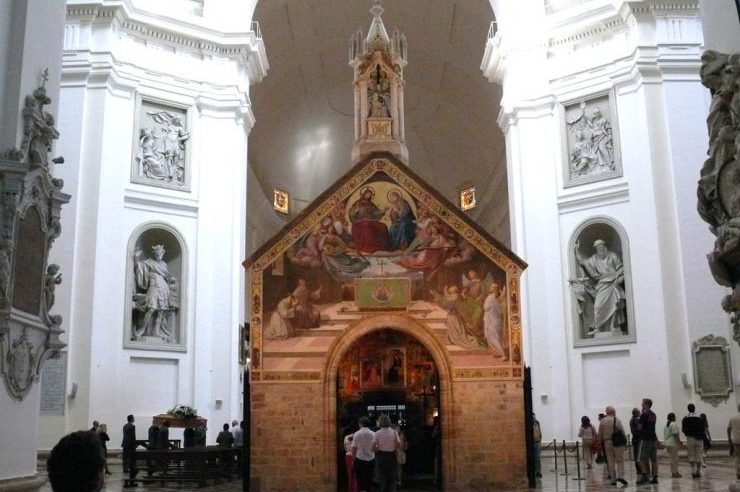
On Saint Mary of the Angels, called Porziuncola (“little portion“)
1704 illustration from “Collis Paradisi Amœnitas, seu Sacri Conventus Assisiensis Historiæ“, as found on p.107 of “The Story of Assisi” by Lina Duff Gordon
If we dig a bit, we find a nice summary by Pope Benedict XV on the salient points regarding this very special place, which we summarize below:
It is taught that in the days of Pope Liberius (IV century) pilgrims from Palestine brought here a fragment of the sepulcher of the Blessed Virgin Mary, that is to say, the place of the Assumption, and thus was the place named Saint Mary of the Angels.
Here St. Francis wrote the rule approved by Pope Innocent III (“admonished by divine vision”, writes Benedict XV).
Here Clare, the noble virgin of Assisi, having forsaken the world, was clothed in the poor Franciscan habit, and instituted the second Order.
Here also originated the Third Franciscan Order [note of clarification: that of the Penitents, whose ancient rule we follow].
By this place were the first Chapters of the Franciscan order, including the famous “Chapter of Matts” of Pentecost.
Here St. Francis, after refusing six times, finally agreed that he and the brothers would share a meal with St. Clare and the sisters. It is recounted that their souls glared so brightly that the people from the surrounding areas thought the forest was ablaze.
Here St. Francis had a vision of the Lord and Our Lady, and went to Perugia to implore Pope Honorius III in 1216 for a most extraordinary and unusual favor: “that anyone who comes [to the Portiuncola] confessed and penitent be absolved from the punishment and guilt from the day of baptism to the day and hour of entrance in said church”. Such an indulgence was unheard of in those days! Yet, three times did the Supreme Pontiff give his assent. Upon the Saint rejoicing and departing his presence, came the Pope’s affectionate remark and the Saint’s moving reply:
“You simpleton, where are you going? What proof do you carry?”
“Your word suffices to me! I seek no further instrument, other than the Virgin Mary be the parchment, Christ the notary, and the Angels the witnesses!”.
There is a pious story coming from the nephew of one of the early brothers, who accompanied Francis back from Perugia to Assisi. They stopped to rest a while and, upon awakening, St. Francis said: “Brother Masseo,I tell you from God that the Indulgence that the Supreme Pontiff gave me is confirmed in heaven!”
Here Francis stood by the entrance after returning from Perugia and, stretching his fatherly arms, said to all:
“I want to send you all to heaven!
I announce to you an Indulgence
which I obtained from the mouth of the Supreme Pontiff…”
St. Francis at the Portiuncola, 1226
Here Francis implored his Guardian and his brothers to take him to die.
“No, no! To Our Lady of the Angels! – Francis begged – I want to die where I began!” (from “The Perfect Joy of St. Francis”, by Timmermans)
Finally, here he died, naked on the floor (ref. Job 1:21), a broken, small 43-year-old man, marked with the Stigmata of the Lord he so loved, surrounded by his brothers who so loved him, under the loud warbling of hundreds of larks soaring heavenward…St. Francis of Assisi, whom Holy Church would call the Seraphic Father, the Alter Christus, but who, in his letters, introduced himself as little brother Francis….the little one….your servant…a worthless and weak man.
On the Great Pardon, or the Portiuncula Indulgence
One scholar wrote:
“it seems incredible that a perpetual plenary indulgence with no attached condition of almsgiving or personal sacrifice should have been granted in favor of an obscure chapel in Umbria. Yet we have six sworn statements of contemporaries, regulations of the General Chapters of the Order, and 53 pontifical acts of the XIVth century either confirming it or defending it”.
The Catholic Historical Review, Vol. 24, No. 4 (Jan., 1939), p. 466
This is just as St. Francis had told Pope Honorius: “If it is the work of God, He will make it manifest” – and this He has done – through His Church – through the centuries!
Of this plenary indulgence can benefit the faithful – for themselves or for a deceased as suffrage –
(a) either by directly visiting Santa Maria degli Angeli and the Porziuncola shrine it contains (in Assisi)
…and they will recite a Pater (Our Father) to reaffirm their dignity as children of God received in Baptism
…and they will pray for the intentions of the Supreme Pontiff, condition which is satisfied by reciting one Pater and one Ave, although one may also recite any other prayer if recited for this intention. This would also be fittingly performed on the same day.
On Indulgences in general, and Plenary Indulgences in particular – or, how to gain one
To benefit from an indulgence, the person must be baptized, must not be excommunicated, and hopefully in the state of grace. Furthermore, one must have the general intention of gaining the indulgence, and of course carry out the works mentioned above.
Most importantly, however, for the indulgence to be plenary and not partial, it requires the exclusion of all attachment to sin, even venial sin.
This has been historically considered the most complex of the conditions: no man, however holy, can call himself free of sin, but many can honestly call themselves free of affection towards sin, to the best of their knowledge!
In 2004, the Apostolic Penitentiary used the following language:
…as long as they are totally free from any desire to relapse into sin…
“The requirement is not “freedom from all sin“, rather, that “there is no sin which the soul is unwilling to renounce”.
A person should know if he’s in compliance, because an attachment implies a refusal to fix a situation – as when sometimes, deep down, we don’t want to let go of certain sins, even if “small”.
This is quite different from weakness, or habitual sin that is being battled…to souls in these situations, the Church is ready to aid!”
Confession, Reparation…and Indulgences – or, how they are closely related!
Pray to the good Lord to take away any desire, albeit small or hidden, for sins both grave and venial, and go as far as to bring forth in your heart a salutary hatred of sin, remembering that God is all-good and all-loving and that even the smallest sin displeases him.
After all, what is an indulgenceif not but a “continuation” of the Sacrament of Penance? That is to say, “a remission before God of temporal punishment for sins whose guilt is already forgiven”?
We know that the matter of sacramental Confession is the acts of the penitent: contrition, confession and satisfaction.
say NO to sin!
We should strive to a perfect contrition (CCC 1452) and perfect contrition builds more and more on detachment from sin, first from the “great” sins and then from the “small” ones! A devout soul, then, should not find much difficulty in complying with the requirement to be detached from all sin. The rest of us should simply keep working our way there, knowing that it is entirely up to us to not want to sin, while it is entirely a gift of God to bless us with the grace needed to overcome sin. “Without me – says the Lord – you can do nothing” (Jn 15:5), but He also says, “be perfect, as your heavenly Father is perfect” (Mt 5:48), and later, to St. Paul, “my grace is enough for you” (2Cor 12:9).
In the form of the Sacrament, “I absolve you”, assuming the penitent did not put any obstacles, such as willfully lying or withholding, or later failing to do any satisfaction, but rather that the penitent had a sincere sorrow for their sins and a firm resolution to avoid them in the future, all their sins from the very moment of Baptism (or from their last Absolution) till that moment are forgiven and remitted through the power of the Keys – even sins that you may have forgotten to mention!
Yet, such forgiveness and remission of sin does not imply the forgiveness of the temporal punishment due to every sin.
Sin carries both a stain and a punishment. When the stain is cleansed from the soul by sacramental absolution, the temporal punishment is not always remitted, except through the remedy of satisfaction, by avoiding near occasions of sin, resolving to sin no more, and doing works of penance. Such satisfaction also atones to our Mother the Church, whom we often forget is injured by our sins, and it also deters others from sin by way of example.
Last but not least, temporal punishment is the reason for Purgatory…the ecclesia dolens… Someone reported that St. Padre Pio once said: “let us do our Purgatory here on earth…by accepting everything from God’s hand“. (ref. Job 1:21…again…)
Interiorly, satisfaction heals the wound caused by sin. St. Bernard taught that “the stain is removed from the soul by God’s mercy, while the wound is healed through the remedy of penance…and even then, some scar remains”.
In this we see the great love and care of Holy Mother Church, Bride of Christ and as such minister of Redemption, custodian of that great treasury of expiatory works of Christ and the Saints! By granting an Indulgence, our Mother the Church is coming to our help in ridding us of the temporal punishment we have accumulated by our sins – or, when we apply the indulgence to a faithful departed, to help us help one another!
St. John Paul II summarized this wonderfully in 1999:
“[indulgence] is a sensitive subject, which has suffered historical misunderstandings […]
The starting-point for understanding indulgences is the abundance of God’s mercy revealed in the Cross of Christ. The crucified Jesus is the great “indulgence” that the Father has offered humanity through the forgiveness of sins […] in the logic of the covenant, which is the heart of the whole economy of salvation, this gift does not reach us without our acceptance and response. […]
[I]t is not difficult to understand how reconciliation with God, although based on a free and abundant offer of mercy, at the same time implies an arduous process which involves the individual’s personal effort and the Church’s sacramental work.
For the forgiveness of sins committed after Baptism, this process is centered on the sacrament of Penance, but it continues after the sacramental celebration. The person must be gradually “healed” of the negative effects which sin has caused in him (what the theological tradition calls the “punishments” […] Precisely for the sake of complete healing, the sinner is called to undertake a journey of conversion towards the fullness of love.
The temporal punishment itself serves as “medicine” to the extent that the person allows it to challenge him to undertake his own profound conversion. This is the meaning of the “satisfaction” required in the sacrament of Penance.
The meaning of indulgences must be seen against this background of man’s total renewal by the grace of Christ the Redeemer through the Church’s ministry.
The Church has a treasury, then, which is “dispensed” as it were through indulgences. This “distribution” should not be understood as a sort of automatic transfer, as if we were speaking of “things”. It is instead the expression of the Church’s full confidence of being heard by the Father when – in view of Christ’s merits and, by his gift, those of Our Lady and the saints – she asks Him to mitigate or cancel the painful aspect of punishment by fostering its medicinal aspect through other channels of grace. In the unfathomable mystery of divine wisdom, this gift of intercession can also benefit the faithful departed […]
We can see, then, how indulgences, far from being a sort of “discount” on the duty of conversion, are instead an aid to its prompt, generous and radical fulfilment. This is required to such an extent that the spiritual condition for receiving a plenary indulgence is the exclusion “of all attachment to sin, even venial sin” […]
Therefore, it would be a mistake to think that we can receive this gift by simply performing certain outward acts. On the contrary, they are required as the expression and support of our progress in conversion. They particularly show our faith in God’s mercy and in the marvellous reality of communion, which Christ has achieved by indissolubly uniting the Church to himself as his Body and Bride.”
My mother always said, “Darkness can never conquer light.” Looking at the world today things look dark if we don’t seek out the light.
Covid-19 has done more than making some people sick and kill others. It has thrown families into crisis. Some mourn a loved one. Others wonder about an elderly relative in a nursing home where visitors are not allowed. Spouses spend hours sitting, praying, and wondering if their partner is ever coming off the ventilator. Patients struggle to breathe. Their bodies ache. They have lost all sense of taste and even of smell. The endless coughing does not allow them a peaceful night’s sleep.
We must also consider how this virus has impacted the lives of healthcare professionals. They do not lose their humanity. Many have loved ones, including spouses, parents, children. Upon entering nursing school or medical school, they never dreamed that their lives would be on the line. Those things happened to people in the armed forces, not to healthcare professionals.
Long days on your feet were to be expected, but caring for more than ten patients was not a common occurrence among nurses. There was little fear of taking home a virus that could literally kill one of your children or elderly loved ones. As the number of nurses, doctors, medical technicians, and others contracted the virus, the workload became heavier. Instead of 12-hour shifts, some people were putting in 18-hour shifts. Yet, these people have spouses, children, parents, and even pets at home, waiting for them.
When your loved one is a patient in a hospital, a resident in a lockdown nursing home, a nurse, physician, or technicians, one doesn’t always enjoy a good night’s rest, wondering, worrying.
Also, the loss of income to many workers has stretched their resources beyond their means. When businesses are locked down, real people are home paying bills and buying groceries, with no idea when they will go back to work and bring home a paycheck. People who have worked hard all their lives to open a small retail store are now paying bills with no income.
Then there is also violence, looting, and confrontations on our streets. This has been one of the most active hurricane seasons in decades. Wildfires have left thousands of people homeless. Terrorism and military posturing have not taken vacations.
People wonder: “where is God in all of this? If God is so loving and merciful, why are so many people suffering? Does prayer really produce results?” Some are angry at God. They feel abandoned.
Given the picture of the world today, it is very natural to question one’s faith. God does not get angry because we doubt, or because we are angry at Him.
We find answers to our questions of faith when we reflect on the lives of men and women of faith such as: Saint Maximilian Maria Kolbe who died in a concentration camp to save the life a family man; Saint Teresa of Calcutta who left home at the age of 18 to become a missionary in one of the poorest countries in the world.
Then there are spouses and parents such as Saint Gianna Beretta Molla who chose to give her life rather than abort her preborn child. She delivered this child and died shortly after.
Speaking of people with strong faith, I can never forget what the Blessed Mother said to Saint Bernadette Soubirous of Lourdes, as she lay, dying of very painful bone disease, at the age of 35:
I cannot promise you happiness in this life, only in the next.
Christ never promised us that life in this world was going to be painless. As we enter the Christmas Season, we must meditate on the fact that the Son of God was born with a price on His head. Herod was looking to kill the little boy. His parents had to flee with Him into Egypt. Despite the threat of infanticide and later execution on a cross, God chose to be born into a world that offered Him no exemption from suffering and loss.
God chose to be born into a world filled with suffering and loss of many kinds. He navigated through this world always remembering that nothing is impossible for the Father. Let us never forget that God brought light into the world at a stable in Bethlehem and later at the resurrection from the dead.
Christmas is a commemoration of the time when God broke into the darkness of humanity to bring the light of faith, hope and charity. It is also a time of anticipation. Christ promised that He would return to judge the living and the dead. He will return to shed light on our sins and our acts of love.
Christ said the greatest act of love man can do is to lay down his life for his neighbor.
The chaos, fear, conflicts, and confusion that we’re experiencing can be moments of light if we reach out to those who suffer. We don’t have to give them anything. The shepherds who went to the manger to see the divine infant didn’t come bearing gifts. They were poor themselves. But they brought the greatest gift of all: support, love, and companionship to a young family in trouble.
Most of us enter the Advent season looking forward to the Christmas holiday. We’re planning meals, making guest list, shopping for gifts or planning to travel. As we spiral into Christmas, we sail through Advent without taking note of its true meaning.
From our Jewish roots in the Old Testament God invites us to remember. He supplies the flood and Noah’s ark with the rainbow as a remembrance of His promise never to destroy the earth by water again.
When men tried to reach for Heaven building a tower, God brought it down with His mighty power. The failure of the tower of Babel reminds us that man cannot reach God by human means, only by the means that God has given us through the Patriarchs: Abraham, Isaac, Jacob, Noah, Moses. He speaks to us through the prophets, especially Isaiah, Jeremiah, and Ezequiel. Each contact with man was a reminder of who is God and who is man. Then there were the kings, beginning with Saul, David, Solomon, and others. Through each new era, using different human beings, God continues to remind us that only He is God and we are His people.
Faithful Jews carefully remembered and protected the memory of these events. When Gabriel appears to Zechariah, he struck him mute to remind him of God’s power and free will. Whereas when he appears to the Virgin Mary to announce the conception and birth of the Son of God, he does not need to remind Mary of all the signs that God had given in the past to remind us that He was God. Mary knew exactly what Gabriel was talking about. She was a faithful daughter of Israel who remembered the Lord’s great signs in the past and the prophecies that promised a redeemer. She does not ask Gabriel for proof. She raises only one question, “How is this to be, since I do not know man?”
The encounter between Mary and Gabriel is the beginning of the first Advent in history. God goes beyond communicating His expectations and plans for humanity. Through Mary, he throws Israel into the future, into things to come that the prophets and patriarchs had foretold. God doesn’t deny humanity knowledge of His power and providence: “Nothing is impossible for God.”
Instead of giving Mary more laws and more guidance, He announces His break into human history. The Incarnation is a historical event that reminds us of God’s great love for humanity, especially Israel. The Incarnation is also the singular event that sets in motion anticipation for Him who is to come. To believe that God can and is going to break into human history, we must remember the past.The memories of what God communicated in the past explain the reason for the birth of Christ. This was a period of reflection and anticipation of what was coming. It was the words spoken through God’s chosen instruments and events in the past that clarified who was to come and why He was coming. From the moment of the Incarnation to the day of Christ’s birth, those who remembered God’s operation the past understood that God’s activity did not end with the last prophet. On the contrary, God’s activity was about to be personalized.
The Second Person of the Holy Trinity was coming to redeem us from sin and save us from our indifference, lust for power and pleasure, our search for comfort in worldly things while forgetting that which comes beyond our life on earth. He planned to enter the world to redeem humanity from its sin, to save us from ourselves. God’s plan for redemption was not going to be influenced by the sins, beliefs, and practices of Israel. Man could do nothing to prevent the Creator of human history to enter human history.
Advent did not end with the birth of Christ. Nor did it end with His Passion and Resurrection. Jesus left us with much to remember, the Beatitudes, the corporal works of mercy, moral teachings, and most importantly, Himself present in the consecrated host that we receive and that we adore.
He promised to return. But this time, not to redeem humanity. He has already done this. He promised to return to judge the living and the dead. Those who remembered everything that God has revealed through human history and lived accordingly, will be saved. Those who choose not to remember cannot possibly prepare for the advent of Christ as judge.
Most of us are comfortable with ourselves, because we never examine our thoughts, actions, and beliefs using the everything that God has revealed and promised. We fail to live according to God’s plan. Like the builders of the Tower of Babel, we dream and work on our achievements, not knowing if they’ll ever become reality. The only reality of which we can be sure is that Christ does not lie. He promised to come as a judge and king, he will not digress from this plan.
We can continue to ignore what God has told us to remember, ignore what Christ did, ignore what the Apostles handed down to us, and live our lives according to our plan not knowing if our plan conforms to God’s plan.
Or, we can choose to examine our plans, thoughts, desires, and actions against the background of Revelation, and to turn away from everything that distances us from God, everything that condemns us to eternal damnation.
Advent is a time to reflect on what God has taught and done for us to prepare for His second coming.


















 Franciscans of Life