Spiritual aridity is as different from spiritual apathy as Rome is from Tokyo. There can be many causes for spiritual aridity, but explaining each cause would turn this into a book of Christian spirituality and psychology, Let’s settle for the existential experience of spiritual aridity.
Existentially, spiritual aridity can best be described as thirst in a sandy desert. Once looks for a connection with God in prayer, the Sacraments, the Church, even the Gospel. At the end, not finding that spring that we once experienced in the spiritual life, we become despondent. We argue that there is no spiritual gain in prayer, the Mass, the Church, or even those around us.
The biggest problem is that we fault all religious activity as falling short and not meeting our spiritual needs. We fail to look into our soul. We are afraid of the darkness we might find there. Our reasoning ability becomes weak.
But God is not found through human reasoning, As complete and perfect, God is far superior to the collective of human wisdom.
God is that body that illuminates the night. The darker the night, the more visible are the stars of space. The stars that shine in the night are the sunlight that light up our day. Do we give up on prayer, the Sacraments, and the Church because of the human weakness that we find there, or the catastrophic mess that we are?
We need to remember that through the centuries, many have seen the weakness that we see…however, some of those people cry out to God to brighten the darkness that they see around them. Some of our most admirable saints have spent years calling out to God, the light of the night and the water in an oasis.
The more the cry out to God, “come be my light,” the stronger we become without realizing it. Grace is not a human feeling. It’s a seed planted in the soul where the Divine Gardener will water it and protect it from death as long as we persevere, “Come be my light”.
We carry on with whatever good the Church, Sacraments, and the Sacred Scriptures will offer. But each time we come into contact with the cold desert night, we call out to Him who can be the light we seek. The search for the light of God, however, requires that we never give up on calling, “Come, be my light”. God has never abandoned one who called out to Him. Those who give up calling out to God will be burned by the light of the Son whom they have given up. Man gives up hoping for the light. The Light for each man will always allow Itself to be seen; but only when God knows that it will do some good for us and through us.
We can never forget that we are the sheep that can’t find the Good Shepherd. But He is always closer to us when the desert looks the darkest or feels the coldest.
May the Immaculata always guide us through the dark desert.
Those of you who know him personally, are aware of the many health struggles he has faced during the past few years, and how much we owe to the Lord and to the Immaculate to be able to celebrate this day.
Happy Birthday messages can be emailed to: superior@franciscansoflife.org
Bro. Jay will receive them directly!
This will be a small community+family gathering, between 11 am and 5 pm approximately. If you do wish to briefly stop by, due to health reasons etc. please RSVP first, by calling/texting 786-495-3426 and we will coordinate a time and provide you with the location of the get-together.
More than anything, we humbly ask you for a prayer – not only for the physical and spiritual health of Bro. Jay, but for the respect for life in the whole world.
Thank you kindly!
*** For any questions, please email: brothers@franciscansoflife.org ***
More than half of the Justices of the Supreme Court of the United States have agreed on a draft that reviews the constitutionality of Roe v Way as it was written in 1973. The conclusive verdict is to be handed down later this spring or early summer.
As Franciscans of Life, this review has captured our attention. More importantly, we have become aware that people who object to this review have gathered to protest in front of the Justices’ homes, without regard for the safety of the families who live inside. As citizens, we have the right to protest and communicate our demands to the government in peaceful and safe demonstrations. There is, however, no moral justification for the dangers arising when angry mobs gather, especially before the homes of private citizens. Spouses, children, grandchildren, seniors living in the homes are not public figures. They have the right to a quiet and peaceful life as the rest of us. Disturbance of the peace and instilling fear in private citizens is immoral and – as we have stated above – dangerous to the collective safety.
I’m saying all of this because, as Franciscans of Life, we know that human life is sacred from conception to natural death. Life is the supernatural act of God in favor of humanity, a humanity that His Son, Jesus Christ, would assume at a precise moment in history, society, and ethnicity.
We believe that the Second Person of the Holy Trinity became man, developed in the womb of a human mother, was born of her, and was unjustly executed on the cross. Taking on our human nature side by side with His divine nature, and being executed, was an act of God’s love for humanity.
Our Country fought a civil war for many reasons, the most important being the belief that no human being can own another human being – not even one’s mother. We have no ownership of the person in the womb, thus killing an unborn baby is claiming ownership and authority that is not ours. Abortion is a false belief that the preborn child has less rights than a slave, and that the child in the womb is as much the property of the mother as a lung.
The Franciscans of Life are inviting everyone we know to join our Rosary Crusade, to pray that Congress and state governments will pass laws that protect the right to life of every person, from conception to natural death.
We invite you, your family, and friends to pray the Holy Rosary every Saturday, starting this Saturday, which the Church reserves for Our Heavenly Mother, until the Saturday before the Feast of the Assumption (August 13).
You don’t have to go to the parish church. You can pray from your home, car, or any quiet place. Just pray. The Rosary is the most powerful private prayer in our armory. Popes have called it “scourge of the devil,” “treasure of graces,” “heavenly instrument,” “glory of the Church”.
Born of a noble family, she chose to follow the example of her townsman St. Francis, wishing to follow the Lord with her whole heart in an austere life of poverty, but rich in the practice of charity and loving care.
She professed vows in the hands of Saint Francis on March 18, 1212, thus founding the “second order”, whose nuns would be first known as Poor Ladies. (In her honor, in 1263 Pope Urban IV officially changed the name of the Poor Ladies to the Order of Saint Clare.)
St. Damiano – where Christ had deigned to speak to St. Francis – was eventually the chosen residence of their first community. St. Clare was joined by her sister Agnes and even by her own mother!
Much could be said about their spiritual relationship to the other Franciscan orders, and to how she encouraged and supported St. Francis (particularly after he received the Stigmata, whose secret he kept from all but a few…)….of her miracles…of how she protected Assisi…but perhaps she would like us to remember in particular her Franciscan devotion to holy poverty, whom Franciscan scholars point out as the foremost characteristic of her spirituality.
When Cardinal Ugolino (Pope Gregory IX) imposed the Benedictine rule on them, for years she strived to have a rule in the spirit of Saint Francis for her sisters, and her rule was approved by Pope Innocent IV two days before her death, the privilege of “highest poverty” being the final gift in this earthly life by her Divine Spouse…she died at the age of 60 on August 11, 1253.
“The Apostolic See usually acquiesces in the pious and honest wishes of those who ask that a kindly favor be given them. Therefore, beloved Daughters in the Lord, inclined to your prayers, we confirm with the same apostolic authority the Rule and way of life of your Order…”
“Solet Annuere (1245)”, Pope Innocent IV
At her funeral, Pope Innocent IV insisted the brothers perform the Office for the Virgin Saints rather than the Office for the Dead…indeed, she was formally canonized just two years later by Pope Alexander IV, who would call her “Clara claris praeclara meritis“, “a clear mirror of example”, and would say of her: “O clarity of blessed Clare to be admired!“
“O blessed poverty who bestows eternal riches on those who love and embrace her!” – she would write. And to her Divine Spouse she would say: “Contempt of the world has pleased You more than honors, poverty more than earthly riches“.
She wrote several letters to St. Agnes of Prague, who was the daughter of Queen Constance and King Ottokar I of Bohemia. St. Agnes of Bohemia (as she is also known) refused marriage proposals from the kings of Germany and England, and from the Holy Roman Emperor himself – all for the sake of following in the footsteps of Christ! Her family financed the construction of a monastery in Prague, where she entered with seven other ladies in 1236. Pressured to be elected Abbess, she insisted she be called “senior sister” and often cooked for the sisters. She died on March 2nd 1282, was beatified in 1874, and was canonized in 1989. To one such letter belongs the title of this article, specifically found in today’s Office of Readings:
“Happy indeed is she who is given the grace of sharing this holy way of life, of clinging to it with every fiber of her being…behold the poverty of him who was laid in the manger…What wondrous humility! What astonishing poverty! Note the countless toils and sufferings he endured to redeem the human race…As you meditate in this way remember me, your poor mother, and know that I have inscribed your happy memory deeply on the tablets of my heart”
from a Letter of St. Clare to St. Agnes of Prague
I wish to close this post with some of today’s antiphons. They are, in themselves, a powerful summary of our Holy Mother’s life.
“Clare was concerned with the things of the Lord to be holy in body and spirit……she wore and humbled her body with fasts…she accounted all else rubbish therefore she found better and more permanent possessions. She spurned the world’s perishable glory to gain Christ.
The hand of the Lord strengthened her, she will therefore be blessed forever. She cast all her care upon God. She hoped in him and he came to her assistance.
Come, let us adore Christ the king whom Clare loved with all her heart.“
“[A] lovely, subdued melody floated through the forest above the solitary and forsaken little chapel of Our Lady of the Angels, just when a shepherd was passing by with his sheep. The shepherd turned pale and looked up at the fallen-in roof, but there was nothing to be seen. “Have they got an organ now?” he wondered. He pushed the little door open. All was dark and still within. Overhead the music was becoming more and more heavenly, as a hundred golden voices seemed to mingle in counterpoint. “Lord, how beautiful! It’s enough to make one want to die, it’s so beautiful!” he thought, for he was so moved that he could not utter a word. His heart told him what was happening…”
August 2nd is coming along, and with it, two happy occasions – the “Great Pardon” (as the Portiuncula Indulgence is known in some places) and the “flocking” of the Franciscans of Life (regulars and externs) to the Motherhouse after a bit of a hiatus from community gatherings.
There will be a note of sadness, as our dearest brother Leo will not be with us for the first time…since his passing on May 26th of 2020. Four hundred years earlier, St. Philip Neri passed away on the very same day. Let’s pray for the repose of our dear brother Leo, and ask in a special way for the intercession of St. Philip, “Pippo Buono” as the Romans called him due to his kind and gentle disposition… All who knew our Brother Leo knew of his natural gentleness and kindness, which is what, perhaps, inspired our Superior to name him Leo at Novitiate, in honor of that first brother Leo, a gentle soul whom St. Francis used to call “ you little lamb of God”.
But this article – which from its prolixity you will most likely know is authored by brother Bernardo – is not so much about our community as it is about the Portiuncula Indulgence! We will go over the Porziuncola, “Santa Maria degli Angeli”, and then we will dig a bit more into the matter of indulgences – a matter of heavenly and motherly love – and its relationship to the wonderful Sacrament of Confession – so, please, stay with us!
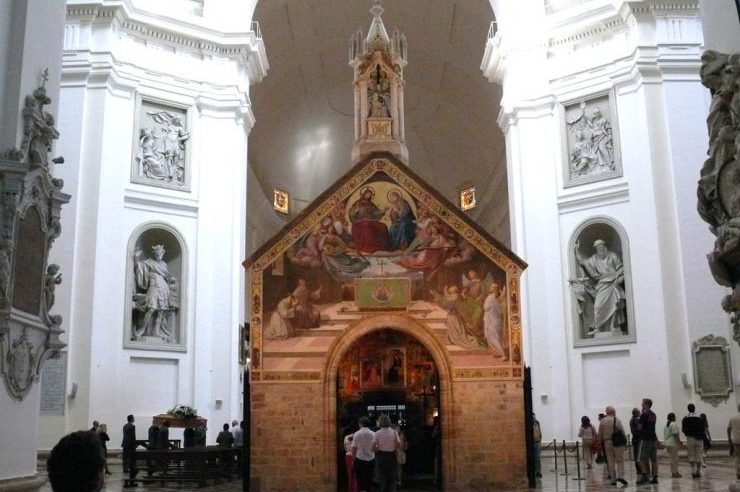
On Saint Mary of the Angels, called Porziuncola (“little portion“)
1704 illustration from “Collis Paradisi Amœnitas, seu Sacri Conventus Assisiensis Historiæ“, as found on p.107 of “The Story of Assisi” by Lina Duff Gordon
If we dig a bit, we find a nice summary by Pope Benedict XV on the salient points regarding this very special place, which we summarize below:
It is taught that in the days of Pope Liberius (IV century) pilgrims from Palestine brought here a fragment of the sepulcher of the Blessed Virgin Mary, that is to say, the place of the Assumption, and thus was the place named Saint Mary of the Angels.
Here St. Francis wrote the rule approved by Pope Innocent III (“admonished by divine vision”, writes Benedict XV).
Here Clare, the noble virgin of Assisi, having forsaken the world, was clothed in the poor Franciscan habit, and instituted the second Order.
Here also originated the Third Franciscan Order [note of clarification: that of the Penitents, whose ancient rule we follow].
By this place were the first Chapters of the Franciscan order, including the famous “Chapter of Matts” of Pentecost.
Here St. Francis, after refusing six times, finally agreed that he and the brothers would share a meal with St. Clare and the sisters. It is recounted that their souls glared so brightly that the people from the surrounding areas thought the forest was ablaze.
Here St. Francis had a vision of the Lord and Our Lady, and went to Perugia to implore Pope Honorius III in 1216 for a most extraordinary and unusual favor: “that anyone who comes [to the Portiuncola] confessed and penitent be absolved from the punishment and guilt from the day of baptism to the day and hour of entrance in said church”. Such an indulgence was unheard of in those days! Yet, three times did the Supreme Pontiff give his assent. Upon the Saint rejoicing and departing his presence, came the Pope’s affectionate remark and the Saint’s moving reply:
“You simpleton, where are you going? What proof do you carry?”
“Your word suffices to me! I seek no further instrument, other than the Virgin Mary be the parchment, Christ the notary, and the Angels the witnesses!”.
There is a pious story coming from the nephew of one of the early brothers, who accompanied Francis back from Perugia to Assisi. They stopped to rest a while and, upon awakening, St. Francis said: “Brother Masseo,I tell you from God that the Indulgence that the Supreme Pontiff gave me is confirmed in heaven!”
Here Francis stood by the entrance after returning from Perugia and, stretching his fatherly arms, said to all:
“I want to send you all to heaven!
I announce to you an Indulgence
which I obtained from the mouth of the Supreme Pontiff…”
St. Francis at the Portiuncola, 1226
Here Francis implored his Guardian and his brothers to take him to die.
“No, no! To Our Lady of the Angels! – Francis begged – I want to die where I began!” (from “The Perfect Joy of St. Francis”, by Timmermans)
Finally, here he died, naked on the floor (ref. Job 1:21), a broken, small 43-year-old man, marked with the Stigmata of the Lord he so loved, surrounded by his brothers who so loved him, under the loud warbling of hundreds of larks soaring heavenward…St. Francis of Assisi, whom Holy Church would call the Seraphic Father, the Alter Christus, but who, in his letters, introduced himself as little brother Francis….the little one….your servant…a worthless and weak man.
On the Great Pardon, or the Portiuncula Indulgence
One scholar wrote:
“it seems incredible that a perpetual plenary indulgence with no attached condition of almsgiving or personal sacrifice should have been granted in favor of an obscure chapel in Umbria. Yet we have six sworn statements of contemporaries, regulations of the General Chapters of the Order, and 53 pontifical acts of the XIVth century either confirming it or defending it”.
The Catholic Historical Review, Vol. 24, No. 4 (Jan., 1939), p. 466
This is just as St. Francis had told Pope Honorius: “If it is the work of God, He will make it manifest” – and this He has done – through His Church – through the centuries!
Of this plenary indulgence can benefit the faithful – for themselves or for a deceased as suffrage –
(a) either by directly visiting Santa Maria degli Angeli and the Porziuncola shrine it contains (in Assisi)
…and they will recite a Pater (Our Father) to reaffirm their dignity as children of God received in Baptism
…and they will pray for the intentions of the Supreme Pontiff, condition which is satisfied by reciting one Pater and one Ave, although one may also recite any other prayer if recited for this intention. This would also be fittingly performed on the same day.
On Indulgences in general, and Plenary Indulgences in particular – or, how to gain one
To benefit from an indulgence, the person must be baptized, must not be excommunicated, and hopefully in the state of grace. Furthermore, one must have the general intention of gaining the indulgence, and of course carry out the works mentioned above.
Most importantly, however, for the indulgence to be plenary and not partial, it requires the exclusion of all attachment to sin, even venial sin.
This has been historically considered the most complex of the conditions: no man, however holy, can call himself free of sin, but many can honestly call themselves free of affection towards sin, to the best of their knowledge!
In 2004, the Apostolic Penitentiary used the following language:
…as long as they are totally free from any desire to relapse into sin…
“The requirement is not “freedom from all sin“, rather, that “there is no sin which the soul is unwilling to renounce”.
A person should know if he’s in compliance, because an attachment implies a refusal to fix a situation – as when sometimes, deep down, we don’t want to let go of certain sins, even if “small”.
This is quite different from weakness, or habitual sin that is being battled…to souls in these situations, the Church is ready to aid!”
Confession, Reparation…and Indulgences – or, how they are closely related!
Pray to the good Lord to take away any desire, albeit small or hidden, for sins both grave and venial, and go as far as to bring forth in your heart a salutary hatred of sin, remembering that God is all-good and all-loving and that even the smallest sin displeases him.
After all, what is an indulgenceif not but a “continuation” of the Sacrament of Penance? That is to say, “a remission before God of temporal punishment for sins whose guilt is already forgiven”?
We know that the matter of sacramental Confession is the acts of the penitent: contrition, confession and satisfaction.
say NO to sin!
We should strive to a perfect contrition (CCC 1452) and perfect contrition builds more and more on detachment from sin, first from the “great” sins and then from the “small” ones! A devout soul, then, should not find much difficulty in complying with the requirement to be detached from all sin. The rest of us should simply keep working our way there, knowing that it is entirely up to us to not want to sin, while it is entirely a gift of God to bless us with the grace needed to overcome sin. “Without me – says the Lord – you can do nothing” (Jn 15:5), but He also says, “be perfect, as your heavenly Father is perfect” (Mt 5:48), and later, to St. Paul, “my grace is enough for you” (2Cor 12:9).
In the form of the Sacrament, “I absolve you”, assuming the penitent did not put any obstacles, such as willfully lying or withholding, or later failing to do any satisfaction, but rather that the penitent had a sincere sorrow for their sins and a firm resolution to avoid them in the future, all their sins from the very moment of Baptism (or from their last Absolution) till that moment are forgiven and remitted through the power of the Keys – even sins that you may have forgotten to mention!
Yet, such forgiveness and remission of sin does not imply the forgiveness of the temporal punishment due to every sin.
Sin carries both a stain and a punishment. When the stain is cleansed from the soul by sacramental absolution, the temporal punishment is not always remitted, except through the remedy of satisfaction, by avoiding near occasions of sin, resolving to sin no more, and doing works of penance. Such satisfaction also atones to our Mother the Church, whom we often forget is injured by our sins, and it also deters others from sin by way of example.
Last but not least, temporal punishment is the reason for Purgatory…the ecclesia dolens… Someone reported that St. Padre Pio once said: “let us do our Purgatory here on earth…by accepting everything from God’s hand“. (ref. Job 1:21…again…)
Interiorly, satisfaction heals the wound caused by sin. St. Bernard taught that “the stain is removed from the soul by God’s mercy, while the wound is healed through the remedy of penance…and even then, some scar remains”.
In this we see the great love and care of Holy Mother Church, Bride of Christ and as such minister of Redemption, custodian of that great treasury of expiatory works of Christ and the Saints! By granting an Indulgence, our Mother the Church is coming to our help in ridding us of the temporal punishment we have accumulated by our sins – or, when we apply the indulgence to a faithful departed, to help us help one another!
St. John Paul II summarized this wonderfully in 1999:
“[indulgence] is a sensitive subject, which has suffered historical misunderstandings […]
The starting-point for understanding indulgences is the abundance of God’s mercy revealed in the Cross of Christ. The crucified Jesus is the great “indulgence” that the Father has offered humanity through the forgiveness of sins […] in the logic of the covenant, which is the heart of the whole economy of salvation, this gift does not reach us without our acceptance and response. […]
[I]t is not difficult to understand how reconciliation with God, although based on a free and abundant offer of mercy, at the same time implies an arduous process which involves the individual’s personal effort and the Church’s sacramental work.
For the forgiveness of sins committed after Baptism, this process is centered on the sacrament of Penance, but it continues after the sacramental celebration. The person must be gradually “healed” of the negative effects which sin has caused in him (what the theological tradition calls the “punishments” […] Precisely for the sake of complete healing, the sinner is called to undertake a journey of conversion towards the fullness of love.
The temporal punishment itself serves as “medicine” to the extent that the person allows it to challenge him to undertake his own profound conversion. This is the meaning of the “satisfaction” required in the sacrament of Penance.
The meaning of indulgences must be seen against this background of man’s total renewal by the grace of Christ the Redeemer through the Church’s ministry.
The Church has a treasury, then, which is “dispensed” as it were through indulgences. This “distribution” should not be understood as a sort of automatic transfer, as if we were speaking of “things”. It is instead the expression of the Church’s full confidence of being heard by the Father when – in view of Christ’s merits and, by his gift, those of Our Lady and the saints – she asks Him to mitigate or cancel the painful aspect of punishment by fostering its medicinal aspect through other channels of grace. In the unfathomable mystery of divine wisdom, this gift of intercession can also benefit the faithful departed […]
We can see, then, how indulgences, far from being a sort of “discount” on the duty of conversion, are instead an aid to its prompt, generous and radical fulfilment. This is required to such an extent that the spiritual condition for receiving a plenary indulgence is the exclusion “of all attachment to sin, even venial sin” […]
Therefore, it would be a mistake to think that we can receive this gift by simply performing certain outward acts. On the contrary, they are required as the expression and support of our progress in conversion. They particularly show our faith in God’s mercy and in the marvellous reality of communion, which Christ has achieved by indissolubly uniting the Church to himself as his Body and Bride.”
My mother always said, “Darkness can never conquer light.” Looking at the world today things look dark if we don’t seek out the light.
Covid-19 has done more than making some people sick and kill others. It has thrown families into crisis. Some mourn a loved one. Others wonder about an elderly relative in a nursing home where visitors are not allowed. Spouses spend hours sitting, praying, and wondering if their partner is ever coming off the ventilator. Patients struggle to breathe. Their bodies ache. They have lost all sense of taste and even of smell. The endless coughing does not allow them a peaceful night’s sleep.
We must also consider how this virus has impacted the lives of healthcare professionals. They do not lose their humanity. Many have loved ones, including spouses, parents, children. Upon entering nursing school or medical school, they never dreamed that their lives would be on the line. Those things happened to people in the armed forces, not to healthcare professionals.
Long days on your feet were to be expected, but caring for more than ten patients was not a common occurrence among nurses. There was little fear of taking home a virus that could literally kill one of your children or elderly loved ones. As the number of nurses, doctors, medical technicians, and others contracted the virus, the workload became heavier. Instead of 12-hour shifts, some people were putting in 18-hour shifts. Yet, these people have spouses, children, parents, and even pets at home, waiting for them.
When your loved one is a patient in a hospital, a resident in a lockdown nursing home, a nurse, physician, or technicians, one doesn’t always enjoy a good night’s rest, wondering, worrying.
Also, the loss of income to many workers has stretched their resources beyond their means. When businesses are locked down, real people are home paying bills and buying groceries, with no idea when they will go back to work and bring home a paycheck. People who have worked hard all their lives to open a small retail store are now paying bills with no income.
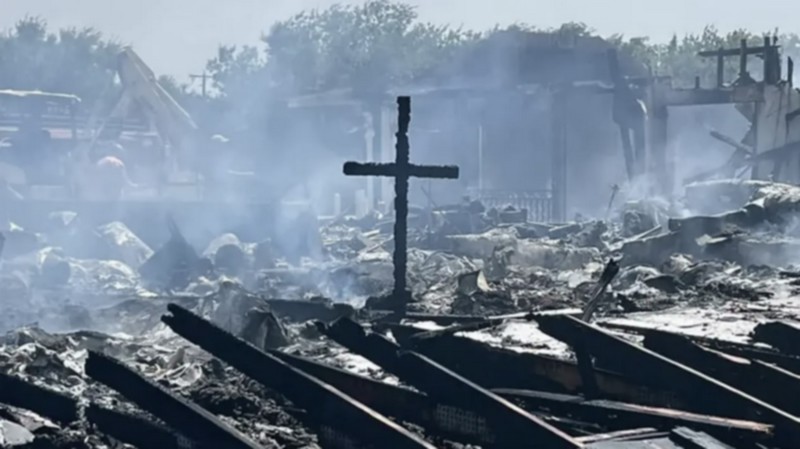
Then there is also violence, looting, and confrontations on our streets. This has been one of the most active hurricane seasons in decades. Wildfires have left thousands of people homeless. Terrorism and military posturing have not taken vacations.
People wonder: “where is God in all of this? If God is so loving and merciful, why are so many people suffering? Does prayer really produce results?” Some are angry at God. They feel abandoned.
Given the picture of the world today, it is very natural to question one’s faith. God does not get angry because we doubt, or because we are angry at Him.
We find answers to our questions of faith when we reflect on the lives of men and women of faith such as: Saint Maximilian Maria Kolbe who died in a concentration camp to save the life a family man; Saint Teresa of Calcutta who left home at the age of 18 to become a missionary in one of the poorest countries in the world.
Then there are spouses and parents such as Saint Gianna Beretta Molla who chose to give her life rather than abort her preborn child. She delivered this child and died shortly after.
Speaking of people with strong faith, I can never forget what the Blessed Mother said to Saint Bernadette Soubirous of Lourdes, as she lay, dying of very painful bone disease, at the age of 35:
I cannot promise you happiness in this life, only in the next.
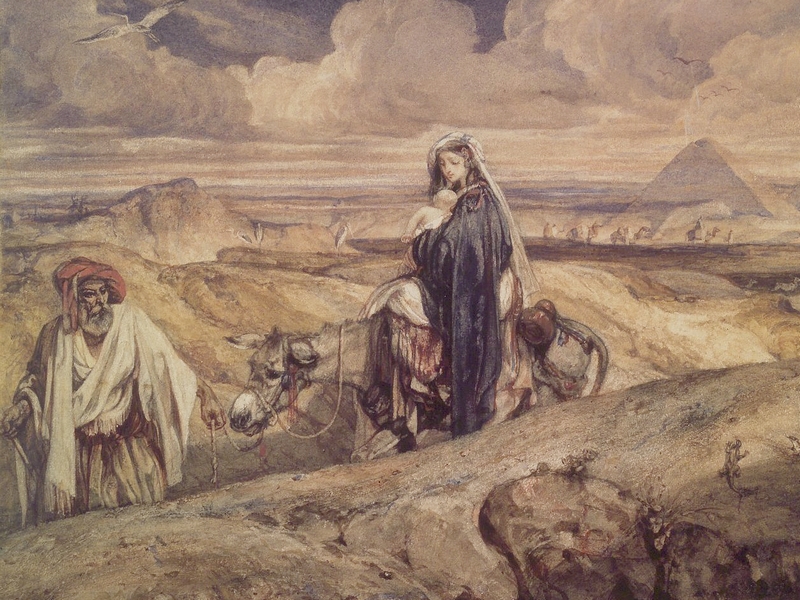
Christ never promised us that life in this world was going to be painless. As we enter the Christmas Season, we must meditate on the fact that the Son of God was born with a price on His head. Herod was looking to kill the little boy. His parents had to flee with Him into Egypt. Despite the threat of infanticide and later execution on a cross, God chose to be born into a world that offered Him no exemption from suffering and loss.
God chose to be born into a world filled with suffering and loss of many kinds. He navigated through this world always remembering that nothing is impossible for the Father. Let us never forget that God brought light into the world at a stable in Bethlehem and later at the resurrection from the dead.
Christmas is a commemoration of the time when God broke into the darkness of humanity to bring the light of faith, hope and charity. It is also a time of anticipation. Christ promised that He would return to judge the living and the dead. He will return to shed light on our sins and our acts of love.
Christ said the greatest act of love man can do is to lay down his life for his neighbor.
The chaos, fear, conflicts, and confusion that we’re experiencing can be moments of light if we reach out to those who suffer. We don’t have to give them anything. The shepherds who went to the manger to see the divine infant didn’t come bearing gifts. They were poor themselves. But they brought the greatest gift of all: support, love, and companionship to a young family in trouble.
WE COMMEND HIS SOUL TO THE MERCY OF THE RISEN CHRIST AND WE THANK ALMIGHTY GOD FOR HIS LIFE AMONG US
The Franciscans of Life announce the death of Brother Leo Gerard Belanger, FFV.
Brother Leo Gerard Belanger, FFV, age 66, of Pickerington, Ohio, formerly of Palm Beach Gardens, FL, passed away Tuesday, May 26, 2020 at his residence. Born February 19, 1954 in Fall River, MA to the late Armand and Corinne (St. Germain) Belanger.
He worked as a nurse for 36 years, the last 15 years in hospice care. He was a very compassionate person who loved taking care of his patients. Leo joined the Franciscans of Life in 2014. He was one of the earliest brothers in vows. He touched the hearts of many, especially his Franciscan Brothers of Life, and he will be greatly missed.
Interment will be at Sacred Heart Cemetery in New Bedford, MA.
Friends who wish to do so, may contribute to the Church of Our Lady of the Miraculous Medal, 5225 Refugee Rd., Columbus, Ohio 43232 in his memory.
The Franciscans of Life wish every one of our family, friends, and benefactors a Happy and Blessed New Year.
We want to remind everyone that January first is not only New Year’s Day in the western calendar, but it’s also a special solemnity in honor of Our Lady. It’s the Solemnity of the Mother of God. It is the only feast day that we celebrate honoring Our Lady’s “divine maternity”.
In a world where motherhood and childbearing are often viewed as a burden or an inconvenience, at the very least, Catholics remember that motherhood is a gift from Heaven. God becomes man and is born into a human family. Every one of us has existed in the mind of God the Father for all eternity. This “divine thought” becomes a human being at conception. God has seen us in His image and likeness since the beginning.
Let us pray that this year, humanity will awaken from the nightmare of abortion and euthanasia. Pray that nations come to respect life, from the womb to the tomb, as a mystery that comes from God and is destined to return to God at a time according to His plan.
Topic shift: the Franciscans of Life have completed our year-end review. We planned our days, schedules and activities for this new year, to allow us more time for silence, solitude, prayer, penance, a fraternal life. Like every human family, a community of consecrated persons, religious or lay, is called to live as a family that reflects the community of the Holy Trinity.
It is very easy to get caught up in the “to do’s” of everyday life, to the point where doing becomes man’s only source of satisfaction and enrichment. Unfortunately, becoming or being is forgotten and replaced by doing. We hope that others will join us in the quest to become people of deeper prayer, more sacrificial penance, and joyful members of families, parishes, and communities.
Brother will vow to live in obedience to God, the Church, and the constitutions and superior of our community. He will surrender the right to own property and will vow to live the rest of his life without property, money, or special distinctions. He will vow to live celibate chastity until death, so that he may devote every moment of his life to Christ, the Immaculate, and the people of God.
Franciscans of Life also make a fourth vow: to proclaim the Gospel of Life to the voiceless. We follow the example of St. Francis and his command to the first Franciscans, to live in peace with all men, to have a special place in our hearts and their mission for the poor, elderly, sick and abandoned. The Gospel of Life demands in a special way that we treat all travelers and immigrants with respect and charity. Please pray for Brother Bernardo and for the Franciscans of Life, that we may be faithful to the end.
—>
May the new year bring many blessings into your lives. Let us pray that it will be a year where man moves closer to peace, deals more justly with other people, and detaches from excessive material goods to the detriment of his soul.
In 2009, a solitary Franciscan set out to serve families and individuals who struggle with abortion, euthanasia, assisted suicide, infanticide and capital punishment. Most important we work for the salvation of soul and body.
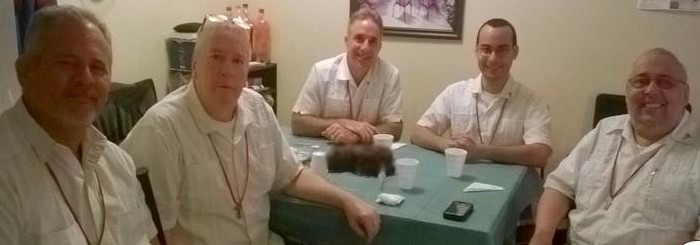
Today, there are six brothers. Three are Regular Brothers and three are Extern Brothers.
The Regular Brothers make vows of chastity, poverty and obedience and a fourth vow, to proclaim the Gospel of Life. The Extern brothers make a solemn promise, which they renew annually, to support pro life ministry, to live a life of prayer and penance, and to observe the Rule of Penitents, given to us by Saint Francis of Assisi in 1221.
The proclamation of the Gospel of Life demands that we appreciate every man, woman and child as a gift from God, in whom God resides.
The brothers run Project Joseph, for the Archdiocese of Miami Respect Life Ministry. We are currently in four centers where we reach out to men who are considering abortion, who are too poor and are anxious about another mouth to feed, and men who are not aware that Christ loves every human being and will not leave us to struggle alone, though at times it may seem that way.
Our brothers teach the faith to children in religious education, where we present the Bible in the manner that St. Francis of Assisi taught it to his early brothers and friends. One of our brothers is the community questor. He teaches at a school for students whose needs cannot be met in the local public-school system.
His small stipend goes to paying rent, utilities, groceries, gasoline, car maintenance, medical bills and unexpected expenses. The brothers try to be truly poor, not just appear to be poor. Like St. Francis of Assisi, we leave behind family, jobs, careers, bank accounts, inheritance, friends and everything that draws us into the secular world, instead of drawing us closer to Christ.
To date, the Regular Brothers live in a room that is on loan to them by a family member. The situation is crowded. In return the brothers take care of housekeeping, cooking, laundry, and other household chores. This allows them to pay a very small monthly rent of $325.00.
We pray that God will send us house where we can welcome new candidates who wish to serve the family, the terminally ill and the immigrant poor. It would allow us to expand our ministry as the number of brothers grows.
We invite any Catholic man between 18 and 50 years of age to talk to us. Maybe God is calling you to be one with the poor, as was Saint Francis and to proclaim the Gospel of Life through your works, teaching, community living and life of prayer.
We are entering that time of the year which we jovially refer to as “Franciscan season”. There are just so many unique events taking place, such as the feast of St. Francis (a Solemnity for the Franciscan family) preceded by the Transitus (crossing over), the commemoration of the Poverello’s entrance into Heaven; the beginning of our “little lent” on the feast of St. Michael (now feast of the Holy Archangels); the commemoration of the Franciscan saints and deceased…AND October is also Respect Life Month, which takes a very special meaning for the Franciscans of Life.
We are kicking off by supporting 40 Days for Life, in particular the Hollywood, FL chapter. We are doing so not only by making a special effort to fill in hours to support the ongoing prayer vigil, but also by promoting the event through a simple video tutorial on how to find a prayer vigil anywhere in the U.S. and how to register for volunteering. Check it out!
On the evening of Wednesday, October 3rd we celebrate the Transitus of St. Francis at the Chapel of St. Maximilian Kolbe Catholic Church in Pembroke Pines, FL, thanks to the kindness and support of the parish pastor and staff. A special thanks goes to the Charismatic Renewal prayer group that also meets on Wednesday evenings, who kindly welcomed our brother Bernardo last year.
The Transitus is a simple yet solemn ritual in which the brothers, following the historical recount by Brother Thomas of Celano, re-enact the last moments in the earthly life of the Seraphic Father and his “crossing over” to Heaven. On this occasion, the Testament of St. Francis is also read. You are welcome to join us! For more details and if you wish to confirm your attendance, you can visit
What else? Much more. During Respect Life Month we will participate in the Life Chain on October 7 and many other events to support and promote the work of Respect Life Ministry Archdiocese of Miami, in particular Project Joseph. Why not take a moment to find out more about this unique program to protect the unborn by serving fathers in crisis pregnancies? Visit www.projectjoseph.org and make sure to watch the short video at the end of that page! We include it here for your convenience:
Feel free to email us if you want to find out more about these events, or about our little Catholic brotherhood! We are an emerging community, joyful to obediently serve the needs of the local Church, pray for the intentions of the Holy Father, and live a simple life of penance and prayer.
There are several ways to stay in contact besides directly emailing us. For example, you can subscribe to our community blog using the little box on the side of this page (see below) and you will receive new articles in your email.
How to subscribe to our blog
You can also follow us on Facebook at https://www.facebook.com/franciscansoflife , we try to post our events and share pro-life news, and we even have a group for those who want to keep in touch and inquire on our way of life.
We are also on Youtube at https://www.youtube.com/franciscansoflife We have two interesting series being edited already, one on the Gospel of Life and one on our Constitutions – and many interesting videos already published. Make sure to “subscribe” and click on the “bell” to receive a notice when the new videos come up!
And if you are wondering how to support us, check out the How to Help page of our website, and feel free to read and share our Vocations material.
Thank you for walking with us as we build something beautiful for the Immaculate.















 [click to see full-scale picture]

 Franciscans of Life