St. Pius X – our “Brother Giuseppe”


We are celebrating today the feast of a Franciscan saint, Pope Pius X. Born Giuseppe Sarto, he entered seminary at 15, was ordained at 23 and became pastor of Salzano (province of Venice) at age 32, where he remained for the following eight years.

Young_St_Pius_X

It is during his residence in Salzano where he became a professed member of the “Ordo Franciscanum Saecularis”. Originally known as the Brothers and Sisters of Penance, this was the third order founded by St. Francis after that of the Friars Minor (the Franciscans) and of the Poor Ladies (the Poor Clares). It welcomed those who wished to follow the life of the Gospel but could not join the “regular” orders – this included married men and women, diocesan clergy, and also those who were single but discerning the call to marriage.

“Brother Giuseppe” was known for his kindness to the poor. He restored the Church of Salzano, enlarged the hospital, and was known during his years as bishop of Mantua to give copies of texts of dogmatic and moral theology to poor seminarians.

Upon election as bishop of Rome, with the name of Pius X, he followed his spiritual father St. Francis in promoting devotion to the Holy Eucharist, even when this meant breaking with long-established customs in the Latin Church.

He encouraged the faithful to receive Holy Communion daily in a time in which frequent communion was far from being the customary practice. He also dispensed the sick from the pre-communion fast, which at the time was due from midnight of the previous day. Furthermore, he strongly promoted giving First Communion to children as soon as they manifested sufficient discretion, lowering the “age of reason” from 12 to 7 years old. Finally, he urged the frequent reception of the Sacrament of Reconciliation in order to worthily receive Holy Communion.

Intending to “restore everything in Christ”, he began a series of extensive reforms of the liturgy.
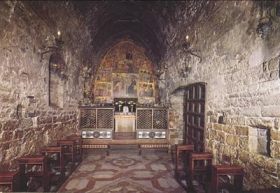
SMaria_degli_angeli_Porziuncula

The Porziuncula, a simple church where the first Franciscans praised and glorified God

The first step he took in this direction was to affirm the primacy of Gregorian chant in the Latin churches, but not for the reasons that some today wish to attribute it… He did so because it represented a much simpler musical style than the theatrical style that was predominant at the time, namely Classical and Baroque compositions. His intent was all-encompassing: by restoring the chanting by the people, he wished to restore the active participation of the faithful in the liturgy. In this he would be echoed by his successor to the Chair of Peter, who insisted that chant had to be restored to the use of the people since “it is very necessary that the faithful attend the sacred ceremonies not as if they were outsiders or mute onlookers“.

Insisting in the importance of the participation of the lay faithful in the life of the Church, St. Pius mandated that catechism classes be established in every parish in the world, and redacted a Catechism known for its “simplicity of exposition and depth of content”, which found its worthy successor in the Catechism of the Catholic Church, not StPiusXatDeskaimed to the use of the clergy but to the entire People of God.
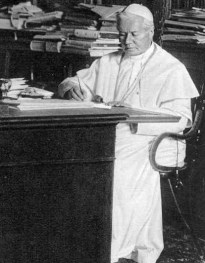
His most encompassing reforms were of the Code of Canon Law and of the Divine Office. The former received a universal structure. The latter was a major revision: he abolished and forbade the Breviary established by St. Pius V, promulgating a revision that rearranged the psalms, dividing them when too long, and significantly reducing the individual Hours. The changes also made necessary a reform of the Roman Missal, which was completed in the 1920 typical edition by his successor to the Apostolic See. This was the fourth revision of the so-called “Tridentine Mass” since the day that St. Pius V established it as the norm for most diocesan clergy of the Latin Rite.

During his pontificate, St Pius X was very close to the people in times of natural disasters – we recall the earthquake of Calabria and the eruption of Mount Vesuvio – and showed his paternal care towards the Secular Franciscan Order by asking the Franciscan friars to take spiritual care of them (see the Latin document here). The Franciscan spirit which permeated his life and pontificate could be summarized by his words concerning the Catholic attitude towards the Holy Father:

“How must the Pope be loved? Not in word, nor in tongue, but in deed, and in truth. When a person is loved, one tries to adhere in everything to his thoughts, to execute his will, to interpret his desires. When we love the Pope, we make no arguments around what he disposes or demands, or about how far obedience must go, and in what things one must obey; we do not say that he has not spoken clearly enough…we do not place his orders in doubt…we do not limit the scope in which he can and should exercise his authority; we do not set above the authority of the Pope that of other people no matter how learned who dissent from the Pope, who may be learned but are not holy, because he who is holy cannot dissent from the Pope.

This is the cry of a hurting heart, that with deep bitterness I express, not for your sake, beloved brothers, but with you in order to deplore the conduct of many priests, who not only dare to debate and criticize the wishes of the Pope, but are not ashamed to reach impudent and shameless disobedience, with much scandal for the good and with so much ruin of souls. (Discorso 18-XI-1912)”

In this he echoes the words of the Seraphic Father who writes:

“Brother Francis, and whoever may be at the head of this religion, promises obedience and reverence to our Lord Pope Innocent and to his successors. And the other brothers shall be bound to obey Brother Francis and his successors. […] Let all the brothers be Catholics, and live and speak in a Catholic manner. Let none of the brothers preach contrary to the form and institution of the holy Roman Church. (Rule)

The Lord gave me and still gives me such faith in priests who live according to the manner of the holy Roman Church because of their order, that if they were to persecute me, I would still have recourse to them. And if I possessed as much wisdom as Solomon had and I came upon pitiful priests of this world, I would not preach contrary to their will in the parishes in which they live. And I desire to fear, love, and honor them and all others as my masters. And I do not wish to consider sin in them because I discern the Son of God in them and they are my masters.”  (Testament)

St Pius was known to have said: “I was born poor, I lived poor, and I wish to die poor.” Falling ill on the feast of the Assumption, also weighed down by the distress of the First World War that he had tried so difficultly to prevent, he expressively prohibited the embalming of his remains and was buried in a simple, unadorned tomb in the crypt of St Peter’s Basilica.
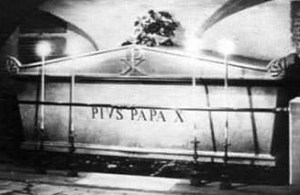
tomb_Pius_X

To him the Lord entrusted the Church at a very difficult time – when the world was transitioning into the Great Wars that would forever change its face and usher a new era for civilization in terms of destruction and reconstruction. We are all indebted to him for the courage and simplicity with which he embraced the task of laying the foundations for a comprehensive renewal of the Church.

For those who wish to read some of his writings, you may visit the page dedicated to him on the website of the Holy See, here.



“Never Forget to Love”


St. Maximilian, Pray for us.

St. Maximilian,
Pray for us.

On Friday, 14 August, the Church celebrates the feast of Saint Maximilian Maria Kolbe.  Many know that Saint Maximilian Kolbe was a Conventual Franciscan friar who gave his life, in a concentration camp, to save the life of a young man who was a husband and father.  More here

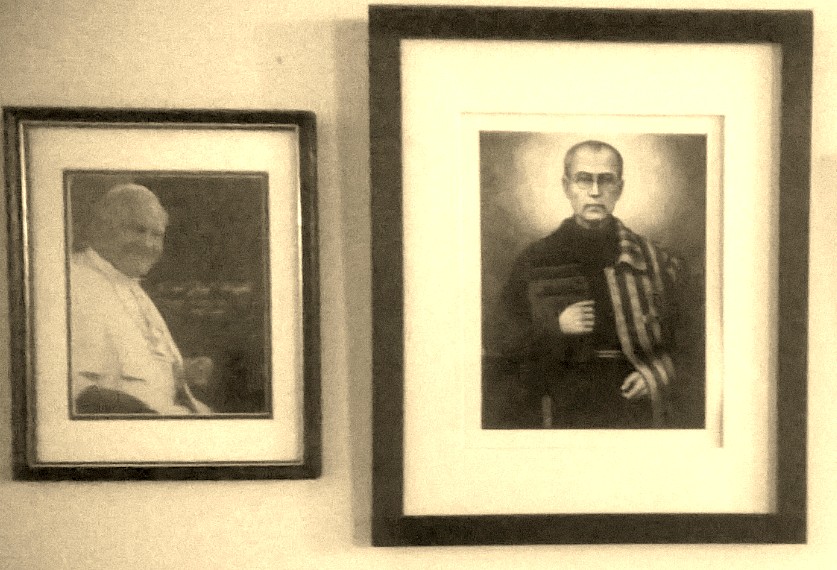
Maximillian, along with the Immaculate and Saint John Paul II, is patron of the Franciscans of Life.  Maximilian also founded the Knights of the Immaculate, movement to promote devotion to the Mother of God, devotion that allows her to point to Christ as she did at Cana.  This he did after he consecrated his life to the Immaculate.    The Church has named Maximilian the Patron Saint of those who work for the Gospel of Life.

In honor of Saint Maximilian, the Franciscans of Life will gather for a festive supper and solemn vespers on the evening of August 14th.  There will be food, music, pictures, games and a great deal of fraternal spirit.  Please keep the Franciscans of Life in your prayers this day.

Man is called to a fullness of life which far exceeds the dimensions of his earthly existence, because it consists in sharing the very life of God. The loftiness of this supernatural vocation reveals the greatness and the inestimable value of human life . . .” (Evangelium Vitae).

FFV On The Web


Br_BC

A brother writing for the blog

This year the Franciscans of Life, ever faithful to the inspiration of St. Maximilian Kolbe, have dedicated several blog posts to articles on a variety of topics spanning from Franciscan studies to theology, to current Church issues to life issues.

We have also embarked in a full redesign of our website, franciscansoflife.org, that was launched in June.

Besides our own modest publication efforts, other sources have kindly featured our content. We are very grateful to them and we wish to recognize them. If we missed any, please let us know 🙂

In January, the Archdiocese of Miami “Let’s Talk” Blog featured our May 2014 article “What’s a brother? Do we really need them?” under the title “What is a brother?” (they even provided a Spanish translation: “¿Qué es un hermano?“).

In February, St. Bride’s Catholic Church in Bothwell (Scotland), a parish to whom an enclosed community of Poor Clares is attached, featured our  January 2015 article “Conscience in crisis” in their parish newsletter (click here).

In May, Respect Life Ministry Archdiocese of Miami featured content from our April 2015 article “Project Joseph – Better Men, Better Dads“, including the Youtube video presentation that we produced, on their new web page about Project Joseph (click here). They also mentioned that FFV provides initial and ongoing formation for Project Joseph mentors.

In June, the Institute on Religious Life featured our emerging community in their Vocation Blog (click here).


[How to Help]

Published in: on August 1, 2015 at 3:00 PM  Leave a Comment  

Our new website is up!


We are proud to present our entirely re-designed community website!

new_website

Take a look at it at http://www.franciscansoflife.org and help yourself to donuts and soda while you are at it!

El discernimiento requiere de muchas rosquillas

He just visited our new website : )

A family celebration


This Saturday we had an interesting event, as both memorials of the Immaculate Heart of Mary and of St. Anthony of Padua coincided. For the Franciscan family, the day of St. Anthony is a feast. Since the Immaculate is our patroness, we wished to honor her in some way.

St_Anthony_and_Family

We decided to visit the Shrine of Our Lady of Charity by Biscayne Bay (Miami), where we would attend the midday mass in honor of the Immaculate Heart.

The legend of the statue of “la Caridad del Cobre”, as it is commonly known among the Cuban people, traces back to the 1500s, when it was found floating in the Nipe Bay (Holguin province) by three young slaves (“los tres Juanes”) from the copper mines. The statue was placed near the mines, first in a humble hut and eventually in a church. She was proclaimed the Patroness of Cuba in 1916 by Pope Benedict XV.

Our_Lady_of_Charity

The Cuban Exile to Miami retained its devotion to la Virgen de la Caridad, and one of its representatives, the Rev. Augustin Roman, began working with Archbishop Carroll to build a shrine in her honor.

Appointed Auxiliary Bishop of Miami in 1979, he would oversee its construction and serve as its rector up to the very last day of his life.

The brothers arrived at the Shrine around 11:30 am and were joined by a good friend.

WP_20150613_005b

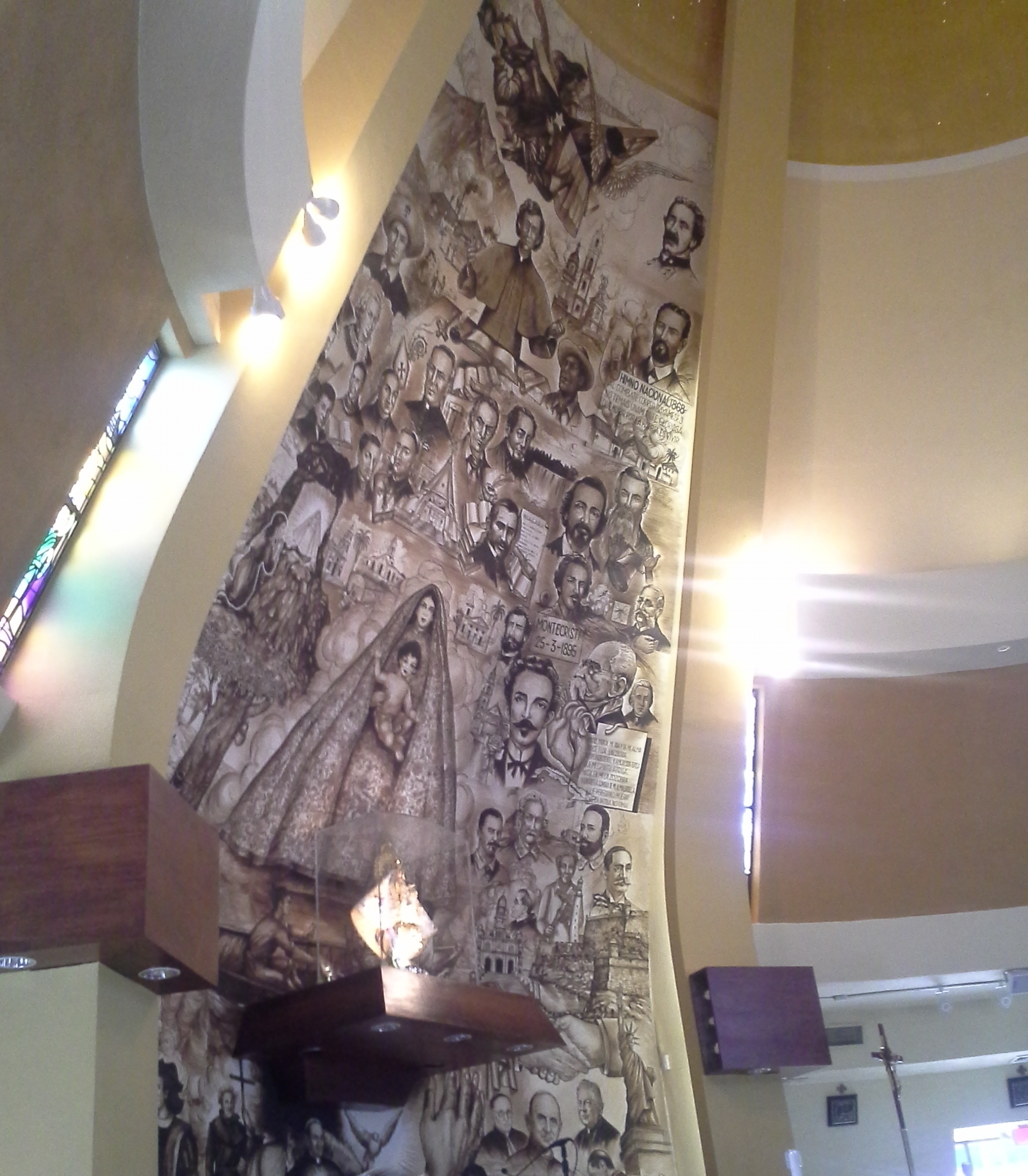
Before Mass, presided by Fr. Rumin OFM, they had some time to admire the artwork inside the Shrine, along with the blessed replica of the statue that arrived from Cuba in 1961.

WP_20150613_003

The mural behind the altar is a tribute to the faith of the Cuban people going all the way back to the 1500s. An overview of the different parts can be found on the website of the Shrine, here.

20150613_114820

Afterwards, we gathered at the little kiosk outside of the Shrine, where we enjoyed typical Cuban food, such as “guarapo” (a juice made from sugar cane), croquetas, and pan con jamon y queso 🙂 We were soon joined by a group of “spectators” who were quite interested in the crumbs left behind!

WP_20150613_007

[How to Help]

“To be held as precious”


Today the Latin Church celebrates the solemnity of Corpus Christi to commemorate the institution of the Eucharist.

JPII W EUCHARIST

Although the Seraphic Father never experienced this feast, he and his brothers certainly had a special devotion to the Holy Eucharist during his lifetime. In fact, St. Francis focused his first Admonition on the Holy Eucharist, professing that

the Sacrament of the Body of Christ which is sanctified by the word of the Lord upon the altar by the hands of the priest in the form of bread and wine […] is really the most holy Body and Blood of our Lord Jesus Christ.

St. Francis emphasized that the Holy Eucharist shows the Lord’s great humility and simplicity, the same that He showed in the Incarnation:

Behold daily He humbles Himself as when from His “royal throne” He came into the womb of the Virgin; daily He Himself comes to us with like humility; daily He descends from the bosom of His Father upon the altar in the hands of the priest.

eucharist in creche

The awe inspired by the great love of the Word made Flesh, united to the awareness that in this world we can see nothing corporally of Christ except the Holy Eucharist (Testament) moves us to revere the Real Presence and, by association to show respect for “the chalices, corporals, ornaments of the altar, and all that pertain to the Sacrifice“. These, Francis reminds, us, must be held as precious (Letter to all the Custodes).

In the Latin Church, such reverence was expressed in ways that were typically European, according to the circumstances. Customary gestures arose, some of which acquired meaning, and others to which meaning began to be attributed.

The latter revealed a weakness: the meaning of reverence appeared from the outside in. One had to ask “Why?” in order to be told “it is a sign of reverence“.

Other customary gestures, however, allowed the action to speak for itself. Consider for instance the elevation after the consecration, a late medieval introduction intended to show the consecrated host to the people. When St. Elizabeth Ann Seton, prior to her conversion from Anglicanism, witnessed this for the first time, she was well aware of what was being done (since it existed in the Anglican rite), but the awe that accompanied it was what she perceived, an awe sparked by the Catholic belief in the Real Presence. This, and not the gesture per se, would eventually lead her to the Eucharist. Reverence, then, can be experienced or defined.

St_Seton

The Church, rather than rigidly defining reverence, mediates its experience by pointing to the value of that which is sacred. This she does in a twofold manner: expressing dismay when that which is sacred is treated carelessly, and showing forth the different degrees of reverence due to the sacred.

As an example of the former, the Church states that “sacred objects, which are designated for divine worship by dedication or blessing…are not to be employed for profane or inappropriate use” (CIC 1171), and that they be made of materials “truly noble in the common estimation within a given region, [being] reprobated…any practice of using…common vessels…or which are mere containers” (RS 117).

As an example of showing the different degrees of reverence that are due, consider the chalice. The minor clerics handled the empty chalice. The subdeacon handed the filled chalice to the deacon before consecration. The priest handled the consecrated chalice.

When for practical reasons laymen replaced the ministry of the minor orders and subdiaconate, the lay ministers handled the empty chalice, the deacon poured wine into the chalice and handed it to the priest, and the priest consecrated.

When order is restored, confusion disappears and once more reverence becomes visible.

If, however, we do not let reverence speak for itself, but rather focus on rigidly defining it, we risk embracing two imperfect mindsets.

In the first of these, we may apply gestures that express reverence in situations that do not call for it, which leads to an over-generalization or over-use of such gestures, so that eventually they lose their reverent meaning and become “common”.

An example of this is the practice of genuflection. In the Latin Church, genuflection became a common sign of reverence towards the Blessed Sacrament. Eventually, genuflections became common throughout the liturgy even when the Blessed Sacrament is neither present on the altar, nor reserved in the Tabernacle. This begs the question: “Why genuflect?” To which the answer comes: “As a sign of reverence“. This led to confusion, as the distinction between reverence due to the Blessed Sacrament and respect due to a sacred object (namely, the altar) became unclear. This of course can lead to such gestures being eventually discarded because they are no longer associated with the original context and thus  perceived as superfluous repetition.

The second of these mindsets, one may begin to perceive the absence of certain gestures as a “lack of reverence”, or the presence of certain gestures as a “need”, given our sinfulness or even “uncleanliness”.

Consider, for instance, the usage of gloves by altar servers. When the law of the Latin Church reserved, so to speak, the handling of the sacred vessels to the minor clerics, this came neither from divine revelation nor because of an intrinsic spiritual meaning. Certainly it was not the Church’s mindset that the laity was “unworthy because unholy”. It was done for very practical reasons. Furthermore, laymen and religious often functioned as sacristan. At times they handled the vessels with a piece of cloth, because it was fairly easy to transfer grease and dirt from their hands to the vessels.

gloves

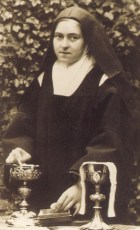
Yet by the 19th Century we read that if the sacristan is a layman rather than a minor cleric, “it is at least becoming that a veil be used in handling the chalice and the paten” (Collectio Rerum Liturgicarum). Statements such as these were understood in the negative, as implying that the gesture of a lay man or woman handling the chalice with bare hands is a lack of reverence, because the laity are somewhat “unclean”, hence the need to “restrict” them outside of the sacristy and to grant clerics alone the “privilege”of handling the sacred vessels. This, of course, confuses the way the Church intended to bring order and distorts the meaning of reverence. Even the previous Code of Canon Law stated that the sacred vessels could be handled by either the clerics or those who had their custody, including laity and religious (CIC/1917 1306), where the word “laity” made no distinction between male and female .

St-Therese-sacristan-2

St. Therese of Lisieux as sacristan

As for the honor due to the clergy, the Seraphic Father reminds us that it is “on account of their office and administration of the most holy Body and Blood of our Lord Jesus Christ, which they sacrifice on the altar and receive and administer to others” (Letter to all the Faithful). That is to say: we honor them because they are the ministers of the Eucharist; they are not the ministers of the Eucharist because of their holiness.

In brief: this mindset, which focuses on our sinfulness alone, fails to acknowledge the Incarnation. Yet, it can still be found today, even when minor orders are no longer present in the Latin Church (with a few exceptions) and their functions are performed by the laity.

To avoid the two slippery slopes that we have described, we should bear in mind that the Church does not rigidly define reverence, but rather orders roles and gestures according to the need. Again, when order is restored, confusion disappears and once more reverence becomes visible.

Consequently, the focus shifts from our sinfulness and unworthiness to the Incarnation. At that moment, the Word becomes Flesh and the Second Person of the Holy Trinity assumes our nature, breaking into human history and beginning the journey towards our redemption.

True reverence has its roots in the Incarnation and naturally returns to it. We reverence Our Lord Jesus Christ when we acknowledge Him as true God and true man, hence becoming aware of who He is, our very brother, and of who we are in relationship to Him, children of the Most High.

St_Francis_embrace


Br. Bernardo di Carmine

[How to Help]

“Life calls out to life”


A couple of months ago we mentioned that there would be some upcoming articles focusing on Project Joseph and on our family, the Franciscans of Life. The former we addressed in April. Today we continue this “mini series” by answering the question…

Who Are The Franciscans Of Life?

all_pic

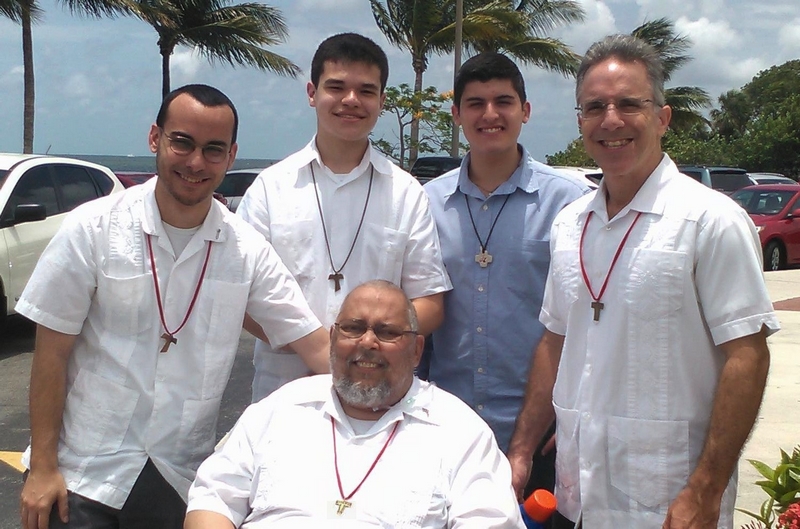
   The Franciscans of Life is a private association of Catholic laymen who are celibate, singler, or married.  It is the hope of the society to become a public association of the faithful someday, maybe an institute of mixed life, where regular and secular meet.

   We exist with the permission and blessing of the Archbishop of Miami, the Most Reverend Thomas Wenski. Men from six countries, four language groups and three generations make up the fraternity.

   We attempt to replicate that brotherhood that grew up around Saint Francis of Assisi in the thirteenth century, where there were friars, nuns, married men and women, diocesan priests, widows and single people who followed the Gospel according to the Rule of Penance written by Saint Francis.  Today, our fraternity is comprised of men only.  There are “regular” brothers who live the evangelical counsels in private vows and “extern” brothers who live the evangelical counsels as single or married men.

Our Way of Life

life

The Franciscans of Life make a covenant to live the Gospel according to the Rule of Penance and the constitutions of the society.  Every brother, celibate, single, or married is a full member of the fraternity.  Therefore, each one binds himself to observe obedience to the Church and the superior of the fraternity, to live a life of detachment from material things and temporal honors, and to persevere in chastity in the celibate, single, or married life.

While all of the brothers in Franciscans of Life are lay and secular, we use the term “extern” to identify those brothers who are married or single and hoping to marry, and the term “regular” to identify those brothers who live in community, are in private vows and are celibate.

 Eucharist, Liturgy of the Hours, private prayer, fasting and abstinence are the guiding lights for the brothers.  Fraternity is a hallmark of Franciscan tradition.  Therefore, the brothers look to Christ and the apostles and endeavor to follow that model of fraternal life and service.

Common prayer, sharing, openness to each other, our families, and support for each other along the journey toward the perfection of charity are the means by which the brothers sanctify their lives and the lives of those they touch.  The brothers are faithful and obedient to the Catholic Church as she speaks to us through the successor of Peter and the local bishop.

Our Mission

mission

The mission of the fraternity is to proclaim the Gospel of Life through service to the voiceless, in particular the preborn child and his family, the terminally ill and the elderly, the immigrant poor who feels hopeless, and the person living with disabilities.

The brothers engage in a variety of apostolic activities in the Archdiocese of Miami. These include catechesis, campus ministry, Respect Life, prayer vigils at abortion mills, and serving fathers in crisis pregnancies through Project Joseph. Other apostolates are hospice and linking immigrant poor with community resources.

The invisible dimension of the brothers’ mission is a life of atonement for those who embrace the culture of death.

Extern Brothers


secular_brothers

The extern brothers live in the secular world, but are not of the world.  They are husbands, fathers, and single men.  The fraternity is also open to deacons and diocesan priests who have the permission of their bishop to join.

   These brothers hold typical jobs in the world and belong to different parishes in the Archdiocese.  However, they come together with each other and the regular brothers at the weekly family meeting, liturgical functions, prayer, and apostolic activities.

   Those who are husbands and fathers include their spouses and children in as many of the fraternal activities as possible.  In this way, the Franciscan spirit is carried into the family and the family is embraced by the fraternity.

   The extern brothers and their families engage in the proclamation of the Gospel of Life through participation in activities that promote the sanctity of life.

Regular Brothers


regular_brothers

These brothers live in community under the leadership of a superior.  They make private vows of obedience, poverty and chastity and are celibate for life.

None of the brothers owns anything individually or in common.  They rent their home, share their material resources, and work to provide for their material needs as prescribed by Saint Francis in his Testament.  When the income is not enough, the brothers beg as did the early Franciscans.

The daily life of these brothers is comprised of prayer, apostolic service to the voiceless, study, and labor that generates enough income to support the brothers and their work for the poor.

Under the guidance and encouragement of a superior also known as a guardian, the brothers strive to live as a family where brother serves brother as Christ served the apostles when he washed their feet at the Last Supper.  These brothers spend a great deal of time together at prayer, work, ministry, study, recreation and rest.


Trinitarian

Jerónimo_Ezquerra_Holy_Trinity


Like Saint Francis and the first generation Franciscans, the Franciscans of Life look to the Trinity for guidance and example in community, intimacy, love, unity and holiness.


Marian


heroes

Saint Maximilian Kolbe and Saint John Paul II are the patrons of the Franciscans of Life.  From these saints we learn to live under the mantle  of the Immaculate and to protect the sanctity of life from conception to death.

Vita ad vitam vocat…”

Prayerfully consider whether the Lord is inviting you to walk the way with us. In doing so, bear in mind the sayings of our patron saints: “Do not be afraid…forget not love!”

We look forward to hearing from you!

[How to Help]

Ask whatever you will


As some of you may already know, I’m back in the hospital. I’ve been here almost two weeks and there is no discharge on the horizon. My major body systems are not cooperating with each other. You fix one and the others go into distress (kidneys, lungs, pancreas, heart, and circulation).

It is a very challenging week in our fraternity. First, I became ill. Then Brother Leo’s sister died this weekend. Please keep him and his family in prayer. He had to fly to Boston. We miss him dearly.

As if that were not enough, Brother Bernardo was left alone to care for me since Leo is in New England. The challenge . . .? Brother Bernardo has come down with his own case of tonsillitis and has final examinations this week. The poor man is trying to recover, to help me and to prepare for finals. Pray that God will reward him with peace and trust.

On the positive side, patients, staff and guests at the hospital are very curious about Franciscans of Life. They don’t get to see much of us, because we don’t do traditional parish work. Our day is broken down into segments of prayer, teaching and preaching the Gospel of Life through a variety of apostolates, atonement for the culture of death, and fraternal life among us, like that of the early Franciscans.

People are fascinated when we explain that we’re looking back to go forward. I believe this has caused some Catholics to look back as well. We get many people who suddenly remember being influenced by a Franciscan here and there. If these memories transport people into the presence of God, then it must be the good spirit’s leading. One never knows the extent and power of redemptive suffering.

If you abide in me, and my words abide in you, ask whatever you will, and it shall be done for you. By this my Father is glorified, that you bear much fruit, and so prove to be my disciples. As the Father has loved me, so have I loved you; abide in my love. 10 If you keep my commandments, you will abide in my love, just as I have kept my Father’s commandments and abide in his love. 11 These things I have spoken to you, that my joy may be in you, and that your joy may be full. (John 15:7-13).

Our other concern is finances. God has plenty of money but the service providers want the money from us. Flying to funerals, going to doctors’ visits, paying for meds and paying for co-insurance for my inpatient is a toll.

Saint Paul reminds us that we can do everything in Him who strengthens us. Jesus reminds us that with him all things are possible. As a fraternity, we are willing and able to weather this storm. But we have to be together again in South Florida. All of us over the map does not lend itself to presence. To be together to pay bills and have enough to share with voiceless. We need to be together to preserve the Trinitarian Communion that is essential to our way of life.

Pray for Brother Leo and his family that God will give them peace and bring him home soon. Pray for Brother Bernardo that God will give him spiritual and physical strength to follow His lead and that his condition improves so that he can do well on his final examination, this week.

As for me, pray that as superior I may lead by the example of the Suffering Servant.
God bless you.


 [How to Help]

Project Joseph – Better Men, Better Dads


St_Joseph

The Story behind Project Joseph

   In 2009 Brother Jay Rivera, founder of the Franciscans of Life, was volunteering at Respect Life’s Pregnancy Care Center in Hollywood, Florida when he began to notice that the fathers of the infants in danger of being aborted were not being served by Respect Life Ministry.

   It was not that the Archdiocese had anything against the dads.  Simply . . . no one noticed. Men dropped off the expectant mother at the center, be it for class, counseling or material assistance, and sat in their cars, drove away or waited in the waiting area.  The volunteers who served at the center would eagerly jump to the assistance of the expectant mother, but would have little or no interaction with the father.     As Brother Jay watched, the thought hit him.  “This is very much like Planned Parenthood and other ‘pro-choice’ organizations.  Pregnancy is a woman’s issue.”

    Like many other Franciscan fraternities, the Franciscans of Life place themselves under the protection of the Immaculate.  Brother began to pray to the Immaculate for guidance.  He also spoke to Joan Crown, Archdiocesan Director of Respect Life Ministry for the Archdiocese of Miami.

     He laid out before them his concern that the fathers of the preborn babies were out of the loop.  They didn’t know what to do or what was expected of them.  Many of them were frightened by the sudden news of a pregnancy, wanted to walk away from the situation in the hopes that it would go away or offered to pay for an abortion as one would pay someone compensation for damages in an accident.  The mothers were holding on to their preborn babies, but uncertain whether to go forward with the pregnancy.

    Thanks to the support from the volunteer counselors and teachers at Respect Life, most of the mothers were determined to give the pregnancy a chance.  However, giving your preborn child a chance is not the same as eagerly awaiting his birth.  That chance can be revoked at any time.

    Brother began walking up to the dads in the parked cars and invited them to come into the center.  The men seemed friendly enough, but not too sure what to do about this invitation.  They were hesitant.  Of course, Brother Jay had no idea what he was going to do with the men either.  He knew that he had to offer them something.

     Finally one father, whom we shall call David, came inside.  He was not too eager to be there, but he seemed curious to find out what this older gentleman who looked like a monk wanted.  The first time that he entered the center they spoke for about 45 minutes about anything that came up.

    That night, Brother again knelt in prayer asking for guidance.  He prayed to St. Francis of Assisi, founder of the Franciscan family, to the Immaculate, patroness of the Franciscans, and to St. Maximilian Kolbe, a Franciscan saint who is the patron of pro-life workers.       Simply put, he called a team meeting and placed the situation on the table.

We have preborn children who are at risk for abandonment and death, if both father and mother don’t step up to the plate.  But they don’t know what to do and I don’t know what to teach them, because there is so much information out there and such little time here.” 

    While at prayer he felt someone saying, Give it to St. Joseph.”

    The next day would be the first Sunday of the month, the day that the Secular and Regular Franciscans have their local community gathering.  Brother went to bed and dreamed.  He was in a small room that was illumined, but there were no signs of electricity, no flames, or windows.  The room just glowed.  In the room stood a friar with his back to the door.  Brother Jay recognized this friar as Brother Francis of Assisi.      Brother Jay saw the grey sleeve of Francis’ habit rise as he raised his arm pointing to something in front of them.  When he looked, Brother Jay saw a wooden statue of St. Joseph, about 10 inches tall, holding the child Jesus in one arm and something green in the other hand.

    The next day, he attended the fraternity meeting and shared his concern with his Franciscan brothers and sisters.  He mentioned the dream as well.  A Franciscan sister who was at the meeting got up and left the room.

    She came back with a white box. As she handed the white box to Brother Jay, she said:

Someone gave this to me about 12 years ago.  I have another, so I put it in my closet waiting to find someone to whom I could give it.  This morning, as I was getting ready to come to the gathering, something told me to put this in my car.  I think it’s for you.

    When Brother opened the box, there was the wooden statue that he had seen in his dream.  It was 10 inches tall.  St. Joseph was holding the child Jesus in one arm and something green in the other hand.  They were lilies.

    This was the confirmation.  Saint Joseph had accepted the challenge.  He would walk with Brother Jay and the expectant dads in crisis pregnancies.

Where Is Project Joseph Today?

family_PrJoseph

Today, Project Joseph has evolved into an archdiocesan network of formation and service for men who are in crisis pregnancies.

The program operates out of four of the five archdiocesan pregnancy help centers:  Hollywood, North Dade, South Dade and Fort Lauderdale.

At each center there is at least one trained mentor who provides small group education to fathers, counseling and material assistance.

Fathers may attend an entire program of 18 modules divided into three blocks of six:  Becoming a Better Man; Parenting; Future Planning.

After completing this set of modules, fathers are invited to continue in the program where they receive education and support in other areas of fatherhood such as:

  • community resources,
  • behavior management,
  • infant development,
  • chastity and human sexuality,
  • legal rights of fathers,
  • faith and parenting,
  • marriage and family,
  • and safeguarding children.

Dads are “paidParent Dollars for every session they attend.  They can cash in these parent dollars for anything from diapers to cribs and mattresses.  A father may join Project Joseph at any point from the moment of conception until the child is one-year old.  Project Joseph is always there to help if a father needs to return later.

There is no charge for the services that we provide, nor do we charge the Archdiocese of Miami for such services.  Project Joseph is financed through grants and donations.

Through the year, Project Joseph serves approximately 20 fathers per week, 50 weeks out of the year.  The only time the program is closed is during Holy Week and Christmas week.

It is run by men for men.  Our mentors are volunteers from the community. They are Catholics in good standing with the Church.

The Franciscans of Life provide initial and ongoing formation for the mentors.

Project Joseph is grounded in the spirituality of St. Francis of Assisi.

Fathers and mentors are brothers who walk side by side on this journey, as did Saint Francis of Assisi and those whom he and his brothers served.  The mentors approach the fathers from the “bottom up”.  Like Saint Francis, they are here to serve, not to preach, teach, correct, discipline or be heard.   They preach the Gospel through their lives and through their unconditional love for every man whom they serve.  We train our mentors in the pastoral methods of Saint Maximilian Kolbe, a Franciscan Friar and patron of pro-life workers.

Like his spiritual father, Saint Francis, Saint Maximilian placed his trust in the Immaculate.  He planted the seed and allowed her to guide him and those with whom he walked.  Like Christ, he was willing to lay down his life for his brother, especially if that brother was the father of a family.  Our mentors are formed in the spirit of total detachment from self and confidence in the Immaculate and Divine Providence.  We do what we need to do for the dads and we get out of God’s way.

If you are a man in the Archdiocese of Miami, ask yourself if God is inviting you to help us proclaim the Gospel of Life by walking with your brothers. Do not worry about not knowing what to do. We in the apostolate will walk with you and our brothers. Contact us to find out more!

Below is a short video about Project Joseph:

 [How to Help]

Holy Week: a time to choose


Palm Sunday

As Holy Week moves along,palm-sunday-crosses-6 the Franciscans of Life are also moving right along with the liturgy and the celebration of the paschal mysteries.  The week began with the liturgy of Passion Sunday (Palm Sunday).  The brothers attended  the liturgy as family.  It was a very moving day for us, especially for those brothers who had never seen the liturgy of Palm Sunday in the Ordinary Form.  The beauty and solemnity of the liturgical celebration removed any doubt that the Ordinary Form can raise the heart and  mind to God as much as the Extraordinary Form.  In both, Christ does his part.  It is up to us to do our part.  The young men and women from LifeTeen reenacted the Lord’s passion as the Gospel was read. We were impressed to see how prayerful the kids looked and how well they memorized the many lines in the Gospel reading.  Of course the priest and the deacon helped out during the reading.

Meet Our New Postulant

Monday night was a very special night for the fraternity.  We received a new postulant, Alberto Emilio Rodriguez.  Alberto joined us as an aspirant several months ago.  He is the product of a solid Catholic home and

Alberto está a punto de comenzar el discernimiento

Postulant Alberto Rodriguez, FFV

Catholic education.  We thank his parents and the Marist Brothers for their investment in Alberto.  Postulant Alberto is active in the community, especially in youth retreats.  As a student the only thing we can say is that he is brilliant.  He was accepted by three leading universities in the United States, all of which offered him full scholarships.

Lazaro Rodriguez (father), Postulant Alberto, Br. Jay and Br. Luis sign the registry after Alberto is received as a posulant

However, Alberto has decided to study in Miami and form with the Franciscans of Life.  He has responded to what Jesus said to his apostles at the Last Supper when he washed their feet:

14 Now that I, your Lord and Teacher, have washed your feet, you also should wash one another’s feet. 15 I have set you an example that you should do as I have done for you. 16 Very truly I tell you, no servant is greater than his master, nor is a messenger greater than the one who sent him. 17 Now that you know these things, you will be blessed if you do them. (John 13:14-16).

As we have said, he is academically gifted, speaks two languages, is the class president at his school, has been a retreat speaker and altar server, is an excellent drummer and an aeronautics aficionado.  Most important, he is a man of great faith and a deep prayer life.

New Secular Franciscan of Life

We have also received a new brother as novice for the Secular Franciscans of Life, Brother Luis Charbel.

WP_20150323_030

Br. Luis Charbel, FFV was received as a novice at St. Maximilian Kolbe Chapel.

Br. Bernardo di Carmine and his mother, Mrs. Angela Torres


Brother Bernardo Di Carmine delivered a beautiful reflection during solemn vespers when Luis was received.

Luis is originally from Colombia.  He and his wife have made Miami their home along with their beautiful eight children.  Luis came to us driven by the Holy Spirit.  He has always experienced an attraction to the spirit of St. Francis.  His children serve the poor in a Franciscan ministry.  However, Luis had never done anything about his craving for Francis of Assisi and his way of life until he saw an article about Project Joseph, which the Franciscans of Life operate for Respect Life Ministry Archdiocese of Miami.  Docile to the Holy Spirit, he responded to Christ’s challenge to the apostles during his Passover with them:

12 Very truly I tell you, whoever believes in me will do the works I have been doing, and they will do even greater things than these. (Jn 14:12).

"Louis-ix" by El Greco - Transferred from en.wikipedia; transferred to Commons by User:Sfan00_IMG using CommonsHelper.Author: Original uploader was Uri at en.wikipedia. 2003-07-01 (original upload date). Licensed under Public Domain via Wikimedia Commons - http://commons.wikimedia.org/wiki/File:Louis-ix.jpg#/media/File:Louis-ix.jpg

St. Louis IX by El Greco

Like Alberto, Luis is also a man of profound faith and prayer.  His patron saints are Saint Louis King of France, the patron of the Third Order of St. Francis, and Saint Charbel Makhluf, Maronite monk and hermit, known for his intense life of prayer and asceticism.  Luis couldn’t have picked better patron saints.

Saint Louis IX was a contemporary of Saint Francis of Assisi and king of France.  He is one of the earliest secular brothers in the Franciscan family, a faithful husband and the father of eleven children.

Saint Charbel Makhlouf, O.L.M. The Wonder Worker

Saint Charbel was Maronite monk and hermit at the Monastery of Saint Maron where he lived a life of severe asceticism.  For those who may not understand the term asceticism, it has little to do with corporal penances and much to do with the practice of the virtues.  As an ascetic, Saint Charbel disciplined his mind and body to conform to the virtues of Christ and his Blessed Mother.

Like Saint Charbel, Luis has a very personal relationship with the Immaculate and recently completed his consecration to Mary in the Kolbe tradition.

Holy Week: time to reach out

John’s Gospel tells us that after Jesus had finished the Last Supper and had washed his disciples’ feet he said to them

“Love each other as I have loved you. 13 Greater love has no one than this: to lay down one’s life for one’s friends. 14 You are my friends if you do what I command. 15 I no longer call you servants, because a servant does not know his master’s business. Instead, I have called you friends, for everything that I learned from my Father I have made known to you. 16 You did not choose me, but I chose you and appointed you so that you might go and bear fruit—fruit that will last—and so that whatever you ask in my name the Father will give you. 17 This is my command: Love each other.”  (Jn 15:12b-17).

Holy Week is the perfect time to reflect on our universal vocation:  the perfection of love. It’s a time to examine what we do and who we are, keeping in mind the precedence of being over doing.

Jesus calls us friends, for that is our universal vocation.  He has loved us enough to call us his friends.  Brothers Alberto and Luis have taken the leap of faith.  Christ chose and extended his hand from the cross in friendship.  Like Saint Francis of Assisi, they responded.

 [How to Help]