In our previous article on Hurricane Matthew, we closed discussing the attitude of anxiety that can contaminate others during such events, and we mentioned that our Holy Father St. Francis taught us instead to always go through the world filled with the Lord’s peace and joy.
In this article we wish to share a bit more alongside some practical “hints” on how to achieve and maintain inner peace during difficult times.
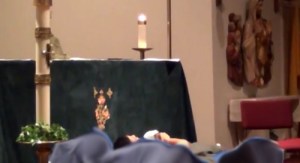
Transitus at St. Maximilian Kolbe parish
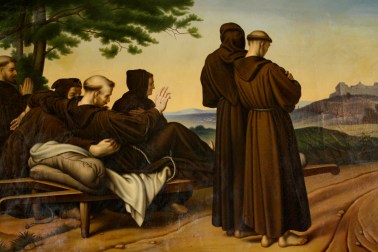
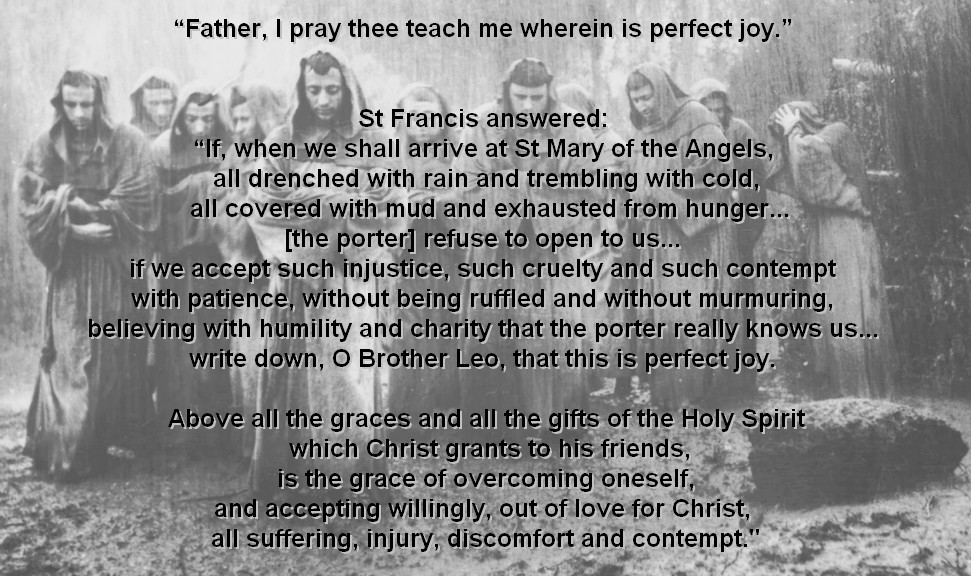
On his deathbed, afflicted by physical suffering and by the struggles of the newborn Franciscan family, St. Francis was able to compose his beautiful Canticle, of which we quote only some strophes:
Be praised, my Lord, through all your creatures…
Praised be You, my Lord, through Brother Wind,
and through the air, cloudy and serene,
and every kind of weather …Praised be You, my Lord, through Sister Water…
Praised be You, my Lord, through Brother Fire…
Praised be You, my Lord,
through those who give pardon for Your love,
and bear infirmity and tribulation…Blessed are those who endure in peace…
Praised be You, my Lord,
through our Sister Bodily Death…Woe to those who die in mortal sin.
Blessed are those whom death will
find in Your most holy willl…
This is the commitment that the brothers take upon themselves when they profess to follow the life of St. Francis, when they commit to become mirrors of perfection.
Such was the inspiration that our Father gave us, that he would inspire other great saints to imitate this model. St. Teresa of Avila would write: “Let nothing disturb you”. St. Ignatius of Loyola would speak of “holy indifference” as “not preferring health to sickness, riches to poverty, honor to humiliation, long life to a short one[; instead] wish only for those conditions that will aid our pursuit of the goal for which we have been created”.(Spiritual Exercises) There are many other examples, but ultimately, they all refer back to the ultimate source of Peace and Joy, the good Lord who once said: “Do not worry about your lives…do not worry about tomorrow!” (Mt 6:25,34).

Furthermore, as Franciscans of Life, we bear the additional commitment of witnessing to the power and majesty of Life, eternal and all-powerful. “I have come that you may have life, and have it fully” (Jn 10:10). Church Father St. Irenaeus once commented:
“The glory of God is man fully alive, and the life of man is the vision of God. If the revelation of God through creation already brings life to all living beings on the earth, how much more will the manifestation of the Father by the Word bring life to those who see God.”
In a practical way, we know that “nobody has seen the Father except the one He sent” and that “he who has seen the Son has seen the Father”, as our Lord reminds us of this and St Francis wishes us to imitate this. Therefore the Franciscan of Life, when seeking to proclaim the Gospel of Life, looks at the person of our Lord within his earthly life, particularly at times when He was surrounded by great agitation and nervousness. How did He act? What did He say?
Thus walking unhurriedly amidst a hurried crowd, being polite at a tired stored employee, smiling at an upset customer, helping a frustrated stranger who is looking for batteries, all of these take a different meaning as they proclaim the Light that shines in the darkness.

A friend of our community mentioned to us during a recent conversation that she felt “ashamed” as she, too, was guilty of having rushed through several stores and having been glued before the TV screen following the alert updates. We do not wish you to misunderstand us… as we said, we too went through the necessary preparations, as prudence is a great virtue. There are, however, certain elements that everyone – even those who have not been through years of formation in Franciscan spirituality – can apply in their daily life to find more of that interior silence that helps us maintain the quiet through the storm.
For example, we avoid following the secular news – including weather updates. The Superior, a man who has mastered interior silence, is tasked with following the development of the event – whatever the event may be – and sharing what he considers necessary for the brothers to know.
To build on a metaphor by Thomas Merton, it seems that the media in this day and age has sadly become a sort of “digital acupuncture” designed to stimulate every possible nerve in the human body, to keep us “on the edge”. “Fortunately”, though, our first-world stores come to the rescue with every sort of product that will reinforce our sense of safety by reinforcing our sense of “having” – even when we purchase those items on credit cards and therefore we are increasing our degree of “not having” (that is, if we assume for the sake of the argument that money is something one can “have”, that is, if we assume that money “is” something).
To make things worse, the media – even those with the best intentions – often miss the elephants in the room. Mother Teresa, recently canonized to the great joy of us all and of so many around the world, reminds us that we need not look far in order to find our neighbor in need. Even before we look at Haiti and the Caribbean, we ought to ask ourselves what we can do to help the homeless men and women on the streets of Miami, Fort Lauderdale, and many other cities of Miami-Dade and Broward who may not even know that there is a deadly hurricane coming their way. Some of them may not have the means to reach a shelter, others may lack an ID that will allow them access into a shelter. Could we find it in our heart to welcome them into our homes for the length of the emergency?
To turn off the “excitement” of the media and to turn from “self” towards the “other” – here are two very useful ways to maintain inner silence, peace, and joy.
The last suggestion I would like to make comes from the spiritual director of St. Teresa of the Andes, a young Carmelite mystic to whom the Lord revealed that she would die within the month. Upon mentioning this to her spiritual director and asking how to go about the remainder of the month, she was told: “Live as usual, as if you were not going to die“. For, in the words of St. Francis, “blessed are those whom the Lord will find doing His holy will“. Then even dreadful, ugly, scary Death becomes no longer our enemy, but our sister.


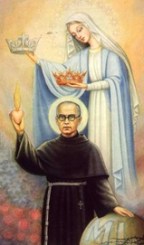 According to his parents’ and brother’s memories, Maximilian was typical pre-adolescent who had the ability to get under people’s skin like most kids in that age group. His mother often cried out in despair, “What’s to become of you Raymond? Note: He was born Raymond Kolbe. But there was something special about this apparent little magnet for trouble. His parents had taught him to pray. As a child, he knelt before Our Lady and asked her, “What is to become of me?” Our Lady gave him a choice between a crown of martyrdom and a crown of purity. Raymond chose both.
 First for youth – St. John Paul told the youth of the world, “Do not be afraid of Jesus Christ.” When Our Lady offered Raymond a choice between martyrdom and purity, he chose both. We think of this story and we swoon over this wonderful little boy who was so pious and so holy. We completely miss what God wants to teach us. Those who struggle, as did Raymond, are also called to a life of virtue and sacrifice. Prefabricated saints don’t need to practice heroic virtue or make heroic sacrifices. Sinners do.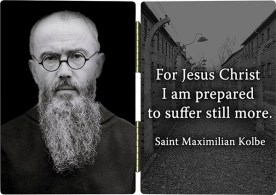
 remained open to the God of surprises rather than planning out their children’s lives in advance and trying to steer them into careers and marriages without consulting God’s plan for them. They educated their children in the faith, provided the academic education available to them and offered them guidance along the way. But they never owned their children. Their children belonged to God. When Christ called Raymond to become Brother Maximilian, it may have not been what Mr and Mrs Kolbe expected or planned, but they trusted. If this was truly the voice of God calling their son, he would be safe and they could offer him no better assurance of his happiness and salvation. If it was simply an illusion of youth, God would open their son’s eyes to the folly of his choice in life. Again, they trusted.
 The lesson to be learned is that even when we are unsure what God wants from our children, if the choice is not a sinful one or a danger to to self or others, we can stand back and let the Immaculate guide. She can only guide our children to her Son. Her GPS is locked on Christ as the compass is locked on the North Pole. There is nothing to fear and much to be gained.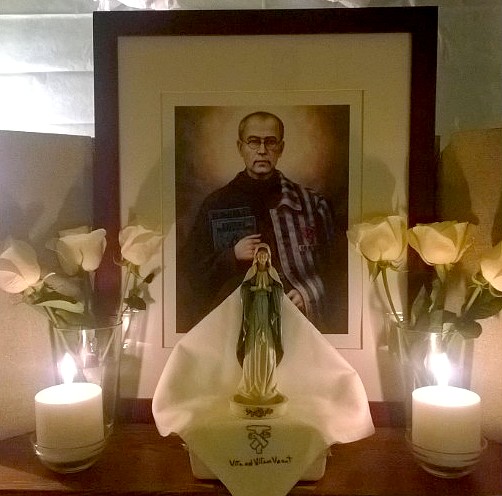




 on TV at 7PM. That was time for evening prayer. Then there were night prayers that were said at bedtime. The very first prayer that I learned to say was the Lord’s Prayer. Because I grew up in a bilingual home, my mother made sure that I could pray it in two languages. After that, other prayers were added, including prayers at the table.


 These are our sleeping quarters, also called cells. No brother owns anything, not even a room of his own. A large room is divided by curtains, as you would see in a hospital. Behind each curtain there are two beds for two brothers, bunks. There is an aisle along the length of the bed that is 18 inches wide and another curtain, behind which there is another cell with two more beds the same size. The brothers always remember Jesus’ words, “The Son of Man has no place to lay his head.”
 Every brother is assigned a flat sheet and a single blanket. We use only what we need, not what we like. We don’t use comforters or fancy bedspreads. The money that can be spent on those items can just as easily be put into our apostolate among the voiceless, even if it’s just paying for gas to get from point A to point B. After a few days, one becomes so accustomed to this arrangement, that we no longer miss our old bedroom in our former home. The community house becomes home and the cells become our bedrooms; but they are more than that. It is here that we experience the intimacy and poverty of the fraternal life that St. Francis so loved. Like Christ and his Apostles and like Francis and the early brothers who shared huts, the brothers practice charity and detachment.
 In the sleeping area there is always a small oratory. An oratory is not a chapel. The Blessed Sacrament is not reserved there. Oratory comes from the Latin word oratio, meaning to speak and to pray. Oremus,”Let us pray. Let us speak with God.” The brothers last conversation before retiring is with Jesus and His Immaculate Mother. His first conversation of the day is also with the beloved Mother and Son. During the day, the brother sneaks into the oratory, like a lover sneaking along the hedges to have a quiet words with his sweetheart. Christ and the Immaculate are our sweethearts.
 We don’t have closets, since we don’t have many clothes. We share a row of hooks where we hang up our formal and work habits. We also have a pair of grey pants and a grey banded shirt. Here you see a typical work habit for a postulant. Novices and professed brothers wear it with a cord or without a cord, depending on the task at hand. The work habit it short. It does not reach the knees. It’s our version of grunge clothing. Nothing is ever wasted. Our Constitution reminds us that like St. Francis, we follow the poor and suffering Christ who walked to Calvary in shredded clothes, except for his sacred seamless tunic. When a garment is too damaged to wear, it is cut up and used to patch up other work habits. It is not unusual to see our brothers wearing patches on their work habits or displaying grease stains from an engine. These stains are tough to wash out. But we manage.
 We don’t have cooks or housekeepers. Those are chores that we do ourselves. The brothers take turns cooking, scrubbing and cleaning. Those brothers who have never done it before or don’t know how are taught by more experienced brothers.
  St. Francis said that we are to be “minors”. During the Italian Middle Ages there was a social class known as the Minores. It seems that these men and women were of the lower class of serfs and peasants. Even among the peasants, there was social stratification. Christ reminds us that we have been sent to serve, not to be served. “Go out and do what I have done for you.”

 We even have two pups. The black and brown handsome fellow is Max, named after St. Maximilian Kolbe.
  The little fawn cutie is Tasha, named after a character on Star Trek Generations. Yes, we have former Trekkies among us. The brothers may not watch television. Start Trek is out of the question. Besides, who has time.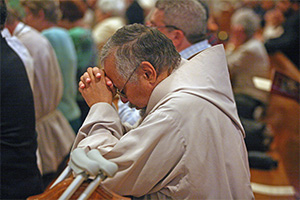


 3.
3. Franciscans of Life