Can you help us find help?


When I was a kid my mother would always tell me to “cut to the chase.”  So, I will.  We need ongoing financial backing from friends and friends of friends.

The Franciscans of Life have a steady income of $2,610.00 a month.  We live in a very modest home where four brothers share one bedroom that we divided into individual cells using curtains as you would see in a hospital room.

Having said this, here is a chart our monthly expenses.

Rent $700.00
Electricity $185.00
Telephone $220.00
Internet $100.00
Gas $125.00
Metro $40.00
Medications $250.00
Auto Insurance $320.00
Groceries $200.00
Charity $1,300.00
Total $2,840.00

The Immaculate has always come through for us by way of our friends.  We hope that she will continue to do so.  The brothers need to continue their education to better serve the voiceless.  Our brothers participate in the apostolate while they attend school full-time.

We proclaim the Gospel of Life at no cost to the Archdiocese, parishes, schools or individuals.  All expenses are assumed by the community, including travel.

We serve in the following apostolates:

Respect Life Archdiocese of Miami – our brothers run Project Joseph, a mentoring, counseling and education program for fathers in crisis pregnancies.

Hospital ministry to the sick and dying – our brothers take Holy Communion to the sick, provide spiritual support for the patient and the family.  Often, the brother is asked to clarify a question of morality on an end of life issue.  If the brother can answer, he does so.  If he cannot, he finds a deacon or priest who can help; but the patient and family are never abandoned.  The brothers also provide a limited amount of education on the Gospel of Life to healthcare personnel, when they approach us.

Religious educationthere are not many consecrated men teaching the Gospel of Life in our religious education classes.  Franciscans of Life are one example of the few who are.  We teach not through hate speech or morbid graphics.  On the contrary, we guide our students through the Old and New Testament where they discover the dogmas of the Catholic faith, the sacraments, the liturgy, and the moral lessons contained in Sacred Scripture.  Thus the students are exposed to the Gospel of Life.  “Before I formed you in the womb I knew you, before you were born I dedicated you,”  (Jeremiah 1:5)      

Immigrant poor – our brothers provide guidance to any immigrant who asks for it.  Sometimes an immigrant will email us asking for information on inexpensive housing, free medical care, leads on employment.  One of our brothers is charged with keeping a database on our website with the most current services available not only to the immigrant poor, but to all who are poor.

In addition, our brothers supplement rent for disabled immigrants who don’t have access to government assistance.  They also provide small material support such as bus tickets so that individuals can go to a job interview or to see a doctor.  They may buy lunch for someone who’s hungry.

One day, it was raining very heavily.  One of our brothers spotted a homeless person who was barefooted.  Brother stopped the car, took off his sandals and gave them to the barefooted man.  Obviously, brother arrived barefoot at the motherhouse and the sandals had to be replaced.  They were replaced, with an old pair of patched sandals that had been cast aside.  Brother is still putting mileage on them.

Right now we have two brothers in school.  Our Adopt a Brother program has raised about $2500.00 of the needed $5000.00.  Fortunately, tuition is paid in increments, not in one lump sum.  But it still has to be paid.

Every regular brother must complete a degree in Spiritual Theology, which prepares him to provide spiritual care, guidance, support, and encouragement to those who are far from Christ.  In addition, the brother must also complete a secular degree in education, technology, nursing, counseling, social work, or some other specialized area.  The brother who is not academically oriented must complete a technical training program such as automotive maintenance, electricity, carpentry, cooking, pluming, tailoring, or any other technical area that will support the apostolate and our service to the voiceless.

Please help us find help.

 a one-time gift or a monthly gift using PayPal, maybe a check made out to Franciscans of Life sent to the address below.

If the donation is for the Adopt a Brother program, please indicate this on the memo line.  We keep those donations in a separate column in our ledger.

Thank you for helping us find ongoing support.

You can also pray that we find benefactors.  Prayers count too.

May the Immaculate drape you in her mantle, protect you from all evil and lead you to her Son, Jesus Christ.


Increasing in more ways than one


Our little family seems to be going into a growth spurt.  The first shot . . .

JEANNIE 31 WEEKS PREGNANTBrother Jay’s granddaughter is inside.  NO . . . not in the box.  🙂
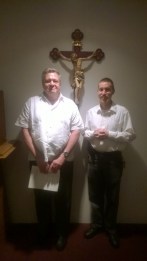
IVERSON HOLMBERG ASPIRANTSNext . . . meet the new aspirants.

Right:  Thomas Holmberg

Left:  Andrew Phillip Iverson

Tom has entered as an aspirant for the Extern Brothers.  He is a husband, a dad and a grandfather.  Welcome to our family, Tom.  Our prayers are always with you.

Andrew is an aspirant for our Regular Brothers.  He will live in community, make private profession of obedience, poverty, chastity and fidelity to the Gospel of Life.  We’re happy to have you among us, Andrew.

Observe the difference in the aspirants’ uniform.  The Extern Aspirant wears a white Habanera shirt with a TAU pin on his left lapel, while the Regular aspirant wears a white button-down shirt (short or long sleeve) with a TAU pin on his left lapel.

The aspirant phase is an optional step before a man requests to be admittedIVERSON INTERROGATIONd as a postulant.  The usual duration is no more than three months.  The aspirant and the formation team discern when it’s time to take the next step.
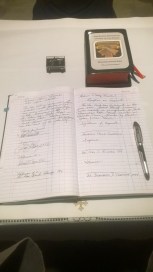
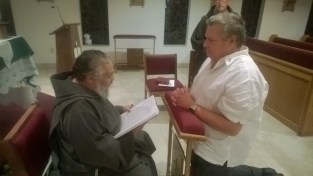
Each candidate is publicly interrogated by the superior.  He must swear that he understands what he’s doing and that he’s doing so freely.

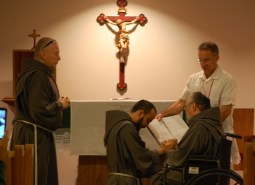
ASPIRANCY ALTAR

On the altar are the TAU pins, symbol of the Franciscan family, the breviary for the Regular aspirant and the register that each aspirant and the superior must sign, witnessed by at least one brother.

Tom kneelsHOLMBER SIGNING in front of the superior to sign the register of admission.
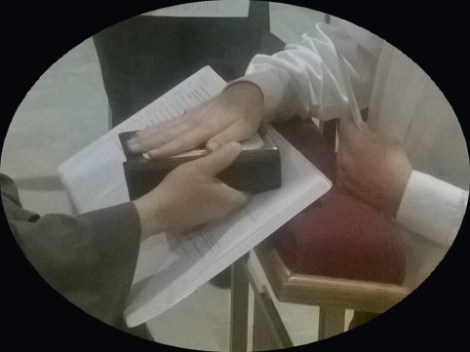
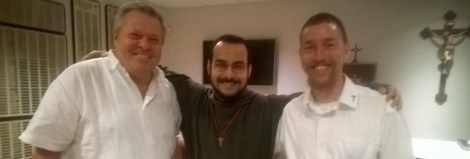
The  new aspirant is received in a private ceremony that takes place during Vespers.  Only Franciscans of Life attend this ceremony.  Profession of vows takes place with a few invited guests, such as relatives friends and clergy.

Because the Regular Brothers are bound to pray the entire Divine Office, the Regular aspirant is given a breviary.  During this phase he becomes familiar with the Divine Office and begins to pray Lauds and Vespers.  Eventually he will pray Matins Lauds, Sext, Vespers and Compline.RECEPTION OF BREVIARY 1

The Regular aspirant places his hands on the breviary before receiving it from the superior who says to him, “Believe what you pray and pray as you believe.”

BERNARDO AND ASPIRANTS.jpg

Brother Bernardo D’Carmine was the sponsor and witness for both aspirants.

We must give special thanks to the Latin Mass Community of Miami for Brother Bernardo and Aspirant Andrew Phillip.  The community cultivated both vocations.  This is an example of the “oneness” of our Church.

The Franciscans of Life do not bear the label, “Traditionalist” nor are we part of the Ecclesia Dei Community, those institutes committed to the Extraordinary Form of the mass and to the Divine Office as it was prayed in 1962.  Nonetheless, Franciscans of Life is traditional in a very different sense.

Our Constitution mandates that we recover and imitate the life of the first generation Franciscans.

If you aspire to go forward, you must first look back.


Published in: on August 25, 2016 at 10:06 AM  Leave a Comment  

Following Mary’s GPS


On August 14, we celebrate the feast of St. Maximilian Maria Kolbe, patron of the Franciscans of Life, and the 75th anniversary of his martyrdom.  The next day, August 15th, is the solemnity of the Assumption, also known as the Feast of the Dormition of Mary in the Eastern Churches.  For the moment, let’s put the Assumption on the side.  By the end of this article, we’ll see how it all fits together.  Let’s begin with Maximilian Kolbe.


  1. Todeszelle_Pater_Maximilian_Kolbes,_KZ_Auschwitz_I,_Block_11We must get past the end of the story in order to understand any saint and his or her journey into the mind of God. All too often we look at the finished product, who the person was at the time of death or in the later years of their life, completely missing a life journey that should inspire us to do better.  Such is the case with St. Maximilian Kolbe.  When you mention his name, everyone remembers him as the priest who traded places with a condemned man Auschwitz and whom the Nazis starved and killed by lethal injection.  This heroic act of faith and charity did not spring up on the spur of the moment.  There was a lifetime that led to Maximilian’s ultimate sacrifice where he unites his life and death to that of the Crucified Christ to give man a chance at new life.
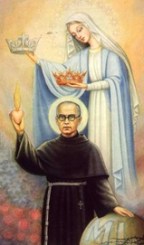
  1. MAX AND MARYAccording to his parents’ and brother’s memories, Maximilian was typical pre-adolescent who had the ability to get under people’s skin like most kids in that age group. His mother often cried out in despair, “What’s to become of you Raymond?  Note:  He was born Raymond Kolbe.  But there was something special about this apparent little magnet for trouble.  His parents had taught him to pray.  As a child, he knelt before Our Lady and asked her, “What is to become of me?”  Our Lady gave him a choice between a crown of martyrdom and a crown of purity.  Raymond chose both.

Here is a learning moment for those who are parents.  As important as it is to reign in your restless children and protect them from getting into trouble, as seemed to be Mrs Kolbe’s daily task with Raymond, it is imperative that we never forget that even those little mischievous creatures that we love and call children were given to us to form so that they can return to God.  The school that any child must attend is the school of prayer.

256px-Luxembourgers_in_England-_Evacuees_in_Surrey,_1942_D11110Raymond, despite the grief that he caused his mother, learned to go to prayer when he didn’t know where else to turn.  This is not something that comes built into a child.  This is the work of actual grace given by God to the parent, which the parent passes on to the child as he promised at the child’s baptism.  In other words, Raymond prayed because his parents had fulfilled the covenant they made when they baptized him, “to bring him up in the faith.”  A child who is brought up in the faith may be derailed, but can find his way back more easily than those who have not grown up in the Catholic faith.  We should pay special attention to those parents who raise saints.  Often, they serve as good models for parenting.

  1. At the age of 15, Raymond decided to join the Franciscans. He enters that branch of the Franciscans known as the Friars Minor Conventual or simply the Conventual Franciscans. Upon entering the novitiate, he is invested in the Franciscan habit and given the name Maximilian Maria.  From that point until his death he will be known as Friar or Brother Maximilian Maria. There is much to be learned here.

Jesus and boyFirst for youth – St. John Paul told the youth of the world, “Do not be afraid of Jesus Christ.” When Our Lady offered Raymond a choice between martyrdom and purity, he chose both.  We think of this story and we swoon over this wonderful little boy who was so pious and so holy.  We completely miss what God wants to teach us.  Those who struggle, as did Raymond, are also called to a life of virtue and sacrifice.  Prefabricated saints don’t need to practice heroic virtue or make heroic sacrifices.  Sinners do.
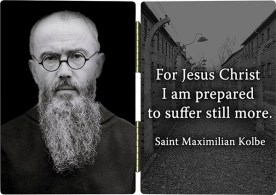
Raymond admitted that he was a sinner.  He also trusted Christ.  He was not afraid of Him.  If Christ used his Immaculate Mother to guide Raymond to Himself, Raymond was willing to take that step into the unknown and follow her lead.  He didn’t become a Franciscan Friar because this was what he wanted to do.  He may have wished to be a friar.  But he examined his attraction to the Franciscan life in light of the call that Christ made to him through the Immaculate.  Raymond entered the Franciscans because the Immaculate said to him, “Do whatever he tells you.”  She promised to be by his side along the journey.  There was no reason to fear Christ, no reason to fear embracing a life of uncertainty, sacrifice, long days and short nights, penances and many humiliations.  Maximilian teaches us that Christ calls us down paths that he has paved specially for each of us.  Christ never calls you where you cannot walk.

The question for the young person should be, “What is to become of me, Lord?”  This was Raymond Kolbe’s question and the Immaculate responded, “Do whatever he tells you.”  Life is not about what I want to do, but about God’s plan for me.

ST MAX AUSCHWITZ

Second for parents:  The Kolbe parents were committed to raising their children in the Catholic faith, as they had promised at their baptism.  They were also conscious that their children were not their special project, but they were a temporary gift from God that they would have to return when God asked.  However, they had no idea what God would ask of their children, when or how.  They st josephremained open to the God of surprises rather than planning out their children’s lives in advance and trying to steer them into careers and marriages without consulting God’s plan for them.  They educated their children in the faith, provided the academic education available to them and offered them guidance along the way.  But they never owned their children.  Their children belonged to God.  When Christ called Raymond to become Brother Maximilian, it may have not been what Mr and Mrs Kolbe expected or planned, but they trusted.  If this was truly the voice of God calling their son, he would be safe and they could offer him no better assurance of his happiness and salvation.  If it was simply an illusion of youth, God would open their son’s eyes to the folly of his choice in life.  Again, they trusted.
Madonna001The lesson to be learned is that even when we are unsure what God wants  from our children, if the choice is not a sinful one or a danger to to self or others, we can stand back and let the Immaculate guide.  She can only guide our children to her Son.  Her GPS is locked on Christ as the compass is locked on the North Pole.  There is nothing to fear and much to be gained.
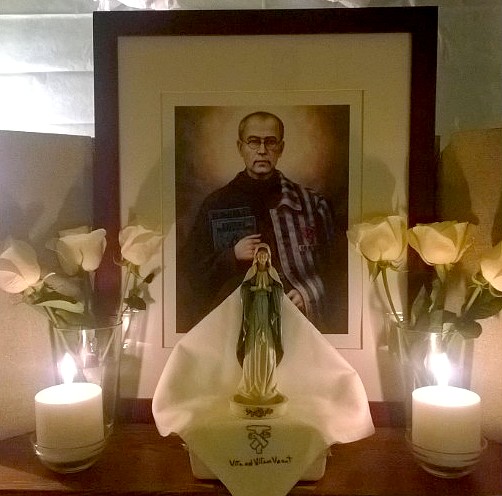
This year, during the feast of St. Maximilian Kolbe, let us focus less on the end product, the martyr and more on the boy, the man and his parents.  Let us learn to follow the guidance of the Immaculate and to trust her Son as they did.  When we commit to following the guidance of the Immaculate, which leads to her son, then the Assumption needs very little if any explanation.  She who leads others to her Son was also called to follow Him in body and soul and will lead all men to the same end.

Shrine to the Immaculate Conception and St. Maximilian Kolbe at the FFV Motherhouse.

Guess what?


Hello friends! Pax et bonum!

We would like to share some highlights from the past few months.

Of course, there has been more going on. 🙂 Lent and the Easter season were spiritually fruitful times full of joy and great moments of fraternity. We also posted two new videos on our Youtube channel (http://youtube.com/franciscansoflife) and several updates and interesting news on our Facebook group (http://www.facebook.com/groups/franciscansoflife). We even published our Wikipedia page (http://en.wikipedia.org/wiki/Franciscans_of_Life). Check them out when you get a chance!

These highlights are from our community life and apostolate – more of an “insider’s peek”. As you go over them, please keep us in your prayers. Also pray for the men who are discerning with us, and for all those whom the Most High will invite to join us when the time is right. Pray that the seed of their vocation may flourish for the proclamation of the Gospel of Life to the voiceless. In the territory in which we serve  there is much work to be done 🙂 Please prayerfully consider whether God may be inviting you to walk with us.


General Chapter

As per the Franciscan tradition, the brothers held a General Chapter on Pentecost (actually, the Monday after Pentecost).

The Mother House with the new artwork for Pentecost

chapter002

The Document of the General Chapter

The tradition of the Capitulum goes back to the 8th Century Benedictines.  The first”General Chapter” for an entire community was celebrated by the Cistercians in 1195.

The IV Lateran Council established in 1215 that all religious communities should celebrate Chapters at regular intervals as a means of promoting reform of religious life. At the time of St. Francis, a General Chapter was celebrated twice a year from 1209 to 1216, once a year from 1217 onward.

This is the highest authority over the community, and the decisions taken by the chapter are binding even on the Superior. At the end, a Document is redacted with the mandates of the Chapter and a summary of the discussions, along with an introduction by the Superior General.

Some of the brothers at the General Chapter


Weekend Retreat

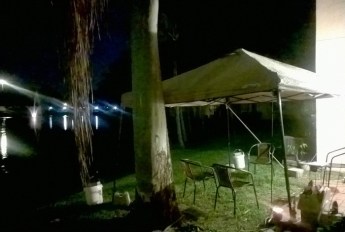
The community organized  a weekend retreat which also provided an opportunity for a limited number of inquirers to come and see. The theme of the retreat was Conversion of Manners. Brother Chris provided the canopy and the buckets, and installed it with Brother Leo. Brother Leo rescued it from the stormy winds that followed 🙂 After that, the weather was perfect. The participants gathered on Friday afternoon, shut down and put aside their cellphones, and all contact with the outside world became off-limits.

The outdoors location of the retreat

WP_20160201_003

Cells 2 and 3.

The retreat included the prayer of the Liturgy of the Hours, formation, fraternity, times of silence and private prayer, and overnight stay. Visitors were allowed to sleep in their own cella, the same the brothers use. We made sure we washed the sheets ahead of time 🙂 The Superior, as traditional, gave up his cella to a guest – our friend Alex – and slept on the couch.

Visitors also witnessed the Friday night Chapter of Faults, where the brothers accuse themselves before the Superior and their brothers of their faults against the Holy Rule and the Constitutions. Attendance to this ritual is ordinarily reserved to the brotherhood.

It was a joyful and edifying experience. Brother Jay, our Superior, delivered the formation talks. Brother Leo was in charge of the meals.

Br. Leo at work – Max and Tasha stand guard

Brother Bernardo ensured that the citronella candles were lit (he has a thing about our brothers mosquito) and helped take down the canopy at the end of the retreat.

Five minutes later, a storm hit again, with much lightning. Brother Jay remarked that the guys taking down the canopy reminded him of Ben Franklin trying to harness the power of lightning 😛

The Storm!

Solemn Promise

On June 20, Extern Brother Luis Charbel, having completed his formation, made his Solemn Promise to live according to the Holy Rule of Penance and our Constitutions for one year. The Extern brothers do not profess the Evangelical Counsels, but they bind themselves to observe their spirit in accordance with their state of life. They are truly members of the fraternity, and the Constitutions provide separate chapters to guide them. Brother Luis Charbel is an exemplary Extern Brother. His entire family attended the event, which took place at the Chapel of St. Maximilian Kolbe Catholic Church during the liturgy of Vespers – including his 28-week pre-born child 🙂

Br. Luis professes his Solemn Promise


Project Joseph

The brothers were very excited that Tom, a good friend of the community who had begun his training to be a Project Joseph mentor, completed his training and began serving the dads of the North Dade Center of Respect Life Ministry Archdiocese of Miami. The dads are very excited to be able to have a weekend session and this is also the first time that a Respect Life center offers two weekly Project Joseph sessions! Brother Bernardo was assigned as liaison between the mentors and the center director. He reports directly to our Superior, who oversees the entire Project from the administrative office. Keep your eyes on the Florida Catholic for more on Project Joseph  and the Franciscans of Life 😉

Announcement of the new session

Adopt-a-Brother

adopt_a_student_brotherWe want to express a heartfelt thank you to our friends and benefactors who have participated and still participate to our fundraising to cover the education of our brothers.

Graduate school in Spiritual Theology and Education is an expensive proposition for our emerging community,  but these are skills that we need to serve the voiceless in our ministry. We do not charge the Church or the people whom we serve. Following the Testament of St. Francis, the brothers work to provide for their needs and, only when necessary, they beg. Our monthly income keep our simple living quarters and car up and running and cover for food and medical expenses.

The Adopt-a-Brother program is still up and running. You can read more about it here. We post updates on our Facebook group and we will notify when we have reached our goal. We only ask for as much as we actually need. 🙂

motherhouse

The FFV Motherhouse

The statue of Our Lady at the Motherhouse. It is the same image from the Miraculous Medal which all the brothers wear.


The Surpassing Invisible Beauty of Truth


When we observe works of art, in particular sacred art, we are necessarily brought out of ourselves into a new perspective.

­­­­­­­­­­­­

Yet we often hear the claim that modern art is disconnected from beauty and, by extension, is unable to communicate the beauty of holiness. Pope Benedict XVI explained this as follows:

“We are experiencing not just a crisis of sacred art, but a crisis of art in general of unprecedented proportions. It is a symptom of the crisis of man’s very existence. The immense growth in man’s mastery of the material world has left him blind to the question of life’s meaning that transcend the material world.”

Atlas-Statue-Rockefeller-Plaza-Fifth-Avenue-HDR

Modern man defies the transcendent

Unfortunately, many have ran with similar statements too quickly and too far, arriving to claim that modern art is “ugly” and that modern sacred art is nothing but “secular (profane) artworks embedded in sacred spaces”.

Consequences of iconoclastic mindset

The iconoclastic mindset

Others, connecting many more dots than what prudence dictates, have claimed that modern art is ugly because modern souls belong to a global society falling into apostasy. At the extreme end of the spectrum we find the histrionic-schismatic mindset of those who claim that “the ugly images found in Novus Ordo churches are the final offense of the devil, an outrage that sums up all lesser offenses because it represents his goal of obliterating the image of the holy ones in the Church”.

Sadly, the proponents of these and similar statements are indeed upholding a tradition, but not the tradition of Catholic sacred art. They are, in a sense, the modern version of the ones who raised up their scandalized voices to the work of Michelangelo in the Sistine Chapel. Their claim? Michelangelo’s work was too modern.

Paul Barolsky, a  specialist in Italian Renaissance art, explains that contemporary critics of “the first modern artist” accused the Last Judgment of being disconnected from the norms of classical form and violating religious decorum.

Last_Judgment_Sistine_Chapel

However, “The images are not photographs…their whole point is to lead us beyond what can be apprehended at the merely material level to awaken new senses in us, and to teach us a new kind of seeing, which perceives the Invisible in the visible. The sacredness of the image consists precisely in the fact that it comes from an interior vision and thus leads us to such an interior vision. It must be a fruit of contemplation. Art is always a gift. Inspiration is not something one can choose for oneself. It has to be received. Before all things, it requires the gift of a new kind of seeing”.

Many modern art forms, even within sacred art, accomplish this wonderfully even though they may depart from more traditional artistic styles. They are not “modernist”, nor do they belong to that school that religious illustrator Matthew Alderman has called “the Other Modern”.

The Franciscans of Life are patronizing the work of a local artist whom we believe is a representative of the above, and we will feature his artwork for sale on a dedicated section of our website http://www.franciscansoflife.org The proceeds will go towards the education of our student brothers. This young artist specializes in concept illustration, book covers, and fictional fantasy. He has displayed remarkable talent in the production of sacred art using traditional and digital mediums.

Artwork in the community room at our mother house.

Artwork in the community room at our mother house.

St. John Paul II reminds us that modern artists are, just like artists of all ages, men passionately dedicated to the search for new “epiphanies” of beauty, admiring the work of their inspiration, sensing in it some echo of the mystery of creation. While acknowledging that in the modern era a new kind of humanism marked by the absence of and opposition to God has gradually asserted itself, the Church has not ceased to nurture great appreciation for the value of art, even beyond its typical religious expressions…for even when they explore the darkest depths of the soul or the most unsettling aspects of evil, artists give voice to the universal desire for redemption.

Julian_Pentecost

Pentecost

The pontiff reaffirms that just as the Church needs art to make perceptible and attractive the world of the invisible without emptying the message itself of its transcendent value and its aura of mystery, art also needs the Church for the great source of inspiration offered by the religious theme. This partnership has been a source of mutual spiritual enrichment and has led to a greater understanding of man, and to an opening of the human soul to the sense of the eternal.

Pope Francis, in his encyclical Laudato Si, reminds us that we must be able to look even beyond the traditional means of the craft:

Julian_Corpus_Christi

Corpus Christi

“Technoscience, when well directed, can also produce art and enable men…to leap into the world of beauty. Valuable works of art no make use of new technologies. So, in the beauty intended by the one who uses new technical instruments and in the contemplation of such beauty, a quantum leap occurs, resulting in a fulfillment which is uniquely human.”

It is therefore our hope that we will look at all expressions of modern art, and particularly at sacred art, with a renewed understanding of man’s quest for the beyond. There is much to be appreciated, as long as we are capable of casting aside prejudices and overly zealous attitudes.

Art indeed “goes beyond the search of the necessities of life…it expresses practical wisdom, uniting knowledge and skill, to give form to the truth of reality in a language accessible to sight, [and] sacred art is true and beautiful when it evokes and glorifies ….the surpassing invisible beauty of truth and love”.

These words come from a relatively recent book, the Catechism of the Catholic Church, but reflect a wisdom that is timeless. We find it echoed by the same Michelangelo, who affirmed that “every beauty which is seen here by persons resembles more than anything else that celestial source from which we all are come”.

Julian_St_Joseph_and_Christ

St Joseph and Christ in the Workshop


Video: A Year with the Franciscans of Life


Published in: on April 11, 2016 at 11:48 PM  Leave a Comment  

A question . . .


handoutClick to enlarge

What happens to a man who enters the Franciscans of Life?


To answer the first question, NOTHING.  We stopped torturing people a long time ago.  Having said that, you may find that you go through a transformation that you never thought was possible.  “I can never do that.”  Many people say.

The first thing one learns is to share.  For us, this means living in very small spaces.  You thought that an airplane bathroom was small?  Check out our sleeping arrangements.

WP_20160201_009These are our sleeping quarters, also called cells.  No brother owns anything, not even a room of his own.  A large room is divided by curtains, as you would see in a hospital.  Behind each curtain there are two beds for two brothers, bunks.  There is an aisle along the length of the bed that is 18 inches wide and another curtain, behind which there is another cell with two more beds the same size.  The brothers always remember Jesus’ words, “The Son of Man has no place to lay his head.”

WP_20160201_004Every brother is assigned a flat sheet and a single blanket.  We use only what we need, not what we like.  We don’t use comforters or fancy bedspreads.  The money that can be spent on those items can just as easily be put into our apostolate among the voiceless, even if it’s just paying for gas to get from point A to point B.  After a few days, one becomes so accustomed to this arrangement, that we no longer miss our old bedroom in our former home.  The community house becomes home and the cells become our bedrooms; but they are more than that.  It is here that we experience the intimacy and poverty of the fraternal life that St. Francis so loved.  Like Christ and his Apostles and like Francis and the early brothers who shared huts, the brothers practice charity and detachment.
The cells are in the enclosed part of the house where no outsiders may enter, male nor female, not even our moms.  While in the cells, we avoid unnecessary conversation so that in solitude and silence the soul may be more attentive to the voice of God speaking from within.  The cell and the enclosure are only external reminders of an internal attitude that every brother should have.  Each of us carries within him an interior cloister where only the soul and God interact.  This awareness is the summit of poverty, when you own nothing, not even your inner space . . . everything belongs to the Beloved.

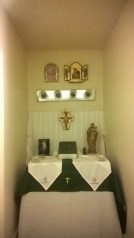
WP_20160130_004In the sleeping area there is always a small oratory.  An oratory is not a chapel.  The Blessed Sacrament is not reserved there.  Oratory comes from the Latin word oratio, meaning to speak and to pray.  Oremus,”Let us pray.  Let us speak with God.”   The brothers last conversation before retiring is with Jesus and His Immaculate Mother.  His first conversation of the day is also with the beloved Mother and Son.  During the day, the brother sneaks into the oratory, like a lover sneaking along the hedges to have a quiet words with his sweetheart.  Christ and the Immaculate are our sweethearts.

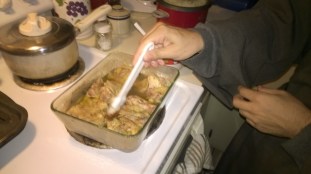
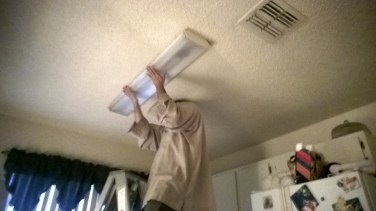
TUNIC_SMOCKWe don’t have closets, since we don’t have many clothes.  We share a row of hooks where we hang up our formal and work habits.  We also have a pair of grey pants and a grey banded shirt.  Here you see a typical work habit for a postulant.  Novices and professed brothers wear it with a cord or without a cord, depending on the task at hand.  The work habit it short.  It does not reach the knees.  It’s our version of grunge clothing.  Nothing is ever wasted.  Our Constitution reminds us that like  St. Francis, we follow the poor and suffering Christ who walked to Calvary in  shredded clothes, except for his sacred seamless tunic.  When a garment is too damaged to wear, it is cut up and used to patch up other work habits.  It is not unusual to see our brothers wearing patches on their work habits or displaying grease stains from an engine.  These stains are tough to wash out.  But we manage.WP_20141209_001 (1)  We don’t have cooks or housekeepers.  Those are chores that we do ourselves.  The brothers take turns cooking, scrubbing and cleaning.  Those brothers who have never done it before or don’t know how are taught by more experienced brothers.  WP_20151212_004St. Francis said that we are to be “minors”.   During the Italian Middle Ages there was a social class known as the Minores.  It seems that these men and women were of the lower class of serfs and peasants.  Even among the peasants, there was social stratification.  Christ reminds us that we have been sent to serve, not to be served.  “Go out and do what I have done for you.”


CARAVAN 1

It’s time to leave.  A brother may be going to class at the university, while another is going to the hospital or to hospice and another brother is on his way to do counseling or education with dads in crisis pregnancies or going to visit a newborn baby that was going to be aborted.  The brother is always there to say “Hi Little One”BABY M-2 (2)

Life calls out to life  We even have two pups.  The black and brown handsome fellow is Max, named after St. Maximilian Kolbe. max_and_tasha The little fawn cutie is Tasha, named after a character on Star Trek Generations.  Yes, we have former Trekkies among us.  The brothers may not watch television.  Start Trek is out of the question.  Besides, who has time.

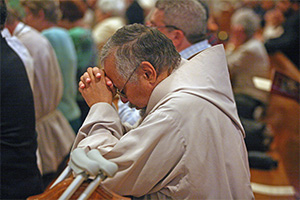
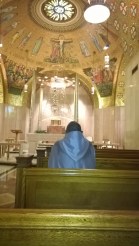
No day is complete without prayer and the
Holy Eucharist.Archbishop Thomas Wenski celebrates Mass for Nascent Life

WP_20140819_035
In between we manage to insert
an hour of private prayer at 5:30 AM, the Liturgy of the Hours: morning, midday, evening, night and midnight.  There is always time for the Holy Rosary.

profession of vows

I VOW AND PROMISE . . .

Dancing Friar

COME AND SEE

Brother Bernardo Makes Vows


After three months as an aspirant, three months as a postulant and 12 months as a novice, Brother Bernardo D’Carmine made temporary vows as a Franciscan of Life.

DSC_0049

The vows are obedience, poverty, chastity and a fourth vow to proclaim the Gospel of Life.  Brother made vows during a solemn celebration of evening prayer (vespers) on January 18, 2016 at St. Maximilian Kolbe Chapel in Pembroke Pines, Florida.

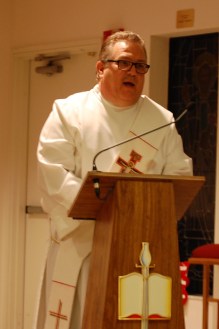
Presiding over the Liturgy of the Hours was Rev. Mr. Scott Joiner.  Deacon Scott also preached the “exhortation” reminding us all that one man’s conversion can change the Church and history, referring to the Seraphic Father, St. Francis of Assisi. DSC_0027

The first step is to embrace the poverty of Christ and his most blessed mother.  He also reminded the Franciscans of Life that we are an outgrowth of a long and venerable family that is more than 800 years old, with more than 100 different congregations, orders, societies and institutes.  Today, there are almost one million Franciscan men and women around the world, secular and religious, lay and cleric, men and women.  It all began with one man who responded to Christ’s call to “rebuild his house.”

Deacon Scott witnessed the profession, but he did not receive the vows.  Brother Jay Rivera, superior of the Franciscans of Life, received the vows.   Mrs. Tina Handal led the singing with the litany of Franciscan saints and blessed.  She did an outstanding job for the Lord and the community that was present.  She has an incredible spirituality and a voice that expresses it beautifully.    Extern brother, Chris Handal and regular brother, Leo Belanger were the witnesses to the profession.  Present were friends of DSC_0073Brother Bernardo’s from his days at university, other friends from the area and his mother, Mrs. Angela Torres.  The group was small.  The ceremony was simple, dignified, reverent and above all, prayerful.
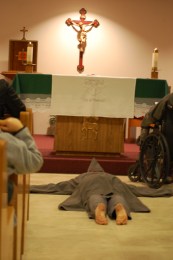
Brother Bernardo will continue graduate studies in computer science, computer engineering, theology and philosophy.  In addition, during the period of temporary vows, the brother continues his Franciscan formation with studies in Franciscan history, spirituality, rule and constitutions, Franciscan pastoral practices, and Sacred Scripture.  Along with classes at the university, several hours per week active in the apostolate, a life in community, the brother is also homeschooled in Franciscan studies and Scripture. The years as a “student-brother,” as we call those in temporary vows, are very busy and exciting years.  The most exciting part of all is the brother’s knowledge that his life now belongs to Christ and to the voiceless.

DSC_0039

Litany of Saints

Published in: on January 19, 2016 at 8:18 PM  Leave a Comment  

Let God do the driving


As everyone who follows us on our blog or on Facebook knows, we were in desperate need of a car.  Our car was totaled on December 26.  A few days after the accident, I remembered something that St. Francis said in his Testament.

Let those who know not [how to work] learn, not through desire to receive the price of labor but for the sake of example and to repel idleness. And when the price of labor is not given to us, let us have recourse to the table of the Lord, begging alms from door to door.

I know that we do not bring in enough money to purchase a car, not even a used one.  Other than a few hundred dollars from the insurance company, we had nothing.

However, God will never be outdone in generosity and in pity for us.  I remembered this passage from the Testament and decided to beg for help.

In less than 24 hours after posting our cry for help, we received three offers to help us.  The first was from an old friend who said, “I have a car that I want to give to you.”   Imagine our joy when we heard this good news.  But there is more . . .

An hour later, a dealer who supports our work for the Gospel of Life called me.  “Brother, I can help you.”

The next morning we received an email from another generous person.  “Pick the car you want.  I’ll pay for it.”

All of this is leading somewhere, so please stay with me.  The Franciscans of Life have just finished a three month process during which we reviewed our constitutions and did some editing for greater clarification.  The chapter on poverty required the greatest amount of attention.  For greater clarity we inserted an article into the chapter on poverty.

The brothers shall own only one car per house.  They may not own a new car, nor an old car that is commonly used by the wealthy.  They are to acquire used cars, either through their effort or the generosity of others.  Let these vehicles be such that they conform to what the working man or woman in the lower economic sectors would drive.  Let them not use said vehicles for recreation.  They are tools for service to the voiceless.

We now had an interesting situation.  We had a vendor who was willing to give us a very generous deal on a used car.  There was a benefactor who wanted to purchase a car of our choosing and there was the father of a family who was offering his car as a gift.

We, the brothers, discussed what to do and which offer to accept.  It was finally decided that the superior should decide.  I hate it when the brothers do that.  😦  Guess who has to decide?  😀

The question on the table was, “What would be the most natural for a poor man?”

This was easy.  People don’t usually call the poor and offer to purchase a vehicle of their choice for them.  That offer was now off the table; although we are very grateful.  The poor don’t get telephone calls from dealers offering them a bargain on a car, simply because they’re poor.  I wish this would happen more often.  Unfortunately, it does not happen often enough.  That offer was off the table as well.

This left one offer on the table.  The older family car that was offered to us free of charge.  I remembered that the first car I ever owned was a hand-me-down from my sister.  I was broke.  The only thing that I could afford was that old car.

The end of the story is that we have a car and it’s beautiful.  It’s a 2004 Dodge Grand Caravan with 156,000 miles and a few dents and scratches on the outside, but it’s perfect under the hood.

Here are the pictures.

There are several other dimensions to this story.

First:  The brother who was involved in the accident in one of our novices who is about to make vows this week.  The car was totaled; but Brother walked away without a scratch, not even a headache.  Not only was he not hurt, he was smiling when he arrived home.  His first words to me were, “I feel very peaceful.”  If this is not a sign of a man whom God has called to himself, I don’t know what is.

Second dimension:  During our review of the Constitutions, we asked The Immaculate to point us in the right direction.  “Are we doing the Will of God?  Is this way of life and this work what God wants from us?”  The Lord protected our novice from physical harm and blessed him with great peace and joy, despite the hardship.  Interior peace is the best sign that one is in compliance with God’s Will.

Finally, the third dimension to this story, without the car, our student brothers cannot travel to the university.  We cannot continue our work in hospice, pregnancy centers, university campus, religious education and among the immigrant poor.  We live in an area where public transportation is very poor.  It would take two hours to get to the university using public transit, when it takes 25 minutes by car.  A brother would spend four hours on the road to go to a class.  This is time that has to be stolen from prayer, community, and apostolate.

Not only did God’s providence come through for us through the generosity of others; but he confirmed us in our vocation.  God does not provide transportation to go where he does not want us to do so.

The last thing for today, we need to do some body work on the car.  We have $1,300.00.  We need about another $500.00.  If you can spare $1.00, it would help.  If you know someone who does body work in the Fort Lauderdale area and can hook us up with a good price, that would be very helpful.

While we’re on the subject of money.  We want to thank everyone who donates to Franciscans of Life.  Every month, we manage to reach the necessary dollar amount to pay our rent and utilities for that month.  Isn’t that awesome.  🙂