“Good night, son!”


“Pax et bonum”! I am very happy to wish you a blessed new year and to share with you the highlights of my first week of postulancy in residence at the Franciscans of Life motherhouse. I hope you like it!

It has been great to begin my residency during the Christmas season.

In retrospective, I can see I experienced both the great solemnity of the Nativity and the secular “holiday” of New Year as times of “glad tidings”, of a new beginning, as well as a reminder that Christ lives. “My mother and my brothers are those who hear the word of God and act on it”, says the Lord. And St. Paul, who was no “forgetful listener”, would say: “I live, no longer I, but Christ lives in me”.

In short: this first week was for me the time to welcome the birth of Christ in my heart and embrace Him in my brothers.

Nativity and Christmas tree

Arriving to the motherhouse was not a new experience, but this time it took a whole new aspect. I wasn’t just visiting. I was at home, now.

After settling in, I was invited to go to evening mass at the nearby parish of St Boniface. It felt great to begin this way. As Brother Jay always reminds us, “everything begins at the beginning”. I was very happy to attend this mass with my brothers and to pray Vespers with them afterwards, before the Blessed Sacrament.

This would be the first “in residence” taste of the fraternal liturgical life. Little did I know (I say this with great joy!) that this would become the “heart and soul”of my daily life of love!

The life in fraternity is “in common” in many ways. We strive to serve one another and to meet each other’s needs. We all seek to love and be loved, and in the life of the regular brothers we are always attentive to each other’s needs for spiritual support, safety, and affection.

The common life is also very practical. Our community embraces early Franciscan poverty in which the brothers did not just share common property. We simply have what is strictly necessary.  For this purpose, Father Superior worked right away on the motherhouse weekly schedule to meet the needs of a postulant student brother and assure that I can continue my formation while pursuing my first doctoral degree – all the while living the peaceful and joyful life of penance of the Franciscans of Life.
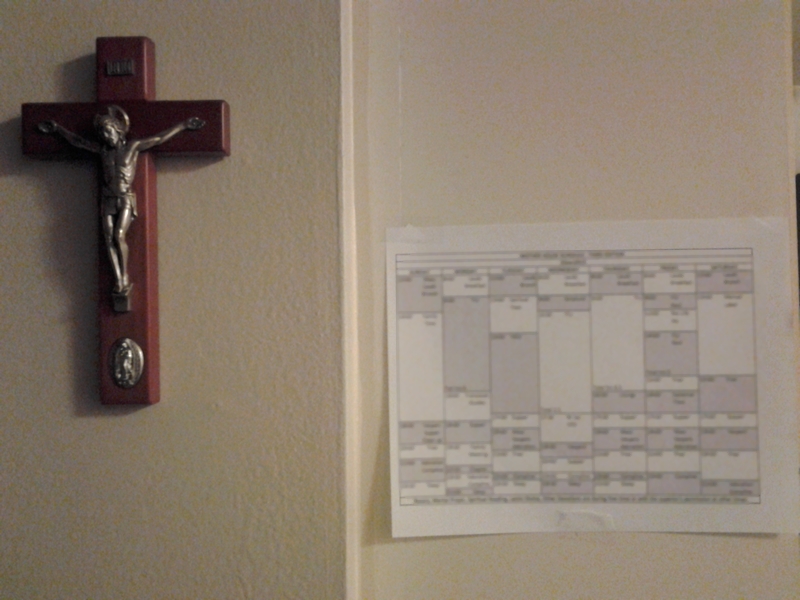
schedule

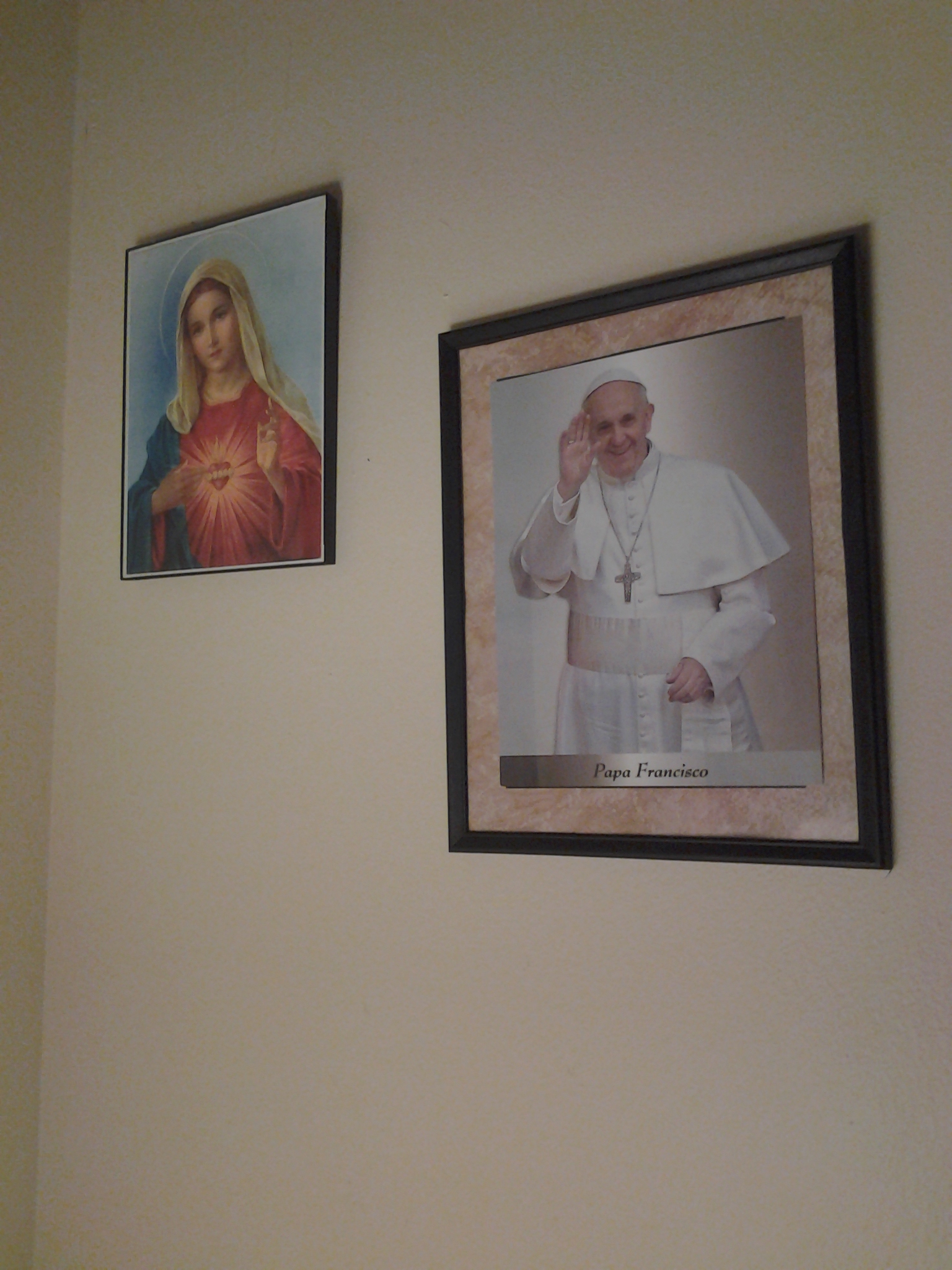
My days begin at the “cella” (pronounced like “shell”), where I sleep “at a pillow’s distance” from Father Superior. It is always a joyful experience, as we encounter one another in awakening and, shortly afterwards, our Lord in the prayer of Lauds.

Due to the diminute size of the “cella”, the brothers must take turns; one brother takes care of the beds while the other lights the candles at our little prayer table, before the icon of the Immaculate and the crucifix of San Damiano. It is here that we keep the prayer intentions entrusted to us.  On one day in which my turn came around for the latter and I was particularly sleepy, I recalled the words of an earlier liturgical reading: “Awake, sleeper!”. For a moment, I thought I could feel the Lord’s eyes on me…but when I turned around, I realized it was Father’s glance! “Are you done waking up, or do you need a hand?” 🙂
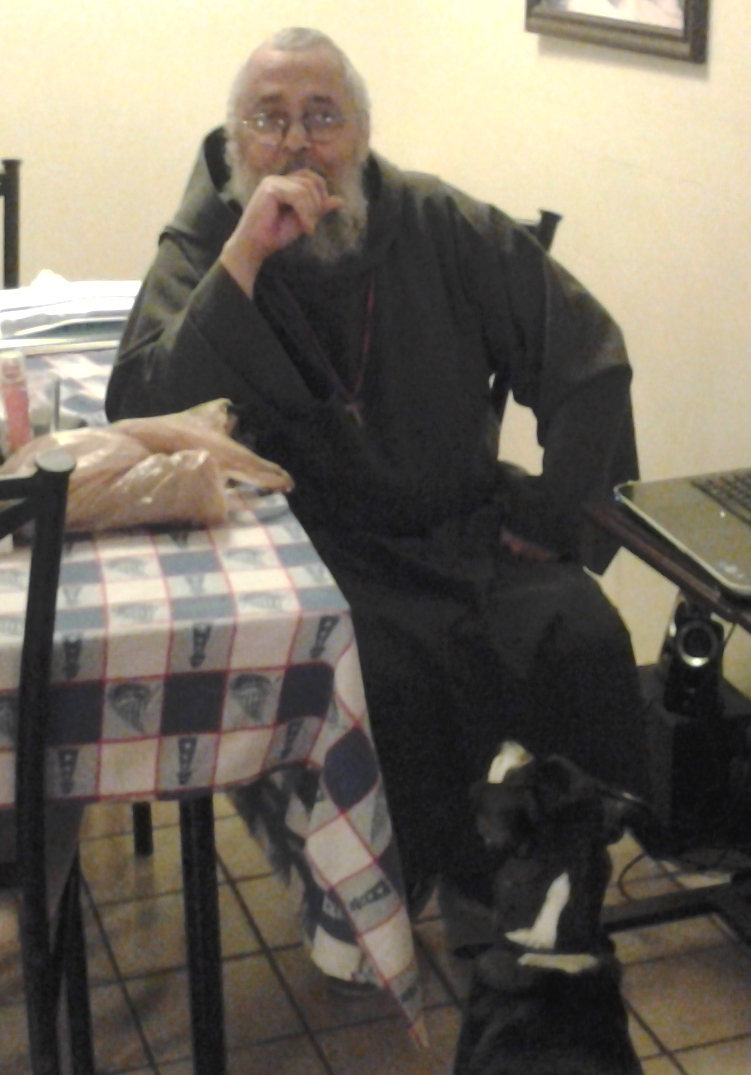
looking

Having warmed up the soul with prayer, we take care of the rest with breakfast (and, not uncommonly, some laughter!) On more than one occasion I “showcased my cooking skills” by preparing some awesome toasts with coffee (although I ought to admit that the greater merit goes to the new toaster oven that we recently received from a kind benefactor).

toasts

What happens in the mornings depends on the daily schedule.

Most weekdays we coordinate our schedules for academics and apostolate, and we often share the community car by planning our daily trip accordingly. Several days, however, the morning begins with a formation class in topics such as spiritual theology, sacred liturgy, and Franciscan studies.

Saturday is dedicated in a particular way to prayer and to taking care of the motherhouse. Once a month, we dedicate it to a full day of prayer and recollection. This week, however, was my opportunity to “brush up” my broom and mop skills 😉

mopping

Sunday is our family day. Usually, we begin the day by going to the nearby parish of St. Maximilian Kolbe to attend mass.

Once a month, however, we also travel to Miami, to the mission of Sts. Francis and Clare, where I serve as acolyte for the local Latin Mass Community. While we worship in community in the Ordinary Form of the Roman Rite, Father Superior and the brothers know that I have been an E.F. altar server for several years with great joy and to my spiritual benefit. They have kindly accommodated for me to be able to continue to do so without turning the extraordinary into the norm.

The weekday afternoon usually includes some free time for spiritual reading, private prayer, a walk around the lake, and (for me, in a special way) time for homework. This doesn’t mean I am “off the hook” for an afternoon formation class, however! 🙂

Saturday afternoon is often the occasion to buy the necessary groceries for the week and take care of the needs of our lovely companions Max and Tasha.

max_and_tasha

On Family Day, it is not uncommon to spend the afternoon at a nearby park, alternating times of prayerful contemplation to times of joy and fun.
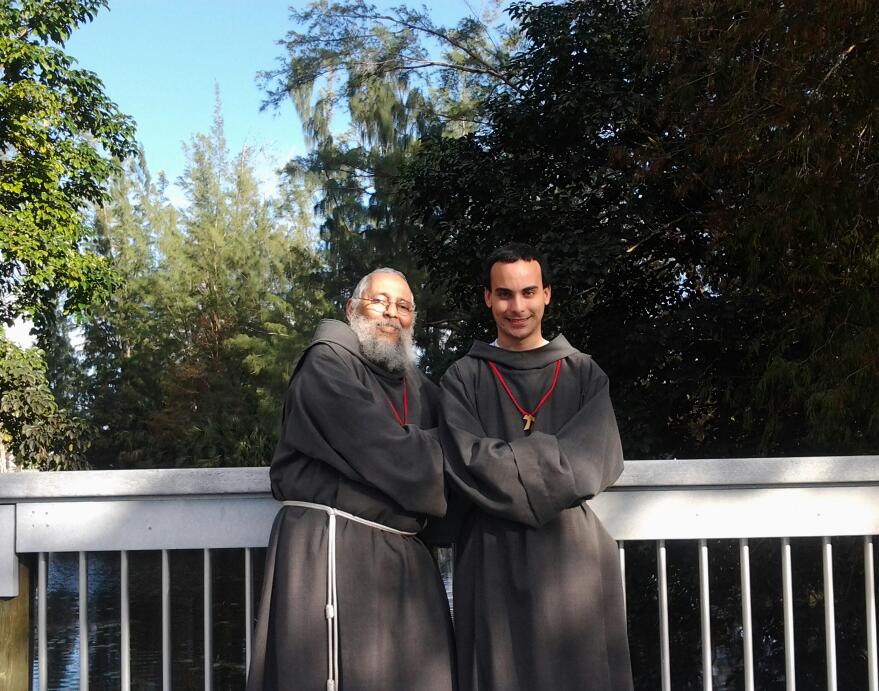
20150104_154249-1

The evening is usually marked by attending daily Mass followed by Vespers, in turn followed by supper.

Something beautiful happens on Monday evenings, as the regular and secular brothers gather for the weekly “chapter”. This is one of my favorite experiences of our fraternity life – to welcome all the brothers and be welcomed with a warm embrace, and then pray Vespers together, receive formation, plan our joint efforts in our common service to the voiceless, and also share weekly experiences.

It is written: “How good and how pleasant it is, when brothers dwell together as one!” This is exactly what I experience at our “family meetings”, as the secular brothers, who are husbands and fathers, enrich us with the experience of a Catholic family life, and at the same time allow us to share with them the fruits of peace and good that we find in the celibate life in community.
20150112_193911

At the end, Father Superior sends the secular brothers back to their families with a warm embrace. This is a very moving moment, but it is also a reminder that I must retreat to the “cella”, for this evening is the time for the regular brothers to have the Chapter of Faults. The regular brothers recollect, as Father Superior enters the cell and sits quietly. One by one, we “come into the light, that our deeds may be manifested”.
20150113_014327-1

When my turn comes, I kneel before Father Superior, entrusting myself to his justice and mercy, and opening myself to my brothers, as I accuse myself of my faults against the Holy Rule and our Constitutions. After receiving Father Superior’s firm but gentle correction, I prostrate before the Crucified Lord and, arms outstretched, I recite my Confiteor. As I hear Father’s words “Arise, in the name of the Lord”, and I sit down amidst my brothers, I have the unshakable certainty that despite my limitations, my Superior and my brothers still love me. As Brother Leo steps forward, I glance at the eyes of the Crucified. Those eyes, and the peace in my heart, are enough to make me wish to leap for joy. But I remain recollected, as I recall the words of our Holy Father St. Francis: “Let us begin, for up to now we have done nothing.”

The night finishes with a visit to His Majesty, who in the Blessed Sacrament awaits for us at the St. Francis chapel of a nearby parish.

Before walking into the chapel, Father Superior guides us through a review of our day. This is one of the most meaningful times of the day for me, as I can rejoice at the good experiences of the day and analyze missed opportunities to encounter and serve Christ, in order to see what got in the way and what can I do better.

After a time of adoration, we lift our cowls and we let the words of Compline echo silently before His face: “Lord, now you let your servant go in peace…”.
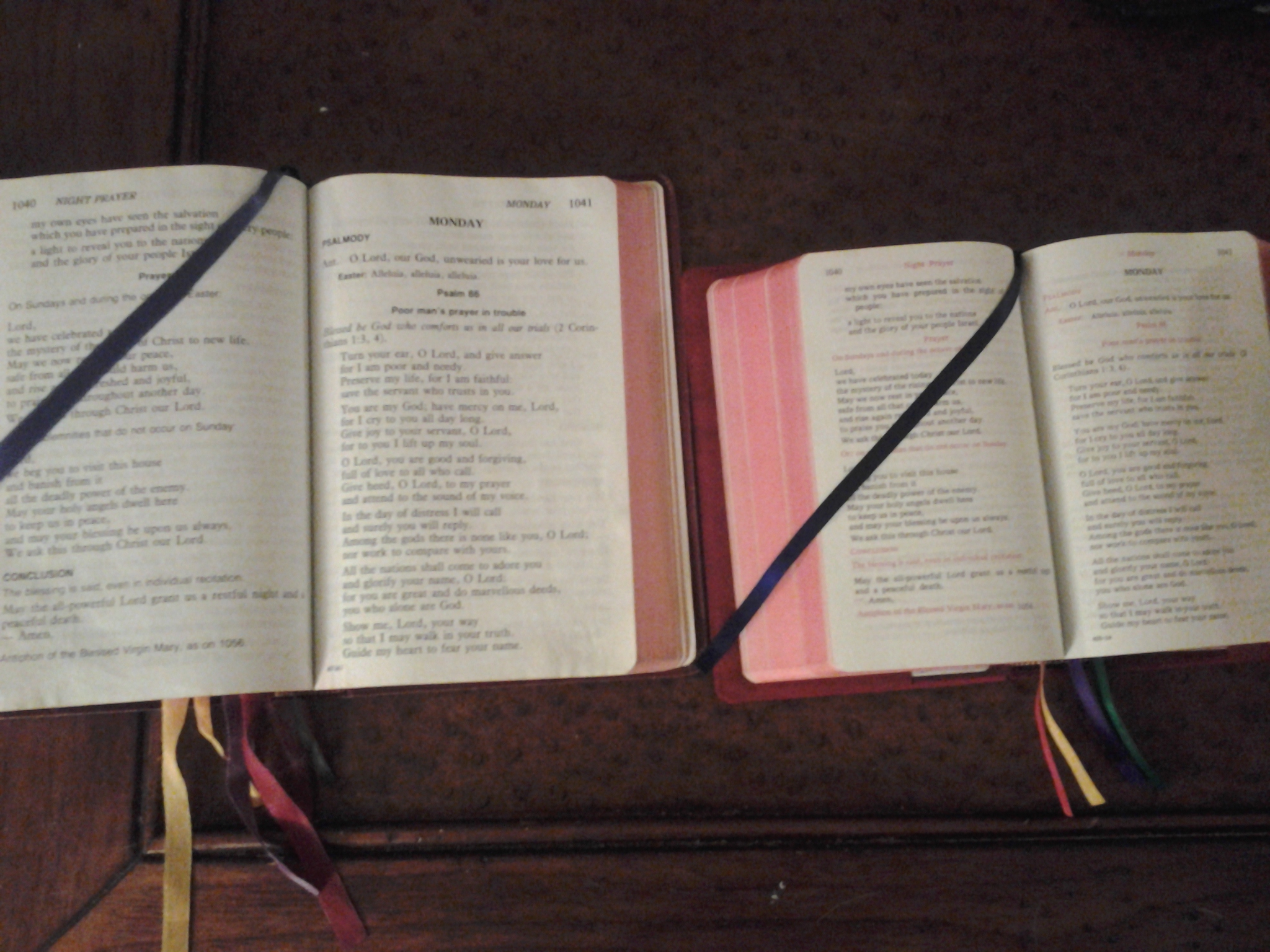
20150112_192325

We return to the motherhouse and retreat into our “cella”, our beloved cloister. Lights go off. I lay down in bed “and sleep comes at once”. It’s been a good day, I tell myself. The night is silent. I thank God for the present moment, for the love, and for the gift of a life of penance in service to the voiceless.

And just as I am about to fall asleep, a pillow hits me. “Good night, son!”

Br. Bernardo, FFV

[How to Help]

Parents and God: friends or foes?


This week, I’ve had the privilege of working with many parents and their children.  When you work in the field of evangelization, you get to meet many families.  I consider it pretty special.  I always walk away feeling that I have exchanged gifts.  It can be an individual member of a family or an entire family who gives me a gift and to whom I give a gift.

For the sake of privacy and because it would be silly to give so many details, I’m going to combine all of my families into three groups.

GROUP I:

I received a letter from someone whom I do not know.  I have never met this person or any member of her family.  It was a lovely letter.

Brother JR, I just wanted to thank you – you were so instrumental in our family’s conversion five years ago. I spent many long hours reading your articles, which were always gentle and full of the beauty of the faith. For that, for helping us know the beauty of the Catholic Church, I am forever grateful.

God bless you, and please know you’re in my prayers.

This letter moved me a great deal.  The Holy Spirit can use anything and anyone to save.  The key is to be aware of that one is an instrument, not the solution to a problem and certainly not God.  Messages like this help us.

My articles are not written with children in mind.  They’re written for adults.  This means that an adult in the family read the articles and shared it with spouse and children.  This is a parent who has found a means to evangelize the family, a means that works for that family.  This is the duty of parents, to bring their families to the faith.

GROUP II:

The other case is also a letter representative of how other parents think.  I have the honor of helping some men and women discern their vocation.  I like to think of it as walking alongside them.  At the end of the day, God does the calling and they respond.  I’m just there to make sure that the person is paying attention.

In vocation discernment, I not only walk with the inquirer, but I often walk with the parents, if they allow it.

During the walk, I have received many positive and holy reactions from parents, especially those parents who have given God a hearing.  I call it a hearing, because they have sought me out or invited me to their home so as to understand what it is that God is asking of them and their sons.  I’m not God and I’m not the son.  I’m the middleman.  I get the opportunity to have some wonderful conversations with parents about consecrated life, marriage, Holy Orders, and parenting.   I received a letter from a parent that really speaks for the several parents with whom I’ve spoken and edited it for privacy and brevity.

Dear Br. Jay,

God’s greatest gifts to a couple are their children.  It is with great joy and love for God that we support our son’s aspiration to become a religious brother or any other vocation he chooses.  Our son . . . and our family are blessed to have you in our lives.  May our God of love and peace keep you healthy to continue to serve Him.

With much love and admiration,

I had to share this message, because I’ve heard this from other parents.  They understand that their children are a gift.  They understand that giving their son or daughter license to respond to God’s plan for his or her life is an act of love for God and the child.  They understand that having a guide is a blessing that God gives to the family, to the son or daughter and to the guide.  We’re all blessed that God has called us to cooperate with Him in His plan for the salvation of this soul.  They have understood the most important part of all.  God has a plan for every human being who is conceived.

“Before I formed you in the womb I knew you, and before you were born I consecrated you; I appointed you a prophet to the nations.”  Jer 1:5

One’s vocation in life has already been written in God’s heart before one ever existed.  All one has to do is follow what God puts before you in the present moment.  He takes care of the rest.

GROUP III:

I also have had experience with a third group of families who struggle with the idea of a vocation to the priesthood and to the consecrated life.  The reasons for their struggles can be many.  I believe that the bottom line is that they are worried about their children’s happiness.  But here is where faith should enter the picture.

One’s happiness is not dependent on the parent.  A man’s happiness is dependent on the choices he makes.  If he chooses to cooperate with God’s plan for his life, he will be happy.  If he chooses some other plan (no matter how noble), he may as well sign his own death sentence.  There is no happiness outside of God’s plan for you.

In these families, parents want to take charge and direct the son or daughter in whatever direction they believes is best for the adult child.  There can be validity to this.  If my son or daughter were dating someone with a criminal background and were talking marriage, I have a duty to warn my child.  At the end of the day, it is my child who consents to the marriage or not.  It is not I who consent.  My duty before God and child is to guide.  Guidance is not the same as control, manipulation, placing temptations before our children to get them to change their minds (See Thomas Aquinas), nor is it the same as commanding, threatening or using guilt.

The Catechism of the Catholic Church tells us that children living at home have to submit to their parents, meaning to their rules, because it’s the parents’ home.  They do not have to submit to that which is not beneficial to their soul.

As they grow up, children should continue to respect their parents. They should anticipate their wishes, willingly seek their advice, and accept their just admonitions. Obedience toward parents ceases with the emancipation of the children; not so respect, which is always owed to them. This respect has its roots in the fear of God, one of the gifts of the Holy Spirit. (Catechism of the Catholic Church, 2217).

Our faith also tells us that

“Parents must regard their children as children of God and respect them as human persons. Showing themselves obedient to the will of the Father in heaven, they educate their children to fulfill God’s law,(Catechism of the Catholic Church, 2222)

And finally, our faith tells us,

“Parents should respect and encourage their children’s vocations. They should remember and teach that the first calling of the Christian is to follow Jesus (Catechism of the Catholic Church, 2253).

Occasionally, the adult child is up against a parent that seems to have forgotten this.  If I could send a message to parents it would be very simple.

Man was created to cooperate with God, not compete with Him.  To compete with God is to place oneself and one’s child on a slippery slope.  Don’t do it.  You may regret it.  You never know the long-term damage that you may do to your child’s soul.

Some important points to remember.

First, for the parent, competing with God is contrary to the vocation of parenting.  It raises the question, where is God in this picture?

Therefore, life must be treated with the greatest reverence.  Creating obstacles that interfere with the development of a person’s life according to God’s plan runs the risk of violating the sanctity of that person’s life.

I encourage all parents on this slope to step back.  We don’t have to agree with our children’s choices of a vocation.  Our daughter can bring home the last man on earth whom we would pick for her husband; but if there is no moral impediment and he makes her happy, I have to trust that God loves me and loves my child.

Second, for the child, one may never yield to the will of another, when that will is in conflict with God’s plan.  

This includes other people as well, not just parents.  It’s not a license to rebel against parents and follow others down the wrong path.

God makes His plans pretty clear through people, prayer, scripture, sacraments, and events in our lives.  Love of parents is binding until death; but love of God is the first and greatest commandment and it does not end at death.  We are called to love God for eternity.

We too must trust that even if our vocational choice causes our parents some grief, God loves our parents more than we do.  He will give them what they need.  We can never give our parents what God can give them.  We need to move on and give to God what He asks and take what He gives.  Sometimes, the grief is part of God’s plan.  There is such a thing as redemptive suffering.

Father Mitch Pacwa tells the story of how his father swore that he would never speak to him again and would disown him if he joined the Jesuits.  Mother Angelica told the story of how she had to run away from home to join the Poor Clares, because her mother would not hear of it.  I know that Mother Angelica’s mother eventually softened and actually entered the community.  I don’t know if Mr. Pacwa ever made peace with his son.  These two people are examples of a man and a woman who would not stand on the slippery slope with their parents, no matter how much they loved them.  Regardless of how much or how little they understood God’s plan for their lives, they knew that they had to follow the lead that God was giving them.  God would unwrap the rest with time.

If you keep another person company on a slippery slope, because it will make them happy, you may want to ask yourself the question that Christ asked St. Francis.  “Is it better to serve the Master or the servant?”

We must love and assist our parents in every way we can.  But we must always serve the Master first.  When we do, He will give us the means to honor our father and mother.  Was Mary abandoned by Christ?  Yet Christ said,

“Here are my mother and my brothers!  For whoever does the will of my Father in heaven is my brother and sister and mother.” (Matt 12:49-50)

God is both merciful and just.  He will have mercy on those who live according to His plan.  Beware of God’s justice.  It is not God who punishes.  God’s justice is an act of love.  He allows us to live and die with the consequences of our choices.

Jesus said, “Amen, I say to you, there is no one who has given up house or brothers or sisters or mother or father or children or lands for my sake and for the sake of the gospel 30 who will not receive a hundred times more now in this present age: houses and brothers and sisters and mothers and children and lands, with persecutions, and eternal life in the age to come. (Mark 10:29-30)

God created families, parents and children.  When he did so, he had a plan for each member of the family.  None of us can presume to love our parents, spouses, or children more than God loves them.  All of us must see our families as a gift that is part a plan in the mind of God.  We have to allow God to unfold that plan little by little.  As He unfolds it, He also gives us the resources to love each family member even more than we do  now.  In the meantime, we follow the lead that he places before us.  If parents and children make an honest mistake, God will help us find our way.

St. John XXIII said, “Follow the signs of the times.”


I’m over here . . .


Archbishop Thomas Wenski celebrates Mass for Nascent LifeThere are many things about my life, apostolate and role in my community that I love.  But I believe the one thing that I love the most is the many interesting questions that people ask me, not to mention the fact that the people are equally interesting.

In discussing life’s choices with people, I often hear the word “hurt”.  Many conscientious people are fearful of hurting others by their choices, especially their parents and siblings.  This is laudable.  We must always avoid intentionally doing something that will harm another person, be it a parent or a stranger. However, we must be very careful here.

There are two key words there, “intentional” and “harm”.  When harm is intentional, a person knows that this particular evil choice will do harm to another person and he goes forward with it.  This does not mean that good choices never cause pain.  They often do.  But the choice remains good.  One has a moral duty to choose the good and avoid evil.  When there are two goods to be chosen, one has a moral duty to choose the higher good, if there is freedom to do so.

Let’s apply this to vocation.  A vocation is a call from God to man.  God calls man to one of several states in life:  marriage, holy orders, or some form of consecrated life.  These are all good, because they are all from God and lead back to God.  However, they don’t lead  everyone back to God.  If someone forces himself into a marriage to please another person, it is very difficult to find a path to God in a marriage where one is responding to the wishes of another and not to a call from God.

The same holds true the other way around.  One may walk away from a call from God to please another person, because we don’t want to cause pain.  Let’s assume that all things point to the consecrated life or to Holy Orders.  One’s heart is already there.  Along come a parent or sibling, and one holds back from responding to God’s call so as not to cause this other person pain.  What has one done?

In effect, one has inverted the order of love.  The Commandment is very clear.  “Love God above all things and your neighbor as yourself.”  In choosing to avoid the higher good so as not to hurt the other person, we have placed that person above God and brought God down to our level.  We have no problems sacrificing neither ourselves, nor God in this case.  We just don’t want to sacrifice the other.  We have assigned the highest place to the neighbor and the second place to God alongside ourselves. 

No human being has the right to claim God’s place in our hearts and in our choices.  Nor do we have the right to assign God’s place to another, no matter how much we love that person.  There are some things that God wants us to do for others and some things that He reserves for Himself as the Lord and Giver of life.

Let’s remember, when discerning God’s will for our lives, the answer is always in the order of love.  The first place belongs to God.  We respond by doing that which pleases God first and neighbor second. It always pleases God that we make every attempt to serve and please our  neighbor, but never at His expense.  To do so would be a sin against justice.  God does have rights.  Therefore, he has first claim on our lives, whether we’re speaking about parents and children, husbands and wives, or brothers and sisters.  None of these have rights that trump God’s right to our love and surrender.  If anyone of them claim what is rightfully God’s, it is rightful to resist.

We may never do anyone intentional harm.  Intentional harm is an avoidable act that will hurt the other person .  Following God’s will is never to be avoided.  How do we know when we’re following God’s will?

First, there is knowledge.  We know that something is good and pleasing to God.  Our faith enlightens our knowledge.

Second, there is peace.  Even though we know that some tears will be shed, we know that we can place the situation in God’s hands and that in His eternal time, He will comfort those who mourn and reward the generous.

Third, we know that those who truly love us will not grieve forever.  As they realize that we are happy and that we are where we belong, they will be happy.

You cannot love another person and not be happy when he’s happy.  That’s not love.  It’s selfishness.  To cave into selfishness is to cave to sin.  Be it our selfishness or the selfishness of another, selfishness has no place in true love.  True love gives even if it hurts.  Look at St. Francis, St. Clare, St. Thomas Aquinas, St. Gianna Molla, St. Elizabeth Ann Seton, Our Lady . . . were they wrong to love God more than they loved their family and friends?

This praiseworthy fidelity, while not seeking any other approval than that of the Lord, “also becomes a living memorial of Jesus’ way of living and acting as the Incarnate Word in relation to the Father and in relation to the brethren” (St. John Paul II).


Listen attentively, not aggressively


bride & groomThe subject of the family is central to any discussion of the Gospel and society.  God has always chosen to reveal Himself through the family.  He created Adam and Eve as parents to the human family.  He called Abram and Sarai to become mother and father of many nations.  He brought Moses out of his biological family, grafting him to a royal Egyptian family so as to bring His Israelite family out of slavery.  He raised the royal family of David from which he would take human nature in the Holy Family at Bethlehem.  His told Mary “Do not be afraid. Go and tell my brothers to go to Galilee,” (Mt. 28:10).  Throughout salvation history, God has spoken to the world through family life and from within the family.

The Franciscans of Life, though we are a very small and young family, are not less or more Catholic than our other Catholic brothers and sisters.  Christ calls us to live the Gospel in the manner that St. Francis of Assisi lived it.  Building on the experiencelogo of St. Francis, we believe that Christ also calls us to remind the world that the Gospel is a gospel of life.

To proclaim the Gospel of Life, one must proclaim the Gospel of the Family.  It is in the family where Life calls out to life (Vita ad vitam vocat).  If we follow the Gospel, we must accept that human life begins within the context of family.  Every human being has a dignity that protects his right to be conceived, nurtured and born into a family.  He has a right to protection, formation, and to receive care from a family.  At the end of life, he has the right to die naturally in the arms of his family.

From within the natural family, God calls men and women to form new and younger families, as well as families of brothers and sisters who consecrate their lives to live francis and clareaccording to the Gospel.  Such a consecration can take different expressions, from monastic, religious order, society of apostolic life, secular institute, diocesan hermits to consecrated virgins.  To the degree that these associations reproduce the relationship between Christ and his apostles, whom he calls “my brothers”, these are real families. They foreshadow family life in the Kingdom of God beginning with the Trinitarian family.

These thoughts help us who are trying to follow the extraordinary synod on the family with great interest.  Our Catholic identity comes from feeling with the Church.  We’re not talking about feeling emotional.  We’re talking about loving God and man with the Church.  To do so, we must know what the Church is thinking.

Here is where we must draw an important line.  We, brothers, remind ourselves that a synod is a listening session for the Holy Father and from that session will come ideas that the Holy Father will consider for the ordinary synod in October 2015.  The Holy Father will exercise his authority once he has all of the information on hand.

Because the synod has no authority, it all rests with the pope.  The brothers are not alarmed by some of the statements that the media alleges that some bishops have made, nor are we alarmed by those that we know some bishops have made.  The Church cannot change revealed truth.

As stated above, to proclaim the Gospel of Life one must proclaim the Gospel of the Family.  However, it is not we who decide what the Gospel says or does not say.  It’s the teaching 1240044_302298416577020_831596592_nmagisterium of the pope that teaches us what the Gospel says.  It’s important to listen carefully to what the bishops are telling the pope about family; because when all of this discussion is over and done with, the pope will probably issue a post synod exhortation that will carry the weight of the Church’s teaching authority.  Listening carefully requires that we withhold reacting to what is being said until the pope speaks.

We don’t have to agree with every idea that the bishops put on the table.  The pope invited them to be honest and candid.  When you have that kind of openness, you’re going to have to put up with a degree of chaos and nonsense as well.  We cannot have open dialogue without crisis.  There is no such thing.  An open dialogue invites all parties to re-examine what we believe and give respectful thought to what we have never thought about before.  This includes those of us who are not in Vatican City right now.  Not only should synod participants be listening attentively, every Catholic must listen attentively and resist the temptation to judge, condemn, and bash anyone who says something that sounds wrong to us.

There are always some challenges.  These are what lead to crisis or struggle.  The speaker may be wrong.  The person may be quoted incorrectly.  The statement may be sloppy so that it does not accurately reflect what the person is really thinking.  The idea may need to be expressed using tighter language so that it avoids ambiguity.

The Franciscans of Life are listening, assessing what makes sense and what sounds outrageous.  Regarding that which sounds outrageous, we are not pointing fingers at any bishop or cardinal.  We are not labeling anyone a Modernist, conservative, liberal or traditionalist.  We are not sounding the alarm of apostasy among the bishops.  On the contrary, if it sounds outrageous to our ears, we try to understand why it sounds outrageous to us.  The statement may truly be outrageous or we may be hearing it incorrectly.

In the meantime, the Franciscans of Life continue to pray for the pope, the synod fathers, the family and the world.  We continue to hold on to what the Church has traditionally taught us NEWMANabout the family; but we are open to the fact that there are always new experiences that help us better understand what God is saying to us about Himself and our salvation.  These experiences should not be ignored.  Very often, new experiences contribute to our understanding of doctrine.  They don’t change the doctrine, but they can enhance our comprehension.

We invite other Catholics to listen attentively.  Be faithful to what the Church has always taught and be honest and humble enough to admit when we realize that we can still be taught more.  No one ever reaches a ceiling of understanding of God and his divine plan for the human family.  Let us avoid characterizations, name calling, judging people, and self-righteousness.  Let us embrace the truth that the Church has taught using whatever experience can help us better understand the truth.

At the end of the day, we’re looking for the truth that God has revealed to us about the family.  We want to understand whatever there is out there to be understood, not just pieces here and there.  If we ignore those whom we consider to be on theJesus and boy opposite side of the house, how would we know that we truly understand what God is revealing to us?  To understand we must listen, ask questions, separate the reasonable from the unreasonable, truth from falsehood, and Gospel from fashion.  Only then will we be on the right path toward achieving our ultimate goal, to know God, serve God and love Him with all of our heart, mind, body and soul, here and in eternity.

Let us listen attentively, not aggressively.


DON’T MESS WITH MY FAMILY


This afternoon I received an important challenge from one of our brothers.  October is an important month, because it’s Respect Life Month.  There are also other important events happening this month.

Today, the Extraordinary Synod on the Family began in the Eternal City of Rome.  On October 19th, Venerable Paul VI will be become Blessed Paul VI.  I don’t think that any of this is a coincidence.

Some people have narrowed down and boxed in pro-life ministry to fight against abortion.  There is probably no greater fight than the fight for human life, but we must not limit ourselves to life in the womb.  We must extend our concern to all people from conception to natural death.  We must protect life at all stages of development and in all conditions: Mc Carthy walk 4healthy, sick, poor, rich, male, female, old and young, with special attention to the voiceless.

But where does life flourish?  Where should life find its first home if not in the family?  Today’s family is under attack, maybe no more than families in the past, but certainly by different kinds of demons.  The enemy is resourceful, if nothing else.  He can find different ways of tearing apart the fabric of the family by war, poverty, disease, bigotry, politics, infidelity, heterodoxy, apostasy, atheism and secularism.  The key is not how creative the enemy can get.  The key is how smart we are.

Human life, outside of the context of family life, is very difficult to defend, much more difficult to protect.  To defend means to defend the dignity of human life.  Man has a dignity that is inherent to his roots, which are found in the hand of the Creator.  This dignity must be defended from those who would reduce man to an unexplained accident in the cosmos, making him expendable because he has no justification for his existence; therefore, no inherent value.

Any footbDON'T MESS WITH MEall player will tell you that the best defense is a good offense.  Translated into Gospel terms, human life must be protected from the culture of indifference which is a culture of death.  The best way to protect man and preserve him for the Kingdom is to push back against the economy of sin.  Sin can no longer be allowed to be the currency that rules our lives as individuals, families or nations.  When sin governs our lives, man despairs and the message of Christ is smothered by the cries of angst . . . . Man looking for gods, rather than GoPope Paul VId.
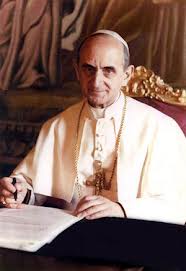
Pope Paul VI foresaw this coming and tried to warn us in his now famous encyclical Humanae Vitae, on the transmission of human life between husbands and wives in the intimacy of marriage and the shelter of the family.  It is probably the Holy Spirit who has inspired Pope Francis to beatify Pope Paul VI at the end of the Extraordinary Synod on the Family.  Immediately following, on October 22nd is the first feast day of St. John Paul II, the author of Gospel of Life.

We besignslieve that this is a good month to do something together that is open to other members of the Catholic and pro-life community.  The Franciscans of Life encourage everyone who reads our blog to organize an activity for this special month on life and the family.  It can be something as simple as an evening rosary between several families, a night of praise and worship, a penitential service in atonement for those who destroy instead of build the human family.  You may want to organize a meal with several couples to celebrate traditional marriage and family.  The demon that afflicts human life and weakens the fabric of the family will only be evicted from our lives with prayer and fasting.  A family or community day of fasting and abstinence is alwaysSt. Max good option.

Please post your ideas in the comments below so that others who read this can take some ideas back to their families and their parishes.  Remember the words of Sacred Scripture.  “Do not be afraid.”  Through the prayers of the Immaculate Christ is slowly, but surely conquering the kingdom of darkness.  He will not leave us orphans.

http://www.catholicnewsagency.com/news/us-bishops-invite-faithful-to-pray-for-family-synod-35304/ (more…)

Monastic Dad Without Mystic Coffee


This is my last full day of vacation at the home of my daughter and son-in-law. In one sense, I’m sad to be leaving, because I won’t be seeing IMG_3369them again until December. On the other hand, it will be nice to get home, back into my routine and not live out of a suitcase. I don’t see how these folks who travel a lot do it. Living out of a suitcase is not fun.

I’ve made some interesting discoveries during this vacation, discoveries that one does not make in the seminary or on retreat. There are some rules that one must follow if one is a Dad, father-in-law, sibling, theologian and religious superior.

  • If you debate with your family, you will lose every time. Your family does not use the methods of Augustine, Aquinas and Bonaventure and you haven’t used your family’s methods since you left the world; you’re a little rusty.
  • Humor can often be a mystery. You often find yourself wondering what they’re laughing about or you’ll laugh and they won’t understand. Sometimes you get the joke 20 minutes later.
  • If you have a relative who likes to play the Devil’s Advocate, just tell him or her that you accept that you’re as dumb as sheep and move on to pizza. Those of us who are monastic don’t know how to respond to the Devil’s Advocate, because St. John Paul II banned this kind of argumentation in 1983. It’s been a long time since some of us have had to deal with the Devil’s Advocate.
  • Obedience and authority have nothing to do with relationships. Monastic relationships are defined by a hierarchy. You never question a superior or a brother who is older than you are unless he commands you to violate the moral law. Relationships out here are built on respect, love, trust, friendship, cooperation, complementarity and common goals, just as in religious life. However, they are horizontal, not vertical as in a monastic community.
  • Forget structures and schedules. We are very used to following a horarium and doing things a certain way, speaking a certain way, saying some things and never saying other things, or simply doing things in a certain order. In this world, you have to be very flexible. Schedules are governed by work, domestic chores, social commitments and custom. In our world, schedules are governed by the superior, period. He makes up the schedule and the entire community follows along. It’s very easy.
  • As far as what you can or cannot say, the rule and constitutions take care of that. Out here, the rules are not written down. You have to observe. You may often have what I call “The Stupid Look” on your face, because you don’t have a road map for the day or for the conversation. You’re trying to figure out what’s what.

I believe that secular clergy have an advantage over religious men, especially monastic religious. The life of the secular clergy is closer to that of the typical family.  The secular clergyman has never renounced the world. He simply has a different place in the Church. He is a deacon, priest or bishop. But he is not required to distance himself from the secular world.

The life of the monastic is very different. Our first time with our family we may feel like one who is learning to ski. His feet are in two worlds at the same time and he has to keep them from colliding or he will fall.  He’ll feel that he is neither a good monastic nor a good family member.

As a monastic spending time with family, one goes through three stages.

1) You’re excited to see your family; nothing bothers you.

2) You realize that you’re in a different world and you feel anxious.

3) You throw your anxiety into God’s hands and you relax.

Many people think monastic is a place where there is an eight foot wall and you never leave. The truth is that monastic is a way of living and thinking. It can take place in a monastery or on the road. Each order is different. To be monastic is to build your life around prayer, silence, solitude, brotherhood, study, penance and out of that grows service. When you’re a dad and a monastic, your life is very different from that of your adult children, their spouses, and friends.  You have to detach from your old self to become the person Christ means for you to be today.

This Happens to People Who Take Things for Granted


Ever notice how we take things for granted? I’ve been unable to walk with my dog for a very long time, because I can’t breathe. I finally got my supplier to give me a portable oxygen bottle, the kind that you carry in a bag over your shoulder. I assure you that it’s lighter than may daughter’s handbag. 😀

I went out with Max, our doggie. I walked the length of two cars. He was so good too. When I became fatigued I said, “Easy.” I have never taught him “Easy”. It just came out, almost as if I was talking to myself. Nonetheless, I noticed that as soon as I said it, he looked at

St. Maximilian (aka.  Max)

St. Maximilian (aka. Max)

me and sat down. He waited patiently for me to recover so we could walk back the length of the two cars and return to the house. My son took over from there for his real walk. I think that I was not the only one who missed being outside together. I used to take things for granted, such as the patience that my dog had toward me. It thought it was I being patient with him and I took for granted the air I breathed. Not any longer. 🙂

Published in: on June 28, 2014 at 12:26 AM  Leave a Comment  

La Aventura Conjunta de Franciscanos de Vida y Respeto a la Vida de la Arquidiócesis de Miami en el Apostolado de Vida.


En nuestra primera empresa conjunta, los Franciscanos de Vida y la Oficina de Respeto a la Vida de la Arquidiócesis de Miami presentó una mañana de formación para hombres que sirven en el Proyecto José, un apostolado de alcance y formación dirigido a padres que enfrentan embarazos en crisis. El Proyecto José se dirige directamente a los padres, mas incluye a las madres y a la familia a través de sesiones individuales y familiares.

Aunque no todo Franciscano de Vida es asignado al Proyecto José, a todo hermano (seglar y consagrado) se le requiere conocer todos los aspecto del trabajo pro-vida llevado a cabo por la Sociedad.

El hermano Jay, Superior de los Franciscanos de Vida y Director del Proyecto José, Arquidiócesis de Miami, dio comienzo a la mañana con una reflexión sobre la escuela franciscana de espiritualidad cristiana. Subrayó los elementos clave de nuestra espiritualidad, que la rinden el modelo más apropiado para llevar el Evangelio de la Vida a nuestros padres en nuestras circunstancias particulares: minoría, hermandad, expiación, la Cruz, Encarnación, la Trinidad, y empatía.

El hermano Chris siguió con una meditación sobre la vida y herencia de San Maximiliano Kolbe, subrayando la contribución que San Max ofreció en toda s vida al Evangelio de la Vida a través de la Inmaculada, lo que llevaría eventualmente a su martirio voluntario para salvar a un padre y mantener a una familia unida.

El padre Alfred Cioffi, profesor de biología y bioética en la Universidad St. Thomas, miembro de la Junta de Asesores de Respeto a la Vida de la Arquidiócesis de Miami, y gran amigo de los Franciscanos de Vida, ofreció una presentación sobre asuntos de final de la vida, presentación hermosa sobre los principios que todo Católico debe de tener a la mano para poder tomar decisiones morales apropiadas al lidiar con enfermedades terminales propias o de familiares.

En conclusión, la Sra. Joan Marie Crown, Directora Ejecutiva de Respeto a la Vida de la Arquidiócesis de Miami, le habló al grupo sobre los planes futuros del ministerio. Estos incluyen la inauguración de un nuevo edificio que hospedará un Centro de Embarazo, las oficinas diocesanas de Respeto a la Vida, y la oficina del hermano Jay para el Proyecto José.

Ha sido una mañana interesante. El hermano Jay recién salía del hospital después de una pelea con la neumonía, mas trajo su concentrador de oxigeno portátil e hizo lo suyo. Luego tuvo la oportunidad de pasar un tiempo junto a algunos de los hermanos y varios jóvenes que están discerniendo la vocación de hermanos consagrados en Franciscanos de Vida.

Ha sido maravilloso ver un grupo integrado de hombres que están respondiendo a la llamada de Cristo a servirle en el padre sin voz y en su hijo prenacido, ya sea como mentores laicos, como hermanos seglares, o como hermanos consagrados. Algo quedó demostrado: estos hombres son claramente hermanos los unos con los otros y con aquellos quienes Cristo les envía.

En conclusión, queremos agradecer a Mary Tate, la directora del Centro de Ayuda de Embarazo North Dade de la Arquidiócesis de Miami, por acoger el evento esta mañana. Mary dedicó el tiempo libre de su Sábado para pasar la mañana con nosotros. Como siempre, el amor de Mary para quienes no tienen voz, para el ministerio, y para los hermanos, se transmite a través del brillo de sus ojos, de su cariño, de su sentido del humor, y de su paciencia con todos nosotros. Ella es como la mamá que los Franciscanos de Vida necesitan.

Algunas fotos para que nuestros lectores pueda saborear algo del día.

El hermano Superior necesitaba recuperar el aliento - aspirantes y hermanos le hacen compañía - esta es hermandad.

El hermano Superior necesitaba recuperar el aliento – aspirantes y hermanos le hacen compañía – esta es hermandad.

Alberto está a punto de comenzar el discernimiento

Alberto está a punto de comenzar el discernimiento

Luis funge de mentor al discernimiento de Alberto

Luis funge de mentor al discernimiento de Alberto

El discernimiento requiere de muchas rosquillas

El discernimiento requiere de muchas rosquillas

¿Sigues en discernimento? :)

¿Sigues en discernimento? 🙂

Joseph King y José también hacen un poco de discernimiento personal

Joseph King y José también hacen un poco de discernimiento personal

Raul Camarca y Mary Tate emergen de la cocina. ¿Mas discernimiento?

Bernardo y Mary Tate emergen de la cocina. ¿Mas discernimiento?

El hermano Chris y Raul van para allá.

El hermano Chris y Bernardo van para allá.

Tiempo de volver al trabajo.

Tiempo de volver al trabajo.

Pero Hermano, ¡estamos tan cansados luego de todo ese discernimiento!

Pero Hermano, ¡estamos tan cansados luego de todo ese discernimiento!

El Dr. James Dugard y la Sra. Joan Crown en una discusión profunda durante la pausa. No tenemos idea de que estuviesen discerniendo.

El Dr. James Dugard y la Sra. Joan Crown en una discusión profunda durante la pausa. No tenemos idea de que estuviesen discerniendo.

Padre Alfred Cioffi ofrece una sobresaliente presentación sobre principios morales para decisiones de final de la vida. No, Joan no se quedó dormida. Simplemente no alcanzó a las rosquillas. Los hermanos se las comieron. :O

Padre Alfred Cioffi ofrece una sobresaliente presentación sobre principios morales para decisiones de final de la vida. No, Joan no se quedó dormida. Simplemente no alcanzó a las rosquillas. Los hermanos se las comieron. :O

Para más información sobre este importante asunto, visiten:

http://www.usccb.org/issues-and-action/human-life-and-dignity/end-of-life/euthanasia/index.cfm (en español: http://goo.gl/Fc5SQV )

y

http://www.flaccb.org/CDLD/index.php
Ahí encontraran todo lo que se necesita para preparar una Declaración Católica sobre la Vida y la Muerte – Directiva Anticipada (Designación de Sustituto para Cuidado de la Salud, Testamento Viviente)

Los Franciscanos de Vida desean agradecer la Oficina del Ministerio Respeto a la Vida de la Arquidiócesis de Miami para esta oportunidad de reunirnos como hermanos y hermanas para reflexionar sobre el Evangelio de la Vida y nuestra vocación común a la santidad.

Gracias a Bernardo por la traducción al castellano.

Franciscans of Life and Respect Life Archdiocese of Miami Joint Adventure in the Apostolate of Life


In our first joint venture, the Franciscans of Life and the Office for Respect Life Ministry of the Archdiocese of Miami held a formation morning for men serving in Project Joseph, an outreach and formation apostolate to dads in crisis pregnancies. Project Joseph deals directly with the fathers, but includes the mothers and extended family thorugh individual and family sessions.

While every Franciscan of Life is not assigned to Project Joseph, every brother (secular and consecrated) is required to know every aspect of all pro-life work done by the Society.

Brother Jay, Superior of Franciscans of Life and Director of Project Joseph, Archdiocese of Miami, opened the morning with a reflection on the Franciscan School in Christian Spirituality. He focused the key elements of our spirituality which makes it the most appropriate delivery model for the Gospel of Life to our dads in our particular circumstances: minority, fraternity, atonement, the Cross, Incarnation, the Trinity, and empathy.

Brother Chris followed with a meditation on the life and legacy of St. Maximilian Kolbe, stressing St. Max’s lifelong contribution to the Gospel of Life through the Immaculate, which would eventually lead to his voluntary martyrdom to save a father and keep a family united.

Father Alfred Cioffi, Professor of biology and bioethics at St. Thomas University, member of the Board of Advisors of Respect Life Archdiocese of Miami, and long friend of the Franciscans of Life presented on the end of life issues. Father gave a wonderful presentation on the principles that every Catholic must have in hand in order to make appropriate moral decisions when facing terminal illness, be it one’s own or that of a loved one.

Finally, Mrs. Joan Marie Crown, Executive Director of Respect Life Archdiocese of Miami addressed the group on future plans for the ministry. These include the opening of a new facility that will house a pregnancy help center, the diocesan offices of Respect Life and Brother Jay’s office for Project Joseph.

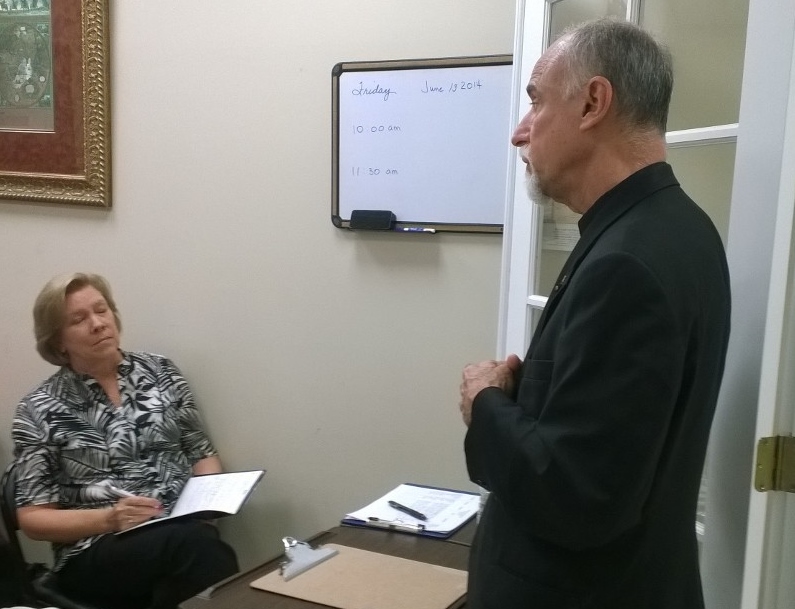
It was an interesting morning. Brother Jay was recently released from the hospital after a bout with pneumonia. But he dragged along his oxygen concentrator and did his thing. After, Brother had the opportunity to spend time with some of the brothers and several young men who are discerning a vocation to the Franciscans of Life as consecrated brothers.

It was wonderful to see an integrated group of men who are responding to Christ’s call to serve him in the voiceless father and his preborn child either as a lay mentor, a secular brother or a consecrated brother. But one thing is clear; these men are clearly brothers to each other and to those to whom Christ sends them.

Finally, we want to thank Mary Tate, the director of the North Dade Pregnancy Help Center of the Archdiocese of Miami for hosting the morning’s event. Mary took time from her free Saturday morning to spend with us. As usual, Mary’s love for the voiceless, the ministry and the brothers comes through the twinkle in her eyes, her warmth, her sense of humor and her patience with all of us. She’s like the mom that Franciscans of Life need.

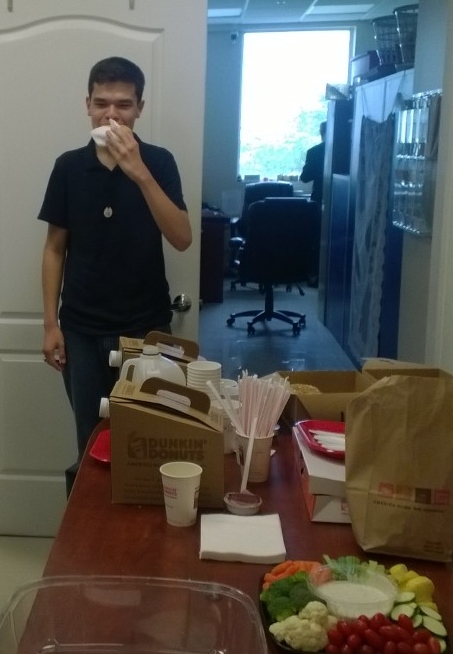
A few pictures to give our readers a TASTE of the day.

BROS WITH BR JAY 1

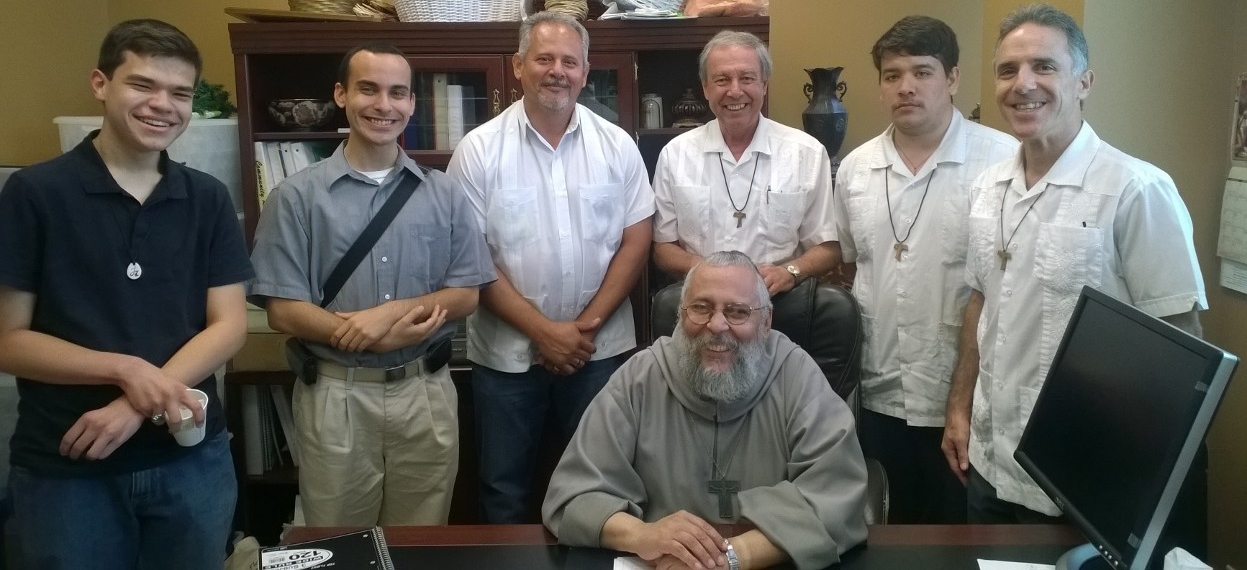
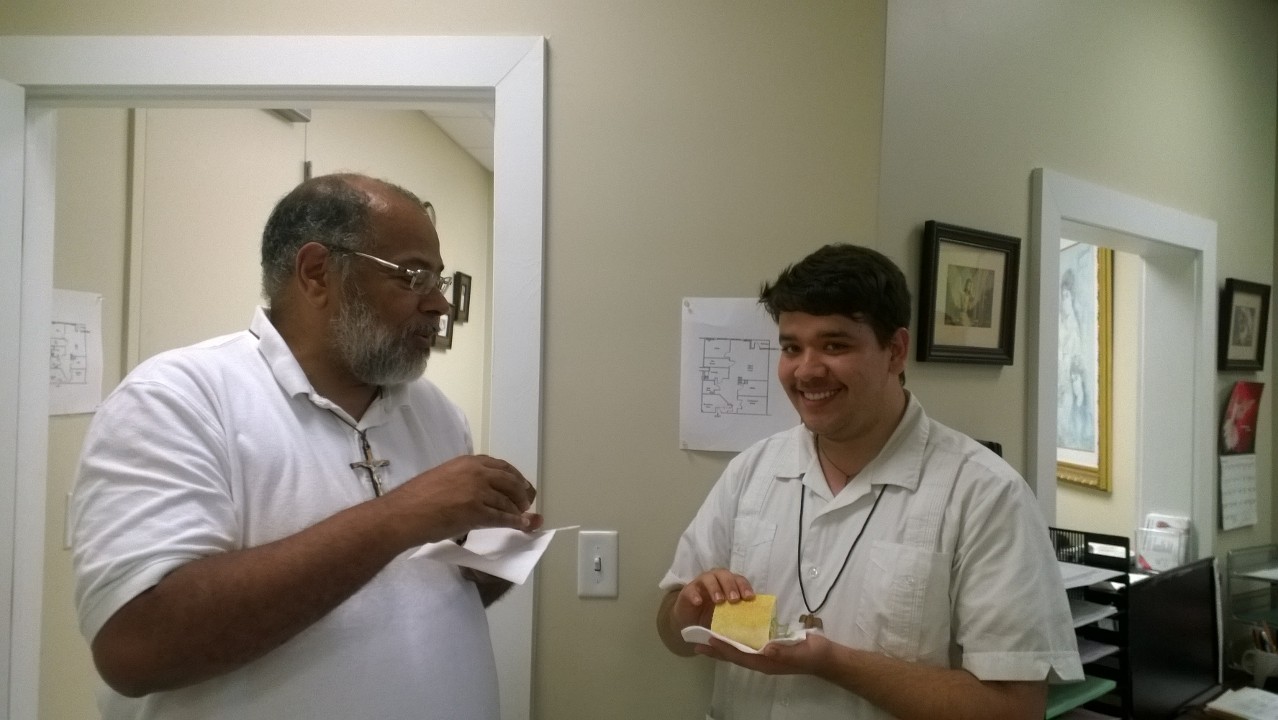
Brother Superior needed to catch his breadth — Aspirants and brothers keep him company — This is fraternity

Alberto is about to begin discernment

Alberto is about to begin discernment

Luis mentors Alberto's disccernment

Luis mentors Alberto’s disccernment

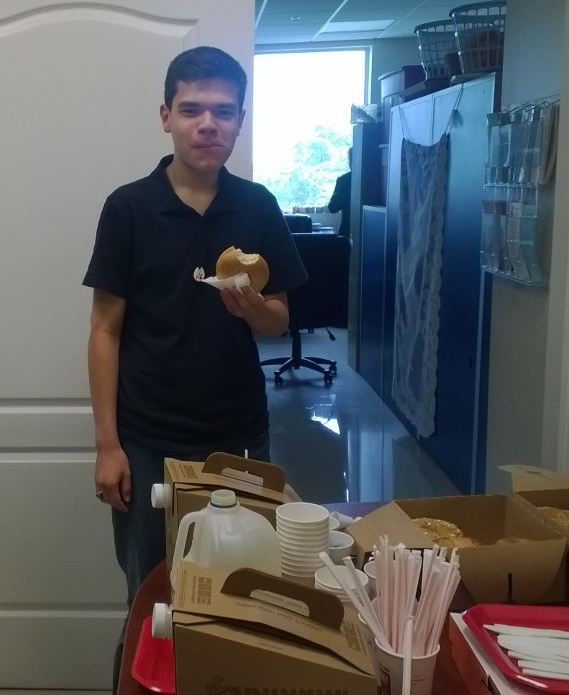
Discernment requires a lot of donuts

Discernment requires a lot of donuts

Are you still discerning?  :)

Are you still discerning? 🙂

Joseph King and Jose are doing a little discerning of their own.

Joseph King and Jose are doing a little discerning of their own.

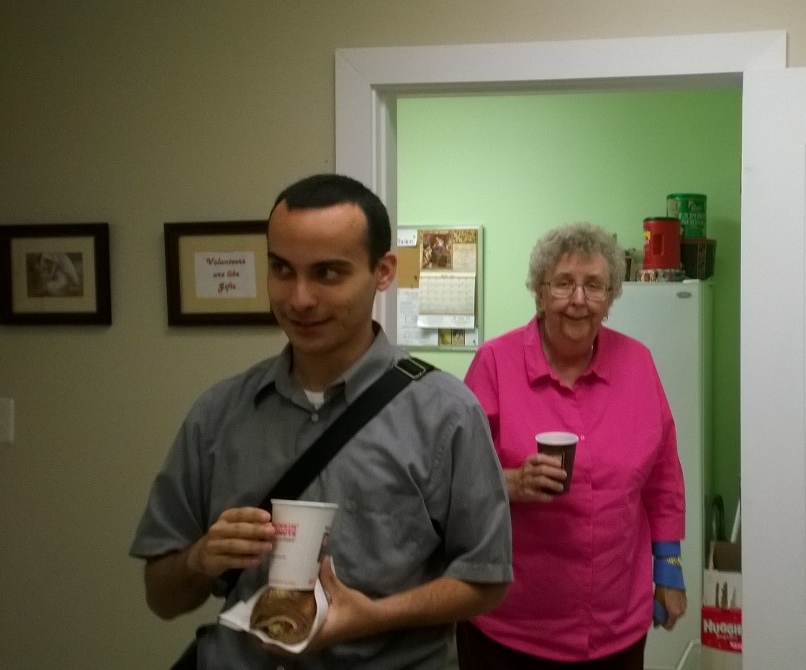
Bernardo and Mary Tate emerge out of the kitchen.  More discernment?

Bernardo and Mary Tate emerge from the kitchen. More discernment?

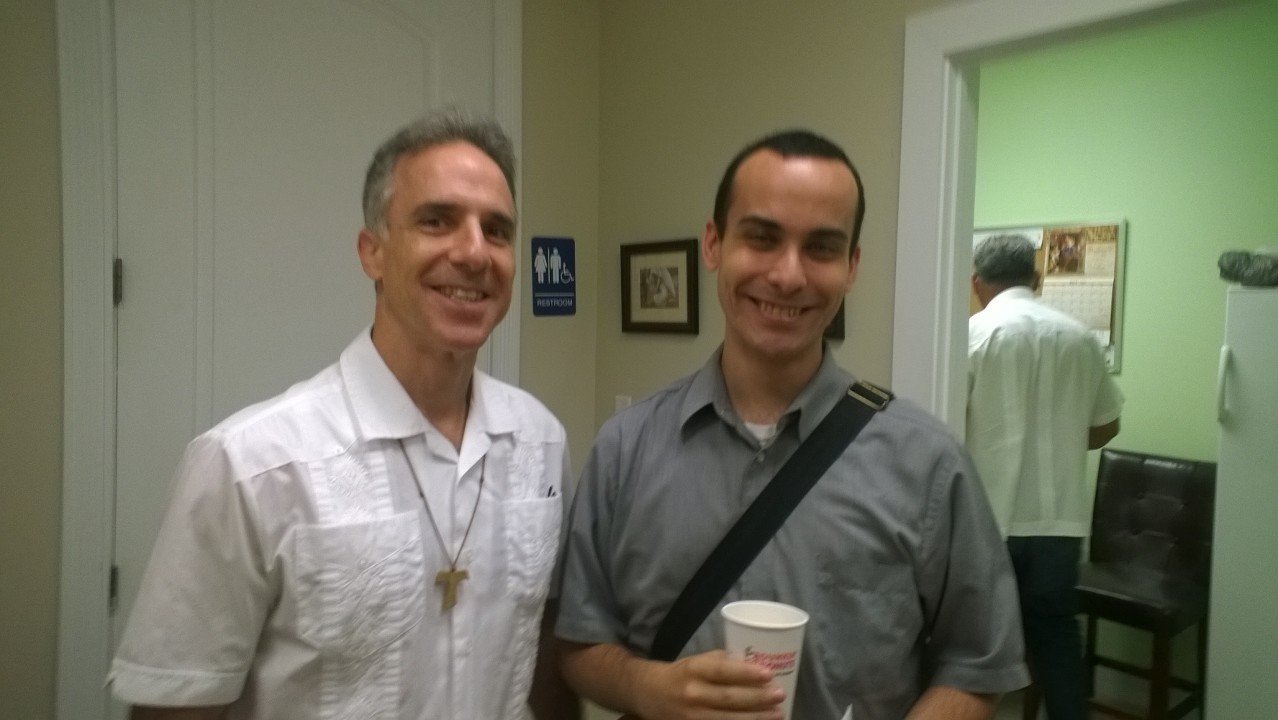
Brother Chris and Bernardo are going for it now.

Brother Chris and Bernardo are going for it now.

Time to get back to work

Time to get back to work

But Brother, we're so tired from all that discernment.

But Brother, we’re so tired from all that discernment.

Dr. James Dugart and Mrs. Joan Crown in deep discussion during the break.  We have no idea what they were discerning.

Dr. James Dugard and Mrs. Joan Crown in deep discussion during the break. We have no idea what they were discerning.

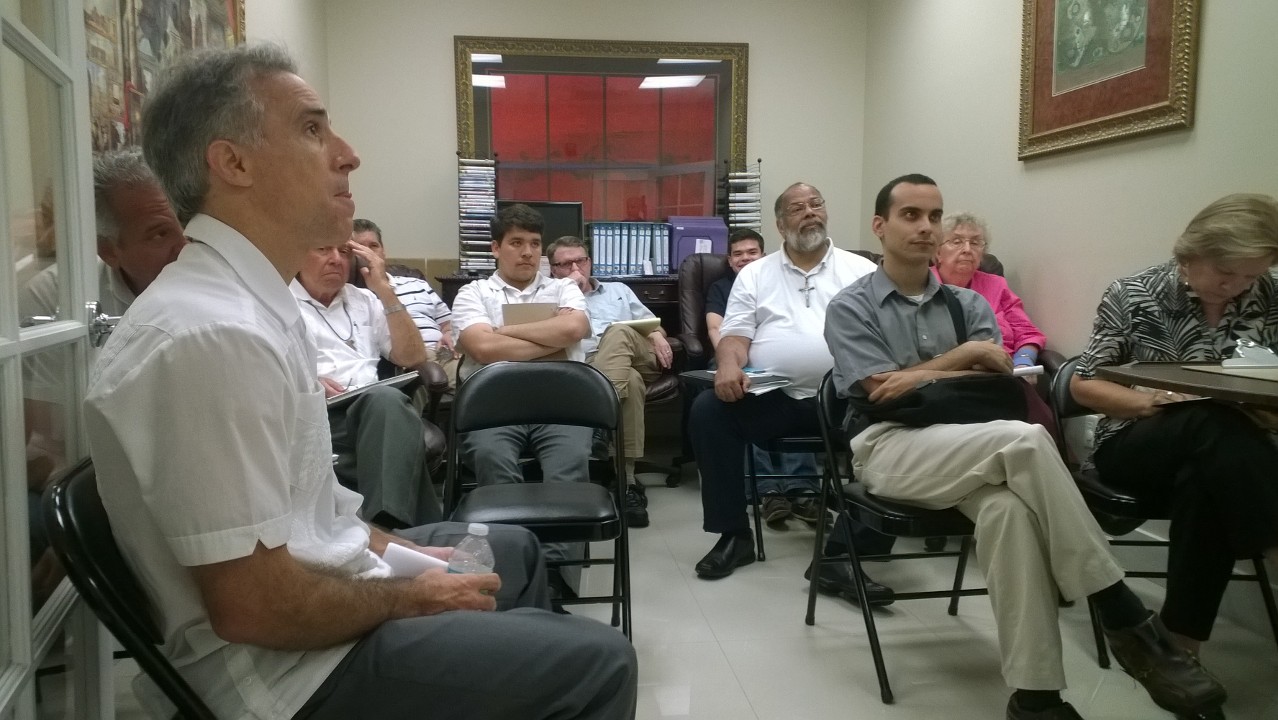
Father Alfred Cioffi delivers an outstanding presentation on end of life moral principles.

Father Alfred Cioffi delivers an outstanding presentation on moral principles for end of life decisions. No, Joan is not asleep. She didn’t get enough donuts. The brothers ate them. 😮

For more information on this important subject visit:

http://www.usccb.org/issues-and-action/human-life-and-dignity/end-of-life/euthanasia/index.cfm

and

http://www.flaccb.org/CDLD/index.php#

You’ll find everything you need to prepare a Catholic Declaration on Life and Death – Advance Directive
(Health Surrogate Designation / Living Will)

The Franciscans of Life want to thank the Office of Respect Life Ministry of the Archdiocese of Miami for this opportunity to come together as brothers and sisters to reflect on the Gospel of Life and our common vocation to holiness.

Sometimes, the Circle of Life Can Be a Beautiful Wobbly Egg


When the pope speaks about the poor, human trafficking, peace, war, unity, hunger, abuses in the Church, he knows about people’s real lives. When he says that those who deliberately choose a childless Jeannie & Julian2marriage, suddenly he knows nothing about people’s real lives and is draconian.

Then comes the “infertile couple card”. No one said that an infertile couple must have biological children, nor did anyone say that they are not allowed to adopt. That sector of the population did not enter into this sermon.

Finally, Fido becomes a papal casualty. This was not true either. Replacing a child with a pet and being anti-pet are not the same thing. I should know. I raised two loving children who are now loving adults with a ratio of two pets per kid. Now, one kid is married and my ratio has increased to four pets per kid. OK, so my daughter traded in the four-legged pet for a two legged husband who just happens to have severe allergies.

The point is that there is no condemnation for those who take on the care and love of a pet. In fact, the Church has always demonstrated great care for nature and its creatures. Just look at monastic communities. One way to teach our children to be responsible stewards of nature is to raise them surrounded by other living species that are treated with respect, love and justice.

How did this author become our new moral magisterium? Because she’s being told that there are consequences when society eliminates children from the equation. She claims that the population is growing. She forgot to mention that in Europe, North America and some countries in the southern hemisphere, the population is also top heavy.

When Americans who paid thousands and thousands of dollars into FICA now have to pay a monthly Medicare premium out of a fixed Social Security check and put out over $150 a month in medications, because Medicare does not cover enough, it seems that we have a shortage of younger people to replace the funds that older people paid and are no longer available to us. She forget these little details. Let’s not forget to ask who’s going to care for the older person who has no family when he takes to a bed.

Read her “logic” and make up your own mind. I’m just glad that I have two beautiful adult children. Our relationship has never been picturebook perfect. We’re three very different people and we like it that way. It’s fun when we come together. You never know what the other is going to say. Sometimes he’ll make you laugh and at other times you just have to wonder about him or her. The Circle of Life is often like a wobbly egg. But I wouldn’t change a thing.

Read this author’s reaction to the Holy Father’s message.

http://www.thedailybeast.com/articles/2014/06/06/pope-francis-is-wrong-about-my-child-free-life.html

Published in: on June 7, 2014 at 4:42 AM  Leave a Comment