When I was in 7th grade, in Italy, one of the students in my classroom had Down’s Syndrome.
This was the first time I encountered a child with special needs. We had a very interesting relationship. He was very friendly and, in many ways, he had that simplicity and innocence that many of us had already lost by then, due to the corrupting influence of the world and a certain family detachment from the Catholic life.
We had many good times and also a few incidents. Some students enjoyed teasing him, due to his simplicity and even, at times, naivete. Also there were certain things that upset him, such as seeing someone picking up trash from the trash can. It was common for some of his peers, every so often, to tease him in more or less innocent ways. Sometimes he took it for a game and laughed, other times however he would get upset.
Yes, I was among those who loved teasing him. Perhaps because it “broke the ice” and in a sense we felt he was really “one of us”. We all teased each other in many different ways, we even got annoyed at each other, so we did not feel (or did not have the maturity to notice) that some of those things would be upsetting or hurtful to our new friend. And we did not always keep in mind that he was physically very strong and could lose his temper if his patience ran out. On one occasion, he “slapped” me on the head while we were watching a movie in the classroom. I do not remember what I may have done earlier to him to upset him, but I am sure I deserved it. It was not a bully’s hit (I was accustomed to those) but the tap of an elder brother correcting a misbehaving youngster.
When his classroom assistant scolded him, he cried. I did not know he could cry. From that day on, perhaps we did not stop teasing him, but we were much more attentive and our relationship improved. We had reached a sort of understanding. We knew each other better. He learned that there are physical boundaries, and we learned that there are emotional boundaries.
Outside of the classroom, I remember once meeting his parents and younger sister. She also had Down’s Syndrome, and she looked very joyful. He was a bit hesitant, perhaps because he was not used to encounter his classmates outside of the usual, safe classroom environment, but we “warmed up” to each other while my parents greeted his. My dad was then a psychologist that worked at a center for children with Down’s Syndrome, so it is possible he knew him and his parents already. I also remember once, during the winter, walking down the coast with my mom, and meeting him and his mom. I was in High School by then. I waved to him, and he looked at me puzzled but then he mentioned my last name. I was happy he had not forgotten me. I hope he remembers the good times more than my distasteful practical jokes.
This was over 16 years ago, but I still remember him as if it was yesterday. In fact, he may be one of the people about whom I have thought the most during the years. I always loved him like a friend, even like a brother. There was something about him, that I missed when I moved on. I never had the joy of sharing the classroom with another child with special needs.
Without knowing anything about Down’s Syndrome, I immediately knew that he was as human as all of us – in fact, inside he was better than many of us. He was, in many ways, protected from the corruption of the world. I am not trying to canonize him, as I know very little about his daily life. I am speaking from the experience of the three years that I shared a classroom daily with him.
I also remember that, as part of my dad’s work, his center and a local newspaper ran a campaign against infanticide. In Italy, the abandonment of a newborn on the streets or in a trash can was much more common than abortion. We had these flyers that people could sign. Our class participated in signing the flyers and in distributing them to other students and their parents when school was over. We all felt it was so sad that parents would abandon their newborn to die, especially if they felt compelled to do so by poverty or by the terror of not knowing how to raise a child, particularly if he had a disability. We all felt that others needed to step up and help those parents so that those children would live. Nobody tried to justify infanticide. Nobody thought of the parents as murderers, because they felt they must have been in a very terrible state of mind to do something so tragic and haunting as forsaking their newborn.
Back then, I did not know what abortion was. I would learn about it many years later. At first, like the non-practicing lukewarm Catholic I was, I thought it was not a big deal. After all, I knew human development in the womb since elementary school (I was an early learner) and I knew that it was not like killing a child, since at its earliest stages it didn’t quite look like one. Then, as I experienced a “conversion” or “call” from the Lord and drew closer to the Church, I became more acquainted with abortion and saw actual images of human development, which complemented my conceptual knowledge and filled me with awe and horror: awe at the beauty of the preborn child, and horror at the thought that I used to think it was “no big deal” to violently and forcefully end the life of that human being who like all human beings was to some degree dependent on others and to some degree developing his own independence. And I did not yet know, not until I entered postulancy in my community, about the most tragic forms of abortion during the second and third trimester. That is something traumatizing to a degree, and I would recommend that people ease in and learn these things by degrees. This is also why I, along with my brothers, firmly oppose the use of graphic signs that may “show the truth of abortion” but in fact are, prima facie, traumatizing and revolting to our innermost humanity. But this is an argument for another article.
Earlier this year, I had the blessing, through the generosity of a benefactor, of attending the annual Statewide Respect Life Conference in Weston (FL) and see the Marian Center Bell Choir perform. This is a choir of children and young adults with Down’s Syndrome. I also learned more than I had ever known about the Servant of God Dr. Jerome Lejeune, the discoverer of the genetic cause of Down’s Syndrome, and had the joy of meeting his widow and Mr. David Lejeune, president of the Jerome Lejeune Foundation.
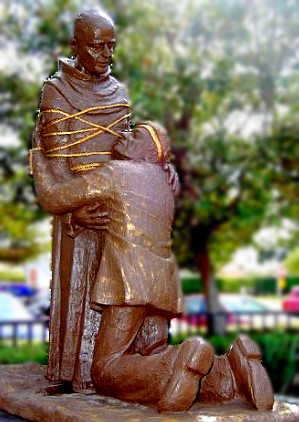
I could not hold my tears when I heard how those who vowed to pursue knowledge, or scientia as the Romans called it, had used Dr. Lejeune’s discovery not to help find a way to make life easier for, or at least ease the sufferings, of our brothers and sisters with Down’s Syndrome (some of whom have additional, concomitant needs) but rather as a way to “detect the problem and terminate the pregnancy” – in other words, as a way to kill the child before he had a chance to complete his development in utero and continue his development in the world, like the rest of us. I came to love Dr. Lejeune, the man who embraced these children with the embrace of Christ who “came that we may have life, and have it to the fullness”.
I have always believed, as part of our way of life and as part of our Catholic faith, that the life issues and that the proclamation of the Gospel of life extend far beyond the one tragic issue of abortion, and that unless the pro-life movement raises the bar above and beyond that one issue, and learns to embrace both men and women in its ministry, it will remain in the minds of the vast majority a group of narrow-minded dogmatic people that don’t understand the needs of women and simply try to force their religious beliefs on others. That has never diminished the gravity of abortion in my mind and heart. I have simply learned that there is a bigger picture and a different way to approach it. And this, too, is for another article.
Why then am I sharing all of this with you? Well, a few days ago we received an email from our friends at the Jerome Lejeune Foundation, who are working hard to establish a beautiful structure in Virginia dedicated to providing healthcare to children with Down’s Syndrome. Mr. David Lejeune was bringing to our attention something that has been stated at such a high level that the word “indignation” does not suffice to describe what we experienced.
The United Nations Human Rights Committee, already notorious for embarrassing itself through its membership policy and flawed recommendations, is working on an official interpretation of the “right to life”. One of its members, Dr. Yadh Ben Achour, stated something outrageous, despite his great education and experience and despite the fact that his grandfather was considered one of the great Islamic scholars of the 20th century (who, adhering to the most enlightened interpretation, taught that prevention of abortion is equivalent to the protection of human souls – see “Ibn Ashur: Treatise on Maqasid Al-Shariah”, p.122, 2006 ISBN 9781565644229).
Dr. Ben Achour stated:
“If you tell a woman ‘Your child has Dow…what is it called? Down syndrome, dawn syndrome – if you tell her that, or that he may have a handicap forever, for the rest of his life, you should make this woman… [pause…] it should be possible for her to resort to abortion to avoid the handicap as a preventive measure. […] We must do everything we can to avoid disabilities“.
The fact that this is not a mere individual opinion, but part of a discussion of an international committee whose very purpose is to protect the rights of all humans, has led the Jerome Lejeune Foundation to demand an apology and reversal of statements, on behalf of the countless voiceless preborn children who die because of similar mindsets and will most certainly die if such a misguided, unfounded idea becomes part of the international definition of the “right to life”.
The Franciscans of Life are joining the JLF in inviting you to sign this request. You can do so easily by following this link: http://opusf.co/2A67Lev
If my story has taught me anything, it is that my life would have been very different if I had not met my friend with Donw’s Syndrome. Perhaps I would not be were I am, writing this article. At this time we are not asking you to consider dedicating your life to this cause, or to offer us financial support. We are only asking you to add your name to the list of those who believe that abortion is not the answer, and that those of us who have a disability – whether it is Down’s Syndrome or something else – are still human beings with an inherent right to life from the very first moment of conception until the day of our natural death.
Thank you for reading this article and pondering on these matters. Again, here is the link: http://opusf.co/2A67Lev
Br. Bernardo, FFV




 My son-in-law, who is an
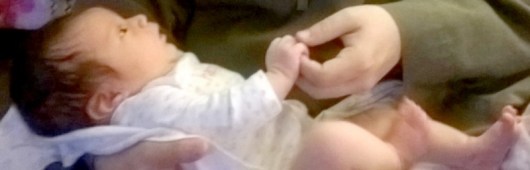
  Recently she has started to walk. She now picks up a book that’s interesting to her, takes it to her mother or father, climbs on the couch next to Mom or Dad and demands that they read to her. Dad captured one of these moments with his “dadmera” (Dad’s Camera). A few days later, came the short video. Katherine picked up a book of her choosing, opened it, and started to read it.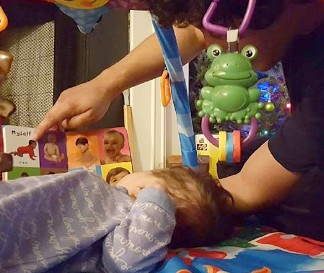
 My son-in-law deserves to be the “Fatherhood Poster Boy”. He’s an excellent father. He’s a black belt in Judo and has taught Katherine some of moves. She squeals in delight when Dad engages with her. As we have said, Katherine has a very intimate relationship with both parents. The bond of love expresses itself in reading, and squeals of delight doing Judo with Dad. It’s too early to try to analyze Katherine’s thoughts. We can only observe and report the interesting things that we see.
 There are some people out there who strongly criticize what they call “The Church of Nice.” Unfortunately, their meaning has been incorrectly applied. They are referring to a community of believers that gives everyone and every fault a pass to avoid conflict or hurting someone’s feelings. Let’s get this straight.
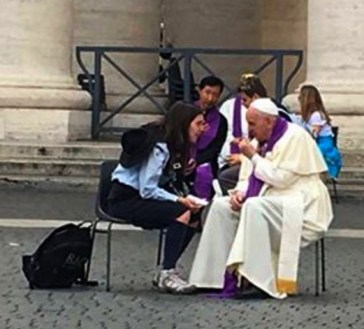 you say and do things? If you cannot answer these questions positively, then one must ask you, why did you go to confession? The confessional is not a washing machine where you throw in a pair of dirty socks and the machine cleans them whether the socks want to be cleaned or not. We are far superior to a pair of sox. We should know the conditions for forgiveness and we should have at least the resolve to sin no more. This is not a guarantee that we will never sin again. It’s a covenant between the individual, God and the Church to avoid hurting others deliberately.
 behavior. You may have grown up in a home where the adults shouted at each other, bullied each other (verbally and physically). As you were growing up you experimented by saying hurtful things to your parents, instead of a severe consequence, your parents simply shouted back and the battle went on until someone ran out of ammunition.
 that’s not the real world. In the real-world people are tough and if you don’t push back, they’ll keep you down and even destroy your life.”
 offend God’s creative power. Your offense sends a message to God and others. The message says, “I don’t care if this person is the image and likeness of God. God’s image and likeness are beneath me. I am free to offend and walk away calmly.”
 er looking through a fog, I finally took and deep breadth and decided to take the risk with eye surgery.




 hen in the Course of human events it becomes necessary for one people to dissolve the political bands which have connected them with another and to assume among the powers of the earth,
 a divine right to be independent and that each human being is equal to those around him, those who came before him and those who will follow.
 the British crown. The Declaration of Independence and what followed was a struggle to to recover and protect man’s God-given right to live, to to be free, to be equal to others, and to pursue happiness.

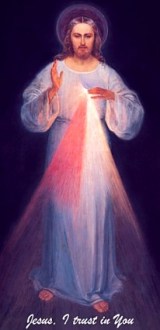 Hay un himno clásico que dice, “Cantemos al amor de los amores . . . .” En los momentos más difíciles de nuestra historia mundial y nuestra historia individual, estas palabras siempre han sido para mí palabras de gran aliento y ánimo. En mi vida he perdido a seres queridos. Algunos han muerto en tragedias, otros por edad, otros por enfermedad, y algunos por negligencia humana. También he sufrido pérdidas económicas.


 3.
3. Franciscans of Life