Who said that you have to like the Pope?


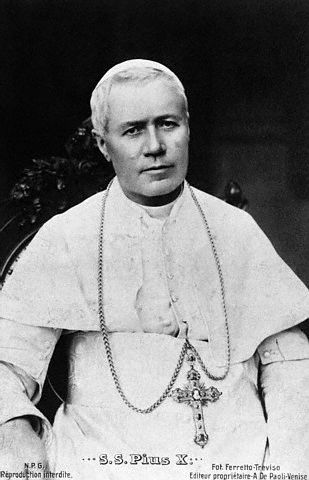
Saint Pius XI found this article to be very helpful and supportive of what I presented in an earlier post, “Under Whose Authority “

Apparently, I’m not the only one who is noticing that people are not making a distinction between what they like and what they don’t like but must learn to live with.

When I was growing up I hated almost every rule that my father imposed on us.  As far as I was concerned, he was a totalitarian despot.  I’ll let you in on a little secret.  I had no idea what a “totalitarian despot” meant.  But I had read the term in a social studies book in school and it sounded like an appropriate label for my dad.

As the years passed and I transitioned from a child to an adult, I came to realize that my father was just a very conservative man from a different generation.  The truth of the matter was that nothing that he imposed on us did any harm to our bodies, mind or souls.  Some of his rules and statements were arbitrary and others were right on the money.  As I became an adult, I jettisoned that which was arbitrary and incorporated into my script that which was truth.

The same applies the pope and others in the hierarchy.  Many times, just like our parents, they say things that are right on the money, but we don’t like what we’re hearing.  That does not mean they’re wrong.  Other times they say things using a language that is different, one that we’re not used to.  That does not mean that they’re wrong.  It simply means that we have to pay close attention to the nuances.  Finally, they may even say things that sound silly to us or not consistent with what came before.  That does not mean that they’re wrong either.  It means that they are speaking to a different generation, at a different time in history, using a different language, and building on what came before, not denying it.

If we don’t understand, it’s like not understanding our fathers or mothers.  We have to learn to respect the person and the office.  The rest is a matter of biting the bullet.  How many people would belittle their parents with such labels as “modernist, apostate, heretic, infidel, devil incarnate” and more, because the parent does not seem to tow the line with what we believe our parents should be saying or doing, in matters of home management, discipline and even faith formation of the children?

I remember that my father was a twice a year mass attendant.  It was not until my mother converted that he started to attend mass every Sunday.  My mom was a formidable woman.  If she said “We’re going to mass,” we were going to mass.  No discussions.  Having said that, I wouldn’t dare place my father on the stand and accuse him of being any of those things that some people attach to the Holy Father.  Respect and love do not depend on being right or being lovable.  Respect and love are a choice that we make to treat every man and woman as Christ did.  Let us never forget that even though Pilate was wrong, he was given authority from above to judge and execute Jesus.  Jesus acknowledged that authority.  He was not a fan of Pilate, but he was a loyal Son of the Father.

We too must learn to live in the Church as loyal sons of the Father.

One last note, this is not an attempt to bash Traditionalist Catholics or the Traditionalist movement.  There are many Catholics in the movement who are very holy people and exercise great self-control when they don’t like something and know how to speak with firmness and respect.  They are to be admired and applauded.

Some of you may like this article.  I thank Scott Eric Alt for sharing it.


Published in: on January 28, 2016 at 2:20 PM  Comments (1)  

Under what authority . . . ?


right and wrongI will never forget what a 10th grade student taught me a long time ago.  I was teaching social studies in a high school.  Mind you, I’m not a sociologist or social scientist.  Our social studies teacher was on maternity leave and I was elected to cover for her.  That being said, the lesson was on the United Nations’ declaration on human rights.  As we were going through the highlights of the document, Chris asked me a very serious question.
“Why doesn’t this say that everyone has the right to be born?  If you don’t have the right to be born, the other rights are useless.” 

I have never forgotten that question or that lesson.

Today, thousands of people prepare to march for life in many cities in the country, the largest march being in Washington, DC, despite the horrible weather.  Why are these people willing to suffer freezing temperatures, numb fingers and toes and 12 inches of snow and ice?  The answer is simple.  They believe in the right to be born.

It is true that many attend the march for life in protest of abortion.  However, there is more to this issue.  We must put abortion in context.  The medical community refers to abortion as the “termination of pregnancy.”  It’s actually a very accurate statement.  Many people prefer to call it murder, holocaust, eugenics, and many other terms.  None of these are wrong.

Nonetheless, the principle behind abortion is flawed, not only because the procedure takes the life of a vulnerable human being.  It is flawed because the right to terminate a pregnancy presumes that society can deny any human being the right to be born.  Birth is not possible, if you terminate a pregnancy.

This puts us on a very slippery slope.  If human beings can lose the right to be born, what is there to say that we can’t lose the right to remain alive?  Why are we crying over the extermination of Syrians, other groups in Eastern Europe, the Middle East and Africa?

Why doesn’t it follow that a society with the authority to withdraw someone’s right to be born can deny the right to stay alive after the fact?

The answer has to do with vision.  We can see the carnage in the Middle East, Africa and parts of Eastern Europe.  We don’t see the carnage behind the doors of an abortion mill.

When I was a graduate student, I learned about a concept called “object permanence.”  A young child believes that an object exists only when he can see it.  When mom says that the toy flew away and hides it behind her back, the toy ceases to exist.  In simple English, the permanence of an object depends on the subject’s ability to see it.  If one can’t see it, it does not exist.  It’s a more primitive version of “out of sight, out of mind”.  Except that this primitive version is normal in human development.  As the person matures, the brain’s functions become more robust and object permanence is no longer dependent on perception, but on knowledge.  “The thing exists, because I know it exists even when I don’t perceive it with my senses.”

For many people, a crime against human life exists only when the human being is perceptible.  When you don’t see the human being, the crime ceases to be.   Therefore we do two things in contemporary society.

First, we look at the fetus and we fail to see a human being who is a real person.  We only see tissue and cells, because that’s what we want to see.

Second, we look at a fetus who is over 30 weeks old and we see what “looks like” a baby.  It only looks like a baby.  It’s not a baby, because we fail to see the baby.

To understand abortion in context, we must keep in mind that human beings often fail to see what they don’t want to see.  It’s called selective blindness.  They convince others that the thing they cannot see does not really exist.  The baby that we cannot see is not really there.  It’s just a “fetus” or tissue.  When I was growing up, they called this “turning a blind eye.”  Today, some people call it “reality”.

ISIS is murderous, because it kills people whom we can see.  We cannot deny their existence, as much as we would like to ignore them.  We have to call such barbaric acts what they are, the murder of innocent people.  In our distorted way of thinking, abortion is not murderous, because no one visible to us is being killed.  At the end of the day, what are we saying about choice and abortion?

It looks like we’re telling ourselves and our neighbors that man decides who has the right to live.  Such a decision depends on the individual’s perception.  If he does not see a human being, terminating a pregnancy is not murder.

The problem with this concept, besides the attack on innocent life, is that every individual can see whatever he or she wants to see and be blind to whatever he or she does not want to see.  The right to be born becomes subjective, no longer an absolute.  The right to be born is determined by the subject who has the power to terminate a vulnerable life. . . the power to see only what he wants to see.

This begs the question.  “Under what authority can man grant or deny another human being the right to be born?”

We must ask ourselves this question as we remember Roe vs Wade in 2016.

Brother Jay Rivera, FFV

Published in: on January 21, 2016 at 7:33 PM  Leave a Comment  

A Tradition of Hopelessness?


I’ve been reading certain blogs and newspapers online by Catholics who believe that the Church has lost her Catholic identity and her traditional roots.  I must admit that the reading is very depressing; but not because of the alleged crisis in the Church.  This is not to deny that there is a crisis of faith in the world, which affects people of all faith traditions.  We can address that in a later post in this blog.  For the time being, allow me to speak about the blogs and periodicals that are being posted online by Catholics.

When I was growing up, I was taught that in a democratic society, disagreement is a sign of health.  When disagreement triggers dialog, the possibility for growth is endless.  Along with such sage advice, my mother also taught me that disagreement must never rise to the level of disrespect for a person or his office.  Crude, disrespectful, dismissive or condescending behavior is simply arrogance.  Arrogance, like any other evil, has no rights.  Therefore, the arrogant person forfeits his right to a dialog with civilized and intelligent human beings.

What we have is certain Catholic journals and blogs publishing articles and posts that disagree with much of what Pope Francis does and say.  There is nothing wrong with that, as long as the Church is open for dialog, which she is on certain points.  However, they take the liberty to apply such terms as Modernist, apostate, heretic, Marxist, sacrilege, indifferentism, syncretism, and more to the Vicar of Christ.

Everyone knows that there has never been such a person as the perfect pontiff.  From the first day of its existence, the pontificate has been plagued by human weakness.  Yet, it has survived.  It has survived, because Grace has never been absent in the Church, especially in the Petrine Ministry.  The first pope denied his master three times.  He behaved with certain prejudices toward Jews and Gentiles, causing Paul to “lose it.”

However, when Paul lost it, he challenged Peter’s behavior and position.  But he also addressed him by his proper title, Cephas or Rock.  Paul did not cease to insist that Simon was the Rock upon which Christ built his Church.  Paul was smart enough to see the weakness in Peter’s behavior when it came to the conversion of Gentiles and smart enough to remember that despite it all, Peter was the Vicar of Christ, not him.  So . . . he took his argument to Peter and to the Council of Jerusalem.  But not once did he stick disparaging labels on Peter.

Some “Traditional Catholics” invoke Irenaeus as their model or Catherine of Siena.  Both of these people held on to the faith during times of crisis in the Church and the world.  Both were honest enough to speak their mind to the pope and point to the errors in the pope’s thinking.  Maybe, the reason why Irenaeus and Catherine share the label “saint” in front of their names, is not because they challenged and questioned, but because they loved and respected.  They acknowledged that whatever they saw as mistakes didn’t change the fact that the pope was the legitimate successor of Peter who was the Prince of the Apostles and the Vicar of Jesus Christ.  They spoke up without mocking, insulting, and labeling the pope or encouraging others to do so.  They communicated their protest with dignity, charity and humility.  I often find this lacking when writers in blogs and periodicals apply hurtful labels to the person of the pope and to his ministry.

Surely, we can learn from Catherine, Irenaeus and many other great men and women in Catholic history, how to speak about those things that are difficult and disturbing without arrogance, rudeness, and hopelessness.


Published in: on January 19, 2016 at 10:14 PM  Leave a Comment  

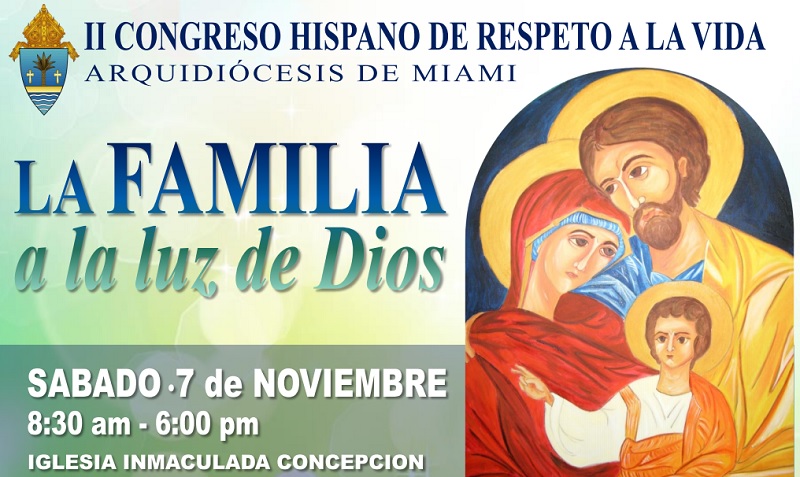
First time in Miami: Respect Life Hispanic Conference


flyer

On Saturday, November 7, the Franciscans of Life attended the Second Statewide Respect Life Hispanic Conference. This is the first Hispanic pro-life conference to take place in the Archdiocese of Miami. The location – Immaculate Conception Catholic Church – was no coincidence: Hialeah is the city with the highest number of abortions in the State of Florida, and the Catholic pro-life efforts in its territory are still limited.

Featuring an impressive panel of speakers, the Conference covered topics such as: “Christian Matrimony: God’s master plan”, “The truth on abortion”, “Recovery after abortion”, “The ethical care of human life from conception to natural death”, “Moral medical methods for the treatment of infertility”, “Spiritual and practical support for couples suffering infertility”, and “Plan of action for the family”.

Hispanic_Conference_talkOne of the talks was titled: “Project Joseph – for fathers”. This was the first time that we presented in Spanish the work carried out in Project Joseph – a joint effort between the Franciscans of Life and Respect Life Ministry Archdiocese of Miami to serve fathers in unexpected pregnancies.

The talk was delivered by our Father Superior, Br. Jay, who founded the program 6 years ago and currently directs it. He was accompanied by Br. Bernardo, Project Joseph mentor at the North Dade Pregnancy Help Center.

The talk – which we will feature in an upcoming article – began by describing how Project Joseph is relevant to the Ibero-American culture, in which too often women, and particularly mothers, are treated as if they were servants or nannies, rather than with the respect they deserve. This leads to the development of dysfunctional environments. As a consequence, there are many situations in which few rights are recognized to the women but many burdens are imposed on her if she becomes a mother, while the father on the other hand retains many rights and few responsibilities. On this note, the origin of Project Joseph were described.

(c) Ana Rodriguez-Soto | FC

(c) Ana Rodriguez-Soto | FC

“Don’t let me catch you talking badly about my Project Joseph dads!”, admonished Br. Jay. “These men are good people. Project Joseph offers them the opportunity to mature and grow as men and as fathers.”  Over 200 fathers have participated and become mature men, responsible and prepared to face the challenges of life.

Br. Jay mentioned that the success of the Project is due to the intercession of St. Joseph, patron of all fathers. His role in the Holy Family, described in a few examples, shows why it is so important to help these men walk in the footsteps of St. Joseph.  The Franciscan charism is also behind the success of Project Joseph, a charism that originates in the Seraphic Father and finds worthy example in the martyr St. Maximilian Kolbe, patron of the pro-life movement.

It was a beautiful, well organized, well attended event. We were glad to be there and have a table set aside for us to raise awareness of the work carried out by the FFV.

Hispanic_Conference_tableOur apostolate to the preborn children and their parents has developed significantly through Project Joseph, and we are particularly interested in recruiting Hispanic or bi-lingual mentors, since many of our dads speak Spanish as their primary language. However, we also serve the chronically and terminally ill and their families and caregivers, as well as the immigrant poor – populations that are very much in need of attention as we look to “The Family in light of God”.

The Conference came to a closing with Holy Mass celebrated by H.E. Thomas Wenski, Archbishop of Miami. During his homily, he underscored the important role of St. Joseph in God’s plan for the family. Here is our translation:

“The theme of this conference has been “The family in light of God.” Here, in Mary, Joseph and the child Jesus, that is, in the holy family, we see reflected God’s plan for the family when there is no stain of sin.

May the prayers and example of the Jesus’ parents strengthen today’s parents in their efforts to raise their children according to God’s will. In thefulfillment of His plan of salvation for mankind, God did not need the participation of Joseph to create the child Jesus. Nevertheless, God decided that the help of Joseph was indeed necessary in raising the holy child. Joseph, as chaste spouse of the Virgin Mary, played an indispensable role in the life of Jesus as his foster father. He was not an absent or indifferent father. In fact, to him was entrusted the safety and well-being of Mary and of Jesus. We see this in the episode of the flight to Egypt. We perceive this in the narration of the child lost and found in the temple of Jerusalem. We can deduce that Joseph played a crucial role in the life of Jesus before he began his public life by the fact that his fellow citizens knew him as “the son of the carpenter”.

God wanted the best for his Son, and thus made it possible for Mary to marry Joseph, for only matrimony ensures the commitment between the parents and for the children. The children are raised better when the effort is carried out by a father and a mother. Thus was then and thus is now: every child needs a father, every child deserves a father – a father like Joseph. For this reason, the Church proposes the family of Nazareth as a model; and if for some reason our earthly family does not count with the presence of a mother or father, the Church invites us to count on Mary and Joseph. They will not disappoint us.”

The event was featured on the Archdiocesan News. Click here to read the article, which features the Project Joseph talk.

If you wish to see some more pictures, courtesy of Respect Life Ministry Archdiocese of Miami, follow this link 🙂

If you have any questions or comments, feel free to reach out to us! We will be glad to help you explore and discern if the Lord is inviting you to proclaim the Gospel of life with us.

Moral Reasoning Through the Complexity of Homosexuality


This is a very complex issue. It’s not as simple as people on both sides of the aisle want to make it. There are some basic principles that do help us understand what is right and wrong. Many people are not educated in these principles.

First: God reveals himself. He discloses himself to man through Sacred Scripture, also through sacred tradition, the baseball_throwingMagisterium of the Church, natural law, and logic.

We can’t just throw a bible verse at something and pretend we have it all figured out. All of these pieces must work together. They are all good, because they all come from the same divine origin.

Second: Faith enlightens reason. We must reason through these questions and let our faith inform us whether or not our reasoning is consistent with what God has revealed about his nature and the nature of man.

Third: People have to distinguish between the action and the person. They are not the same. When a five-year old kills his little brother with his father’s gun during a game of “cops and comicrobbers,” the action is contrary to the commandment, “Thou shall not kill.” However, the five-year old is not a murderer, because he neither intended to actually kill his sibling, nor is he knowledgeable of the commandment. The action remains evil; but the child is not culpable. We can condemn behaviors, but we have to be very careful not to judge people. That would be playing God.

Fourth: Juangel_appears_to_st_josephdging another person involves walking through his or her mind and conscience. One’s thoughts on any issue and one’s moral conscience are part of what is known as the “internal forum”. This is an area of human existence that no human being may trespass or attempt to read without an invitation from the individual who is the lawful guardian of his mind and conscience. We can explain why a certain action or behavior is wrong, but we may not pass judgment on the individual’s moral reasoning unless that person invites us to examine it with him, thus inviting us into the internal forum.


Fifth: There is a big difference between homosexual acts and homosexuality. A person with same sex attraction does not wake up one morning and decide to be gay. As he develops and goes through different life experiences, he becomes aware of his feelings in this area. On the other hand, people freely choose to engage in sexual behavior with a person of the same sex. Choosing to be attracted to the same sex is very rare. That which man does not choose can be neither a sin nor a virtue.

Pope_Francis_on_accompanying

Sixth: Homosexual acts, like heterosexual acts, are freely chosen by the parties involved (except in cases of violent force). The person(s) must use reason to determine whether an act is right or wrong. If the person is a man or woman of faith, that faith should confirm the correctness of his conclusion or point to its moral error.

right and wrongSeventh: Acting on faith and basing our actions on what God has disclosed to us about him, about us and about the relationship between the divine and the human is not the same as playing God. It is using that which makes us in the image and likeness of God to make right choices, that being knowledge of right and wrong.

Eighth: Standing in judgment of an action does not constitute godliness. It’s part of human reason and part of living in society. On the other hand, standing in judgment of the person involved in the action that we reject, IS playing God. No one has the right to judge the conscience of another human being, unless the other person opens up his heart and shares what is on his conscience.

[How to Help]

MEN AND WOMEN, LOVE AND SEX, GOD AND FREEDOM


I read a page on Facebook, of all places, that actually drew my attention to something wrong and something good.  I thought I’d share my thoughts on the subject.  The subject is pornography.

The page on Facebook correctly said that porn kills love.  It becomes an addiction that can destroy human relationships.  This is true.  To this must be added what this “new drug” does to our spiritual life.

cross_window_brick_wallAnything that becomes an obsession, porn, gambling, drinking or other disordered forms of pleasure and “recreation,” will create a wall between God and us.  It is not God who builds the wall.  On the contrary – God wants nothing more than to save us.  He has spent eternity tearing down the walls that man builds to keep Him out.

We believe that God made us in His image and likeness.  However, the porn industry tells us that we are created to take pleasure from each other.  Nowhere in the industry do we find the word, love.  Sex is completely divorced from love.  It is for pleasure and for profit.

Because we are made in the image and likeness of God, we are made to love.  God brought us into existence, not because he needs us, but because he loves us.  Out of love, he gives us knowledge, free will, the capacity to love, the ability to transcend from our world into eternity, and an immortal soul.  These are attributes that God shares with us.  Hence we are truly created in His image and likeness.

upset_coupleWhen someone caves in to porn or any other addictive and disturbing behavior, he or she starts down the path of slavery, because this becomes an obsession.  Gradually, our brain’s hardwiring is altered to the point that we no longer make a free choice regarding love, sex and interpersonal relationships.  We are driven by a hunger for something else; in this case it’s porn.

Here is the problem.  When man becomes driven by his obsessions, this drive erodes his free will to the point that the obsession becomes an addiction and that gift of free will that God gave us is forgotten.  We no longer choose to love.  On the contrary, in the case of this type of addiction, one is trapped in mythological love.  Myth is not real.  Therefore, what we see on the screen is not real love, but fantasy.  Since it is not real, it never fully satisfies our need to give and receive love.  When one’s need is not satisfied, one tends to seek a higher dosage and more frequent dosage of whatever drug one believes will “fix us”, hence the term, “a fix”.

Not all is lost.  On the contrary, there is hope and salvation from our addictions and disordered sexual drives.  The most powerful medicines are found in the sacraments.  Eucharist and confession are not magical solutions to life’s problems.  God is not a magician.  Eucharist and confession are acts of love.  Christ shares his life with us.  He restores us to health because he loves us.

Having said this, God builds on nature.  He does not change it.  There are some things that we have to do and that we can do to overcome our addictions and sexual obsessions.  We begin by examining how we view men and women.  A heterosexual male may see women as subordinate to men and see other men as antagonists.  021001-N-3228G-008He has to compete with other males or he has to refrain from seeing the good and the beautiful in other males, because it’s not the “manly” thing to do.  He has to prove to women that he is powerful. None of this is helpful thinking.

We must recover God’s vision of men and women.  We must remind ourselves tbride & groomhat men and women are our brothers and sisters.  They are equally beautiful and equally worth our attention and love.  Both sexes have much to offer through friendship, marriage, camaraderie, collegiality and other healthy relationships.
This must be followed by concrete action.  One must decide to change one’s behavior.  One of the best programs for people with addictions is the 12-Step program.  It works one day at a time.  Just as no one gets addicted to porn in 30 seconds or less, no one gets off it in 30 seconds or less either.  It’s a daily task.  The good thing is that God does not ask us to live more than one day at a time.  For all we know, today may be our last day on earth.  We must plan for today and as Jesus said, “Do not worry about tomorrow.”  When tomorrow becomes today, we plan for that day.  Each day, we plan to live that day free of our addiction.

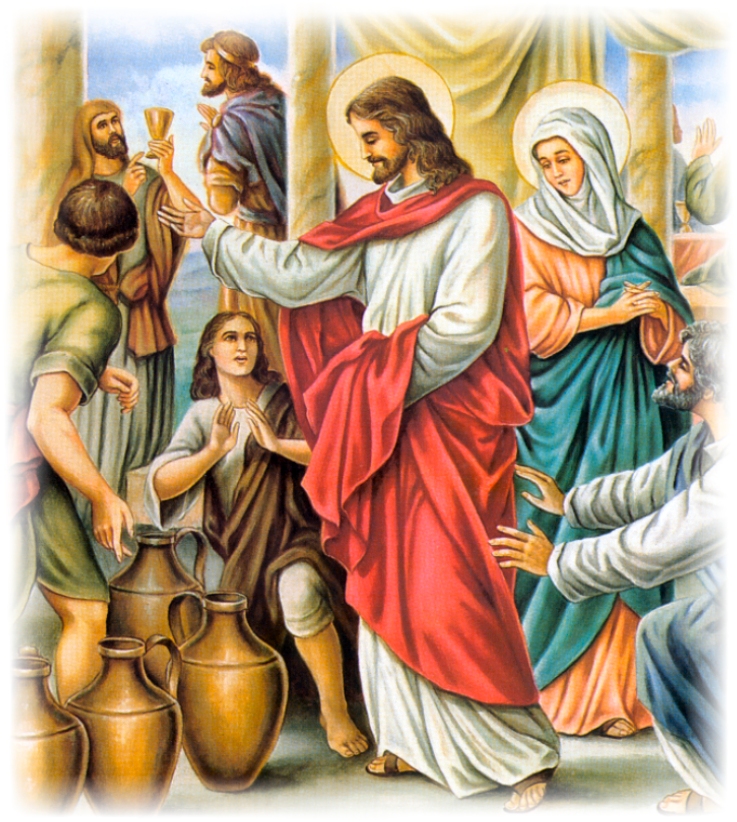
We must not forget the importance and the power of prayer.  Contrary to what some may believe, prayers are answered.  We may not always like the answer, but we receive an answer nonetheless.  The most powerful advocate and mentor in our struggle to live free of addictions and obsessions is the Immaculate.  She can stand as a barrier between us and that which can hurt us.  She soothes bruises that are often the product of our behavior.  Mary is the mother who reminds us that if we “do whatever he tells you” everything will be alright.

prayer_Our_Lady

I’d like to add the importance of community.  One need not join a community such as the Franciscans of Life to experience the common life.  But every man and woman must engage in relationships with other men and women.  These relationships must be productive; meaning that the relationship does well for the other person and for us.  We have to take the risk of friendship, real love, and openness to others.

It is true that human relationships are risky, because we can get hurt.  However, the hurt that we may experience in a human relationship is much easier to overcome than an addiction.  This hurt is the product of love.  We hurt because we first loved.  Had we not loved, we would not hurt.  Addiction is not the product of love, nor does it lead to love.  It’s not even self-serving.

When we remember that Christ is the firstborn of many brothers and sisters, we begin to heal as we view men and women through the eyes of Christ . . . as family, not prepackaged satisfaction.

B. Jay

Cana_joy

[How to Help]

Upon this “quarry” I will build my Church?


Since the closing of the extraordinary synod there has been a great deal of commentary on the blogosphere about the reception of Holy Communion by Catholics who are divorced and invalidly remarried.  The question is not so much as to whether the first marriage was valid and the second is not or the other way around.  The question on everyone’s mind seems to be whether or not Pope JPII W EUCHARISTFrancis is pushing for a relaxation of the law that currently exists, which says that people who are conscious of grave sin should not receive Holy Communion.  Living with someone as if he or she were your spouse when the person is not, would be one of those occasions when objectively one is culpable a grave sin.

I wouldn’t have written this article, if I thought that this is the only issue on the table.  After all, Pope Francis has not said anything that indicates that he is trying to persuade the bishops to change the law or keep the law.  What we seem to be hearing from the Holy Father is that he wants every voice to be heard.  Sometimes, when one opens the door to every voice one finds discordant voices.  Whether it’s prudent to open the door to every voice is an important question.  However, in the case of the extraordinary synod on the family, it’s a moot question, because the horse has already left the starting gate.

We have seen cardinals, bishops, theologians, religious and laymen speak on the synod and the documents that were published after.  The points that concern most people are whether or not these men and women in invalid marriages should bride & groombe allowed to receive Holy Communion; whether or not same-sex couples have something positive to contribute to the Church; and whether or not we can find any good in situations where people who are not spouses live as if they were.  I certainly can’t claim to have the answers to these questions, because they are above my paygrade.  Even if I thought I had the answer, the Holy See is not really interested in my opinion, because it’s not my place in the Church to speak as an authority of matters of faith and morals.  That authority is reserved for the local bishop.  I can only speak as an authority in my home and in my community with the Franciscans of Life.  Even there, I can only repeat what the Church teaches; I cannot teach anything that is outside of Church teaching as if it were the “official” Catholic position.

Here is precisely where we’re having problems today.  The blogosphere is overpopulated with voices that not only have something to say about these questions, but want to speak and be heard as if they had the BOOKS ON HEADauthority to make pronouncements to the rest of the Church.  When they speak they sound intelligent, because they can use big words, throw around some citations from previous popes, councils and older catechisms and there are times when their arguments have some logic.  To the average layman (not as in non-ordained, but as in newbie to Church politics) these voices can be very impressive and persuasive, to the point that these readers become talking boxes for the bloggers.  You hear them repeat, verbatim, what a blogger has written.  This is an interesting development, because the blogosphere seems to be giving birth to its own oral tradition within the Catholic Church and some people are beginning to take this tradition seriously.
At the risk of sounding like these voices, I have to state that bloggers are just that and no more.  St. Francis of Assisi held that a man is what he is before God, san francisconothing else.  This has been part of Franciscan tradition and culture for 800 years.  Why?  Because it works.  Why does it work?  Because it’s true.

When we read what someone puts out there, be he a cardinal, bishop, religious, concerned Catholic layman we must keep this person in his or her proper context.  He or she is what God sees, not how he presents himself.  When God looks at a cardinal, he sees a bishop who has a specific place in the Church, with a specific assignment, specific role and mission.  He does not see another Peter, because there can only be one Peter.  The Church is built upon the faith of one rock, not an entire quarry.

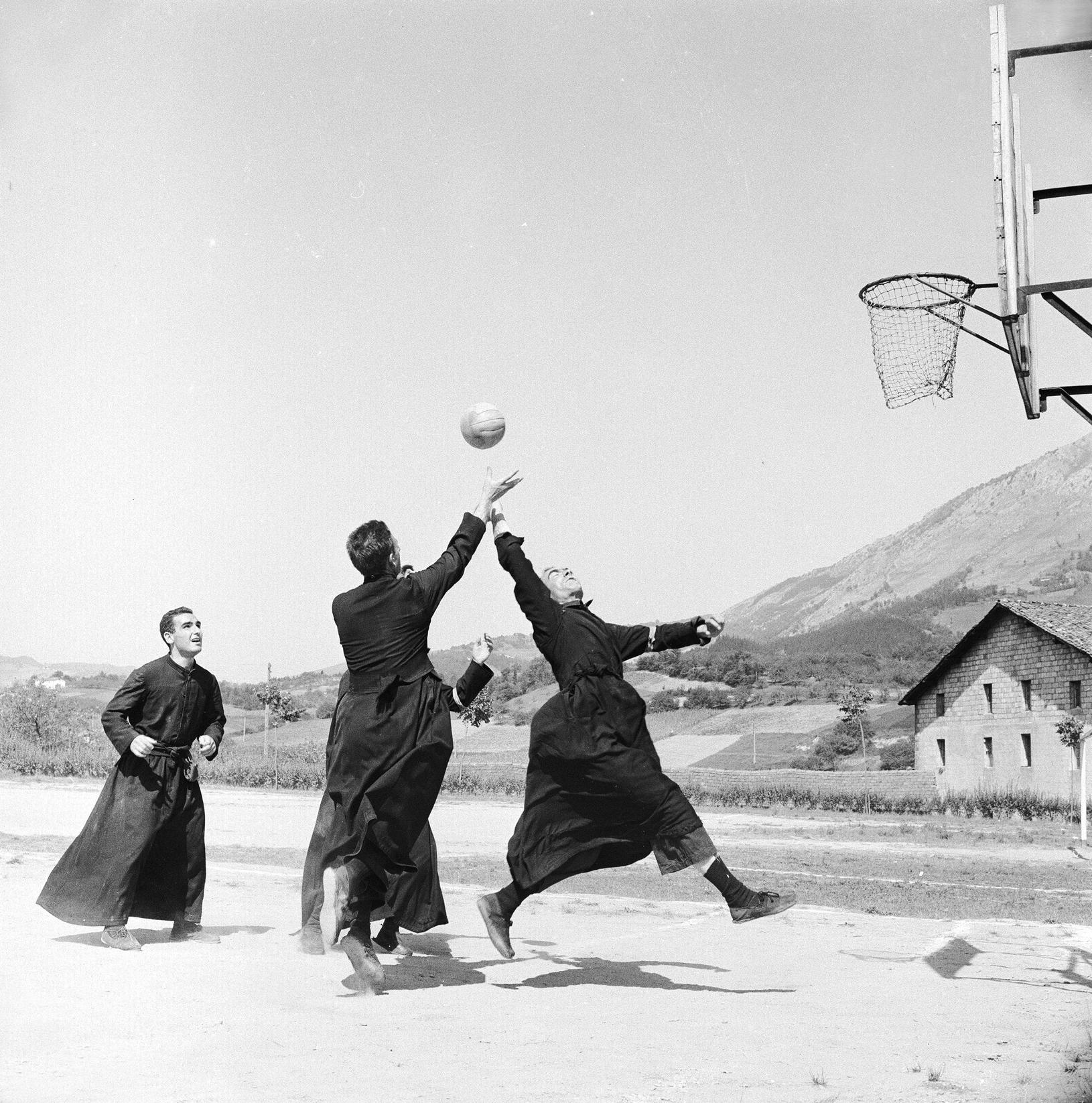
The same applies to lay writers, who are often very impressive.  Nonetheless, they are not Peter.  All of these people are commenting on what Peter has said, failed to say, should say, will never say and that’s fine and dandy.  They are commentators.  We have to take them as such.  I do not take the commentator at clerics playinga Super Bowl show and credit him with the same authority that I credit the referee.  At the end of the day, the person who makes the call whether the ball is in or out of bounds is the ref, not the guy at the microphone.  The guy at the microphone can call the shot anyway he likes it, but his call is not going to determine the outcome of the game.

Listening to and reading what every blogger in town has to say about divorce, remarriage, Holy Communion, same-sex marriage, homosexuality, cohabitation, the family, sex, and many other topics that fall under the umbrella of “family” can be very interesting and very enlightening.  I certainly like knowing what other GOD IS HIDDEN WITHINpeople are thinking.  But I have to remind myself that what I’m reading are the talking points and opinions of others like the sportscaster at the Super Bowl.  These are not the officials who call the shots that shape the outcome of the game.  The only person who can call those shots is Peter.

So far, in this entire discussion on the family, Pope Francis has only said that a synod of bishops has no authority to make or change rules, much less dogma and that the pope calls a synod under his pope franciswatchful eye and under his authority.  Therefore, he and only he can decide what to keep or throw out from what comes from the synod.

Those people who are saying that the Church is going to do A, B, and C, because the synod fathers said something in favor of A, B, and C can be very mistaken.  The Church is going to do whatever Peter decides.  It may be A, B, and C or D, E, and F.

Do not take these bloggers too seriously, nor reporters for that matter or people doing interviews.  Remember St. Francis of Assisi.  A man is what he is before God, nothing else.  None of these men is Peter.  They have strong opinions and are often very rational.  Other times they have very strong opinions and are very illogical.  I don’t pledge my support to the former, because as logical as his opinion may be, he lacks the authority to speak for the Church.  I listen to his opinion and like Mary; I hold these in my heart.  On the flip side, I don’t pledge my allegiance to the latter either, because his opinions are illogical.

Saint Pius XUntil the Church tells me that what appears illogical to me must be obeyed and held, I have no duty to do so.  The key here is “to me”.  Just because something seems right or wrong to me, does not make it so.  Just because I think I understand what the Church has traditionally said on a specific subject does not mean that I do.

We are very proud of what we think, to the point that we throw our ideas out there as if they were revealed truths and we’re willing to insult, hurt, and ignore others who do not agree with our understanding of the faith, morality or Catholic tradition. Which leads me to ask whether at the end of the day, all of these interviews that people are giving, all of these opinions that people are posting on blogs concerning the Church, the family and the pope, and all of these sound bites are just another temptation to pride and disobedience.

How much of all that is said is about love of God and man and how much is about love of one’s opinion and one’s idea of what “is” means?

Conscience in crisis


This year we remember the landmark decision Roe v. Wade of 1973. For 42 years, the American conscience has grappled with the rightness and wrongness of abortion.

Abortion is a human rights issue. If a human being does not have the right to be born, of what use are the other rights that follow? That’s the first problem.

The right to choose does not mean the right to terminate an innocent life. The problem with “it’s a woman’s right” is that we’re saying that a mother has the right to choose to terminate the life of her pre-born child. Should she have the right to terminate the life of a child after he or she is born?

The case of rape does not hold. The father is obviously a heinous criminal, but not the child. He’s her child as well, not just the male’s child. If a parent feels that keeping such a child would do her harm, there are adoption agencies that help with this. One does not need to kill a child to get him out of one’s life.

18week

Another problem with “a woman’s right to choose” is that it strips the man of his right to be a father. The child of a good father only has a father if the woman decides to keep the child – only then the father comes into the equation. However, we’re saying that a raped woman is carrying a “scumbag’s” child. Let’s run with that for a moment. If it’s a scumbag’s child, the child fathered by the good man also has a dad. If the rapist is a parent, so is the good man. What happened to a parent’s duty to bring his children into the world?

We can’t abdicate duties, because we have the means to eliminate the obligation. Means does not make right. We have the means to blow up our planet too.

It is true that we have a duty to protect and provide for those who have been born, regardless of age, social condition and politics. The duty to protect the voiceless is not rooted in the fact that a person has been born so now we have to provide for him.

Our duty to the voiceless is grounded in our humanity. As human beings we acknowledge that other human beings have the same rights as us. They have the right to be born and the right to succeed in life. The human response is to protect those rights from the moment of conception to natural death. Abortion is not a human response. It is a response of humans. Responses of humans are acts of which a human being is capable, but they are not acts that make us better people.

baby_womb

The bible argument does not hold. The fact that Jesus never uses the term abortion does not mean that he was indifferent to it. Abortions did exist in his time. There were many other forms of evil as well.

The Gospel writers report in concepts. Jesus condemned evil, not specific acts alone. Those specific acts that the evangelists mention in the scriptures are given to the reader as examples of evil, not the only evils in the world.

The Scriptures were written as summaries of the faith of God’s people, not as comprehensive statements. If one wants to know what God revealed to man, one must look at the oral tradition as well as the written tradition. Much of what we know about moral truths was passed down from generation to generation through oral tradition. The biblical writings are synopses. We must read beyond the scriptures to fully understand what the early Jews and Christians understood, and understand it as they understood it.

BABY M-2 (2)

[How to Help]

“Walk in my presence . . . ,” Brother begins his journey


The journey of a consecrated brother in the Franciscans of Life has several steps.  At the beginning they seem to move very quickly and then they slowly settle down.  That’s because the early steps are short.  As the child learns to walk, he takes wider steps.

Let’s follow the journey of Br. Bernardo.  It began at Baptism when his parents and godparents promised to raise him in the Catholic faith and he was washed clean of Original Sin by the waters of Baptism and initiated into the Catholic Church.  He would later make his First Holy Communion and then be confirmed, concluding his initiation into the faith.

But God does not stop working with us on the day of our Confirmation.  On that day, He is finished with the initial part of the process.  Then began the next step.  Like any other man, Bernardo had to find his place in the Church.  After a few years involved in campus ministry and debating Traditionalist points on Catholic Answers Forums, he met the Franciscans of Life.  This dialogue/debate between Bernardo and Br. Jay went from 2012 to the September 2013.  It was almost one year.

Br. Jay invited Bernardo to attend a workshop on the Church’s teachings on the life issues with an introduction to Project Joseph.

This is the young man who entered the door on June 14, 2013 at 9:00 AM.  He was very friendly, but reserved and very guarded.  Almost wondering, “What’s a nice boy like me doing in a place like this?”

That didn’t last very long.  Bernardo can’t keep quiet more than 20 minutes at a time and remaining distant is against his nature.  This is a man who is naturally oriented toward others.  This became obvious very quickly, especially as he and Brother Christopher Thomas enjoyed some coffee and donut.

But God was not finished.  Later, Brother Jay would ask Bernardo to visit a family meeting with the Franciscans of Life.  When the meeting ended, he was excited and happy, like a kid who has just been told that he got an A on a math exam.  He continued to attend the family meetings.WP_20140825_066

On August 23, 2014, Brother Jay decided to risk it and invited Bernardo to enter the aspirancy program.  Brother still had reservations.  But he put it all in the hands of the Immaculate.   On the 24th of August, Bernardo accepted the invitation and was received as an aspirant on August 25, 2014.

The aspirants receive a white shirt and a Tau pin that they wear on their collar

WP_20140825_081On October 27, 2014, Brother Jay found himself at prayer in front of the Immaculate.  As usual, he prayed for all of his brothers, secular and consecrated; aspirants, postulants, novices and professed.  He was very tired and his eyes started to close.  As if in  a state between asleep and awake he clearly saw Bernardo’s face.

“Is that whom you want me to call for you,” Brother Jay asked the Immaculate.  “But Mother, there are some complications, because he’s a doctoral student and I don’t yet know his family,” Brother Jay told the Immaculate.  “Please give me a sign that I’m understanding you correctly.”

Suddenly, the sleepiness vanished and Brother Jay started to laugh.  He was not sure what was going to happen next, but he was sure of one thing.  He had a message to deliver for the Immaculate.  It didn’t make a difference whether Bernardo believed it or not.  Brother never promised the Immaculate and she never demanded that Bernardo would believe the message.  He was to deliver the invitation to enter the Franciscans of Life.  The  Immaculate had already placed a strategy in Brother Jay’s mind how Bernardo would be a postulant and finish his degree.  On October 29, 2014, Brother Jay delivered the message and the plan that the Immaculate had put into his mind.  In less than 24 hours, Bernardo accepted the invitation.

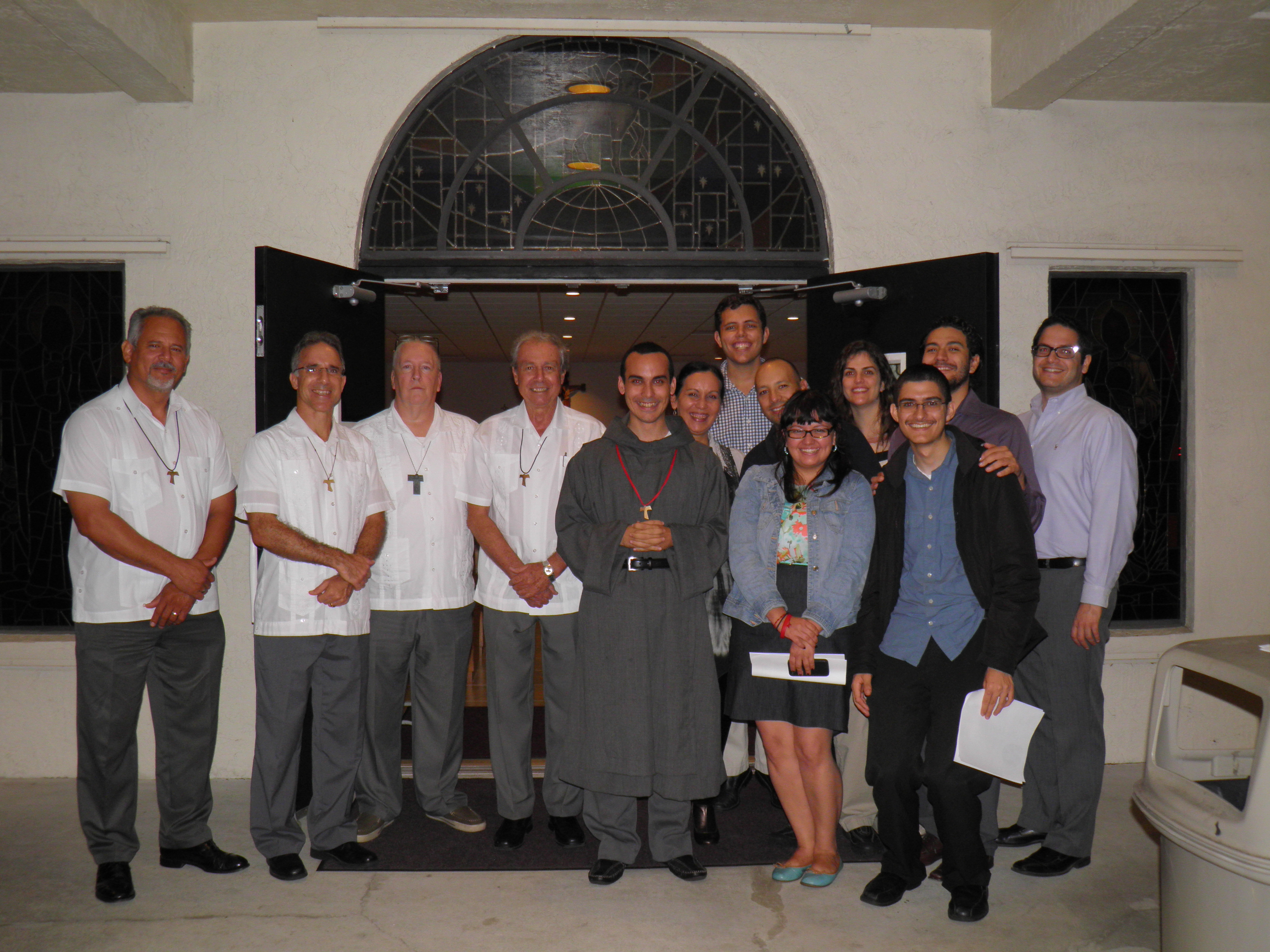
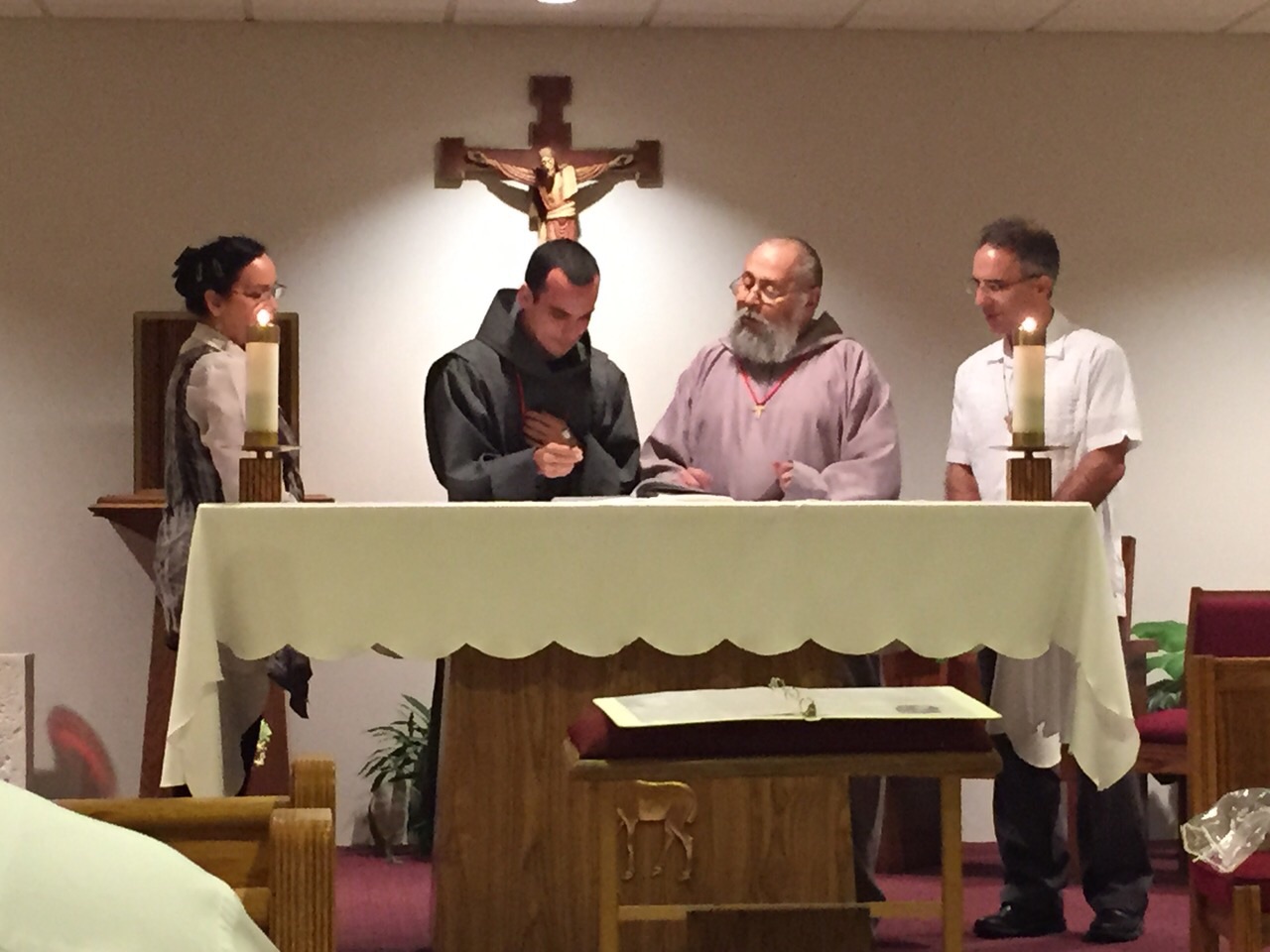
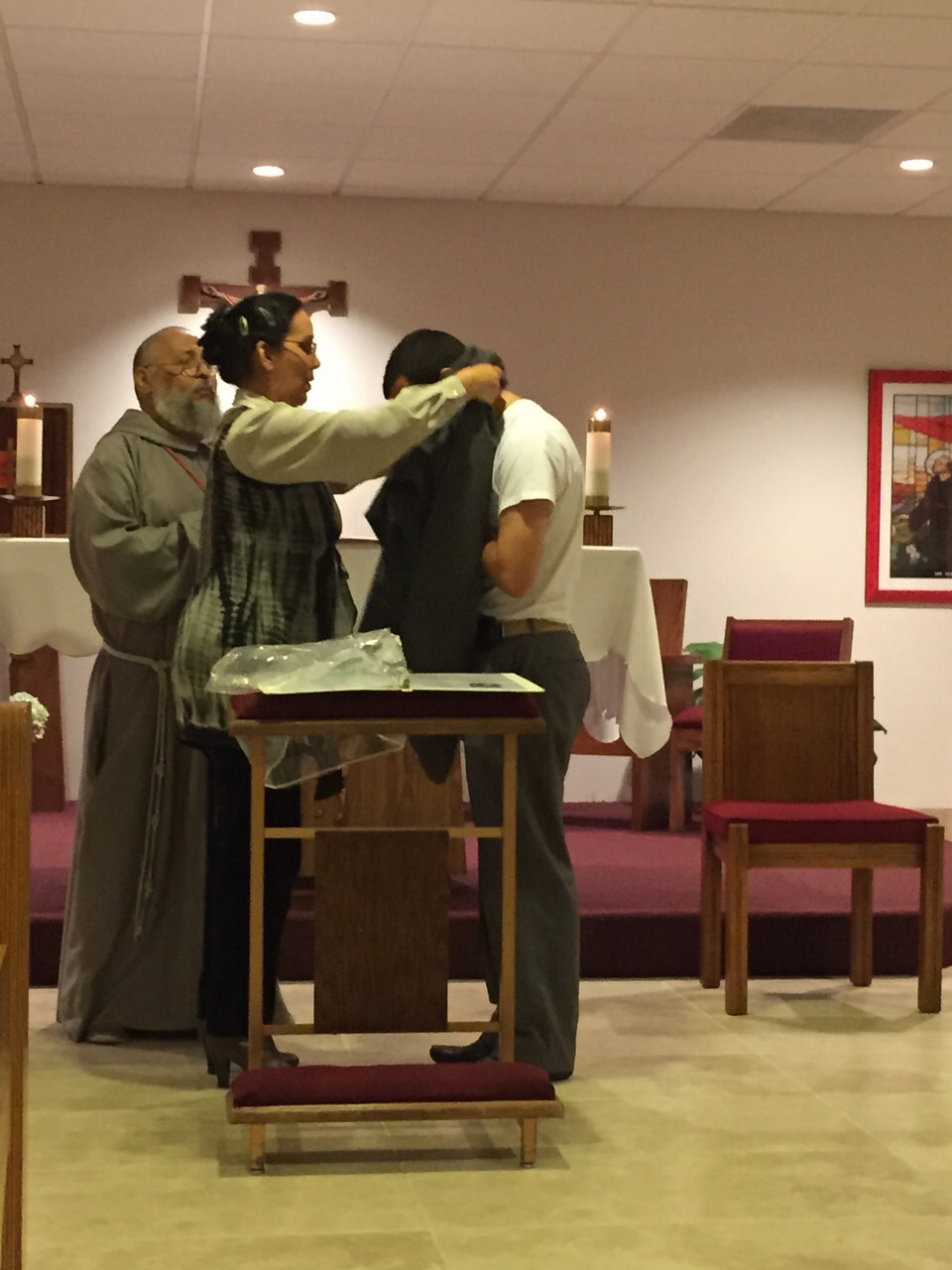
After consulting with the brothers, the date was set.  Bernardo would be invested in the seraphic robe on November 17, 2014 the Feast of St. Elizabeth of Hungary, patroness of the Brothers and Sisters of Penance, whose rule the Franciscans of Life follow.  Brothers have to be invested in the name they received at baptism, when they become novices, a new name is assigned to them.  That evening, he became a Student Brother, in the FFV.  Assisting in the investiture was Mrs. Angela,  Bernardo’s mother and Brother Christopher Thomas, whom Bernardo had chosen as his sponsor and witness.

The habit and all the pieces come in a plastic bag.  Brother Chris was holding the bag, handing Mrs. Torres one piece at a time.  When he handed her the Seraphic Tunic she said, “Que emoción,” which Spanish means “I’m 009so moved.”  

There is no such thing as an investiture without comic relief.  We had to take off Bernardo’s shirt to throw the tunic over his head.  But Bernardo just stood there as his mother and one of us fiddled with the tiny buttons on his shirt.  Finally, Brother Jay said, “Oh for goodness sake.  You can help us, you know.”  The buttons were tiny.

But all worked out well.  At the end of the investiture, Brother, his mother, the brothers and some of his friends who attended took pictures and offered Brother their best wishes.

One thing that the new postulant has to be able to do, besides dress himself is to explain each piece of his habit.  The grey was chosen because it was the original color worn by St. Francis and the early brothers.  The tunic stops at midcalf, because that how many Italian peasants wore them in the 13th century.  The cowl (hood) was worn for warmth and the scapular of Our  Lady we have added over the years in honor of the Immaculate who appeared to St. Simon Stock wearing the clothes of a peasant woman, undyed brown wool for her tunic and apron (scapular) and undyed white wool for the mantle.

The postulant’s habit is held together by a leather belt as a reminder that St. Francis also started his journey wearing a leather belt, before he gave it up for a piece of rope.  The cord is received when one enters the novitiate.

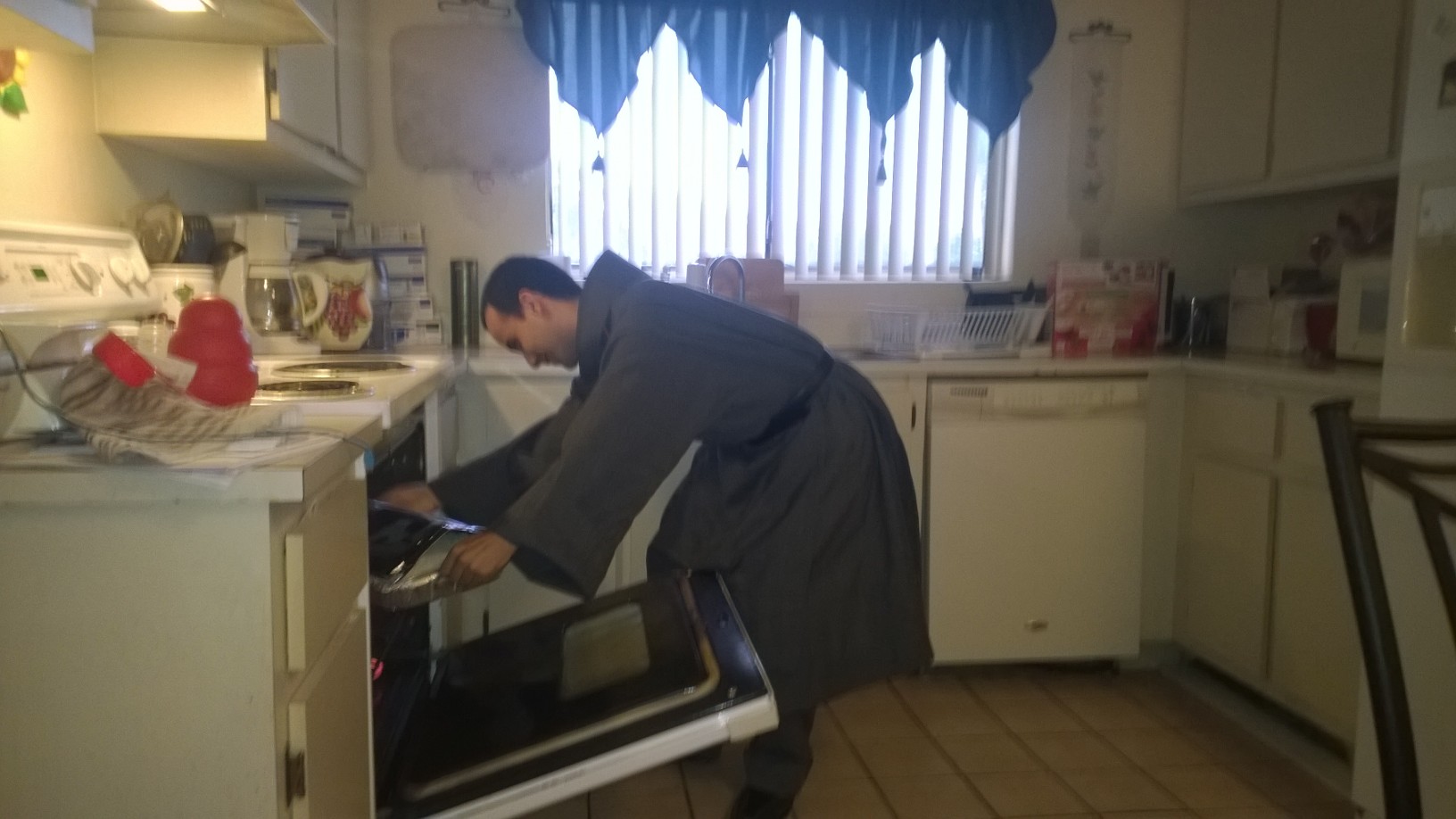
Over the heart, every Franciscan of Life wears the Tau just as St. Francis drew it on his habit when he first learned of its meaning.  Postulants and novices wear a wooden Tau, while professed wear a bronze Tau.  The red cord that holds the Tau in place reminds us of the Passion of Christ to which we have a special devotion.  Finally, there are things to do around the house.  This postulant’s first assignment was to learn how to cook.

Each step is recorded in our family’s chronicles and witnessed by two people other than the superior.  Bernardo had chosen Brother Chris as one of his witnesses, Brother Jay chose Bernardo’s mother to be her son’s second witness, something that does not happen too often. The journey of a new Franciscan of Life only begins here.  There is still much to learn and many steps to be walked.  There is a one year novitiate and at least three years of temporary vows.

You too can walk this path.  Think about it.014

Enjoy the pictures.

Let's see if the oven is ready.

Let’s see if the oven is ready.

WP_20141201_005

Making Mom’s sauce — “Where is she when I need her?”

Figuring out how to cook a precooked lasagna

Figuring out how to cook a precooked lasagna

Getting the lasgna ready for the oven.

Getting the lasgna ready for the oven.

Parents and God: friends or foes?


This week, I’ve had the privilege of working with many parents and their children.  When you work in the field of evangelization, you get to meet many families.  I consider it pretty special.  I always walk away feeling that I have exchanged gifts.  It can be an individual member of a family or an entire family who gives me a gift and to whom I give a gift.

For the sake of privacy and because it would be silly to give so many details, I’m going to combine all of my families into three groups.

GROUP I:

I received a letter from someone whom I do not know.  I have never met this person or any member of her family.  It was a lovely letter.

Brother JR, I just wanted to thank you – you were so instrumental in our family’s conversion five years ago. I spent many long hours reading your articles, which were always gentle and full of the beauty of the faith. For that, for helping us know the beauty of the Catholic Church, I am forever grateful.

God bless you, and please know you’re in my prayers.

This letter moved me a great deal.  The Holy Spirit can use anything and anyone to save.  The key is to be aware of that one is an instrument, not the solution to a problem and certainly not God.  Messages like this help us.

My articles are not written with children in mind.  They’re written for adults.  This means that an adult in the family read the articles and shared it with spouse and children.  This is a parent who has found a means to evangelize the family, a means that works for that family.  This is the duty of parents, to bring their families to the faith.

GROUP II:

The other case is also a letter representative of how other parents think.  I have the honor of helping some men and women discern their vocation.  I like to think of it as walking alongside them.  At the end of the day, God does the calling and they respond.  I’m just there to make sure that the person is paying attention.

In vocation discernment, I not only walk with the inquirer, but I often walk with the parents, if they allow it.

During the walk, I have received many positive and holy reactions from parents, especially those parents who have given God a hearing.  I call it a hearing, because they have sought me out or invited me to their home so as to understand what it is that God is asking of them and their sons.  I’m not God and I’m not the son.  I’m the middleman.  I get the opportunity to have some wonderful conversations with parents about consecrated life, marriage, Holy Orders, and parenting.   I received a letter from a parent that really speaks for the several parents with whom I’ve spoken and edited it for privacy and brevity.

Dear Br. Jay,

God’s greatest gifts to a couple are their children.  It is with great joy and love for God that we support our son’s aspiration to become a religious brother or any other vocation he chooses.  Our son . . . and our family are blessed to have you in our lives.  May our God of love and peace keep you healthy to continue to serve Him.

With much love and admiration,

I had to share this message, because I’ve heard this from other parents.  They understand that their children are a gift.  They understand that giving their son or daughter license to respond to God’s plan for his or her life is an act of love for God and the child.  They understand that having a guide is a blessing that God gives to the family, to the son or daughter and to the guide.  We’re all blessed that God has called us to cooperate with Him in His plan for the salvation of this soul.  They have understood the most important part of all.  God has a plan for every human being who is conceived.

“Before I formed you in the womb I knew you, and before you were born I consecrated you; I appointed you a prophet to the nations.”  Jer 1:5

One’s vocation in life has already been written in God’s heart before one ever existed.  All one has to do is follow what God puts before you in the present moment.  He takes care of the rest.

GROUP III:

I also have had experience with a third group of families who struggle with the idea of a vocation to the priesthood and to the consecrated life.  The reasons for their struggles can be many.  I believe that the bottom line is that they are worried about their children’s happiness.  But here is where faith should enter the picture.

One’s happiness is not dependent on the parent.  A man’s happiness is dependent on the choices he makes.  If he chooses to cooperate with God’s plan for his life, he will be happy.  If he chooses some other plan (no matter how noble), he may as well sign his own death sentence.  There is no happiness outside of God’s plan for you.

In these families, parents want to take charge and direct the son or daughter in whatever direction they believes is best for the adult child.  There can be validity to this.  If my son or daughter were dating someone with a criminal background and were talking marriage, I have a duty to warn my child.  At the end of the day, it is my child who consents to the marriage or not.  It is not I who consent.  My duty before God and child is to guide.  Guidance is not the same as control, manipulation, placing temptations before our children to get them to change their minds (See Thomas Aquinas), nor is it the same as commanding, threatening or using guilt.

The Catechism of the Catholic Church tells us that children living at home have to submit to their parents, meaning to their rules, because it’s the parents’ home.  They do not have to submit to that which is not beneficial to their soul.

As they grow up, children should continue to respect their parents. They should anticipate their wishes, willingly seek their advice, and accept their just admonitions. Obedience toward parents ceases with the emancipation of the children; not so respect, which is always owed to them. This respect has its roots in the fear of God, one of the gifts of the Holy Spirit. (Catechism of the Catholic Church, 2217).

Our faith also tells us that

“Parents must regard their children as children of God and respect them as human persons. Showing themselves obedient to the will of the Father in heaven, they educate their children to fulfill God’s law,(Catechism of the Catholic Church, 2222)

And finally, our faith tells us,

“Parents should respect and encourage their children’s vocations. They should remember and teach that the first calling of the Christian is to follow Jesus (Catechism of the Catholic Church, 2253).

Occasionally, the adult child is up against a parent that seems to have forgotten this.  If I could send a message to parents it would be very simple.

Man was created to cooperate with God, not compete with Him.  To compete with God is to place oneself and one’s child on a slippery slope.  Don’t do it.  You may regret it.  You never know the long-term damage that you may do to your child’s soul.

Some important points to remember.

First, for the parent, competing with God is contrary to the vocation of parenting.  It raises the question, where is God in this picture?

Therefore, life must be treated with the greatest reverence.  Creating obstacles that interfere with the development of a person’s life according to God’s plan runs the risk of violating the sanctity of that person’s life.

I encourage all parents on this slope to step back.  We don’t have to agree with our children’s choices of a vocation.  Our daughter can bring home the last man on earth whom we would pick for her husband; but if there is no moral impediment and he makes her happy, I have to trust that God loves me and loves my child.

Second, for the child, one may never yield to the will of another, when that will is in conflict with God’s plan.  

This includes other people as well, not just parents.  It’s not a license to rebel against parents and follow others down the wrong path.

God makes His plans pretty clear through people, prayer, scripture, sacraments, and events in our lives.  Love of parents is binding until death; but love of God is the first and greatest commandment and it does not end at death.  We are called to love God for eternity.

We too must trust that even if our vocational choice causes our parents some grief, God loves our parents more than we do.  He will give them what they need.  We can never give our parents what God can give them.  We need to move on and give to God what He asks and take what He gives.  Sometimes, the grief is part of God’s plan.  There is such a thing as redemptive suffering.

Father Mitch Pacwa tells the story of how his father swore that he would never speak to him again and would disown him if he joined the Jesuits.  Mother Angelica told the story of how she had to run away from home to join the Poor Clares, because her mother would not hear of it.  I know that Mother Angelica’s mother eventually softened and actually entered the community.  I don’t know if Mr. Pacwa ever made peace with his son.  These two people are examples of a man and a woman who would not stand on the slippery slope with their parents, no matter how much they loved them.  Regardless of how much or how little they understood God’s plan for their lives, they knew that they had to follow the lead that God was giving them.  God would unwrap the rest with time.

If you keep another person company on a slippery slope, because it will make them happy, you may want to ask yourself the question that Christ asked St. Francis.  “Is it better to serve the Master or the servant?”

We must love and assist our parents in every way we can.  But we must always serve the Master first.  When we do, He will give us the means to honor our father and mother.  Was Mary abandoned by Christ?  Yet Christ said,

“Here are my mother and my brothers!  For whoever does the will of my Father in heaven is my brother and sister and mother.” (Matt 12:49-50)

God is both merciful and just.  He will have mercy on those who live according to His plan.  Beware of God’s justice.  It is not God who punishes.  God’s justice is an act of love.  He allows us to live and die with the consequences of our choices.

Jesus said, “Amen, I say to you, there is no one who has given up house or brothers or sisters or mother or father or children or lands for my sake and for the sake of the gospel 30 who will not receive a hundred times more now in this present age: houses and brothers and sisters and mothers and children and lands, with persecutions, and eternal life in the age to come. (Mark 10:29-30)

God created families, parents and children.  When he did so, he had a plan for each member of the family.  None of us can presume to love our parents, spouses, or children more than God loves them.  All of us must see our families as a gift that is part a plan in the mind of God.  We have to allow God to unfold that plan little by little.  As He unfolds it, He also gives us the resources to love each family member even more than we do  now.  In the meantime, we follow the lead that he places before us.  If parents and children make an honest mistake, God will help us find our way.

St. John XXIII said, “Follow the signs of the times.”