Hello friends! Pax et bonum!
We would like to share some highlights from the past few months.
Of course, there has been more going on. 🙂 Lent and the Easter season were spiritually fruitful times full of joy and great moments of fraternity. We also posted two new videos on our Youtube channel (http://youtube.com/franciscansoflife) and several updates and interesting news on our Facebook group (http://www.facebook.com/groups/franciscansoflife). We even published our Wikipedia page (http://en.wikipedia.org/wiki/Franciscans_of_Life). Check them out when you get a chance!
These highlights are from our community life and apostolate – more of an “insider’s peek”. As you go over them, please keep us in your prayers. Also pray for the men who are discerning with us, and for all those whom the Most High will invite to join us when the time is right. Pray that the seed of their vocation may flourish for the proclamation of the Gospel of Life to the voiceless. In the territory in which we serve there is much work to be done 🙂 Please prayerfully consider whether God may be inviting you to walk with us.
General Chapter
As per the Franciscan tradition, the brothers held a General Chapter on Pentecost (actually, the Monday after Pentecost).

The Mother House with the new artwork for Pentecost

The Document of the General Chapter
The tradition of the Capitulum goes back to the 8th Century Benedictines. The first”General Chapter” for an entire community was celebrated by the Cistercians in 1195.
The IV Lateran Council established in 1215 that all religious communities should celebrate Chapters at regular intervals as a means of promoting reform of religious life. At the time of St. Francis, a General Chapter was celebrated twice a year from 1209 to 1216, once a year from 1217 onward.
This is the highest authority over the community, and the decisions taken by the chapter are binding even on the Superior. At the end, a Document is redacted with the mandates of the Chapter and a summary of the discussions, along with an introduction by the Superior General.

Some of the brothers at the General Chapter
Weekend Retreat
The community organized a weekend retreat which also provided an opportunity for a limited number of inquirers to come and see. The theme of the retreat was Conversion of Manners. Brother Chris provided the canopy and the buckets, and installed it with Brother Leo. Brother Leo rescued it from the stormy winds that followed 🙂 After that, the weather was perfect. The participants gathered on Friday afternoon, shut down and put aside their cellphones, and all contact with the outside world became off-limits.
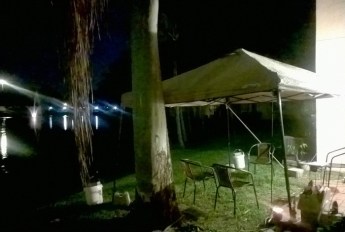
The outdoors location of the retreat

Cells 2 and 3.
The retreat included the prayer of the Liturgy of the Hours, formation, fraternity, times of silence and private prayer, and overnight stay. Visitors were allowed to sleep in their own cella, the same the brothers use. We made sure we washed the sheets ahead of time 🙂 The Superior, as traditional, gave up his cella to a guest – our friend Alex – and slept on the couch.
Visitors also witnessed the Friday night Chapter of Faults, where the brothers accuse themselves before the Superior and their brothers of their faults against the Holy Rule and the Constitutions. Attendance to this ritual is ordinarily reserved to the brotherhood.
It was a joyful and edifying experience. Brother Jay, our Superior, delivered the formation talks. Brother Leo was in charge of the meals.

Br. Leo at work – Max and Tasha stand guard
Brother Bernardo ensured that the citronella candles were lit (he has a thing about our brothers mosquito) and helped take down the canopy at the end of the retreat.
Five minutes later, a storm hit again, with much lightning. Brother Jay remarked that the guys taking down the canopy reminded him of Ben Franklin trying to harness the power of lightning 😛

The Storm!
Solemn Promise
On June 20, Extern Brother Luis Charbel, having completed his formation, made his Solemn Promise to live according to the Holy Rule of Penance and our Constitutions for one year. The Extern brothers do not profess the Evangelical Counsels, but they bind themselves to observe their spirit in accordance with their state of life. They are truly members of the fraternity, and the Constitutions provide separate chapters to guide them. Brother Luis Charbel is an exemplary Extern Brother. His entire family attended the event, which took place at the Chapel of St. Maximilian Kolbe Catholic Church during the liturgy of Vespers – including his 28-week pre-born child 🙂

Br. Luis professes his Solemn Promise
Project Joseph
The brothers were very excited that Tom, a good friend of the community who had begun his training to be a Project Joseph mentor, completed his training and began serving the dads of the North Dade Center of Respect Life Ministry Archdiocese of Miami. The dads are very excited to be able to have a weekend session and this is also the first time that a Respect Life center offers two weekly Project Joseph sessions! Brother Bernardo was assigned as liaison between the mentors and the center director. He reports directly to our Superior, who oversees the entire Project from the administrative office. Keep your eyes on the Florida Catholic for more on Project Joseph and the Franciscans of Life 😉
Announcement of the new session
Adopt-a-Brother
 We want to express a heartfelt thank you to our friends and benefactors who have participated and still participate to our fundraising to cover the education of our brothers.
Graduate school in Spiritual Theology and Education is an expensive proposition for our emerging community, but these are skills that we need to serve the voiceless in our ministry. We do not charge the Church or the people whom we serve. Following the Testament of St. Francis, the brothers work to provide for their needs and, only when necessary, they beg. Our monthly income keep our simple living quarters and car up and running and cover for food and medical expenses.
The Adopt-a-Brother program is still up and running. You can read more about it here. We post updates on our Facebook group and we will notify when we have reached our goal. We only ask for as much as we actually need. 🙂

The FFV Motherhouse

The statue of Our Lady at the Motherhouse. It is the same image from the Miraculous Medal which all the brothers wear.


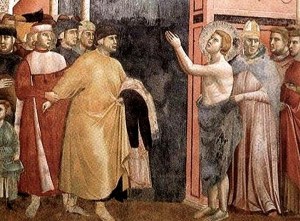 hy man choose celibacy and chastity over a woman?” Another popular question, “How can you live without a woman?”
 can love another person and be intimate. However, when he experiences the love of God, he is filled with peace, interior silence, joy, and courage that he has never experienced. His life is different and he wants more. He cannot turn back to the love and intimacy of human romance, not because human romance is bad, but because he has found something even better than good. He has found Him who is the perfect lover: God.
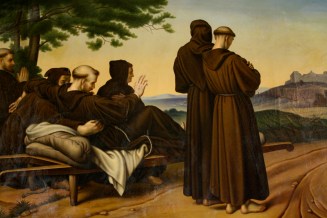 How does he know this? He no longer question himself or his relationship. He is truly loved by God and he freely returns that love. He no longer wonders whether his beloved will change his mind. His relationship is no longer about liking what he feels or what the other feels for him.


 These are our sleeping quarters, also called cells. No brother owns anything, not even a room of his own. A large room is divided by curtains, as you would see in a hospital. Behind each curtain there are two beds for two brothers, bunks. There is an aisle along the length of the bed that is 18 inches wide and another curtain, behind which there is another cell with two more beds the same size. The brothers always remember Jesus’ words, “The Son of Man has no place to lay his head.”
 Every brother is assigned a flat sheet and a single blanket. We use only what we need, not what we like. We don’t use comforters or fancy bedspreads. The money that can be spent on those items can just as easily be put into our apostolate among the voiceless, even if it’s just paying for gas to get from point A to point B. After a few days, one becomes so accustomed to this arrangement, that we no longer miss our old bedroom in our former home. The community house becomes home and the cells become our bedrooms; but they are more than that. It is here that we experience the intimacy and poverty of the fraternal life that St. Francis so loved. Like Christ and his Apostles and like Francis and the early brothers who shared huts, the brothers practice charity and detachment.
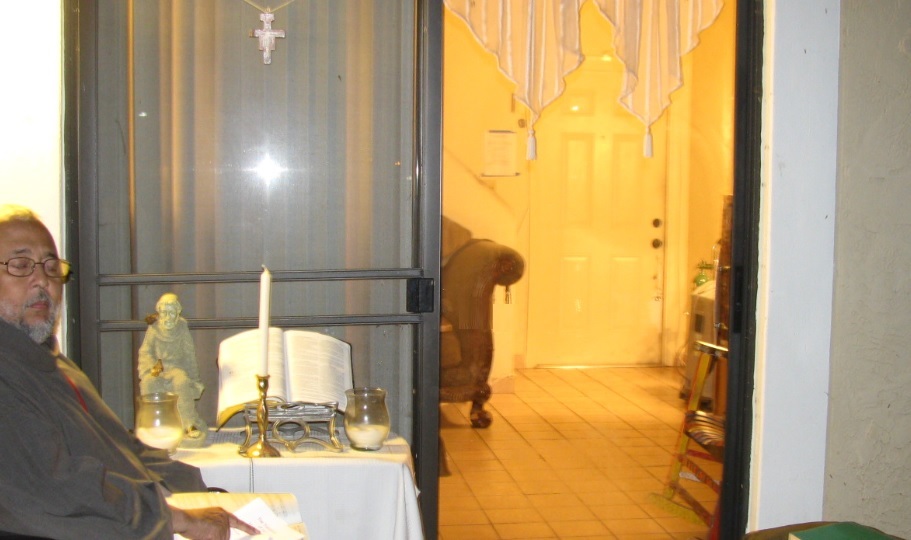
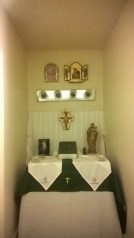 In the sleeping area there is always a small oratory. An oratory is not a chapel. The Blessed Sacrament is not reserved there. Oratory comes from the Latin word oratio, meaning to speak and to pray. Oremus,”Let us pray. Let us speak with God.” The brothers last conversation before retiring is with Jesus and His Immaculate Mother. His first conversation of the day is also with the beloved Mother and Son. During the day, the brother sneaks into the oratory, like a lover sneaking along the hedges to have a quiet words with his sweetheart. Christ and the Immaculate are our sweethearts.
 We don’t have closets, since we don’t have many clothes. We share a row of hooks where we hang up our formal and work habits. We also have a pair of grey pants and a grey banded shirt. Here you see a typical work habit for a postulant. Novices and professed brothers wear it with a cord or without a cord, depending on the task at hand. The work habit it short. It does not reach the knees. It’s our version of grunge clothing. Nothing is ever wasted. Our Constitution reminds us that like St. Francis, we follow the poor and suffering Christ who walked to Calvary in shredded clothes, except for his sacred seamless tunic. When a garment is too damaged to wear, it is cut up and used to patch up other work habits. It is not unusual to see our brothers wearing patches on their work habits or displaying grease stains from an engine. These stains are tough to wash out. But we manage.
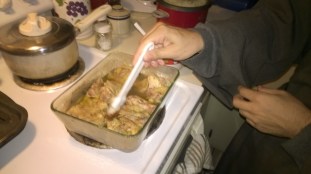 We don’t have cooks or housekeepers. Those are chores that we do ourselves. The brothers take turns cooking, scrubbing and cleaning. Those brothers who have never done it before or don’t know how are taught by more experienced brothers.
 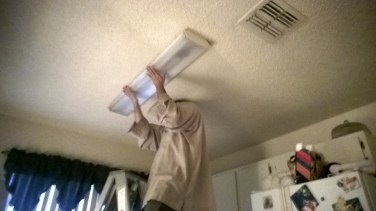 St. Francis said that we are to be “minors”. During the Italian Middle Ages there was a social class known as the Minores. It seems that these men and women were of the lower class of serfs and peasants. Even among the peasants, there was social stratification. Christ reminds us that we have been sent to serve, not to be served. “Go out and do what I have done for you.”

 We even have two pups. The black and brown handsome fellow is Max, named after St. Maximilian Kolbe.
  The little fawn cutie is Tasha, named after a character on Star Trek Generations. Yes, we have former Trekkies among us. The brothers may not watch television. Start Trek is out of the question. Besides, who has time.
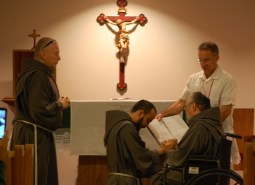
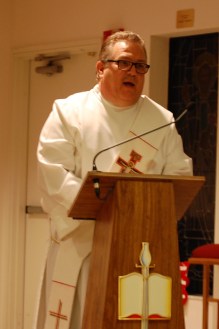
 Brother Bernardo’s from his days at university, other friends from the area and his mother, Mrs. Angela Torres. The group was small. The ceremony was simple, dignified, reverent and above all, prayerful.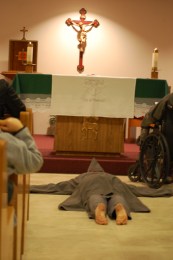








 3.
3. Franciscans of Life