To answer the first question, NOTHING. We stopped torturing people a long time ago. Having said that, you may find that you go through a transformation that you never thought was possible. “I can never do that.” Many people say.
The first thing one learns is to share. For us, this means living in very small spaces. You thought that an airplane bathroom was small? Check out our sleeping arrangements.
 These are our sleeping quarters, also called cells. No brother owns anything, not even a room of his own. A large room is divided by curtains, as you would see in a hospital. Behind each curtain there are two beds for two brothers, bunks. There is an aisle along the length of the bed that is 18 inches wide and another curtain, behind which there is another cell with two more beds the same size. The brothers always remember Jesus’ words, “The Son of Man has no place to lay his head.”
 Every brother is assigned a flat sheet and a single blanket. We use only what we need, not what we like. We don’t use comforters or fancy bedspreads. The money that can be spent on those items can just as easily be put into our apostolate among the voiceless, even if it’s just paying for gas to get from point A to point B. After a few days, one becomes so accustomed to this arrangement, that we no longer miss our old bedroom in our former home. The community house becomes home and the cells become our bedrooms; but they are more than that. It is here that we experience the intimacy and poverty of the fraternal life that St. Francis so loved. Like Christ and his Apostles and like Francis and the early brothers who shared huts, the brothers practice charity and detachment.
The cells are in the enclosed part of the house where no outsiders may enter, male nor female, not even our moms. While in the cells, we avoid unnecessary conversation so that in solitude and silence the soul may be more attentive to the voice of God speaking from within. The cell and the enclosure are only external reminders of an internal attitude that every brother should have. Each of us carries within him an interior cloister where only the soul and God interact. This awareness is the summit of poverty, when you own nothing, not even your inner space . . . everything belongs to the Beloved.
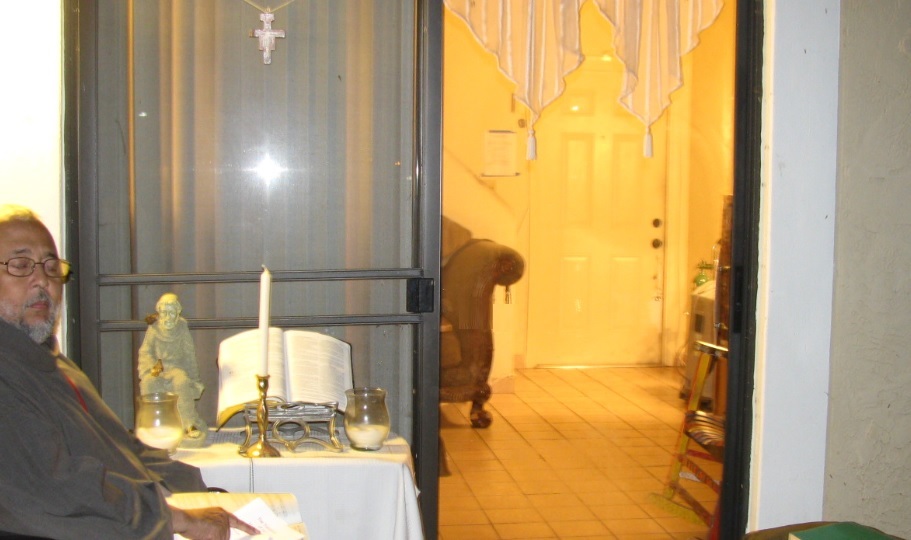
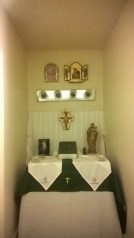 In the sleeping area there is always a small oratory. An oratory is not a chapel. The Blessed Sacrament is not reserved there. Oratory comes from the Latin word oratio, meaning to speak and to pray. Oremus,”Let us pray. Let us speak with God.” The brothers last conversation before retiring is with Jesus and His Immaculate Mother. His first conversation of the day is also with the beloved Mother and Son. During the day, the brother sneaks into the oratory, like a lover sneaking along the hedges to have a quiet words with his sweetheart. Christ and the Immaculate are our sweethearts.
 We don’t have closets, since we don’t have many clothes. We share a row of hooks where we hang up our formal and work habits. We also have a pair of grey pants and a grey banded shirt. Here you see a typical work habit for a postulant. Novices and professed brothers wear it with a cord or without a cord, depending on the task at hand. The work habit it short. It does not reach the knees. It’s our version of grunge clothing. Nothing is ever wasted. Our Constitution reminds us that like St. Francis, we follow the poor and suffering Christ who walked to Calvary in shredded clothes, except for his sacred seamless tunic. When a garment is too damaged to wear, it is cut up and used to patch up other work habits. It is not unusual to see our brothers wearing patches on their work habits or displaying grease stains from an engine. These stains are tough to wash out. But we manage.
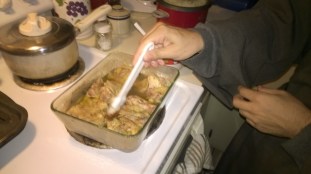 We don’t have cooks or housekeepers. Those are chores that we do ourselves. The brothers take turns cooking, scrubbing and cleaning. Those brothers who have never done it before or don’t know how are taught by more experienced brothers.
  St. Francis said that we are to be “minors”. During the Italian Middle Ages there was a social class known as the Minores. It seems that these men and women were of the lower class of serfs and peasants. Even among the peasants, there was social stratification. Christ reminds us that we have been sent to serve, not to be served. “Go out and do what I have done for you.”

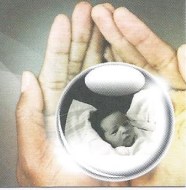
It’s time to leave. A brother may be going to class at the university, while another is going to the hospital or to hospice and another brother is on his way to do counseling or education with dads in crisis pregnancies or going to visit a newborn baby that was going to be aborted. The brother is always there to say “Hi Little One”
 We even have two pups. The black and brown handsome fellow is Max, named after St. Maximilian Kolbe.
  The little fawn cutie is Tasha, named after a character on Star Trek Generations. Yes, we have former Trekkies among us. The brothers may not watch television. Start Trek is out of the question. Besides, who has time.
No day is complete without prayer and the
Holy Eucharist.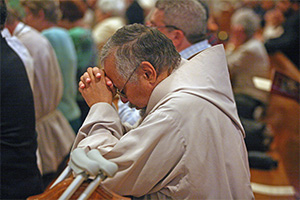
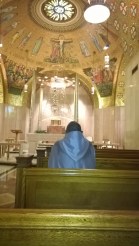
In between we manage to insert
an hour of private prayer at 5:30 AM, the Liturgy of the Hours: morning, midday, evening, night and midnight. There is always time for the Holy Rosary.

I VOW AND PROMISE . . .
COME AND SEE

 I found this article to be very helpful and supportive of what I presented in an earlier post, “Under Whose Authority “
 I will never forget what a 10th grade student taught me a long time ago. I was teaching social studies in a high school. Mind you, I’m not a sociologist or social scientist. Our social studies teacher was on maternity leave and I was elected to cover for her. That being said, the lesson was on the United Nations’ declaration on human rights. As we were going through the highlights of the document, Chris asked me a very serious question.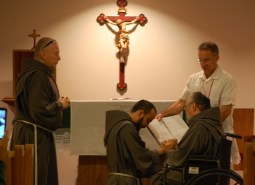
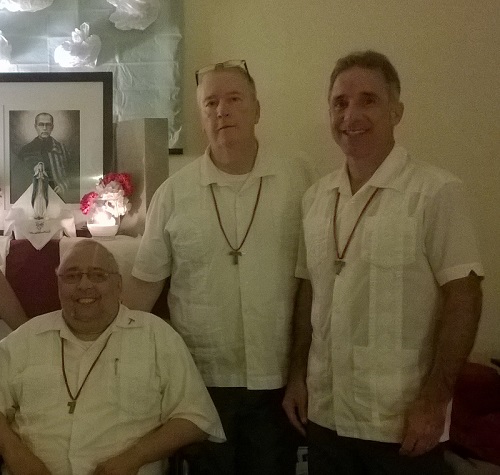
 Brother Bernardo’s from his days at university, other friends from the area and his mother, Mrs. Angela Torres. The group was small. The ceremony was simple, dignified, reverent and above all, prayerful.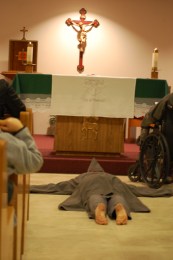


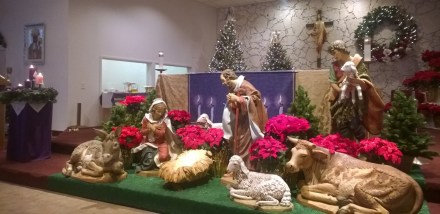
 e Incarnation and the Virgin Birth set into motion the journey to Calvary and our redemption.

 As we prepare for Christmas Day, many small, but wonderful things are happening in our community. Probably the most exciting is the fact that we held a chapter and Brother Bernardo D’Carmine’s request to make vows as a regular brother was accepted by the chapter and ratified by the superior. A regular brother is one who makes vows, lives a celibate life in community and follows a monastic schedule during the day. An extern brother is one who makes a solemn promise to observe the rule and constitutions. However, he remains in the world This can be a diocesan deacon or priest, a married layman or a single man who is hoping to marry.
 ls with hands in the superior’s hand. The superior asks him, “Are you firmly resolved to live the Gospel walking in the footsteps of St. Francis under the protection of the Immaculate.”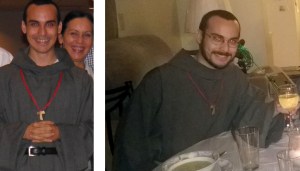











 3.
3. Franciscans of Life