Los Desastres son Oportunidades para Experimentar la Incarnación de Cristo


For English, click here

Cuando el huracán Irma se acercaba al Sur de la Florida, como superior de los Franciscanos por la Vida otorgué a los hermanos permiso para salir de la Florida, buscar refugio en un sitio más seguro, o quedarse en la casa de la comunidad.

Personalmente, escogí quedarme en la casa de la comunidad, también conocida como nuestra “casa madre”. Esto no es asunto de ser bravo o héroe. Sencillamente es nuestra forma de entrar en unión con los pobres. Nuestra casa se halla en una comunidad de bajos recursos. La gente aquí no tiene el dinero para ir lejos. Sus opciones eran ir a unas de las escuelas públicas buscando refugio o fortificar sus casas lo mejor posible y quedarse ahí.

Con frecuencia, el Papa Francisco habla sobre salir a las periferias. También ha utilizado expresiones como “tener olor a oveja”. Contrariamente a lo que muchos piensan, estas ideas no son nuevas.

En el Antiguo Testamento encontramos a Moisés, quien creció como príncipe siendo hijo adoptivo de la princesa. Él sale al encuentro de los esclavos hebreos, respondiendo al mandato del Señor de librar a Su pueblo de la esclavitud. Dios le dijo a Moisés que guiara a Su pueblo fuera de la esclavitud, pero no le quitó su libertad individual. Moisés podía volver a su vida de comodidad y haber dejado que Dios buscase alguien más para que saliera a las periferias y lidiara con los esclavos hebreos que eran pobres, incultos, y a veces infieles a su religión. En otras palabras: los hebreos en esclavitud vivían “en las periferias” por muchas razones. Eran esclavos, extranjeros, monoteístas, no tan sofisticados como los egipcios, y frecuentemente infieles a su religión. Sin embargo, Moisés sale a su encuentro. Los guía fuera de Egipto y muere en medio de ellos.

En el Nuevo Testamento, Nuestro Señor Jesucristo se acerca a los recaudadores de impuestos, a los Samaritanos que fallaban en religiosidad, y a los que la sociedad rechazaba por tener discapacidades o lepra. El Señor se hace uno con ellos. Igual a ellos es víctima, pero Él es la víctima sin mancha de pecado que será elevada en la cruz como ofrenda por los muchos.

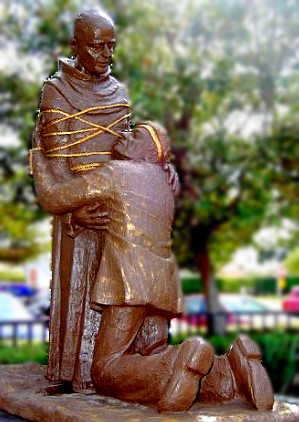
En fin, quisiera mencionar a San Francisco de Asís. Francisco vivió y sirvió entre los leprosos. Mendigó  por su  manjar como un peón, a pesar de ser hijo de un rico comerciante. Él y sus hermanos vivieron en refugios muy pequeños y primitivos. Con frecuencia se refugiaban debajo de pórticos para que la lluvia no les mojara demasiado, y allí pasaban la noche.

Cuando un hombre hace votos como Franciscano por la Vida, sabe con seguridad que su vida jamás será igual.

Dejará detrás de sí todo aquel que consideraba “normal” y “correcto”. Abrazará una vida que puede parecer en contra de la naturaleza. La nuestra es una vida en fraternidad con los que no tienen voz. Hacemos voto de hacernos uno con ellos. Nuestra pobreza no es una imposición del pecado del hombre, sino un don de Diós. La abrazamos como la Segunda Persona de la Santísima Trinidad abrazó nuestra humanidad.

Hombre desamparado busca refugio en una parada de autobús durante el huracán Irma

Es importante que las personas de fe oren por las víctimas de los huracanes Harvey, Irma, y José. También es importante que aquellos entre nosotros que tienen la posibilidad de hacerlo se acerquen a las víctimas de estos desastres naturales.

Con demasiada frecuencia, algunos individuos se sientan en la cátedra del juez como “teólogos del apocalipsis” y proclaman confianzudamente que “Dios está bravo” o que “esta es la gran tribulación descrita por Juan en el Libro de la Revelación”, o que “Nuestra Señora de Fátima nos alertó sobre lo que está ocurriendo”.

La verdad es que nadie tiene acceso íntimo a la mente de Dios para conocer el sentir de Dios hacia cualquier cosa que Él no ha dicho a través de la Revelación o de la Iglesia. Ni hay nadie que tenga acceso al plan de Dios para la purificación de la humanidad.

Afirmar que Harvey, Irma, Corea del Norte, el terremoto en México, etc. son castigos de Diós es arrogancia. El hombre afirma conocer la mente de Dios en situaciones muy específicas. Pero las Escrituras nos recuerdan que nadie conoce la mente de Dios. “Con respecto a ese día y esa hora, nadie los conoce, ni los ángeles en el cielo ni el mismo Hijo, sino solamente el Padre” (Mt 24:36).

¡No presumamos conocer la mente de Dios o entender porqué Dios permite que estas cosas ocurran! Recordemos que los desastres naturales han sido parte de la historia de este mundo desde el comienzo de su existencia. Afirmar que los desastres naturales de hoy en día son el gran castigo de Dios y la señal de los últimos días es presunción.

Sin embargo, no es presunción caminar con aquellos que sufren en estas situaciones. Hay muchas formas de hacerlo. Podemos ayudar a un vecino que se prepara para un acontecimiento natural o se siente desolado y confundido después de la tragedia. Podemos invitar a otros para que oren a Dios que dé a cada víctima lo que él o ella necesita, no lo que nosotros pensamos que necesitan. Debemos evitar la tentación de dictarle a Dios lo que Él debe dar y no dar a los demás como si fuésemos Sus supervisores.

Somos Sus servidores. Nos acercamos al Señor. Le pedimos que nos escuche. Le ofrecemos nuestras oraciones de petición para que Dios provea para los necesitados lo mejor para ellos. Junto a esto, también le pedimos a Dios que nos otorgue la gracia, la valentía, y la generosidad de salir al encuentro de aquellos que han sufrido a causa de estos acontecimientos. Dios quiere que nos acerquemos a ellos. Lo vemos en el Evangelio según Mateo: “Lo que han hecho por el menor de mis hermanos, lo han hecho por mí”.

En fin, citando Evangelium Vitae (El Evangelio de la Vida):

“Algunas amenazas [a la vida] provienen de la misma naturaleza, pero son empeoradas por la culpable indiferencia y negligencia de aquellos que en ciertas ocasiones pudieran remediarlas” (EV 10).

Jamás olvidemos que “fuimos rescatados de las vías fútiles de [nuestros] padres no con cosas perecederas como oro y plata, sino con la preciosa sangre de Cristo, cordero sin mancha” (1 Pt 1:18-19).

No podemos quedarnos sentados intentando leer la mente de Dios. Estos acontecimientos ocurren para el bien de todos. La sangre de Jesucristo, al revelar la grandeza del amor del Padre, nos muestra cuán precioso es el hombre a los ojos de Dios y cuán valiosa e inestimable es su vida. Si vemos la vida como Dios la ve, entonces no nos sentamos a profetizar el Armagedón. Sencillamente hacemos lo que Dios mismo hizo: nos encarnamos en medio de aquellos que sufren, como Cristo mismo se encarnó y sufrió con y por ellos.

Published in: on September 12, 2017 at 5:23 PM  Leave a Comment  

Disasters are Opportunities to Relive the Incarnation of Christ


Para Español Señale Aqui

When Hurricane Irma began to approach South Florida, as superior of the Franciscans of Life, I gave the brothers permission to leave Florida, seek shelter in a safer location, or remain at our community house.

For my part, I remained at our community house, also known as our “motherhouse”.  This is not a matter of being brave or a hero.  It’s our way to become one with the poor.  Our house is in a low-income community.  The people here don’t have enough money to go too far.  Their choices were to go to one of the local public school to seek shelter or to fortify their homes as best as possible and hunker down.

Pope Francis frequently speaks about going to the peripheries.  He’s also been known to use some “colorful” expressions such as “smelling like the sheep.”  Contrary to what many people may think, these ideas are not new.

In the Old Testament, we see Moses, who was brought up like a prince as an adopted son of the princess.  He goes out to the Jewish slaves, responding to God’s command to lead His people out of slavery.  God told Moses to lead His people out of slavery, but He did not take away his freedom.  Moses could have walked back into his comfort zone and let God find someone else to go out to the peripheries and deal with the uncouth, probably poor and sometimes unfaithful Jewish slaves.  In other words, the Jews in captivity were on the peripheries for many reasons.  They were slaves, foreigners, monotheistic, not as sophisticated as the Egyptians, and often very unfaithful to the faith.  But Moses went to them.  He took them out of Egypt and he died among them.

In the New Testament, Jesus goes out to the tax collectors, prostitutes, less than religious Samaritans, and to those rejected by society due to handicap or leprosy.  He becomes one with them.  In becoming one with them, He becomes the unblemished victim of human sinfulness, which was raised on a cross and offered for the many.

Finally, I want to mention St. Francis of Assisi.  Francis lived and served among the lepers.  He begged for his food like a common peasant, despite that he was the son of a wealthy merchant.  He and his brothers lived in very small and primitive shelters.  Often, they had no shelter.  They cuddled up under the awning of an entrance to avoid getting too wet by the rain.  There they spent the night.

When a man makes vows as a Franciscan of Life, the one thing that he knows coming in is that his life will never be the same.

He will leave behind everything that he thought was “normal” and “right”.  He embraces a life that can appear to be against nature.  Ours is a life lived in fraternity with the voiceless.  We vow to become one with them.  Our poverty is not imposed on us by man’s sins.  Our poverty is a gift from God.  We embrace it as the Second Person of the Most Holy Trinity embraced our humanity.

Homeless man seeks shelter at a bus stop during Hurricane Irma.

It is important that people of all faith pray for the victims of Hurricane Harvey, Hurricane Irma, and soon, Hurricane Jose.  It is also important that those of us who have the means to do so, reach out to those who are the victims of these natural disasters.

All too often, some people sit on the chair of judgment as an “Apocalyptic Theologian”, making broad statements that “God is angry” or that “this is the great tribulation that John described in the Book of Revelation” or that “Our Lady of Fatima warned about this”.

The truth is that no one has intimate insight into the mind of God to know how God feels about anything that He has not disclosed through Revelation or the Church.  Nor does anyone have access to God’s plans for the purification of humanity.

To claim that Harvey, Irma, Jose, North Korea, and an earthquake in Mexico is God’s retribution, is arrogance.  Man is claiming to know the mind of God in a very specific situation.  Scripture tells us that no one knows the mind of God.  “But about that day or hour no one knows, not even the angels in heaven, nor the Son, but only the Father,” (Mt 24:36).

Let us not presume to know the mind of God and why God allows these things to happen!  Let us also remember that natural disasters have been part of the earth’s history for as long as it has existed.  To point to those of today as the great punishment from God and the sign of the end times, is presumptuous.

One the other hand, it is never presumptuous to walk with those who suffer in these situations.  There are many ways to do this.  We can lend a hand to our neighbor preparing for a natural event or lost and confused after the tragedy.  We can invite others to pray that God will give each victim what he or she needs, not what we think the victims need.  We must avoid the temptation to dictate to God what He should give and withhold from others, as if we were His managers.

We are His servants.  We approach God.  We ask Him to hear us.  We offer our prayers of petition that God may provide for those in need what is best for them.  Along with this, we ask God to give us the grace, courage and generosity to reach out to those who have been hurt by these events.  God often wants us to reach out.  We see this in Matthew.  “As long as you did it for one of these, the least of my brethren.  You did it for me.”

Finally, from Evangelium Vitae (Gospel of Life):

“Some threats [to life] come from nature itself, but they are made worse by the culpable indifference and negligence of those who could in some cases remedy them,” (EV 10).

Let us never forget that we “were ransomed from the futile ways inherited from [our] fathers, not with perishable things such as silver or gold, but with the precious blood of Christ, like that of a lamb without blemish or spot” (1 Pt 1:18-19).

We cannot just sit around trying to read God’s mind.  These events happen for the benefit of all.  The blood of Christ, while it reveals the grandeur of the Father’s love, shows how precious man is in God’s eyes and how priceless the value of his life.  If we see life as God sees it, then we don’t sit and prophesy Doomsday.  We do what God did.  We become incarnate among those who suffer, as Christ became incarnate and we suffer with and for them.

Naciste el Día del Trabajo


For English, click here

El Día del Trabajo (EE.UU.) ha llegado. En la mayoría de los países, esta fiesta es un desconocido.  Para añadir a mi manera poco ortodoxa de pensar, creo que el Día del Trabajo y el Día de la Madre deben celebrarse juntos. Hacer el primer lunes de mayo, el Día del Trabajo y el segundo domingo de mayo, Día de la Madre. No puedo imaginar una experiencia más tierna y una mayor obra de amor que dar a luz.

Dicho esto, quisiera compartir con ustedes cómo se enseña a los Franciscanos de la Vida a razonar sobre el Día del Trabajo.

Primero: El día Debe comenzar con una lectura de la Historia de la Creación del Libro del Génesis.

Debe ser leído de la manera que los escritores intentaron compartir con sus descendientes. No es un relato científico o incluso histórico de la creación. Es más grande que eso. Es la historia Revelada de la Creación.

Dios se reveló como el origen de todo lo que existe. Se revela como un Padre generoso que da a sus hijos todo lo que necesitan. Hasta la caída de Adán, nada faltaba en la vida del hombre. Él revela que todo en la Creación, incluso los insectos feos que nos molestan son buenos.

Observe que cada etapa de la Creación termina con “y Dios vio que era bueno”. Si el hombre respeta la bondad del orden natural y la bondad de todas las cosas y seres creados, el mundo sería verdaderamente un Jardín del Edén. Este mensaje está muy claro en Génesis. El Jardín del Edén es un lugar donde todas las cosas y todos los seres coexisten en armonía, cada uno respetando el dominio del otro y todo cumple con su papel en el plan de Dios para nuestra salvación.

Segundo: Cuando yo era misionero en América del Sur, la gente a menudo me preguntaba por qué los estadounidenses no trabajaban el Día del Trabajo. Ellos encontraron que esto era una contradicción. Siempre he explicado que es un día que dejamos de lado para honrar a los trabajadores y la empresa humana.

La pregunta es, ¿en América pensamos verdaderamente en todos los trabajadores, o sólo en aquellos que se sientan detrás de un escritorio?

¿Apreciamos el hecho de que, si no fuera por los que trabajan para el Departamento de Saneamiento, estaríamos viviendo en la Edad Media, donde ratas e insectos se alimentaban de la basura que la gente tiraba a la calle y que los niños jugaban a menudo con estas pequeñas criaturas y fueron mordidos por los mismos y murieron? Gracias a los trabajadores de saneamiento, los niños estadounidenses no tienen que sentirse amenazados por roedores e insectos infecciosos. Pueden jugar con relativa seguridad en su patio o en un parque.

(C) New York City Dept. of Sanitation

Llegan los días de fiesta y se van. Las mañanas vienen y también se van. ¿Quién recuerda que el trabajador del saneamiento, el maestro, el abogado, el médico, mesero y cada trabajador en este mundo tiene una vida fuera de su lugar de trabajo? A veces, se enfrentan a grandes dificultades en sus vidas fuera del trabajo. Para algunos, el trabajo es un respiro de los problemas familiares, la enfermedad de un padre anciano, un matrimonio abusivo y otros problemas. Si no oramos por estas personas durante el año, ¿podemos al menos recordarles en oración el Día del Trabajo?

Tercero: No estaba bromeando sobre las madres. Dar a luz es un acto de verdadero amor.

Durante 40 semanas, una mujer se prepara para conocer a su pequeño. Pero a medida que pasan las semanas, las molestias aumentan. Hay dolor de espalda. Hay problemas con la diabetes gestacional y la presión arterial intrauterina.

También hay todas esas cosas que la gente nos dice que puede suceder a nuestros bebés: ceguera, discapacidad intelectual, daño cerebral, y más. La verdad es que el número de niños nacidos con estas condiciones es un porcentaje muy bajo y hoy tenemos los medios y el conocimiento para proveer por esos niños.

Finalmente llega el día. Es el “Día del Trabajo”. La promesa hecha por Dios a Eva en el Libro del Génesis se cumple. Una madre experimenta gran dolor y ansiedad durante horas entre el inicio del parto y el nacimiento de su hijo. Sin embargo, cuando ve y cuenta esos 10 deditos pequeñitos y 10 deditos de esos pequeños pies, todo ese dolor y ansiedad se olvida.

Los papás han estado muy cerca, intentando ser tan solidarios con la mamá como sea posible, a menudo sintiéndose inútiles. Algunos hombres se sienten culpables cuando ven el dolor del parto y como sale el niño del vientre materno. Algunos sienten que, de alguna manera, han contribuido al sufrimiento de la mujer que aman. Esos sentimientos desaparecen cuando llegan a sostener a su hijo y echan un vistazo a esa pequeña carita con su cabecita cubierta con una gorra de punto y envuelta en una manta blanca (con rayas azules y rosadas, por si acaso).

(Ser abuelo también es trabajo duro!)

¿Rezamos por los padres el Día del Trabajo? ¿Recordamos a aquellos que se encuentran ante un embarazo inesperado y están luchando con la pregunta más difícil de sus vidas, “¿Debemos seguir adelante con este embarazo o abortar?” Cuántos padres oran por sus hijos e hijas que, cuando llegue el momento de ser padres, elegirán la vida y no la muerte.

Este Día del Trabajo, recordemos dar gracias a Dios por la Creación del Trabajo. Comprometámonos a coexistir responsablemente, usando lo que necesitamos y preservando lo que no necesitamos para que otros puedan cosechar algunos de los beneficios de la creación.

Recuerde que cada persona tiene una vida más allá del trabajo que él o ella hace. Necesitan nuestra bondad, nuestro respeto, nuestra paciencia y nuestras oraciones.

Por favor, no olvide a sus padres y la labor de amor que le trajo al mundo y el trabajo que han hecho o siguen haciendo para ayudarle a crecer y vivir felizmente.

Por último, recuerde aquellas parejas y aquellos niños pre-nacidos que pueden estar en crisis este año.

Published in: on September 2, 2017 at 8:45 PM  Leave a Comment  

You Were Born on Labor Day


Para Español Señale Aqui

Labor Day is here.  In most countries, this holiday is an unknown.   To add to my unorthodox way of thinking, I believe that Labor Day and Mother’s Day should be celebrated together.  Make the first Monday of May, Labor Day and the second Sunday of May, Mother’s Day.  I can’t imagine a more tender experience and a greater work of love than giving birth.

Having said this, I would like to share with you how the Franciscans of Life are taught to think of Labor Day.

First:  The day should begin with a reading of the Story of Creation from the Book of Genesis.

It must be read the way that the writers intended to share it with their descendants.  It’s not a scientific or even a historical account of creation.  It is bigger than that.  It is a Revealed Account of Creation.  God revealed Himself as the origin of all that exists. He reveals Himself as a generous Father who gives his children everything they need.  Until the fall of Adam, nothing was missing from man’s life.  He reveals that everything in Creation, even those pesky little insects that annoy us are good.

Observe that each stage of Creation ends with, “and God saw that it was good.”  If man respects the goodness of the natural order and the goodness of all created things and beings, the world would truly be a Garden of Eden.  This message is very clear in Genesis.  The Garden of Eden is a place where all things and beings co-exist in harmony, each respecting the domain of the other and everything fulfilling its role in God’s plan for our salvation.

Second:  When I was a missionary in South America, people often asked me why Americans didn’t work on Labor Day.  They found this to be a contradiction.  I always explained that it is a day that we set aside to honor workers and human enterprise.

The question is, do we in America truly think about all workers, not just those who sit behind desks?

Do we appreciate the fact that were it not for those who work for the Department of Sanitation, we would be living in the Middle Ages, where rats and insects fed off the garbage that people threw into the streets and that children often played with these little critters, were bitten and died?  Thanks to sanitation workers, American children don’t have to feel threatened by infected rodents and insects.  They can play in relative safety in their back yard or a park.

(C) New York City Dept. of Sanitation

Holidays come and go.  Mornings come and go.  Who remembers that the sanitation worker, the teacher, the lawyer, the doctor and every working man and woman in the world has a life beyond outside of their work place?  Sometimes, they face great difficulties in their lives outside work.  For some, work is a respite from family problems, the illness of an elderly parent, an abusive marriage and more sadness.  If we don’t pray for these people during the year, can we at least remember them in prayer on Labor Day?

Third:  I was not kidding about mothers.  Giving birth is an act of real love.

For 40 weeks, a woman gets ready to meet her little one.  But as the weeks go by, the discomforts increase.  There are back aches.  There are issues with gestational diabetes and intra-uterine blood pressure.

Then there are all those things that people keep telling us can happen to our babies: blindness, intellectual disabilities, brain damage, and more.  The truth is that the number of children born with these conditions is a very low percentage and today we have the means and the knowledge to provide for them.

The day finally arrives.  It’s “Labor Day”.  The promise made by God to Eve in the Book of Genesis is fulfilled.  A mother experiences great pain and anxiety for hours between the onset of labor and the actual birth of her child.  However, when she sees and counts those 10 little fingers and 10 little toes, all that pain and anxiety is forgotten.

Dads have been standing by trying to be as supportive of Mom as possible, often feeling helpless.   Some men feel guilty when they see the pain of labor and delivery.  They feel that somehow, they have contributed to the suffering of the woman they love.  Those feelings disappear when they get to hold their child and glance into that tiny face covered with a knitted cap and wrapped in a white receiving blanket (with blue and pink stripes, just in case).

  Grand-parenting can be exhausting!

Do we pray for parents on Labor Day?  Do we remember those who find themselves in unexpected pregnancies and are struggling with the question, “Should we go forward with this pregnancy or get an abortion?” How many parents pray for their sons and daughters that when their time comes to be parents, they will choose labor, not death.

This Labor Day, let us remember to thank God for the Work of Creation.  Let us commit to co-exist responsibly, using what we need and preserving what we don’t need so that others may reap some of the benefits of creation.

Remember that every person has a life beyond the job that he or she does.  They need our kindness, our respect, our patience, and our prayers.

Please do not forget your parents and the labor of love that brought you into the world and the work that they have done or are still doing to help you grow and live happily.

Finally, remember those couples and those pre-born children who may be in crisis this Labor Day.

UN MÉTODO DE ORACIÓN DE FRANCISCANOS POR LA VIDA


For English, click here

Esta mañana, tuve una cita médica. Estaba sentado en la sala de espera usando mi hábito de trabajo. Una mujer muy agradable se sentó a mi lado y me preguntó por mi ropa. Le dije que yo era un laico consagrado. Ella no entendía que cualquier persona que no es un diácono, un sacerdote o un obispo es un laico. Aunque se ha hecho alguna distinción entre el laicado universal y los consagrados. Éstos constituyen un cuerpo muy pequeño, pero especial dentro del cuerpo más grande de laicos.

Mientras la conversación continuaba, la amable señora me preguntó: “¿Rezan los hermanos?” Respondí con una sonrisa: “Espero que al menos la mitad de ellos lo hagan”.

Procedió a decir que no sabía cómo orar. Esa fue mi señal. Le pregunté si podía compartir un método muy sencillo que usan los Franciscanos Por la Vida. Se interesó y emocionó.

Nuestro método puede ser utilizado por cualquier persona. Empecé a usarlo hace muchos años y algunos hermanos aprendieron de mí; Pero no soy su dueño.

Primero: Empiece por encontrar el silencio interior. Si el entorno que te rodea es demasiado ruidoso, encuentra un lugar tranquilo. No siempre será una iglesia o capilla si no se puede llegar. Una vez que usted se habitúa a la oración, podrá ignorar el ruido del mundo, incluso si usted está en un partido de fútbol entre Roma y el Brasil, el juego más ruidoso a que he estado. No pude oír nada durante dos días.

Segundo: Díganse a ustedes mismos: “Recordemos que estamos en la santa presencia de Dios”. Incluso si somos sólo vosotros, todos estamos siempre en la santa presencia de Dios. Esto fue algo que San Juan Bautista de La Salle, fundador de los Hermanos Cristianos les enseñó a decir. Recordarme a mí mismo que estoy en la santa presencia de Dios es como abrir la puerta principal de una casa, mirando afuera y viendo hermosos campos verdes con flores, mariposas y una suave brisa. Me refiero a ella como mi “pequeño pedacito del cielo”.

Estas palabras van a desencadenar una respuesta diferente en cada persona. Lo más importante es la conciencia del OTRO. Lo escribí deliberadamente en mayúsculas. Si queremos orar, debemos ser conscientes que Dios es OTRO, no una cosa. Reconocer que hay alguien más grande a nuestro lado, es nuestro primer contacto con Dios en la oración. No hay nada místico aquí. Usted no ve ni oye nada. Es una conciencia de mi presencia ante la infinita ALTERIDAD de Dios.

Tercero: Comienza a hablar como usted habla con cualquier persona. Santa Teresa de Ávila nos enseñó que la oración es hablar a un amigo. Era famosa por sus charlas cortas y muy íntimas con Cristo. Hubo un momento en que tuvo un contratiempo y ella volteó los ojos hacia arriba y dijo: “Señor, no es de extrañar que no tengas muchos amigos.” En otra ocasión las cosas no iban muy bien con una nueva fundación de un monasterio. Una vez más, levantó los ojos y dijo: -¿Por qué me metiste en este lío? Soy sólo una vieja.” Estaba a final de sus cuarentas o principios de los cincuentas

Cuarto: Háblale a Dios acerca de todo lo que está pasando, Todo lo que ha sucedido, o algo que usted anticipa, incluso cosas buenas, como visitar a su familia en todo el país. Por supuesto, Dios sabe estas cosas. Pero hay un lado maternal en Dios. Las madres a menudo saben lo bueno y lo malo en la vida de sus hijos, antes de que se lo cuenten. Pero hay una experiencia de intimidad y amor cuando el niño le cuenta a mamá su historia en sus propias palabras. Dios se complace en escuchar nuestras palabras. La idea de que Dios se deleita escuchándome, me estimula a contarle todo en detalle, como si un estudiante de primer grado regresara de la escuela.

Quinto: Como cualquier otro Padre, Dios sabe lo que hemos hecho mal, antes de decir algo. Recuerdo haber entrado en una habitación y haber obtenido LA MIRADA de mi madre, seguido de: “¿Qué hiciste?”

Puede que te hayas alejado disfrazando la verdad o reteniendo la verdad de mamá, pero no puedes hacer eso con Dios. Este es el momento de hablar de mis faltas, debilidades, tentaciones y realmente decirle a Dios cómo me siento acerca de estas cosas. A veces, hago cosas que siento que están mal, pero no tengo ni idea de por qué me siento así. Otras veces hago algo que todo el mundo dice que está mal, y no me siento culpable. Hablo con Dios de lo que hice, Cómo me siento y le pido su ayuda para comprender la verdad del asunto. Dios no espera que tengamos todas las respuestas sobre el bien y el mal, el bien y el mal, arriba y abajo. Si ese fuera el caso, no tendríamos mucha necesidad de hablar con él en absoluto. Él sólo esperaría nuestro juicio final para interactuar con nosotros. Pero Dios nos conoce y nos ama. Quiere ayudar a despejar las telarañas en nuestras cabezas.

Sexto: Pídale a Dios las bendiciones que usted y el mundo necesitan. No trate de ser Dios y pretenda saber lo que todo el mundo necesita. “Por favor, haz que mi esposa se enfade menos”, o “Por favor, ayuda a mi padre qué está en el teatro de cirugía “. Debemos creer que Dios sabe lo que nosotros y otros necesitamos. Si alguien va a la cirugía, orar por un buen resultado. Si alguien está enojado, ore para que encuentre paz interior. Pero nunca se olvide de pedirle a Dios: “Danos las gracias que necesitamos para hacer lo correcto y expiar todo lo malo que hayamos hecho”.

Séptimo: Ahora es el momento de agradecer a Dios y decirle que nos pondremos en contacto más tarde en el día.  Observe que hay siete pasos. Piensa en los Siete Días de la Creación, las Siete Alegrías de María, las Siete Ultimas Palabras de Cristo. Momentos de gracia parecen venir en siete.

Published in: on August 23, 2017 at 5:12 PM  Leave a Comment  

FRANCISCANS OF LIFE’S METHOD OF PRAYER


Para Español Señale Aqui

This morning I had a doctor’s appointment. I was sitting in the waiting area wearing my work habit. A very nice woman sat next to me and asked me about my clothes. I told her that  I was a consecrated layman. She didn’t understand that anyone who is not a deacon, priest or bishop is a layman. Though some distinction has been made between the universal laity and consecrated men and women. These constitute a very small, but special body within the larger body of lay people.

As the conversation continued, the nice lady asked me, “Do brothers pray?” To which I responded, with a smile, “I hope at least half of them do so.”

She proceeded to say that she didn’t know how to pray. That was my sign. I asked her if I could share a very simple method that the Franciscans of Life use. She became very interested and excited.

Our method can be used by anyone. I started to use it many years ago and some brothers learned it from me; but I don’t own it.

First: Begin by finding interior silence. If the environment around you is too noisy, find a quiet place. It need not always be a church or chapel if you can’t get to one. Once you get into the habit of prayer, you will be able to shut out the noise of the world, even if you’re at a soccer game between Rome and Brazil, the noisiest game to which I have ever been. I couldn’t hear a thing for two days.

Second: Say to yourself, “Let us remember that we are in the holy presence of God.” Even if it’s just you, all of us are always in the holy presence of God. This was something that St. John Baptist de La Salle, founder of the Christian Brothers taught them to say. Reminding myself that I am in the holy presence of God is like opening the front door of a house, looking outside and seeing beautiful green fields with flowers, butterflies and a gentle breeze. I refer to it as my “tiny taste of heaven.”

These words are going to trigger a different response from each person. The most important thing is the awareness of the OTHER. I deliberately wrote it in upper case. If we want to pray, we must be aware of the OTHERNESS of God. Acknowledging that there is someone bigger with us, is our first contact with God in prayer. There is nothing mystical here. You don’t see or hear anything. It’s an awareness of my presence before God’s infinite OTHERNESS.

Third: Just begin to speak as you speak to anyone else. St. Teresa of Avila taught us that prayer is speaking to a friend. She was famous for her short and very intimate chats with Christ. There was a time when she had a mishap and she turned her eyes upward and said, “Lord, it’s no wonder you don’t have many friends.” On another occasion things were not  going very well with a new foundation of a monastery. Again, she raised her eyes and said, “Why did you get me into this mess? I’m only an old woman.” She may have been in her late 40s or early 50s.

Fourth: Tell God about everything that’s going on, anything that has happened, or something that you anticipate, even good things, like visiting your family across the country. Of course, God knows these things. But there is a maternal side to God. Mothers often know the good and the bad in their children’s lives, before they’re told about it. But there is an experience of intimacy and love when the child tells Mom his story in his own words. God delights in hearing our words. The idea that God delights hearing me, stimulates me to tell him everything in detail, like a first-grader coming home from school.

Fifth: Like any other parent, God knows what we’ve done wrong, before we say anything. I remember walking into a room and getting THE LOOK from my mother, followed by, “What did you do?” You may have gotten away disguising the truth or withholding the truth from Mom, but you can’t do that with God. This is the time to talk about my faults, weaknesses, temptations and really tell God how I feel about these things. Sometimes, I do things that I feel are wrong, but I have no idea why I feel that way. Other times I do something that everyone says is wrong, and I don’t feel guilty. I talk to God about what I did, how I feel and I ask for his help to understand the truth of the matter. God does not expect us to have all the answers about good and evil, right and wrong, up and down. If that were the case, we wouldn’t have much need to talk to him at all. He would just wait until our final judgment to interact with us. But God knows us and loves us. He wants to help clear out the cobwebs in our heads.

Sixth: Ask God for the blessings that you and the world need. Don’t try to be God and pretend to know what everyone needs. “Please make my wife less angry,” or “Please get my father through surgery.“ We must believe that God knows what we and others need. If someone is going for surgery, pray for a good outcome. If someone is angry, pray that he may find interior peace. But never forget to ask God, “Give us whatever graces we need to do the right thing and to atone for any wrong that we have done.”

Seventh: Now it’s time to thank God and to tell him that we’ll be in touch later in the day. Notice that there are seven steps. Think of the Seven days of Creation, the Seven Joys of Mary, the Seven Last Words of Christ. Moments of grace seem to come in sevens.


THE WITNESS OF MAXIMILIAN KOLBE


Statue at St. Maximilian Kolbe parish, sculpted by Sr. Margaret Beaudette, S.C. – (c) Jim Davis, Florida Catholic

Those who have heard the name Maximilian Kolbe, immediately remember the friar who gave his life in Auschwitz.  He took the place of an innocent man whom the Nazis wanted to execute as an “example” to others of what happens when prisoners escape.  Nazi logic is as dull as the edge of a butter knife.

They believed that a prisoner had escaped, because they could not find him.  They decided to make an example to discourage escaping; but their victim was an innocent man who had not attempted escape.

Maximilian contemplated this insane scenario.  Insane, because there was no logic to the proposed execution. This irrational sentencing to death of an innocent man was unlikely to discourage any further attempts to escape.  On the contrary, it had the potential to encourage more attempts.  Those present understood that their chances of survival were probably greater if they tried to escape.  If they did get caught and killed by the guards, their death had some meaning.  To be executed to deter further attempts to escape, when one had never attempted to do so, was irrational.

The man whom they chose to execute was a husband and a father.  He cried, not for his life, but for that of his family.  An intact family would soon be deprived of its father, because a group of men with no moral conscience, no sensitivity and no respect for human life were about “console” their wounded pride, because they failed to capture the escaped convict.  The execution of this innocent man was really a ruthless act to appease their disturbed pride.

“Jesus stepped forward… ‘I am he…let these go’ ” (Jn 18)

God had graced Maximilian with intelligence, a conscience, courage, love for all men, a spirit of detachment from all things of this world, and an unwavering trust in the Immaculate.  The Holy Spirit energized the graces that the Father had poured into Maximilian through the cross of His son.  There was no need for time to consider the consequences. Maximilian stepped forward and volunteered to replace the innocent husband and father.

This is God’s moment of glory in the life of St. Maximilian Kolbe, for all to see.  In an instant that required no time and no consideration of the facts, the power of grace, as strong as the wind of a hurricane and burning like flairs from the sun jolted Maximilian.  The rest was up to his will.  He could choose to ignore grace or surrender to the supremacy and wonder of God, knowing that his earthly life was about to come to a cruel and unjustifiable end; but a new life was about to begin.

Maximilian freely chose martyrdom.  But martyrdom is not the choice of a godless man.  God offers martyrdom to those who have lived their lives in His grace and are spiritually solid enough to tolerate martyrdom. They love as they have been loved.

“The light shines in the darkness, and the darkness has not overcome it.” (Jn 1) – Foto (c) ANSA

We honor Maximilian Kolbe and we look to him as a model, not as a hero who gave his life for another man.  Such heroism happens more often than we think.  But Maximilian’s choice was much more than an impulse to protect a life.  Maximilian’s choice was free cooperation with the Love who had loved him first.

Unless we are aware of the presence of the Beloved in our lives and return love for love, we will never have the courage to freely lay down our lives for pure love.

Such courage comes from grace that is not merited by man, but freely offered by God to some souls.  The soul becomes aware of the rule of grace. At the right moment in time, that soul freely and lovingly places itself under the shield of grace and accepts martyrdom.  For this, man must live in the presence of Christ.  Always linked to him through the Immaculate.

“The conflict with hell cannot be engaged by men…the Immaculate alone has from God the promise of victory over Satan. Assumed into Heaven, the Mother of God now requires our cooperation. She seeks souls who will consecrate themselves entirely to her, wh o will become in her hands effective instruments for the defeat of Satan and the spreading of the Kingdom of God upon Earth.” – St. Maximilian Kolbe. [drawing (c) Franciscans of Life]

Saint Clare and the Monstrance


ST CLAREOne the 11th of August, the Church remembers St. Clare of Assisi, the first woman to follow Francis of Assisi.  We consider her the spiritual mother of the Franciscan family.
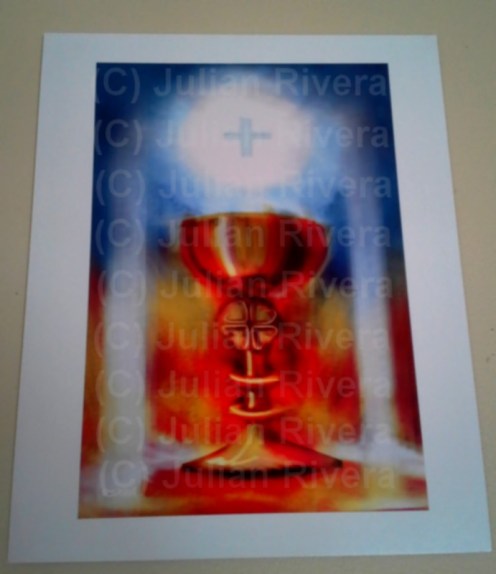
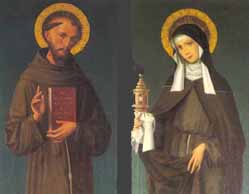
We picture St. Clare holding a monstrance.  The reason being that when Assisi was under siege, St. Clare protected her monastery from the invaders by holding up the ciborium with the Blessed Sacrament.  St. Clare never saw a monstrance.  The first monstrance does not appear until the 16th century.  Clare lived during the 13th century.

But this story tells us a great deal about this woman and about her strong Eucharistic Spirituality.  This event, her writings and her long hours of adoration of the Blessed Sacrament from her sickbed, through a small window that allowed her to see the tabernacle in the monastery chapel, reveal a woman in love with Jesus Christ and to whom Christ was a real person physically present.

We’re often pensive about our favorite athlete, artist, actor, musician, political figure or even a friend or family member.  They are present in our mind, even if we never meet them.

Julian_Corpus_Christi

Digital Artist – Julian Rivera

For information on how to acquire a copy of this beautiful poster, contact us at franciscansoflife@gmail.com

Jesus, on the other hand, is often forgotten, even by Catholics who believe that he is physically, substantially and spiritually present in the Holy Eucharist.  The Apostles handed down to us what they received from Jesus himself, his body and blood under the appearance of bread and wine, but truly different from bread and wine in substance.  The substance of what we see is Christ, alive and physically present.  In every tabernacle around the world, Jesus Christ is physically and wholly present.  Clare knew this.

St. Francis of Assisi often said that he saw nothing of the physical presence of Christ, in this world, except in the Eucharist.  He reminded his sons and daughters to adore Christ in the Blessed Sacrament francis and clareand to behave with grave reverence in the presence of a tabernacle.

We don’t know at what point in her life Clare’s faith in the true and proximate presence of Christ matured.  We know that she paid close attention to everything that Francis taught.  Francis’ admonitions regarding the awe that is due to the Blessed Sacrament and the unquestioning conviction that Christ is with us at all times and in all places, were not lost on Clare.

Many may ask, what did Clare achieve? Clare entered the Monastery of San Damiano at the age of 18 and never left it, not even upon her death.  Her body is still there.

Clare was not the foundress of great works of charity, education or a spiritual teacher as were Catherine, Teresa of Avila, Hildegard, and Therese.  However, she left us something that many Catholics overlook.

She left us an example of faith in the physical presence of Jesus Christ in the Eucharist.  She of one who, like the Virgin Mary, has no doubts about God’s promises.

I will not leave you as orphans; I will come to you. Before long, the world will not see me anymore, but you will see me. Because I live, you also will live,  (Jn 14:18-19).

CHALICE 2

Copyright: Franciscans of Life

The life of Clare of Assisi challenges every Catholic to seek Christ in their lives, in the Holy Eucharist and everywhere.  When we can’t go to Christ, he comes to us.  We must make him the first love of our lives.

Everyone we love, we love because God loved us first.  Without Christ’s love, spouses wouldn’t love each other, parents and children would be simply housemates, and siblings may or may not be friends.   I can love because, Jesus Christ, who is Love made flesh, is closer than my deepest thoughts. His love for me pours out to others.

Clare understood this and shared it with the world.  It’s her legacy to the Church of her time and to the Church today.  In her letters to St. Agnes of Prague, a nun of her order, Clare wrote

Look upon Him Who became contemptible for you, and follow Him, making yourself contemptible in this world for Him.  And then, Place your mind before the mirror of eternity!  Place your soul in the brilliance of glory!  Place your heart in the figure of the divine substance.

12313767_1724552867778905_4437807418574257125_n

Today, it seems that taking life is easier and requires less moral reflection than bringing a life into the world.  We have forgotten the sanctity of life; but God never forgets.  His

divine nature co-exists with human nature in Jesus Christ, ever present among us.  Let us look upon him and place our desires and needs in his divine substance.

As we continue our mission to proclaim the Gospel of Life, we must always remember Jesus.  The Second Person of the Most Holy Trinity became human, died, rose from the dead and remains with us.   Like Clare, trust Him to defeat every form of evil.


Franciscans of Life in the Lord’s Garden


When a man who is discerning a vocation to consecrated life takes a close look at the Franciscans of Life, he may walk away thinking, “What do these guys do?”

Doing has become a trademark of modern society.  Everyone wants to see something happen.  We have  become an “Outcome Oriented Society”.  We fail to understand the need for and the importance of that which nurtures the intellect, the will, and the soul.  The tendency today is to behave as if we were “Transcendental Agnostics.”  Meaning, that we’re not firm believers in the existence of the transcendent, much less in its importance.

If you’re looking to learn what there is beyond doing and planning, you may want to take a closer look at the Franciscans of Life.

FFV PATH (2)

Copyright: Franciscans of Life

Here, you will find men who pray the Liturgy of the Hours five times a day.  Each “hour” takes about 20 – 30 minutes.  The Liturgy of the Hours gives structure to the day and allows the brothers to pray with the Universal Church making use of the psalms, biblical canticles and readings from the Old Testament, New Testament and the Church Fathers. There are no more perfect words on Earth to praise God than the Word of God itself.

Do you feel called to do penance for your sins and those who don’t do penance?  We do that, too.  During the year, the Franciscans of Life abstain from meat every Wednesday and Friday.  We fast every Friday.

We also observe what St. Francis referred to as the “Three Lents”. From the Feast of the Archangels (Sep 29) to the Feast of St. Martin of Tours (Nov 11), we fast and abstain on Wednesdays and Fridays, again during Advent and again during the Great Lent.

When a man is received as a postulant, he receives a small notebook called “The Culpa”.  Every day he records his imperfections against the Holy Rule of St. Francis, the Constitutions of the Franciscans of Life, the wishes of the Superior, and any external fault against God and neighbor.

CROWN OF THORNS (2)

Copyright: Franciscans of Life

The Regular Brothers hold a Chapter of Faults on Friday night, at the beginning of Compline.  Each man kneels in the presence of his brothers and proclaims his faults.  The Superior offers him spiritual guidance and assigns him a light penance to do, so that he may grow in the perfection of love, as did Our Holy Father Francis.

CHALICE 2

Copyright: Franciscans of Life

Daily, each brother carves 30 minutes into his day for spiritual reading and silent prayer, or for Lectio Divina (prayer with the Scriptures).  Also, on their way home from an apostolate, the brother stops at the church on his route to spend time in contemplation with Jesus in the Blessed Sacrament.  The celebration of the mass is the crowning point of the day.  Because of the different work schedules, the brothers attend an evening mass during the week.

But not everything is prayer.  The day has 24-hours.  We make sure that we spend at least an hour of our evening together, doing something fun, from playing a game to watching a video on a DVD.  We do not watch TV, read newspapers or magazines.  Nor do we read blogs on the Internet.  The Superior goes through the news and shares with the Fraternity that which everyone should know, world situations that need prayer and penance, and things that happen in the Church that filter down to our daily lives (not the gossip of the Vatican;  ee have enough gossip in Florida, should we be hungry for useless and often detrimental conversation).

Postulants, novices and junior brothers in temporary vows have frequent formation class in Franciscan history and spirituality, prayer, liturgy, Sacred Scripture, Canon Law, and the writings of the early fathers of the Church.  For higher levels of theology, the brothers may attend a graduate school of theology where the theology faculty has taken the Oath of Fidelity to Catholic Teaching and to the Magisterium as described in Ex Corde and commanded in Canon Law.

You may ask, do the brothers have time to do anything else?  Of course, we do and we do plenty.

APPLE

Copyright: Franciscans of Life

We teach poorer students at community colleges.  These are students who cannot afford the prohibitive cost of college education and are often thrown into community colleges that offer about the same academic rigor as a high school.  Our brothers bring academic excellence to those who can’t afford to pay for it.  While they’re at it, they take advantage of every opportunity to engage the students in thought-provoking discussions.  Not everything is memorization.  Some things in life require critical thinking and prudence.

SHADOWS

Copyright: Franciscans of Life

There are brothers who run Project Joseph, a parenting program for fathers in crisis pregnancies.  These are classes, counseling sessions, material assistance, and anything else that it takes to help a good man become a better and holier father.

We take the Holy Eucharist to the hospital and spend time with the patients and families.  It is not a delivery service.  It is a pastoral ministry.  We pray, talk, listen, console, and offer hope.  Sometimes, an opportunity to offer moral guidance to healthcare professionals presents itself.   We never let that pass.

Brothers also teach Sacred Scripture to middle school students.  So much of religious education today needs to be supported by good theology and Scripture.  Otherwise, the presentations that some books offer from the Old Testament are like what can be found in Disney’s Magic Kingdom.

cloud 2

Copyright: Franciscans of Life

Very often, people write or call for assistance.  These are immigrants who are homeless, unemployed, or who have been abused.  The brothers serve as conduits to community resources.  But the relationship does not stop with a referral to an agency.  The brother engages the seeker into dialogue, eventually touching on matters of faith and morals.

We are gathering material and resources to open our first “learning room”.  The concept is based on the one-room school house.  With the help of volunteers, the brothers hope to provide employment skills to those who are seeking.  Hopefully, they will invite us into their homes and their lives, where we do the real work on the salvation of souls.

Did I mention that the Franciscans of Life own nothing individually or in common?  We live in rented houses, share two cars, and each brother has three outfits in his entire wardrobe.  No one owns computers, televisions, radios, cell phones, iPads, and other gadgets.  When necessary, we buy them for the use of all.  When they are no longer needed, they are stored until someone needs it.  We don’t even own the bed in which we sleep.  When we move, the bed stays behind.

Only the Immaculate knows where she wants us to be.  She is the Mistress of God’s Garden

MY GARDEN

Copyright: Franciscans of Life

Visit our Vocations page here!

Note: the artwork above is copyrighted because it is being produced by one of the brothers for use in our website and other media. If you wish to re-use any of our artwork or wish to learn more about it, contact us.

4TH OF JULY SPEAKS ABOUT GOD’S DESIRE FOR HUMANITY


bald-eagle-1018717_1920

FREEDOM

This is the time of year that we celebrate the Fourth of July.  Considering that July 4th comes around only once a year it makes sense to celebrate it at this time.

The Franciscans of Life would like to challenge all of our readers to stop, think about history and ask themselves, “What are we supposed to be celebrating?

On July 4, 1776, the English citizens who lived in what would later become the United States, sent a scathing letter to King George.  No one knows for sure if the man was already mentally unstable or if the loss of these particular English colonies drove him to a breakdown.  The point is that he did breakdown.

This is what we want to reflect on.  The king broke down because he was confronted with some eternal truths that he had never considered or refused to consider.  Here are a few things that Jefferson wrote. 

When in the Course of human events it becomes necessary for one people to dissolve the political bands which have connected them with another and to assume among the powers of the earth, the separate and equal station to which the Laws of Nature and of Nature’s God entitle them, a decent respect to the opinions of mankind requires that they should declare the causes which impel them to the separation.

The direction in which the Divine Creator, whom we know as God, enlightened the writer and signers of this letter.  God entitles men to live “separately”, meaning independent and “equal” to others.  God does not sentence some men to prosperity and others to hunger, abuse, oppression and at times the denial of the right to live.  Had they believed this, they would have settled for the relationship that the 13 Colonies had with England.

Many Americans seem to forget this concept.  The struggle for independence was based on an absolute truth, not an idea that grew in the minds of the American colonists.  That absolute truth says that man has a divine right to be independent and that each human being is equal to those around him, those who came before him and those who will follow.

There is not historical justification for a culture of death in the United States.  Euthanasia, abortion, and assisted suicide have no place in a society that was founded on the absolute truth that man has been created to live according to the laws of nature. (See above).

We hold these truths to be self-evident, that all men are created equal, that they are endowed by their Creator with certain unalienable Rights, that among these are Life, Liberty and the pursuit of Happiness.

No power on earth, religious, secular, or political has the authority to deny that all men are equal; therefore, all men have to right to seek life, liberty and happiness.  The degrees to which we achieve these lofty goals are going to differ, but the right to pursue them is exactly the same for men and women, Muslims, Christians, Jews, Hindus, Buddhists and others.

As Franciscans whom God has sent into the world to proclaim the Gospel of Life, . . . we, the Franciscans of Life, announce and proclaim that Independence Day is about much more than a revolution against wp_20150118_016the British crown.  The Declaration of Independence and what followed was a struggle to to recover and protect man’s God-given right to live, to to be free, to be equal to others, and to pursue happiness.

No where did the founders say that these rights are for Americans alone or that they can and should be pursued at the expense of the most vulnerable.  Nor did Mr. Jefferson write that either the State or an individual has the right to determine who should be born and who should live until they die natural deaths.

The men gathered in Philadelphia to vote on and sign the Declaration of Independence were logical and thoughtful men, even those who were not devout believers.  They understood that the right to life presumed the right to be born.  There was no need to spell it out.  The also understood that the right to pursue happiness was for the living.  Those who are euthanized and others whom society helps to commit suicide no longer have the right to pursue happiness.  When there is no right to happiness, what is the purpose of struggling to live, even if it’s for a few weeks or years.  The dead cannot pursue happiness, because there is no future outside of space and time.  Therefore, you can’t pursue what is not ahead.  There exists only an eternal present.

who-wrote-declaration-independence

If the Founding Fathers were correct and these rights are of divine origin, not human, it begs the question.  Do human beings have the authority to surrender or deny natural rights?

The final question for today is similar.  Is Independence Day a parochial celebration of American independence from King George and “nasty” England or is it a memorial of an awakening that took place in 1776, when these men became aware and convinced of the truth that all men are created to be independent from tyranny, poverty, war, discrimination, terrorism, hunger and other evils.

Independence does not come wrapped in the American flag.  Independence is built into nature by its Creator who is Himself eternally independent.

The Fourth of July must be a proclamation to all men that we are created to be free, to be equal, to live without threats and to pursue happiness in this life and in the next.


hith-declaration-independence-iStock_000000586071Large-E

Published in: on July 3, 2017 at 3:42 PM  Leave a Comment